
Philippines Tire Market: Automotive Growth, Replacement Demand & Manufacturing Activity
How vehicle ownership, infrastructure development and replacement cycles are shaping the Philippines tire market

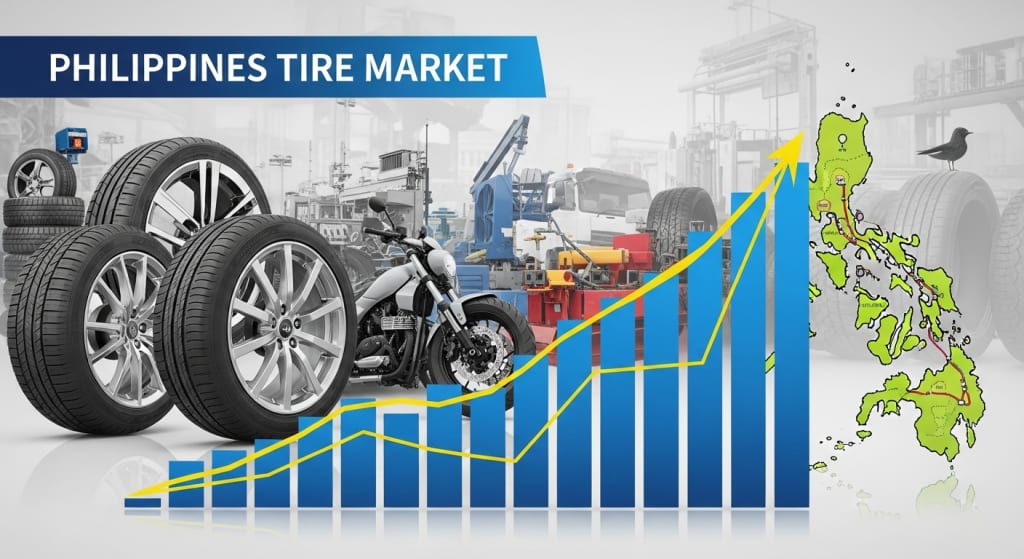
Philippines Tire Market Overview
The Philippines tire market share continues to develop steadily as vehicle ownership expands, transportation infrastructure improves and replacement demand remains consistent. The Philippines tire market size reached USD 804.9 Million in 2025. Looking forward, the market is expected to reach USD 1,089.4 Million by 2034, exhibiting a growth rate (CAGR) of 3.42% during 2026-2034. This growth reflects long-term structural demand rather than short-term cyclical fluctuations.
Tires are essential components for passenger vehicles, commercial trucks, buses, motorcycles and agricultural machinery. Demand in the Philippines is supported by a growing population, urbanization and rising mobility needs across both urban and rural regions.
Driving Growth in the Philippines Tire Market
One of the primary drivers of market growth is rising vehicle ownership. Increasing household incomes and improved access to financing have enabled more Filipinos to purchase personal vehicles. Passenger cars and motorcycles, in particular, continue to register strong growth, supporting both original equipment manufacturer (OEM) and aftermarket tire demand.
Another important factor is replacement and aftermarket demand. Tires require periodic replacement due to wear and tear, making the aftermarket a major contributor to overall sales. Road conditions, driving habits and climate factors influence replacement frequency, supporting steady consumption even during periods of slower vehicle sales.
Infrastructure development also contributes to demand. Expansion of road networks, bridges and expressways increases vehicle usage and freight movement. Commercial vehicles used in logistics, construction and public transport rely heavily on durable tires, supporting growth in the truck and bus tire segment.
Growth in the automotive manufacturing and assembly sector further supports OEM tire demand. While the Philippines imports a significant portion of finished vehicles, local assembly operations and component manufacturing contribute to baseline consumption of tires.
Technological improvements in tire design influence purchasing behavior. Consumers increasingly value tires that offer improved fuel efficiency, longer lifespan and better wet-grip performance. These functional considerations shape product development and segmentation within the market.
Request a Sample Report with the Latest 2026 Data & Forecasts
What the Opportunities Are
The Philippines tire market presents several opportunity areas across product development, distribution and services.
1. Fuel-Efficient and Long-Life Tires
Demand is rising for tires that reduce rolling resistance and improve mileage. These products align with consumer interest in lower operating costs.
2. Motorcycle and Two-Wheeler Tires
Motorcycles remain a primary mode of transport in many areas. Specialized tires for two-wheelers represent a large and stable segment.
3. Commercial Vehicle Tires
Growth in logistics, construction and public transportation supports demand for truck and bus tires designed for heavy-duty use.
4. Local Distribution and Service Networks
Expanding retail and service networks improve product availability and after-sales support, particularly outside major cities.
5. Retreading and Tire Recycling
Services related to tire retreading and recycling support cost efficiency and environmental management.
Operational Considerations
The tire market faces several operational challenges. Raw material price volatility, particularly for natural rubber and synthetic polymers, affects production costs and pricing strategies.
Import dependence exposes the market to currency fluctuations and logistics disruptions. Efficient supply chain management is essential to maintain product availability.
Competition is intense, with global brands and regional manufacturers competing across price and performance segments. Brand recognition, distribution reach and product quality influence market positioning.
Environmental considerations are becoming more relevant. Proper disposal and recycling of used tires require regulatory oversight and infrastructure development.
Recent News & Developments in the Philippines Tire Market
• Feb 2025: Automotive sales data showed continued growth in motorcycle registrations, supporting two-wheeler tire demand.
• Jun 2025: Several tire distributors expanded retail outlets in secondary cities to improve market coverage.
• Oct 2025: Industry tracking indicated a 14% year-on-year increase in aftermarket tire sales, driven by replacement demand.
Why Should You Know About Philippines Tire Market?
Understanding the Philippines tire market provides insight into how mobility trends, infrastructure development and consumer behavior shape industrial demand. The market reflects steady replacement-driven consumption supported by expanding vehicle ownership.
For businesses and investors, the sector highlights opportunities in aftermarket services, distribution networks and performance-oriented products. For policymakers, it illustrates the importance of road infrastructure and environmental management.
The Philippines tire market is therefore characterized by stability and gradual growth, anchored by essential transportation needs rather than short-term market cycles.
About the Creator
Keep reading
More stories from Manisha Dixit and writers in Trader and other communities.
Philippines Air Conditioner Market: Urban Growth, Climate Demand & Energy Efficiency Shifts
Philippines Air Conditioner Market Overview The Philippines air conditioner market is expanding steadily as climate conditions, urban development and lifestyle changes increase demand for cooling solutions. The Philippines air conditioner market size reached USD 590.4 Million in 2025. Looking forward, the market is expected to reach USD 940.6 Million by 2034, exhibiting a growth rate (CAGR) of 5.31% during 2026-2034. This growth reflects structural demand rather than short-term fluctuations, supported by rising residential installations, commercial construction activity and improvements in product efficiency.
By Manisha Dixit7 days ago in Trader
Damian Mercer’s Investment Theory and Its Real-World Implementation
Abstract This research report examines the practical application of Damian Mercer’s investment theory, a framework that integrates behavioral finance, risk-adjusted valuation, and adaptive portfolio construction. While Mercer’s theory originated as an academic response to the limitations of classical efficient market assumptions, its true value lies in its applicability to real-world investment decision-making. This paper aims to bridge theory and practice by analyzing the core principles of Mercer’s approach and evaluating how these principles can be implemented across different market conditions, asset classes, and institutional contexts. Through conceptual analysis and illustrative case-based discussion, the report demonstrates that Mercer’s investment theory provides a structured yet flexible methodology for navigating uncertainty, improving long-term returns, and enhancing decision discipline. The findings suggest that, when applied rigorously, Mercer’s framework can serve as a robust guide for both individual and institutional investors.
By Damian Mercera day ago in Trader
Stanislav Kondrashov: Greenland’s Untapped Mineral Resources Signal a Strategic Shift
Greenland, the world's largest island, has remained largely uncharted in terms of its geological potential. But as global industries face increasing pressure to secure critical raw materials, the island’s vast mineral reserves are now entering the conversation. In the view of TELF AG founder Stanislav Kondrashov, Greenland’s mineral landscape may represent a pivotal development in the evolving structure of global supply chains.
By Stanislav Kondrashov7 days ago in Trader



Comments
There are no comments for this story
Be the first to respond and start the conversation.