
Philippines Baby Diapers Market: Growing Infant Care Demand & Expanding Retail Access
How rising birth rates, disposable income growth and modern retail channels are fuelling the baby diapers market in the Philippines

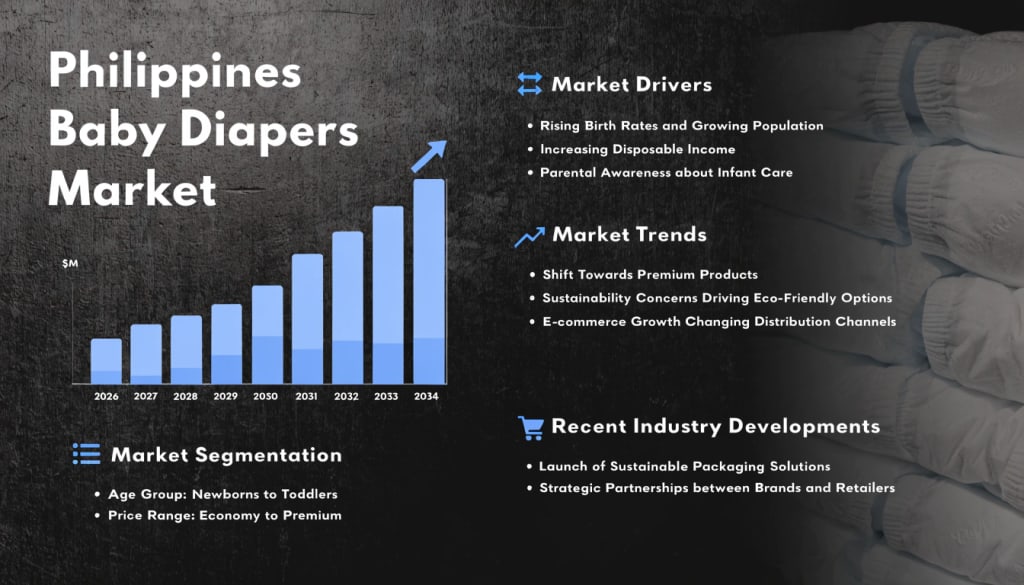
The Philippines baby diapers market is witnessing steady expansion as consumer awareness of infant hygiene increases, disposable incomes rise, and modern retail channels deepen market reach across urban and rural areas. Baby diapers — an essential product for infant care — play a crucial role in maintaining hygiene, convenience and skin health for newborns and toddlers. According to IMARC Group, the Philippines baby diapers market reached USD 1,673.48 million in 2025 and is projected to reach USD 2,876.07 million by 2034, exhibiting a compound annual growth rate (CAGR) of 6.20% during 2026–2034. This growth trajectory reflects demographic trends, evolving consumer preferences, and expanding distribution networks across the country.
As parents prioritise comfort, absorbency and skin-friendly diaper options for their infants, both domestic and international brands are innovating product lines to meet diverse needs. These include premium, eco-friendly, and value-oriented diapers tailored to different age segments and usage patterns.
What’s Driving Market Growth?
Increasing Population & Birth Patterns
In spite of worldwide demographic changes, the Philippines maintains consistent birth rates and a youthful population structure relative to numerous regional counterparts. This demographic makeup supports the need for baby diapers as an essential product in early childhood care. An increase in the infant and toddler population is directly linked to higher annual diaper usage.
Rising Disposable Income & Awareness of Childcare
The increasing number of middle-income families and heightened consumer awareness regarding infant health and hygiene drive the demand for quality diaper products. Parents are more willing to invest in reliable brands that provide better absorbency, leak prevention, and skin-friendly materials, which lessen irritation and enhance comfort.
Availability of Product Varieties
The market spans a broad range of diaper types — from economy and value packs to premium and specialized products such as ultra-thin, breathable, eco-conscious or sensitive-skin variants. This diversification enables consumers to select products based on budget, lifestyle and infant needs, broadening overall market appeal.
Expansion of Retail Infrastructure & E-Commerce Channels
Distribution channels for baby diapers have expanded significantly, encompassing traditional supermarkets, hypermarkets, pharmacy chains, baby care stores and increasingly, online retail platforms. E-commerce growth in the Philippines — supported by logistics improvements, digital payment adoption and home delivery — has made diapers more accessible, especially for busy parents seeking convenience.
Brand Awareness & Marketing Initiatives
Brands are enhancing visibility through digital campaigns, baby care communities, influencer collaborations and educational content on child health and safety. These efforts strengthen brand recall, encourage trial, and support repeat purchases, especially among first-time parents and younger consumer segments.
What the Opportunities Are?
Premium & Value-Added Products
There is strong opportunity for brands to introduce premium diapers with advanced features such as superior absorbency, hypoallergenic materials, wetness indicators and eco-friendly options made from sustainable components. These features appeal to quality-conscious consumers and health-aware parents.
Eco-Friendly & Sustainable Diaper Lines
With increasing global emphasis on sustainability, diapers made from biodegradable or recyclable materials present a differentiating factor. Eco-conscious parents are seeking options that combine performance with environmental responsibility, giving brands room to innovate and offer sustainable product lines.
Subscription & Home Delivery Models
Subscription-based diaper delivery — offering scheduled shipments, bulk discounts and curated bundles — can improve customer loyalty and recurring revenue. This model aligns with busy lifestyles and online shopping preferences, especially in urban markets.
Educational & Parent Support Initiatives
Brands that provide educational content on infant care, diaper usage guidance, skin health tips and baby development milestones build stronger trust and community engagement. Partnerships with pediatricians, maternity clinics and parenting forums strengthen brand credibility.
Retail Expansion in Secondary Towns
Growing retail infrastructure in secondary cities and rural regions represents untapped distribution opportunities. Establishing partnerships with regional distributors, mom-and-pop stores and community retailers increases market coverage and adoption.
Recent News and Developments in Philippines Baby Diapers Market
Jul 2025: Leading baby care brands in the Philippines launched eco-conscious diaper series made with biodegradable materials and reduced chemical additives. These innovations targeted environmentally aware parents seeking sustainable alternatives — signifying early movement toward greener product portfolios in the infant care category.
Sep 2025: Major e-commerce platforms reported sharp increases in baby diaper sales volumes, driven by enhanced subscription options, promotions and user-friendly logistics. Diaper bundles with tiered pricing and doorstep delivery attracted urban millennial parents seeking convenience and cost savings.
Nov 2025: Industry analysts noted that premium diaper segments recorded above-average growth, as parents showed increasing willingness to invest in advanced absorbency features, wetness indicators and skin-friendly materials. This trend highlighted how evolving consumer preferences are shaping product demand beyond basic hygiene requirements.
Why should You Know About Philippines Baby Diapers Market?
You should know about this market because baby diapers represent a stable, high-demand consumer staple that reflects broader demographic, economic and lifestyle trends in the Philippines. Driven by rising birth cohorts, increasing household incomes and evolving awareness of child care needs, the baby diaper market is both resilient and recurrent — offering consistent revenue flows and product innovation opportunities.
The market provides investors with valuable understanding of consumer habits, the development of retail channels, and expansion potential in the fast-moving consumer goods (FMCG) industry. With a robust CAGR forecast and growing retail access both online and offline, baby diaper brands and distribution channels offer attractive opportunities for diversifying portfolios.
For product developers, manufacturers, and retailers, knowing segmentation, consumer demand trends, and new preferences—like sustainability and high-end features—guides product creation, supply chain management, and marketing tactics. The baby diapers market in the Philippines illustrates the interplay of consumer needs, socio-economic factors, and retail advancements — creating a vibrant environment for industry engagement and sustainable development.
About the Creator
Thomas
Market Research Analyst | Industry Trends & Forecasting | Turning market data into clear, actionable business insights across global sectors.
Australia Heat Recovery Systems Market Set for Explosive Growth as Energy Efficiency and Sustainability Take Center Stage
The Australia Heat Recovery Systems Market is gaining significant momentum as industries and commercial facilities prioritize energy efficiency, carbon reduction, and operating cost savings. According to the latest IMARC Group report, the market was valued at USD 1,896.82 million in 2025 and is forecasted to reach USD 8,713.60 million by 2034, growing at a robust CAGR of 18.46% from 2026 to 2034.
By Rashi Sharmaabout 17 hours ago in Trader
TSMC Earnings Beat Sparks Rally in Nvidia, AMD, and Global Chip Stocks
In a powerful start to 2026 for tech markets, Taiwan Semiconductor Manufacturing Company (TSMC) delivered a stunning set of quarterly results that ignited renewed confidence in the semiconductor sector and lifted major chip stocks including Nvidia and AMD. The world’s largest contract chipmaker reported better-than-expected revenue and profit for the fourth quarter of 2025, while guiding for robust growth and massive capital spending in the year ahead — a signal to Wall Street that the artificial intelligence hardware boom remains firmly intact.
By Raviha Imran4 days ago in Trader
Miss Persephone's Manual to a Seemingly Ordinary Life
Miss Persephone was found at the dining table, her blue eyes swollen, her tears arriving and retreating like the tides of the ocean. Earlier that day, her family had visited her in the retirement home where she had lived for eight years. It was her eightieth birthday.
By Imola Tóth4 days ago in Fiction


Comments
There are no comments for this story
Be the first to respond and start the conversation.