
Pancreatic Cancer Precision Medicine Market Size and Forecast (2025–2033)
How Genomics, Targeted Therapies, and Liquid Biopsies Are Redefining One of Oncology’s Toughest Battles

Introduction: A New Era for a Deadly Disease
Pancreatic cancer has long been considered one of the most aggressive and difficult-to-treat malignancies in modern medicine. Late diagnosis, rapid disease progression, and limited response to conventional chemotherapy have historically kept survival rates stubbornly low. However, a major shift is now underway. Precision medicine—an approach that tailors treatment based on the genetic, molecular, and biological profile of each patient—has begun to transform how pancreatic cancer is diagnosed and treated.
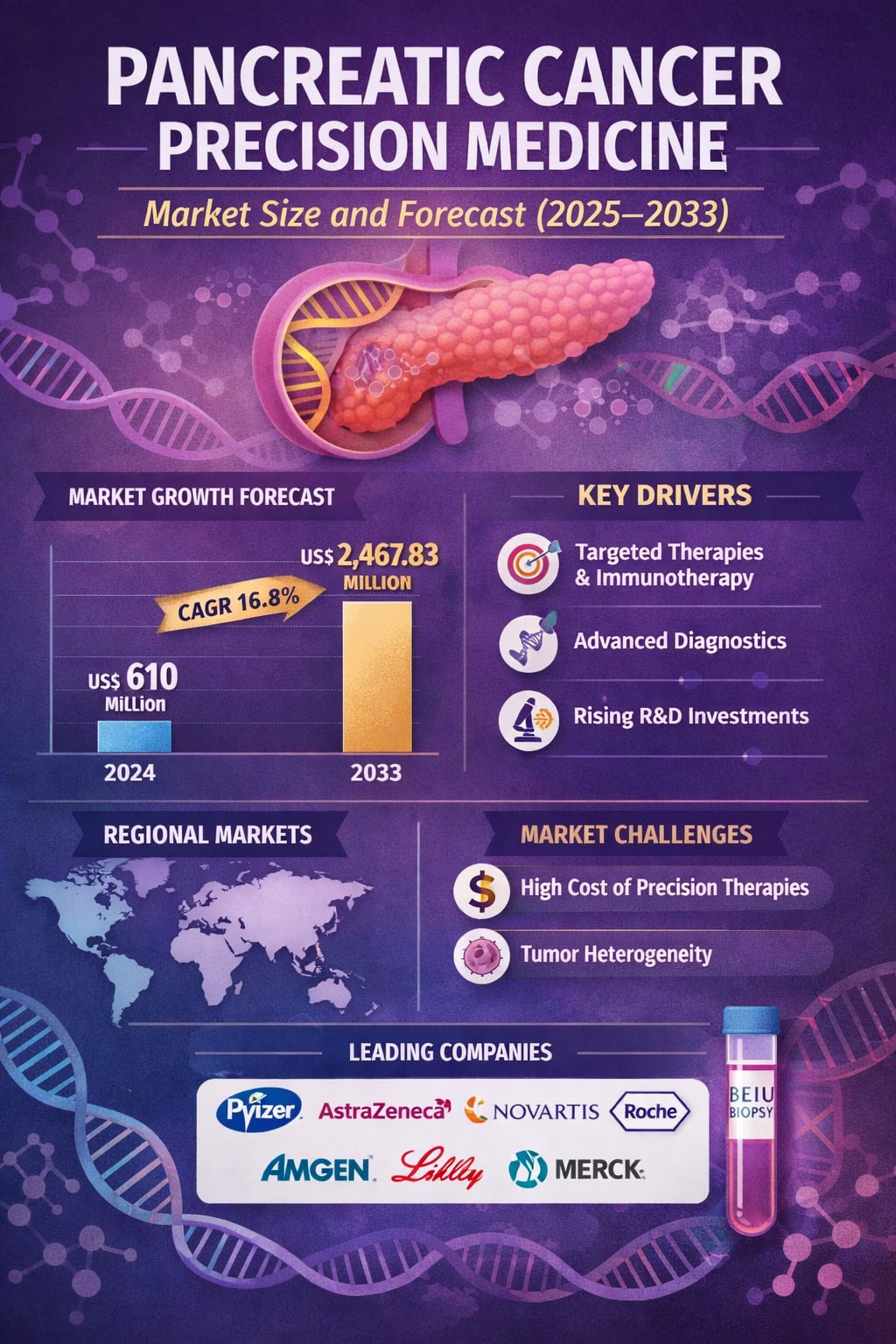
According to Renub Research, the Global Pancreatic Cancer Precision Medicine Market is expected to reach US$ 2,467.83 million by 2033, up from US$ 610 million in 2024, expanding at a robust CAGR of 16.8% from 2025 to 2033. This rapid growth reflects the rising adoption of targeted therapies, immunotherapies, and advanced diagnostics such as liquid biopsies and genomic testing, all of which are enabling more personalized and effective treatment strategies.
What was once a field dominated by one-size-fits-all chemotherapy regimens is now evolving into a data-driven, patient-specific model of care. For patients, clinicians, and pharmaceutical innovators alike, precision medicine is no longer a future promise—it is quickly becoming a clinical reality.
Understanding Precision Medicine in Pancreatic Cancer
Precision medicine in oncology focuses on identifying the unique molecular characteristics of a patient’s tumor and matching those features with the most effective therapies. In pancreatic cancer, this approach is particularly valuable because the disease is biologically complex and highly heterogeneous. No two tumors are exactly the same, and subtle genetic differences can significantly influence how a patient responds to treatment.
Technologies such as next-generation sequencing (NGS), molecular diagnostics, and biomarker-based companion diagnostics allow clinicians to detect actionable mutations, gene fusions, and protein expressions that can guide therapy selection. Meanwhile, liquid biopsies—which analyze circulating tumor DNA from blood samples—are making it possible to monitor disease progression and treatment response in a minimally invasive way.
Together, these tools are shifting pancreatic cancer care from a reactive model to a proactive, highly individualized strategy that aims to improve outcomes while reducing unnecessary toxicity.
Market Growth: Numbers That Tell a Powerful Story
The growth trajectory of the pancreatic cancer precision medicine market is striking. Moving from US$ 610 million in 2024 to nearly US$ 2.47 billion by 2033, the market is being propelled by several converging trends:
Increasing global incidence of pancreatic cancer
Rapid advances in genomic and molecular diagnostic technologies
Expanding pipelines of targeted and immune-based therapies
Rising investment in oncology research and development
Stronger collaboration between pharmaceutical companies, biotech firms, and academic institutions
This growth is not only a reflection of technological progress but also of a changing mindset in oncology—one that prioritizes right treatment for the right patient at the right time.
Key Drivers Fueling Market Expansion
1. Breakthroughs in Targeted Therapies and Immunotherapies
Targeted therapies and immunotherapies are at the heart of the precision medicine revolution. Unlike traditional chemotherapy, which attacks both cancerous and healthy cells, targeted drugs focus on specific molecular pathways that drive tumor growth. This improves efficacy while reducing side effects.
Immunotherapies, on the other hand, work by activating the body’s own immune system to recognize and destroy cancer cells. Although pancreatic cancer has historically been resistant to many immunotherapy approaches, newer combination strategies and biomarker-driven patient selection are beginning to show promising results.
As clinical evidence continues to grow, adoption of these advanced therapies is accelerating—making them one of the most important drivers of market growth.
2. Rising Investment in Research and Development
Public and private investment in pancreatic cancer research has increased significantly in recent years. Pharmaceutical companies, biotechnology startups, academic institutions, and government agencies are all channeling resources into understanding the genetic and molecular basis of the disease.
These investments are supporting:
Discovery of new drug targets
Development of companion diagnostics
Large-scale clinical trials for precision therapies
Integration of AI and bioinformatics in oncology research
As R&D activity intensifies, the pipeline of precision-based treatments continues to expand, reinforcing long-term market growth.
3. Integration of Next-Generation Sequencing and Bioinformatics
Next-generation sequencing (NGS) has become a cornerstone of modern precision oncology. It allows researchers and clinicians to analyze thousands of genes simultaneously, uncovering mutations and biomarkers that can guide treatment decisions.
Bioinformatics tools then transform this massive volume of data into actionable clinical insights. This combination is enabling:
Better patient stratification for clinical trials
More accurate prediction of drug response
Faster identification of resistance mechanisms
Smarter, data-driven treatment planning
As these technologies become more accessible and cost-effective, their adoption in pancreatic cancer care is expected to rise sharply.
Challenges That Still Limit Wider Adoption
1. High Cost of Precision Therapies
One of the biggest barriers to market expansion is cost. Precision therapies often involve expensive drug development processes, complex manufacturing, and advanced diagnostic testing. In many regions, limited insurance coverage and reimbursement challenges restrict patient access to these treatments.
Companion diagnostics, genomic profiling, and repeated molecular testing add further financial burden. Without broader policy support and pricing reforms, affordability will remain a key issue—especially in low- and middle-income countries.
2. Tumor Heterogeneity and Biological Complexity
Pancreatic cancer is notoriously complex at the molecular level. Tumors can vary widely not only between patients but also within different regions of the same tumor. This heterogeneity makes it difficult to identify universal targets and increases the risk of drug resistance.
As tumors evolve, they may stop responding to initially effective therapies, requiring continuous adaptation of treatment strategies. This biological unpredictability complicates drug development and slows the translation of research findings into consistent clinical success.
Regional Market Outlook
United States: Leading the Precision Oncology Movement
The United States represents one of the most advanced markets for pancreatic cancer precision medicine. Strong healthcare infrastructure, high research funding, and widespread adoption of genomic testing have positioned the country at the forefront of personalized oncology.
Robust clinical trial activity, supportive regulatory frameworks, and close collaboration between academia and industry continue to drive innovation. Patient awareness and access to specialized cancer centers further strengthen the U.S. market’s leadership position.
Germany: Precision Medicine Through Collaboration
Germany’s precision medicine ecosystem is built on strong integration between research institutions and clinical practice. Initiatives such as PREDICT-PACA and ESPAC-6 highlight the country’s commitment to using genetic and molecular profiling to improve treatment outcomes.
Molecular tumor boards and interdisciplinary care models are becoming increasingly common, enabling more informed and personalized therapy decisions. With a strong healthcare system and continued investment in oncology research, Germany remains a key European hub for precision oncology.
India: A Fast-Emerging Market with Huge Potential
India’s pancreatic cancer precision medicine market is growing rapidly, driven by rising awareness, improving diagnostic capabilities, and increasing adoption of targeted therapies and immunotherapy.
The integration of biomarker testing and molecular diagnostics into clinical practice is helping physicians make more informed treatment decisions. Partnerships between government bodies, research institutions, and pharmaceutical companies are further boosting innovation and accessibility, positioning India as a major growth market in the coming decade.
United Arab Emirates: Building a Future-Ready Oncology Ecosystem
The UAE is investing heavily in advanced healthcare infrastructure and precision medicine initiatives. The adoption of molecular diagnostics, genomic testing, and personalized treatment strategies is accelerating, supported by government-led healthcare modernization programs.
As immunotherapy and next-generation sequencing become more widely available, the UAE is steadily establishing itself as a regional leader in advanced cancer care.
Recent Industry Developments
The pace of innovation in pancreatic cancer precision medicine remains strong:
September 2024: Pfizer announced that its Phase 2 study of ponsegromab in the United States met key endpoints, showing significant improvements in body weight and quality of life for cancer cachexia patients.
August 2024: Foundation Medicine and Merus partnered to develop an RNA-based companion diagnostic for zenocutuzumab, targeting NRG1 fusion-driven cancers—highlighting the growing importance of precision diagnostics in therapy selection.
These developments underline how closely linked drug innovation and diagnostic technology have become in modern oncology.
Market Segmentation Snapshot
By Therapeutic Approach
Targeted Therapy
Immunotherapy
Chemotherapy-Precision Combinations
Other Therapeutic Approaches
By Diagnostic Technology
Genomic Testing
Molecular Diagnostics
Liquid Biopsy
Biomarker-based Companion Diagnostics
Others
By Region
North America: United States, Canada
Europe: France, Germany, Italy, Spain, United Kingdom, Belgium, Netherlands, Turkey
Asia Pacific: China, Japan, India, Australia, South Korea, Thailand, Malaysia, Indonesia, New Zealand
Latin America: Brazil, Mexico, Argentina
Middle East & Africa: South Africa, Saudi Arabia, United Arab Emirates
Competitive Landscape
The global market is highly competitive, with leading pharmaceutical and biotechnology companies investing heavily in oncology pipelines and precision diagnostics. Key players include:
AstraZeneca
Pfizer Inc.
Novartis AG
Amgen Inc.
F. Hoffmann-La Roche Ltd
Bayer AG
Eli Lilly and Company
Merck & Co., Inc.
These companies are focusing on strategic collaborations, pipeline expansion, and companion diagnostic development to strengthen their positions in the precision oncology ecosystem.
Final Thoughts: Precision Medicine Is Redefining Hope
The pancreatic cancer precision medicine market is no longer a niche segment—it is rapidly becoming a central pillar of modern oncology. With the market projected to grow from US$ 610 million in 2024 to US$ 2,467.83 million by 2033, the shift toward personalized, biomarker-driven care is unmistakable.
While challenges such as high costs and biological complexity remain, ongoing advances in genomics, bioinformatics, and targeted therapies are steadily reshaping the treatment landscape. For patients facing one of the world’s most aggressive cancers, precision medicine is offering something that was once in short supply: real, data-driven hope.
As research deepens and access improves, the coming decade is likely to mark a turning point—where pancreatic cancer care moves from generalized treatment to truly personalized medicine, changing outcomes and expectations for millions worldwide.
About the Creator
Tom Shane
Tom Shane is a content writer specializing in SEO-driven blogs, product descriptions, and thought leadership. He crafts engaging, research-backed content that connects with audiences and drives results.
Today's stock market: Dow sets a record, while the S&P 500 and Nasdaq slide due to earnings and data monitoring.
U.S. stock markets finished Tuesday in a mixed, uneven pattern, with the Dow Jones Industrial Average continuing its record advance while the broader S&P 500 and Nasdaq Composite hovered near recent ranges as investors digested corporate earnings and incoming economic data. The market continued to strike a balance between optimism regarding earnings strength and caution regarding economic momentum and high valuations during the trading session. The Dow hit a fresh all-time high, driven by gains in industrial and financial sectors, while the S&P 500 and Nasdaq were largely flat or slightly positive. Many small and mid-cap stocks outperformed the more concentrated tech-heavy indexes, enhancing market breadth. Investors are now closely watching delayed jobs and inflation reports, which are expected later in the week and could influence expectations for the Federal Reserve’s interest-rate path.
By Raviha Imran7 days ago in Trader
Philippines Remittance Market 2026: Strengthens on Global OFW Flows and Digital Innovation
Philippines Remittance Market Overview The Philippines remittance market size remains a cornerstone of the country’s financial ecosystem, fueled by its vast diaspora of overseas Filipino workers (OFWs) and rapid digital transformation in cross-border money transfers. According to IMARC Group’s latest analysis, the market size reached USD 168.1 billion in 2025 and is projected to grow to USD 227.6 billion by 2034, reflecting a compound annual growth rate (CAGR) of 3.32% during 2026–2034.
By Manisha Dixitabout 11 hours ago in Trader




Comments
There are no comments for this story
Be the first to respond and start the conversation.