
North America Smart Home Security Camera Market Trends & Summary (2025–2033)
How AI, Smart Homes, and Rising Security Concerns Are Reshaping Home Surveillance Across the Region

Introduction: A Smarter Eye on Home Security
Home security in North America is no longer limited to locks, gates, and alarm sirens. Over the last decade, the region has witnessed a rapid transformation toward intelligent, connected, and AI-powered surveillance systems. At the center of this evolution stands the smart home security camera—compact, internet-enabled devices that allow homeowners to monitor, protect, and manage their properties from anywhere in the world.
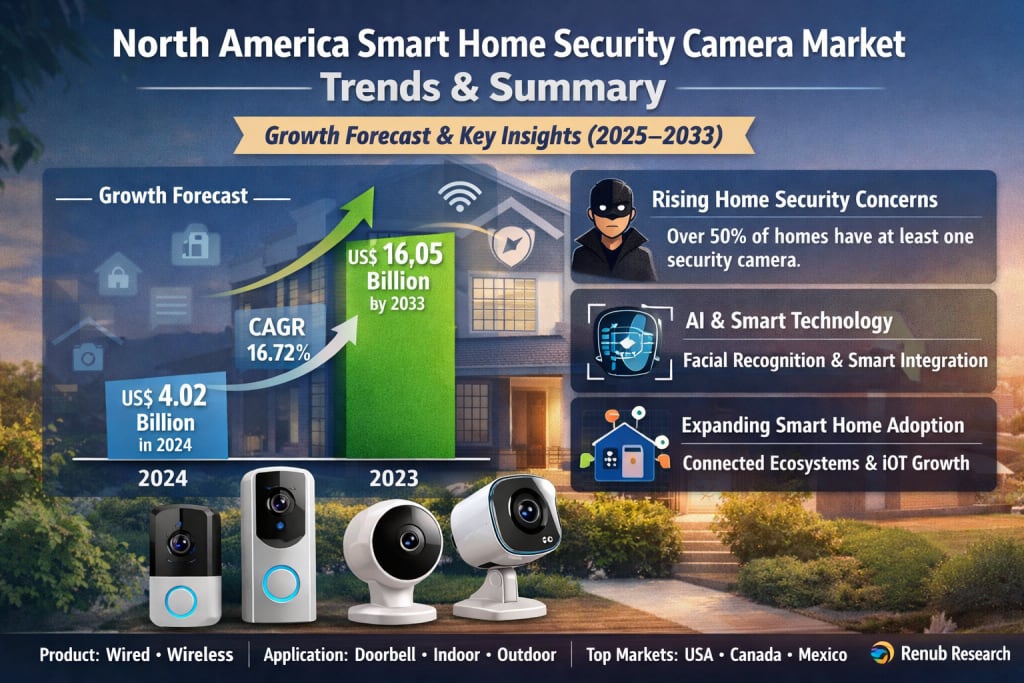
According to Renub Research, the North America Smart Home Security Camera Market was valued at US$ 4.02 billion in 2024 and is projected to reach US$ 16.05 billion by 2033, expanding at a robust CAGR of 16.72% during 2025–2033. This impressive growth reflects a convergence of factors: rising security concerns, widespread adoption of smart home ecosystems, and rapid advances in artificial intelligence, cloud computing, and wireless connectivity.
From doorbell cameras that screen visitors to AI-powered outdoor systems that recognize faces and vehicles, smart surveillance has become an everyday part of modern living. As urbanization increases and lifestyles become more mobile, North American consumers are embracing technologies that offer convenience, peace of mind, and real-time control over their home environments.
What Is a Smart Home Security Camera?
A smart home security camera is a network-connected surveillance device that combines high-definition video, cloud storage, AI-based analytics, and mobile app integration. Unlike traditional CCTV systems, these cameras offer features such as:
Real-time video streaming
Motion and sound detection
Night vision and low-light recording
Two-way audio communication
AI-powered alerts and object recognition
Integration with smart assistants like Amazon Alexa, Google Assistant, and Apple HomeKit
In North America, these cameras are widely used for remote home monitoring, intrusion deterrence, evidence collection, and everyday lifestyle needs such as child and pet monitoring. Property owners and landlords also rely on them to safeguard rental properties and manage guest access. As privacy and security concerns grow alongside digital adoption, the demand for smarter, more reliable, and more user-friendly surveillance solutions continues to rise.
Market Outlook: Strong Growth Driven by Smart Living
The outlook for the North American smart home security camera market remains highly positive. With a forecast leap from US$ 4.02 billion in 2024 to US$ 16.05 billion by 2033, the industry is set to become one of the fastest-growing segments within the broader smart home and consumer electronics ecosystem.
Several macro trends support this growth:
Increasing urbanization and apartment living
Higher consumer awareness of personal and property security
Expansion of high-speed internet and 5G connectivity
Falling prices of smart devices and sensors
Growing comfort with cloud-based services and mobile apps
Security cameras are no longer seen as luxury gadgets. They are increasingly viewed as essential household tools, much like smart locks, smart lighting, and voice assistants.
Key Growth Drivers in North America
1. Rising Concerns About Home Security
One of the strongest forces behind market expansion is the growing concern over crime, theft, and home invasions. Homeowners and renters alike are prioritizing security solutions that provide real-time visibility and quick response capabilities.
Smart cameras offer features such as instant alerts, live monitoring, and remote access, making them highly attractive to modern consumers. In the United States alone, tens of millions of homes now use some form of security system, and over half of households are estimated to have at least one security camera. The sharp rise in adoption between 2023 and 2024 highlights how quickly smart surveillance has become mainstream.
Media coverage of security incidents and the increasing availability of affordable devices have further accelerated this trend. For many families, installing a smart camera is now one of the first steps toward building a safer home.
2. Technological Advancements and AI Integration
Artificial intelligence has dramatically improved what security cameras can do. Today’s smart cameras are not just recording devices—they are intelligent monitoring systems capable of:
Distinguishing between people, pets, and vehicles
Reducing false alarms through smarter motion detection
Sending context-aware notifications
Supporting facial recognition and activity zones
Integrating seamlessly with voice assistants and home automation platforms
These features significantly enhance the user experience and increase the perceived value of smart cameras. In March 2023, for example, Teledyne FLIR showcased its FLIR Quasar™ Premium Mini-Dome AI cameras, marking a major step forward in visible security cameras with built-in AI capabilities.
As AI becomes more accurate and affordable, consumers are increasingly willing to upgrade their existing systems or invest in new, more capable devices.
3. Expanding Adoption of Smart Home Technology
The rapid spread of smart homes across North America has created a natural ecosystem for security cameras to thrive. Consumers are no longer buying standalone gadgets—they are building connected environments where cameras work alongside smart locks, lighting systems, thermostats, and voice assistants.
Security cameras play a central role in these ecosystems, acting as both monitoring tools and automation triggers. For example, a camera can turn on lights when motion is detected or send alerts when unexpected activity occurs.
Industry events such as CES continue to showcase innovations in smart home integration. In January 2025, Universal Electronics Inc. (UEI) announced the expansion of its QuickSet Widget Pro lineup, further underlining the industry’s focus on seamless device compatibility and user-friendly interfaces.
Challenges Facing the Market
1. Privacy and Data Security Concerns
Despite strong growth, privacy remains a critical concern. Smart cameras collect and store large volumes of video data, often in the cloud. This raises fears about data breaches, hacking, and unauthorized access to personal footage.
Some consumers hesitate to adopt smart cameras due to worries about surveillance misuse or exposure of sensitive information. To sustain long-term growth, manufacturers and service providers must continue investing in strong encryption, secure authentication, and transparent privacy policies.
Regulatory scrutiny and consumer awareness around data protection are also increasing, making cybersecurity a key competitive factor in the market.
2. High Upfront Costs and Subscription Fees
While entry-level models are becoming more affordable, premium smart cameras with advanced AI features can still be expensive. In addition, many brands charge monthly or annual subscription fees for cloud storage, extended video history, and advanced analytics.
For price-sensitive consumers, these ongoing costs can be a deterrent, pushing them toward basic or non-smart alternatives. Balancing feature-rich offerings with accessible pricing will be essential for expanding adoption across all income segments.
Segment Insights: Product Categories
Smart Wired Home Security Cameras
Wired cameras remain popular for users who prioritize reliability and continuous power supply. These systems are not affected by battery limitations and often provide more stable connections, making them ideal for permanent installations in homes, gated communities, and commercial properties.
Although installation can be more complex and sometimes requires professional help, wired cameras are still preferred in scenarios where uninterrupted surveillance is critical.
Smart Wireless Home Security Cameras
Wireless cameras are currently the fastest-growing and most popular segment in North America. Their appeal lies in easy installation, flexible placement, and DIY-friendly design. Most models are Wi-Fi enabled and battery powered, making them ideal for renters and homeowners who want quick setup without drilling or wiring.
Improvements in battery life, cloud storage, and mobile app performance have made wireless cameras the go-to choice for modern households, especially as remote work and frequent travel increase the need for remote monitoring.
Segment Insights: By Application
Doorbell Cameras
Smart doorbell cameras have reshaped how homeowners manage their front doors. With real-time video, two-way audio, motion detection, and package alerts, these devices help prevent theft, screen visitors, and enhance everyday convenience.
The rise of e-commerce and package deliveries has further boosted demand, making doorbell cameras one of the most widely adopted smart security products in North America.
Indoor Cameras
Indoor cameras are widely used for child monitoring, pet supervision, and general home oversight. Features like night vision, AI alerts, and voice assistant compatibility make them an integral part of smart home systems.
Their ease of setup and relatively low cost have made indoor cameras a popular entry point for first-time smart security users.
Outdoor Cameras
Designed to withstand harsh weather, outdoor cameras provide 24/7 perimeter protection. High-definition video, infrared night vision, and AI-driven features such as facial and vehicle recognition make them essential for deterring intruders and monitoring property boundaries.
As concerns about trespassing and property crime grow, demand for durable, high-performance outdoor cameras continues to rise across North America.
Country-Level Market Insights
United States
The United States dominates the North American market, driven by high smart home adoption, strong consumer spending, and advanced digital infrastructure. American consumers increasingly prefer AI-powered cameras with cloud integration, facial recognition, and smart notifications.
The rise of DIY security solutions has also played a major role. In July 2023, Edge360 introduced its Surveill VMS, initially developed for government use and later expanded for private sector applications, highlighting the growing demand for advanced digital surveillance across multiple sectors.
Canada
Canada’s market is growing steadily, supported by urbanization, smart home adoption, and heightened security awareness. Harsh weather conditions have increased demand for weather-resistant outdoor cameras with strong night vision capabilities.
Canadian consumers also show a preference for local storage options due to privacy concerns. In May 2024, the Caledon Police launched CAMSafe, a registry of security cameras designed to help speed up crime investigations by identifying nearby surveillance systems.
Mexico
Mexico’s smart home security camera market is expanding due to rising crime rates, improving internet penetration, and the availability of affordable smart devices. Both homeowners and businesses are investing in smart cameras to enhance surveillance and deter intrusions.
As smart home technology becomes more accessible and cost-effective, demand for reliable, budget-friendly security solutions is expected to grow further in the Mexican market.
Market Segmentation Overview
By Product:
Wired
Wireless
By Application:
Doorbell Camera
Indoor Camera
Outdoor Camera
By Country:
United States
Canada
Mexico
Competitive Landscape and Company Analysis
The market features a mix of established security brands and technology giants. Key players covered from four perspectives—Overview, Key Persons, Recent Developments, and Revenue—include:
Vivint Smart Home, Inc.
ADT LLC
Monitronics International, Inc.
SimpliSafe, Inc.
Brinks Home Security
iSmart Alarm, Inc.
LiveWatch Security LLC
Skylinkhome
Protect America, Inc.
Samsung Electronics Co., Ltd.
Competition in the market is driven by innovation, ecosystem integration, pricing strategies, and subscription services, with companies continuously upgrading their offerings to attract and retain customers.
Final Thoughts: A Market Watching the Future
The North America Smart Home Security Camera Market is entering a decisive growth phase. With its value expected to rise from US$ 4.02 billion in 2024 to US$ 16.05 billion by 2033, the sector reflects a broader shift toward smarter, safer, and more connected living environments.
AI-driven features, expanding smart home ecosystems, and rising security awareness will continue to shape consumer preferences. At the same time, addressing privacy concerns and cost barriers will be crucial for sustaining long-term trust and adoption.
About the Creator
Keep reading
More stories from shibansh kumar and writers in Trader and other communities.
United States Frozen Food Market Trends & Summary 2025
A Market on Ice — But Heating Up Fast The United States Frozen Food Market is undergoing a powerful transformation, evolving far beyond its traditional role as a backup pantry solution. According to Renub Research, the market was valued at US$ 79.66 billion in 2024 and is projected to grow at a CAGR of 8.91% from 2025 to 2033, reaching an impressive US$ 171.56 billion by 2033.
By shibansh kumara day ago in Trader
Silver Share Price Today: Market Trends, Demand Outlook, and Investment Insights
Silver prices remain in focus as global markets navigate economic uncertainty, shifting interest rate expectations, and rising industrial demand. Often referred to as both a precious and industrial metal, silver occupies a unique position in the commodities market. Movements in silver share prices and silver-linked stocks are closely watched by investors looking for diversification, inflation hedging, and exposure to green energy trends.
By Hammad Nawazabout 13 hours ago in Trader
Hang Seng Index: Market Trends, Global Signals, and Investment Insights
The Hang Seng Index is one of Asia’s most closely followed stock market indices, representing the performance of leading companies listed on the Hong Kong Stock Exchange. It acts as a key indicator of investor confidence in Hong Kong and mainland China while also reflecting broader global market sentiment. Movements in the Hang Seng Index often influence capital flows across Asia and beyond.
By Hammad Nawaz7 days ago in Trader
from death into life
Young Aldin of Wiloh had never contemplated death. It was almost strange — so many around him had the tendency to obsess over it, to clamor and claw almost desperately at their own perceptions of the end to know death as much as they could: when it would come, why it would come, where it would take them when it did.
By angela hepworth3 days ago in Fiction




Comments
There are no comments for this story
Be the first to respond and start the conversation.