
North America Plywood Market Size and Forecast 2025–2033
From Green Buildings to Mega Infrastructure: Why Plywood Is Back in the Spotlight

Introduction
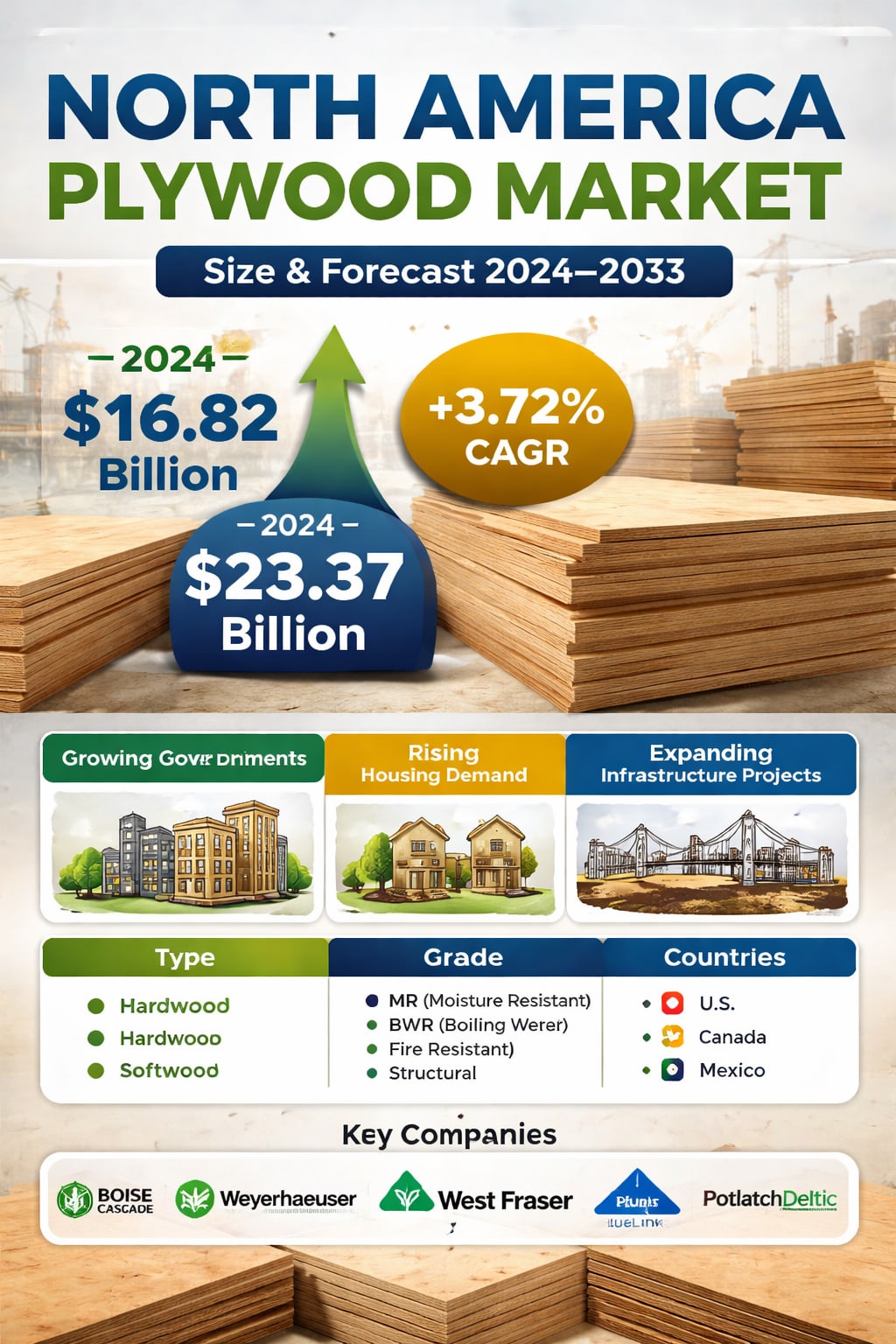
The North America plywood market is entering a steady and resilient growth phase, driven by infrastructure investments, housing demand, and a rising preference for sustainable building materials. According to industry estimates, the North America Plywood Market is expected to reach US$ 23.37 billion by 2033, up from US$ 16.82 billion in 2024, expanding at a CAGR of 3.72% from 2025 to 2033.
This growth is not just a reflection of higher construction activity—it also mirrors deeper structural changes in how buildings are designed, materials are sourced, and sustainability goals are pursued. Government spending, technological advancements in wood processing, and eco-friendly practices are reshaping the market. At the same time, plywood continues to benefit from its reputation as a versatile, strong, and cost-effective engineered wood product used across construction, furniture, packaging, flooring, transport, and decorative applications.
As North America pushes forward with infrastructure upgrades and green building initiatives, plywood is increasingly positioned as a material that balances performance, affordability, and environmental responsibility.
Overview of the North America Plywood Market
Plywood has long been a backbone material in North American construction, but its relevance is growing even stronger in the current sustainability-driven era. Unlike many synthetic building materials, plywood is derived from renewable forest resources, and when sourced responsibly, it supports lower carbon construction practices. This has made it a favored choice among architects, developers, and policymakers who are aligning projects with green building standards and environmental certifications.
The rising adoption of green building codes and energy-efficient construction mandates has further strengthened plywood’s position. Certification programs such as those promoting responsibly managed forests have improved confidence in the environmental credentials of plywood products, helping the industry address concerns around deforestation and resource depletion.
On the manufacturing side, the plywood industry has seen notable technological progress. Automation, advanced cutting and drying techniques, and improved adhesive technologies have significantly enhanced product consistency, durability, and performance. These innovations reduce material waste, improve strength-to-weight ratios, and allow manufacturers to offer specialized plywood variants such as moisture-resistant, fire-resistant, and structural-grade panels.
Digital design tools and data-driven manufacturing processes are also helping producers customize products for specific applications while improving operational efficiency. As a result, plywood is no longer viewed merely as a basic construction input—it is increasingly seen as a high-performance, engineered solution for modern building needs.
Market Size and Growth Outlook
With the market projected to grow from US$ 16.82 billion in 2024 to US$ 23.37 billion by 2033, the North American plywood industry is set for stable, long-term expansion. The 3.72% CAGR reflects a market that is not driven by short-term hype, but by consistent demand from housing, infrastructure, renovation, and commercial construction projects.
Several structural factors underpin this growth:
Continued public and private investment in infrastructure
Strong residential construction and remodeling activity
Increasing use of engineered wood products in modern buildings
Policy support for sustainable and eco-friendly construction materials
Ongoing innovation in plywood manufacturing and product development
Together, these forces are creating a favorable environment for both established producers and newer, technology-driven players in the plywood value chain.
Key Growth Drivers
1. Growing Government Spending on Wood Product Development
Government investment in sustainable forestry and wood product industries has become a major catalyst for plywood market growth in North America. Public funding aimed at modernizing manufacturing facilities, improving supply chains, and promoting green construction is strengthening the competitive position of plywood against alternative materials.
Supportive policies that encourage the use of renewable and low-carbon building materials are also shifting demand toward wood-based products. In addition, infrastructure investments in transportation, logistics, and industrial development reduce distribution costs and improve access to raw materials, benefiting plywood manufacturers across the region.
Such initiatives not only expand production capacity but also stimulate innovation, leading to the development of high-performance plywood products that meet stricter building codes and safety standards.
2. Rising Housing Demand
Housing remains one of the most powerful engines of plywood consumption in North America. Rapid urbanization, population growth, and changing lifestyle preferences continue to drive demand for new homes, apartments, and mixed-use developments.
Plywood is widely used in walls, roofs, subfloors, and interior structures because of its strength, durability, and ease of installation. Beyond new construction, the renovation and remodeling segment is also expanding, particularly as homeowners invest in upgrades, extensions, and energy-efficient retrofits.
Government initiatives supporting affordable housing and the growing popularity of modular and multi-family housing further increase the use of plywood. Its cost-effectiveness and versatility make it a preferred choice for builders who need reliable performance without excessive material costs.
As disposable incomes rise and real estate investments remain strong, demand for quality plywood products in residential construction is expected to stay robust throughout the forecast period.
3. Expanding Infrastructure Initiatives
Infrastructure development across North America is another major growth pillar for the plywood market. From highways and bridges to commercial complexes and public facilities, plywood plays a critical role in both permanent structures and temporary construction works such as formwork, scaffolding, and site enclosures.
In commercial construction, plywood is used for interior applications, facades, partitions, and structural support systems. In public works projects, it remains essential for concrete formwork, protective barriers, and transport-related infrastructure.
As governments increase spending on infrastructure modernization and urban development, the demand for durable, easy-to-handle, and cost-efficient materials like plywood continues to rise. Its strength-to-weight ratio and adaptability make it especially attractive for large-scale projects where efficiency and performance are crucial.
Challenges in the North America Plywood Market
1. Volatile Raw Material Prices
One of the most significant challenges facing the plywood industry is the fluctuation in timber prices. Factors such as climate change, wildfires, pest infestations, and changes in trade regulations can disrupt timber supply and drive price volatility.
These fluctuations directly affect production costs, profit margins, and long-term planning for manufacturers. For builders and contractors, unpredictable material prices complicate project budgeting and procurement strategies, adding uncertainty to construction timelines and costs.
2. Trade Tariffs and Supply Chain Disruptions
Trade policies and supply chain disruptions have also created headwinds for the North American plywood market. Import duties, regulatory scrutiny, and geopolitical tensions have, at times, increased material costs and extended lead times.
Pandemic-related disruptions highlighted the vulnerability of global supply chains, and while conditions have improved, logistics bottlenecks and policy shifts continue to pose risks. For manufacturers and distributors, maintaining stable supply and pricing in such an environment remains a strategic challenge.
Country-Level Market Insights
United States Plywood Market
The United States represents the largest share of the North American plywood market, driven by strong residential construction, commercial development, and infrastructure spending. The country’s large-scale housing market, combined with ongoing renovation activity, ensures consistent demand for plywood across structural and interior applications.
In addition, the U.S. construction industry is increasingly embracing engineered wood products as part of sustainable building strategies. This trend supports the adoption of advanced plywood grades, including moisture-resistant, fire-resistant, and structural variants that meet modern building codes and performance expectations.
With continued investments in housing and infrastructure, the U.S. is expected to remain the primary growth engine of the regional plywood market through 2033.
Canada Plywood Market
Canada plays a crucial role in the North American plywood ecosystem, supported by its strong forestry sector and export-oriented wood products industry. Demand is fueled by infrastructure development, residential construction, and a growing emphasis on environmentally friendly building materials.
Canadian manufacturers are increasingly investing in advanced production technologies and capacity expansion to meet both domestic and international demand. The country’s focus on sustainable forest management and green building practices further strengthens plywood’s position in the construction sector.
Supportive government policies and a well-established supply base ensure that Canada will continue to be a key contributor to regional market growth.
Mexico Plywood Market
Mexico’s plywood market is expanding steadily, driven by growth in construction, furniture manufacturing, and packaging industries. Rapid urbanization and infrastructure development are increasing the need for affordable and reliable building materials, positioning plywood as a practical solution.
Mexico also benefits from strong trade ties with the United States, which serves as a major export destination for wood products. Alongside traditional plywood, the adoption of engineered wood products is rising, reflecting broader modernization trends in the construction and manufacturing sectors.
With a growing industrial base and supportive policies, Mexico is strengthening its role within the North American plywood market landscape.
Market Segmentation
By Type:
Hardwood
Softwood
By Grade:
MR Grade (Moisture Resistant)
BWR Grade (Boiling Water Resistant)
Fire Resistant Grade
Structural Grade
Others
By Application:
Construction
Furniture
Packaging
Flooring
Transport
Decoration
Others
By Countries:
United States
Canada
Mexico
Rest of North America
Competitive Landscape
The North America plywood market features a mix of established wood product companies and specialized manufacturers. Key players are competing on product quality, sustainability credentials, supply reliability, and technological innovation.
Major companies covered include:
Boise Cascade
Weyerhaeuser Company Ltd.
West Fraser Timber Co. Ltd.
BlueLinx Holdings Inc.
PotlatchDeltic Corporation
South Coast Lumber Co. & Affiliates
Hood Industry
RoyOMartin
Each company is analyzed across four dimensions: Overview, Key Persons, Recent Developments, and Financial Insights, reflecting a competitive environment focused on capacity expansion, product innovation, and supply chain optimization.
Final Thoughts
The North America plywood market is on a steady, sustainable growth path, supported by housing demand, infrastructure investment, and the accelerating shift toward eco-friendly construction materials. With the market projected to rise from US$ 16.82 billion in 2024 to US$ 23.37 billion by 2033, plywood is proving that it remains not just relevant, but essential in modern construction and manufacturing.
While challenges such as raw material price volatility and trade uncertainties persist, ongoing innovation, policy support, and strong end-use demand continue to reinforce the industry’s long-term outlook. As green building standards become the norm rather than the exception, plywood’s combination of performance, versatility, and sustainability is likely to keep it at the heart of North America’s construction future.
About the Creator
Tom Shane
Tom Shane is a content writer specializing in SEO-driven blogs, product descriptions, and thought leadership. He crafts engaging, research-backed content that connects with audiences and drives results.
South Korea Apparel Market Insight: Size, Share & Growth
The South Korea apparel market is a vibrant, style-driven segment of the country’s consumer economy, valued at roughly USD ~30–39+ billion in 2025, depending on measurement method and scope. It features strong domestic fashion consumption, deep influence from cultural exports (especially K-pop and Korean media), and rapid adoption of digital retail channels. Key categories include casual wear, athleisure, streetwear, and mid-premium branded apparel.
By Ashutosh Srivastava7 days ago in Trader


Comments
There are no comments for this story
Be the first to respond and start the conversation.