
North America Drone Market Size and Forecast 2025–2033
How Commercial Adoption, Smart Infrastructure, and Defense Investments Are Powering a US$ 26.90 Billion Industry

Introduction: Drones Move from Niche to Necessity
Over the last decade, drones—also known as unmanned aerial vehicles (UAVs)—have evolved from hobbyist gadgets and military tools into essential assets across multiple industries. In North America, this transformation has been especially visible. What was once a niche technology is now deeply embedded in sectors such as agriculture, construction, logistics, energy, media, and public safety.
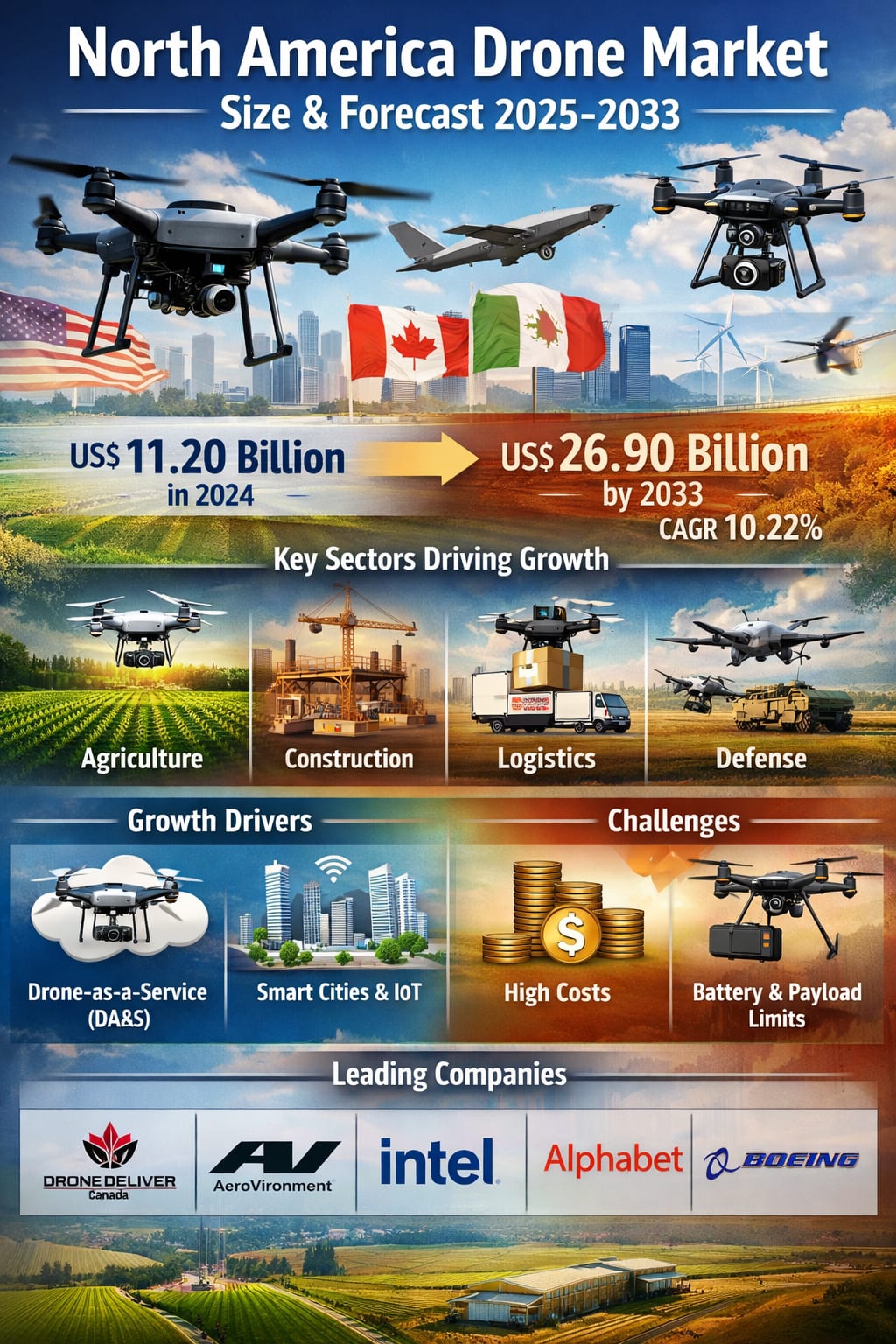
According to Renub Research, the North America Drone Market is expected to reach US$ 26.90 billion by 2033, up from US$ 11.20 billion in 2024, growing at a compound annual growth rate (CAGR) of 10.22% from 2025 to 2033. This strong growth reflects a combination of expanding commercial applications, supportive regulatory frameworks, rising defense investments, and increasing demand for data-driven, real-time aerial insights.
The United States leads the regional market, backed by a powerful technology ecosystem, strong venture capital activity, and proactive regulatory steps by the Federal Aviation Administration (FAA). Canada is emerging as a fast-growing market due to progressive policies and rising adoption across industries, while Mexico is witnessing steady momentum as drone technology becomes more accessible and affordable.
Together, these trends are positioning North America as one of the most influential regions in shaping the global future of drone technology.
Market Overview: A Region at the Forefront of Drone Innovation
North America’s drone market stands out because of its scale, technological sophistication, and diversity of use cases. From monitoring crops in vast farmlands to inspecting critical infrastructure and supporting emergency response teams, drones are increasingly becoming indispensable tools.
The United States, in particular, has built a strong foundation for drone adoption. With a large defense budget, a mature aerospace industry, and a vibrant startup ecosystem, the country continues to drive innovation in drone hardware, software, and autonomous flight systems. The FAA’s ongoing efforts to modernize airspace rules—especially around beyond visual line of sight (BVLOS) operations—are opening the door for more advanced commercial deployments.
By December 2023, over 1.47 million drones were registered in the United States, highlighting a rapidly expanding user base across both recreational and commercial segments. At the same time, major technology companies, defense contractors, and specialized drone manufacturers are investing heavily in research and development to improve battery life, sensor quality, imaging capabilities, and AI-powered analytics.
Canada is also gaining traction, supported by Transport Canada’s evolving regulatory framework that encourages safe commercial operations and innovation. Mexico, meanwhile, is seeing rising interest in drones for agriculture, infrastructure inspection, and public safety, driven by the need for cost-effective and efficient solutions.
Despite challenges such as cybersecurity risks, privacy concerns, and airspace integration, the overall outlook remains highly positive. As industries continue to digitize and rely more on real-time data, drones are expected to play an even bigger role in decision-making and operational efficiency across North America.
Key Growth Drivers Shaping the Market
1. Expansion of Commercial Applications
One of the strongest forces behind the growth of the North American drone market is the rapid expansion of commercial use cases. Drones are no longer limited to photography or military surveillance—they are now core operational tools in multiple industries.
In agriculture, drones support precision farming by monitoring crop health, analyzing soil conditions, and optimizing spraying operations. This helps farmers improve yields while reducing costs and environmental impact.
In construction, drones are used for site surveys, progress tracking, safety inspections, and project documentation, saving both time and labor.
In logistics, companies are experimenting with drones for inventory management and last-mile delivery, aiming to make supply chains faster and more efficient.
The energy sector relies on drones to inspect power lines, pipelines, wind turbines, and solar farms, reducing the need for risky manual inspections.
Meanwhile, real estate and media benefit from high-quality aerial imagery and immersive visual content.
Across these industries, drones improve productivity, enhance safety, and provide data that would otherwise be expensive or difficult to collect.
2. The Rise of Drone-as-a-Service (DaaS)
Another major trend accelerating adoption is the growth of Drone-as-a-Service (DaaS). Instead of purchasing expensive drones, training staff, and managing maintenance, businesses can now access drone services on demand through specialized providers.
This model is especially attractive for small and medium-sized enterprises in sectors such as construction, mining, insurance, and agriculture. DaaS providers offer complete solutions that include hardware, skilled operators, data collection, and analytics. As a result, companies can benefit from drone technology without large upfront investments.
The integration of DaaS platforms with cloud computing and AI-based analytics further increases their value. Businesses can receive actionable insights rather than just raw aerial data, making decision-making faster and more accurate. This service-based approach is playing a key role in making drone technology more accessible and scalable across North America.
3. Integration with IoT and Smart Cities
Drones are increasingly becoming part of broader IoT (Internet of Things) and smart city ecosystems. In modern urban environments, drones can work alongside sensors, cameras, and cloud platforms to deliver real-time data for city management.
In smart cities, drones are used to monitor traffic, assess infrastructure conditions, track environmental changes, and support emergency response teams. Live aerial feeds improve situational awareness, while data integration with AI systems enables predictive maintenance and faster decision-making.
This seamless connection between drones and digital infrastructure enhances efficiency, sustainability, and public safety. As more North American cities invest in smart infrastructure, the role of drones in urban planning and management is expected to grow significantly.
Challenges Facing the North America Drone Market
High Initial Costs
Despite falling prices over time, advanced commercial drones equipped with high-resolution cameras, LiDAR systems, and autonomous navigation features still represent a significant investment. Beyond the hardware, businesses must also consider costs related to software, training, insurance, and ongoing maintenance.
For smaller companies, these expenses can slow adoption, even when the long-term benefits are clear. While models like Drone-as-a-Service help reduce these barriers, affordability remains a key challenge for widespread deployment across all industries.
Battery Life and Payload Limitations
Battery performance and payload capacity continue to limit what drones can achieve in many commercial applications. Most drones still have relatively short flight times, often ranging between 20 and 45 minutes, which restricts operational range and requires frequent recharging or battery swaps.
Payload limits also constrain the type and amount of equipment a drone can carry, which is especially important for applications like LiDAR mapping, industrial inspection, and delivery services. Weather conditions such as strong winds, rain, or extreme temperatures can further affect reliability and safety.
These technical limitations highlight the need for continued innovation in battery technology, materials science, and drone design to support longer, heavier, and more demanding missions.
Country-Level Insights
United States: The Regional Powerhouse
The United States dominates the North American drone market thanks to its strong technology base, large defense budget, and wide-ranging commercial adoption. Drones are widely used in agriculture, infrastructure inspection, public safety, logistics, and media production.
Government support and evolving regulations are helping to encourage innovation while maintaining safety standards. However, challenges remain, particularly around cybersecurity, privacy, and airspace management. Additionally, concerns over national security and reliance on foreign manufacturers influence policy decisions related to drone imports and usage.
Even with these challenges, the U.S. market is expected to remain the main growth engine for the region.
Canada: A Fast-Growing Innovation Hub
Canada’s drone market is expanding rapidly, driven by increasing use in construction, agriculture, logistics, and infrastructure inspection. Transport Canada’s regulatory approach has generally supported both commercial and recreational drone operations, helping to create a stable environment for growth.
While issues such as airspace integration, data security, and infrastructure investment still need attention, continued innovation and supportive policies are expected to keep Canada on a strong growth path in the coming years.
Mexico: Steady Momentum and Expanding Use Cases
Mexico is emerging as an important market for drones, particularly in agriculture, energy, infrastructure inspection, and law enforcement. Drones offer cost-effective solutions to long-standing challenges, such as monitoring large agricultural areas or inspecting remote infrastructure.
Although regulatory updates and airspace integration remain ongoing challenges, rising investment and technological improvements are expected to support steady market growth through the next decade.
Market Segmentation Overview
By Application:
Construction
Agriculture
Energy
Entertainment
Law Enforcement
Other Applications
By Type:
Fixed-wing Drones
Rotary-wing Drones
By Country:
United States
Canada
Mexico
Rest of North America
Competitive Landscape and Key Players
The North American drone market features a mix of specialized drone manufacturers, technology giants, and aerospace companies. Key players covered in the market include:
Drone Delivery Canada
AeroVironment Inc.
UVify Inc.
Intel Corporation
Alphabet Inc.
Boeing Company
Teledyne FLIR LLC
3D Robotics Inc.
These companies compete across multiple dimensions, including hardware innovation, software and analytics capabilities, autonomous flight systems, and service-based business models. Ongoing investments in research and development, strategic partnerships, and new product launches continue to shape the competitive landscape.
Final Thoughts: A Market Set for Long-Term Transformation
The North America drone market is no longer just about flying machines—it is about data, automation, efficiency, and smarter decision-making. With the market projected to grow from US$ 11.20 billion in 2024 to US$ 26.90 billion by 2033, the region is clearly entering a new phase of drone-driven transformation.
Commercial adoption, the rise of Drone-as-a-Service, integration with smart city infrastructure, and continued defense and technology investments are all reinforcing this growth story. While challenges such as cost, battery limitations, and regulatory complexity remain, ongoing innovation is steadily addressing these barriers.
As industries across North America continue to embrace digitalization and real-time data, drones are set to become even more deeply embedded in everyday operations—making them not just a tool of the future, but a cornerstone of modern business and infrastructure today.
About the Creator
Sakshi Sharma
Content Writer with 7+ years of experience crafting SEO-driven blogs, web copy & research reports. Skilled in creating engaging, audience-focused content across diverse industries.
Keep reading
More stories from Sakshi Sharma and writers in Trader and other communities.
Europe Anticoagulants Market Size and Forecast 2025–2033
Introduction: A Market at the Heart of Modern Cardiovascular Care The Europe anticoagulants market is entering a decisive decade, shaped by demographic change, lifestyle-related disease burdens, and rapid pharmaceutical innovation. Valued at US$ 11.63 billion in 2024, the market is expected to reach US$ 23.68 billion by 2033, expanding at a CAGR of 8.22% from 2025 to 2033. This strong growth reflects not only rising clinical need, but also a fundamental transformation in how blood clotting disorders are treated across the continent.
By Sakshi Sharma3 days ago in Trader
Australia Courier, Express and Parcel (CEP) Market to Reach USD 17.7 Billion by 2033 on E-Commerce and Tech Adoption
The Australia courier, express and parcel (CEP) market is expanding steadily as digital commerce, delivery expectations, and logistics technologies evolve across the nation. According to IMARC Group, the market was valued at USD 12.8 billion in 2024 and is projected to reach USD 17.7 billion by 2033, reflecting a compound annual growth rate (CAGR) of 3.30% between 2025 and 2033.
By Rashi Sharmaabout an hour ago in Trader



Comments
There are no comments for this story
Be the first to respond and start the conversation.