
North America Biopsy Device Market Trends & Forecast 2025–2033
How Rising Cancer Burden, Imaging Innovation, and Minimally Invasive Diagnostics Are Reshaping the Region’s Healthcare Landscape

Introduction
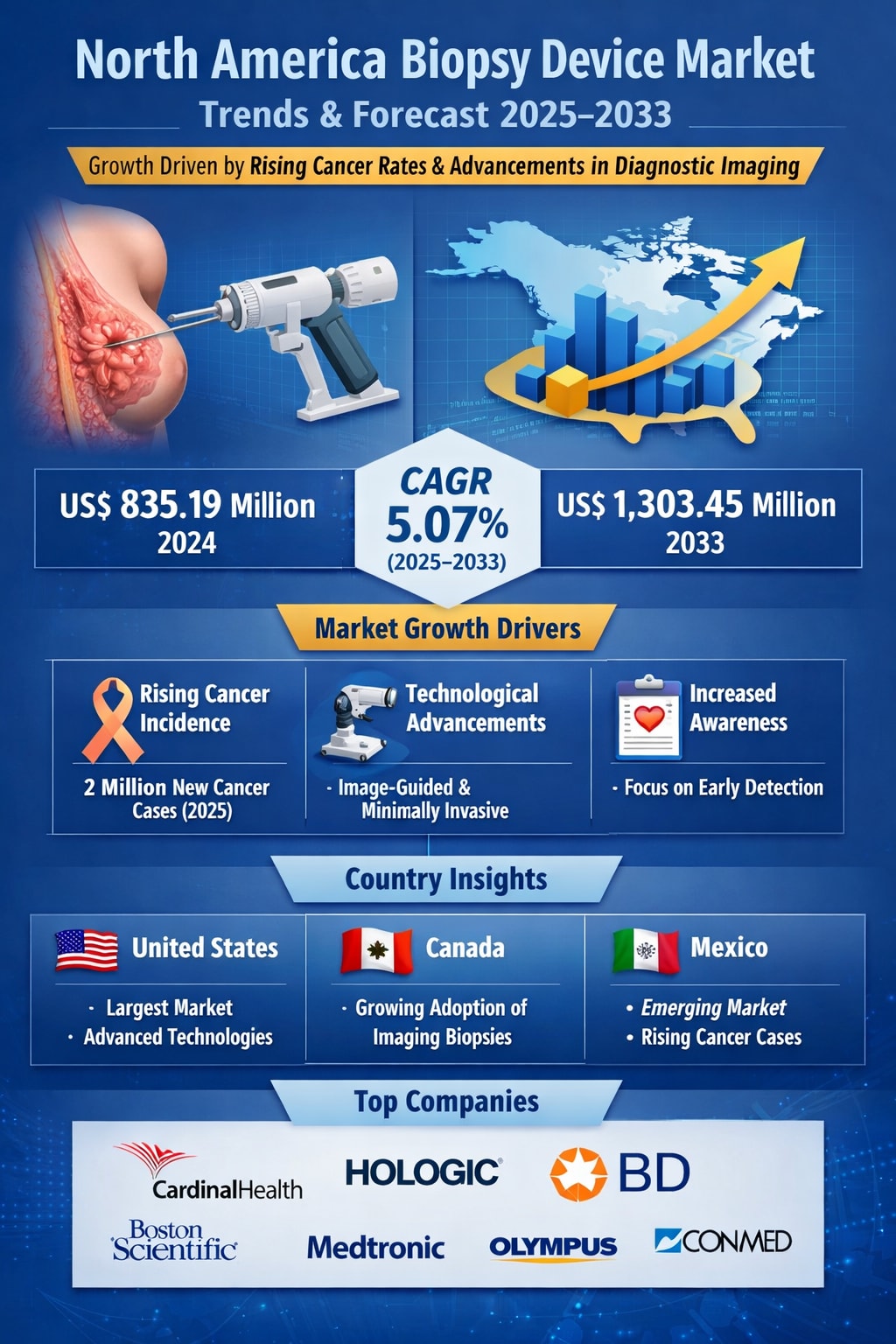
The North America biopsy device market is entering a decade of steady and strategically important growth, driven by the rising burden of cancer, increasing emphasis on early diagnosis, and rapid advances in medical imaging and minimally invasive procedures. According to Renub Research, the North America Biopsy Device Market is expected to reach US$ 1,303.45 million by 2033, up from US$ 835.19 million in 2024, expanding at a compound annual growth rate (CAGR) of 5.07% from 2025 to 2033.
Biopsy devices play a foundational role in modern healthcare. They enable physicians to collect tissue or cell samples from organs such as the breast, lung, prostate, liver, and gastrointestinal tract, allowing accurate diagnosis of cancer and other serious conditions. With healthcare systems across the United States, Canada, and Mexico increasingly focused on early detection, precision medicine, and patient-friendly procedures, biopsy technologies are no longer just diagnostic tools—they are strategic assets in the fight against chronic and life-threatening diseases.
North America Biopsy Device Industry Overview
A biopsy device is a medical instrument used to extract tissue samples from the body for laboratory examination. These samples help clinicians confirm or rule out diseases such as cancer, infections, and inflammatory conditions. Common biopsy device categories include needle-based systems (core needle and fine needle aspiration), vacuum-assisted devices, surgical biopsy tools, biopsy forceps, and image-guided biopsy systems.
Modern biopsy procedures are increasingly supported by imaging technologies such as ultrasound, CT scans, MRI, and stereotactic guidance, which improve accuracy while minimizing patient discomfort. Compared to traditional surgical biopsies, today’s minimally invasive techniques reduce recovery time, lower complication risks, and improve patient compliance.
In North America, the biopsy device market benefits from a strong healthcare infrastructure, high healthcare spending, favorable reimbursement in many segments, and continuous innovation by leading medical device manufacturers. The integration of digital pathology, artificial intelligence, and advanced imaging guidance is further enhancing diagnostic precision and clinical decision-making. Together, these factors are positioning biopsy devices as a critical pillar of modern diagnostic pathways.
Market Growth Drivers
Rising Cancer Incidence
One of the strongest growth engines for the North America biopsy device market is the steadily increasing incidence of cancer. The American Cancer Society estimates that 2025 will see more than 2 million new cancer cases and over 618,000 cancer-related deaths in the United States alone. Breast cancer remains the most commonly diagnosed cancer among women, accounting for roughly 30% of all new female cancer cases, with hundreds of thousands of new cases expected annually.
This growing disease burden directly increases the demand for accurate, timely, and minimally invasive diagnostic procedures. Biopsy remains the gold standard for confirming cancer diagnoses and guiding treatment decisions. As screening programs expand and awareness improves, the volume of biopsy procedures continues to rise, supporting sustained market growth across hospitals and diagnostic centers.
Technological Advancements in Biopsy Procedures
Technology is transforming the biopsy landscape. Innovations such as robotic-assisted biopsy systems, vacuum-assisted biopsy devices, and high-precision image-guided platforms are improving sampling accuracy while reducing patient discomfort and procedure time. These advances are particularly important in complex cases such as lung, prostate, and deep-tissue breast biopsies, where precision is critical.
The integration of AI-driven imaging analysis and digital pathology is also enhancing diagnostic confidence and workflow efficiency. Strategic acquisitions and product launches by major players underline the industry’s focus on innovation and market expansion. These technological improvements not only boost clinical outcomes but also encourage healthcare providers to upgrade their diagnostic capabilities, further driving market adoption.
Growing Awareness of Early Diagnosis
Public health campaigns, advocacy by organizations such as cancer foundations, and wider access to medical information have significantly increased awareness of the importance of early disease detection. Patients are more proactive about screenings, and physicians are more likely to recommend biopsy procedures when imaging results are inconclusive.
Early diagnosis often leads to better treatment outcomes, lower long-term healthcare costs, and improved survival rates—especially in cancers such as breast, prostate, and lung. This shift toward preventive and early-stage care is steadily increasing the demand for reliable, efficient, and minimally invasive biopsy devices across North America.
Key Market Challenges
High Cost of Advanced Biopsy Systems
Despite their clinical benefits, advanced biopsy systems—especially robotic-assisted and high-end image-guided platforms—come with significant acquisition, maintenance, and training costs. Smaller hospitals and diagnostic centers may find it difficult to justify these investments, particularly in regions with tight healthcare budgets or limited reimbursement coverage.
These cost barriers can slow adoption rates and create disparities in access to advanced diagnostic technologies, especially in smaller or rural healthcare facilities.
Regulatory and Reimbursement Hurdles
The biopsy device market also faces challenges related to regulatory approval and reimbursement policies. In the United States, for example, strict regulatory pathways can delay the commercialization of new devices. At the same time, reimbursement policies vary by procedure and device type, sometimes limiting financial incentives for healthcare providers to adopt newer technologies.
These factors can discourage innovation, slow market penetration of advanced solutions, and create uncertainty for manufacturers and healthcare institutions alike.
Country-Level Market Insights
United States
The United States dominates the North America biopsy device market, supported by a high cancer burden, strong healthcare infrastructure, and rapid adoption of advanced medical technologies. Continuous product innovation is shaping the competitive landscape. Recent launches of enhanced biopsy systems—designed to improve tissue sample quality, accuracy, and workflow efficiency—highlight the country’s role as a key innovation hub.
With a strong focus on early diagnosis, personalized medicine, and minimally invasive procedures, the U.S. market is expected to remain the primary growth engine for the region through 2033.
Canada
Canada’s biopsy device market is expanding steadily, driven by rising cancer incidence, growing adoption of image-guided procedures, and a healthcare system that emphasizes early detection and patient-centered care. Hospitals and diagnostic centers are increasingly investing in ultrasound-guided, CT-guided, and MRI-guided biopsy systems to improve diagnostic accuracy and patient outcomes.
The shift toward less invasive procedures and precision medicine continues to support demand for modern biopsy technologies across the country.
Mexico
Mexico represents a growing opportunity within the North American market. Rising cancer awareness, improving healthcare infrastructure, and increased access to advanced diagnostic tools are driving adoption. International medical device companies are actively expanding their presence in the country, introducing modern biopsy solutions for breast, lung, prostate, and liver applications.
As healthcare investment continues and diagnostic standards rise, Mexico is expected to contribute meaningfully to regional market growth over the forecast period.
Market Segmentation Overview
By Product:
Needle-Based Guns
Biopsy Guidance Systems
Biopsy Needles
Biopsy Forceps
Others
By Application:
Breast Biopsy
Lung Biopsy
Prostate Biopsy
Liver Biopsy
Gastroenterology Biopsy
Others
By Technology:
CT Scan Guided
Stereotactic Guided
Ultrasound Guided
MRI Guided
Others
By End User:
Hospitals
Diagnostic & Imaging Centers
Others
By Country:
United States
Canada
Mexico
Rest of North America
Competitive Landscape
The North America biopsy device market is highly competitive, with leading companies focusing on product innovation, strategic partnerships, acquisitions, and geographic expansion. Key players covered in the market include:
Cardinal Health, Inc.
Hologic, Inc.
Danaher Corporation
Becton, Dickinson and Company
Boston Scientific Corporation
Medtronic plc
Olympus Corporation
CONMED Corporation
These companies are analyzed across four perspectives: Overview, Key Persons, Recent Developments, and Financial Insights, highlighting their strategic positioning in the evolving diagnostic ecosystem.
Final Thoughts
The North America biopsy device market is on a solid growth trajectory, fueled by rising cancer prevalence, technological innovation, and a healthcare system increasingly focused on early and accurate diagnosis. With the market projected to grow from US$ 835.19 million in 2024 to US$ 1,303.45 million by 2033, biopsy devices will remain central to the region’s diagnostic and treatment pathways.
While challenges related to cost, regulation, and reimbursement persist, continuous innovation and expanding awareness of early detection are expected to sustain long-term demand. As precision medicine and minimally invasive care continue to shape the future of healthcare, biopsy devices will play an even more critical role in delivering timely, accurate, and patient-friendly diagnoses across North America.
About the Creator
ASX Market Update Today: Gains in Financials and Resources Amid Global Tech News
ASX Market Update Today: Market Shows Mixed but Optimistic Sentiment The ASX market update today reflects cautious optimism as key sectors like financials and resources led the gains, while healthcare and technology stocks showed mixed performance. Investors are closely monitoring domestic economic data alongside global developments that influence sentiment in equity markets.
By Hammad Nawaz2 days ago in Trader
MicroStrategy Bitcoin Trend: How This Move Is Reshaping Corporate Investment
MicroStrategy Bitcoin has become a trendsetter in corporate finance. The company’s bold decision to hold significant amounts of Bitcoin has captured the attention of investors and businesses worldwide. MicroStrategy Bitcoin is not just about profit it is a strategic move that demonstrates the future of business investments. This article explores why MicroStrategy Bitcoin is changing the rules of corporate finance and what it means for other companies.
By John.doe7984 days ago in Trader
Nancy Guthrie: Is a miracle still possible after close to two weeks?
Close to two weeks since Nancy Guthrie's abduction As of February 12, 2026, Nancy Guthrie remains classified as missing for 12 days, but there is no official confirmation that she is deceased. Blood matching Guthrie’s DNA was found on her front porch, indicating she likely suffered an injury during the abduction.
By Cheryl E Preston2 days ago in Geeks


Comments
There are no comments for this story
Be the first to respond and start the conversation.