
Narcolepsy Drugs Market Trends & Summary (2025–2033)
Rising Awareness, Innovation in Therapies, and Expanding Access Drive a High-Growth Global Market

Introduction
The global healthcare industry is increasingly recognizing sleep disorders as a major public health concern, and among them, narcolepsy stands out as one of the most complex and life-altering neurological conditions. Characterized by excessive daytime sleepiness, sudden muscle weakness (cataplexy), disrupted nighttime sleep, and sleep paralysis, narcolepsy significantly affects patients’ quality of life, productivity, and mental well-being. As awareness grows and diagnosis rates improve, the demand for effective pharmacological treatments continues to rise.
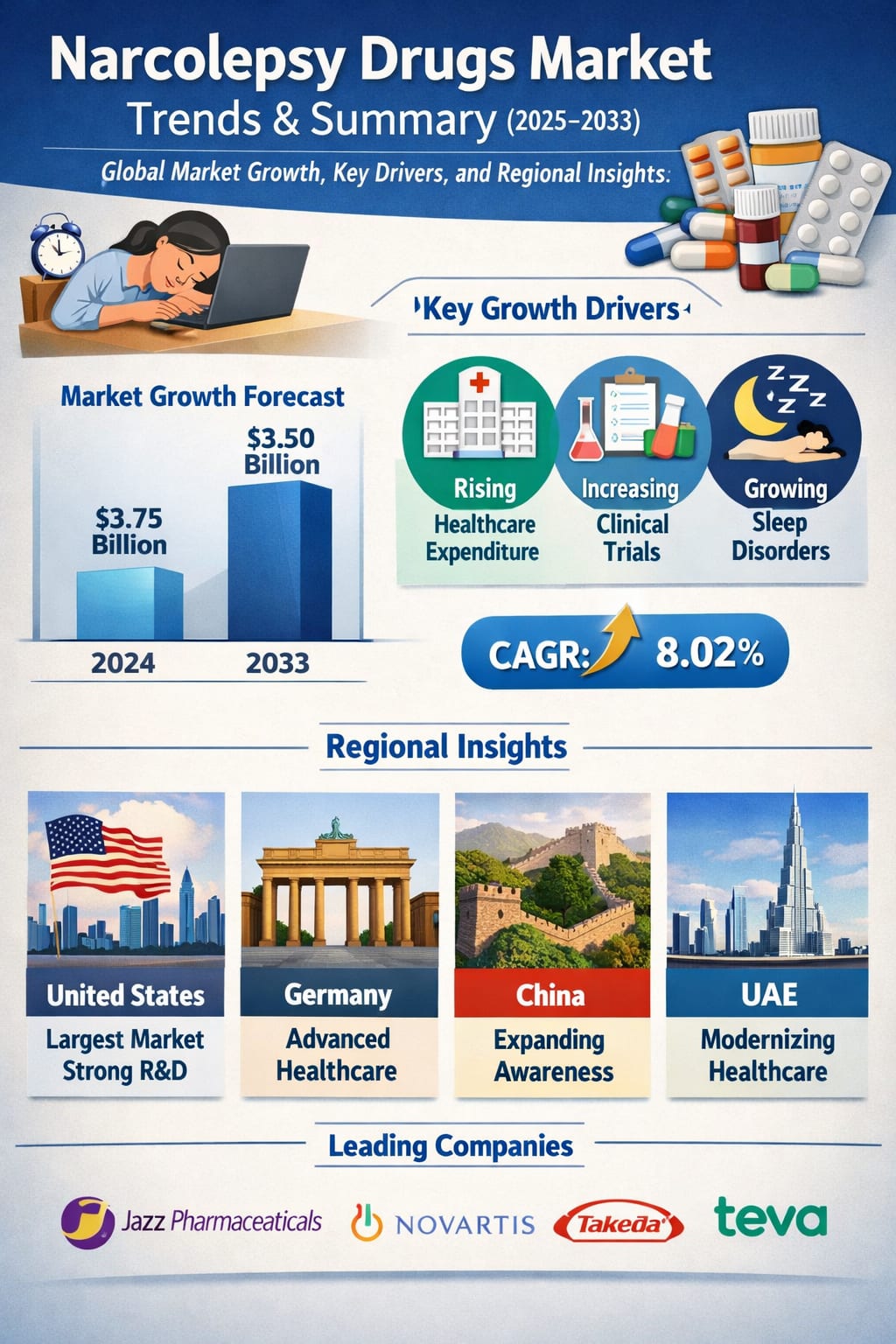
According to Renub Research, the Narcolepsy Drugs Market is expected to reach US$ 7,504.60 million by 2033, up from US$ 3,749.40 million in 2024, expanding at a CAGR of 8.02% from 2025 to 2033. This strong growth trajectory reflects not only the increasing prevalence of sleep disorders worldwide but also steady progress in drug development, regulatory support, and healthcare infrastructure.
Traditionally, treatment has focused on managing symptoms rather than curing the disease. However, the current wave of innovation is reshaping the therapeutic landscape, with newer, more targeted drugs aiming to improve both daytime alertness and nighttime sleep quality. As a result, the narcolepsy drugs market is evolving from a niche segment into a strategically important part of the broader neurology and sleep medicine space.
Global Narcolepsy Drugs Industry Overview
The global market for narcolepsy drugs is expanding steadily due to greater awareness, improved treatment options, and a better understanding of narcolepsy as a chronic neurological disorder. For decades, narcolepsy was underdiagnosed and often misunderstood, with many patients being treated for depression, fatigue, or other sleep disorders instead. Today, advancements in sleep medicine, better diagnostic tools, and stronger advocacy by patient organizations are changing that narrative.
Narcolepsy symptoms—such as excessive daytime sleepiness, cataplexy, hallucinations, and fragmented sleep—require long-term management. Stimulant medications like modafinil and amphetamines have traditionally been used to reduce daytime drowsiness. Meanwhile, sodium oxybate has become a cornerstone therapy, especially for patients with narcolepsy accompanied by cataplexy, due to its dual ability to improve nighttime sleep and reduce daytime symptoms.
The market is also benefiting from the introduction of newer, more targeted therapies designed to offer better efficacy, improved safety profiles, and greater convenience. Pharmaceutical companies are increasingly focusing on therapies that address not just sleepiness but also the emotional and cognitive challenges associated with narcolepsy. While challenges such as high treatment costs and limited access to specialized care remain, the overall outlook for the market is positive, supported by rising diagnosis rates and continuous innovation.
Market Size and Growth Outlook
Based on Renub Research estimates, the narcolepsy drugs market is on a solid growth path:
Market size in 2024: US$ 3,749.40 million
Expected market size by 2033: US$ 7,504.60 million
CAGR (2025–2033): 8.02%
This growth is being driven by a combination of medical, social, and economic factors. On the medical side, better understanding of sleep disorders and improvements in diagnostic capabilities are bringing more patients into treatment. On the social side, rising awareness about the importance of sleep health is encouraging individuals to seek medical help rather than ignoring symptoms. Economically, increased healthcare spending and expanding insurance coverage in many regions are making advanced treatments more accessible.
Key Growth Drivers
1. Rising Healthcare Expenditure
Global healthcare spending has been increasing steadily, enabling better diagnosis and treatment of chronic conditions such as narcolepsy. For example, in 2022, healthcare spending in the United States rose by over 4.1% to around US$ 4.5 trillion, representing a significant share of the country’s GDP. Similar trends are being observed in many developed and emerging economies.
Higher healthcare budgets mean improved access to sleep clinics, advanced diagnostic tools, and specialist care. This, in turn, leads to higher diagnosis rates and greater demand for narcolepsy medications. As healthcare systems continue to prioritize chronic neurological and sleep-related disorders, the narcolepsy drugs market stands to benefit directly.
2. Increasing Number of Clinical Trials
Clinical research plays a crucial role in expanding treatment options and improving existing therapies. Pharmaceutical companies are investing heavily in the development of novel compounds that target the underlying mechanisms of narcolepsy more precisely.
For instance, in August 2024, Alkermes initiated the Phase II Vibrance-2 clinical trial of ALKS 2680 in patients with narcolepsy type 2. This oral, once-daily drug targets the orexin 2 receptor, a pathway closely linked to wakefulness regulation. Such innovations not only expand the therapeutic pipeline but also increase competition, which can eventually lead to better treatment outcomes and, potentially, more affordable options.
3. Growing Prevalence of Sleep Disorders
Sleep disorders are becoming increasingly common worldwide due to lifestyle changes, rising stress levels, irregular sleep schedules, and excessive use of digital devices. According to patient advocacy sources, narcolepsy affects approximately one in every 2,000 people in the United States, translating to about 200,000 individuals, and around 3 million people globally.
As more people experience sleep-related problems and seek medical advice, the number of diagnosed narcolepsy cases is expected to rise. This directly fuels demand for effective drug therapies, making prevalence trends a key driver of market growth.
Challenges in the Narcolepsy Drugs Market
1. High Treatment Costs
One of the most significant barriers to market growth is the high cost of treatment, especially for specialized therapies like sodium oxybate. These medications can be expensive, particularly for patients without comprehensive insurance coverage or those living in low- and middle-income countries.
High out-of-pocket costs can force patients to delay or discontinue treatment, negatively impacting their quality of life and limiting overall market penetration. This challenge highlights the importance of policy support, better reimbursement frameworks, and the development of more cost-effective therapeutic alternatives.
2. Limited Awareness and Underdiagnosis
Despite progress, narcolepsy remains underdiagnosed in many parts of the world. Its symptoms—such as extreme daytime sleepiness and sudden muscle weakness—are often mistaken for other conditions like depression, sleep apnea, or general fatigue.
Limited awareness among both the general public and some healthcare professionals leads to delayed diagnosis and inappropriate treatment. This not only affects patient outcomes but also restricts the potential market for narcolepsy-specific drugs. Increasing education, awareness campaigns, and training for healthcare providers will be essential to overcoming this barrier.
Regional Market Insights
United States
The United States represents one of the largest and most advanced markets for narcolepsy drugs. Growth is driven by strong healthcare infrastructure, high awareness levels, and widespread access to advanced medications such as modafinil, armodafinil, and sodium oxybate. Ongoing research and development, along with active patient advocacy, further support market expansion.
However, high treatment costs and potential side effects of some drugs remain concerns, particularly for long-term therapy. Additionally, underdiagnosis still limits the full potential of the market. Despite these challenges, the U.S. market is expected to continue growing as diagnostic rates improve and new therapies enter the market.
Germany
Germany’s narcolepsy drugs market benefits from a well-developed healthcare system and strong reimbursement policies that reduce financial barriers for patients. Commonly used treatments include modafinil, armodafinil, and sodium oxybate. Increasing awareness and a focus on improving patient quality of life are supporting steady market growth.
Nevertheless, challenges such as underdiagnosis and the high cost of certain therapies persist. Overall, Germany is expected to remain a key European market with stable growth prospects.
China
In China, the narcolepsy drugs market is gradually expanding, driven by improving healthcare infrastructure and rising awareness, especially in urban areas. Demand for drugs like modafinil, armodafinil, and sodium oxybate is increasing as more patients seek treatment.
However, limited awareness in rural areas, underdiagnosis, and relatively high treatment costs continue to restrict market growth. Government efforts to expand healthcare coverage and improve access to medicines are expected to support future expansion.
United Arab Emirates
The UAE market is growing steadily, supported by a modernizing healthcare system and increasing awareness of sleep disorders. Demand for effective narcolepsy treatments is rising, particularly in urban centers with access to specialized care.
High treatment costs, especially in the private healthcare sector, and ongoing underdiagnosis remain challenges. Still, continued investment in healthcare infrastructure and awareness initiatives is likely to drive further market growth.
Market Segmentation
By Disease Type
Daytime Extreme Sleepiness
Cataplexia
Other Disease Types
By Therapeutic Type
Central Nervous Systems Stimulants
Tricyclic Antidepressants
Sodium Oxybate
Selective Serotonin Reuptake Inhibitors
Others
By End Users
Diagnostic Centers
Hospitals
Others
By Country (17 Key Markets)
United States, Canada, Mexico, Brazil, United Kingdom, Germany, France, Italy, Spain, Netherlands, China, Japan, India, South Korea, Australia, South Africa, United Arab Emirates.
Competitive Landscape and Company Analysis
The narcolepsy drugs market is moderately competitive, with several major pharmaceutical companies playing key roles in shaping the industry. The competitive analysis typically covers four main viewpoints: company overview, key persons, recent developments and strategies, and financial insights.
Key Players Include:
Jazz Pharmaceuticals
Ligand Pharmaceuticals
Novartis AG
Takeda Pharmaceutical
Teva Pharmaceutical
Hikma Pharmaceuticals Plc
Harmony Biosciences Holdings
Roche Holding AG
Johnson & Johnson
These companies are actively investing in research and development, strategic partnerships, and portfolio expansion to strengthen their positions in the global market. Innovation, regulatory approvals, and geographic expansion remain central to their growth strategies.
Future Outlook
The future of the narcolepsy drugs market looks promising, supported by strong growth drivers such as rising awareness, expanding healthcare access, and continuous innovation in drug development. As more targeted therapies enter the market, patients can expect better symptom control, improved safety profiles, and greater convenience.
At the same time, addressing challenges related to cost, access, and underdiagnosis will be critical to unlocking the market’s full potential. Policymakers, healthcare providers, and pharmaceutical companies will need to work together to ensure that effective treatments reach all patients who need them.
Final Thoughts
The global narcolepsy drugs market is transitioning from a relatively niche segment into a rapidly growing and strategically important part of the pharmaceutical industry. With the market projected to grow from US$ 3,749.40 million in 2024 to US$ 7,504.60 million by 2033, the coming years will be defined by innovation, expanding access, and increasing recognition of sleep health as a critical component of overall well-being.
While challenges such as high treatment costs and underdiagnosis remain, the overall trajectory is clearly positive. As awareness continues to rise and new therapies reshape the treatment landscape, the narcolepsy drugs market is set to play a crucial role in improving the lives of millions of patients worldwide.
About the Creator
Stanislav Kondrashov on How AI IPOs Will Reshape the Technology Sector in 2026
Three artificial intelligence companies—OpenAI, Anthropic (Claude), and xAI (Grok)—are preparing to go public in what could mark a turning point in the global technology sector. According to TELF AG founder Stanislav Kondrashov, these upcoming IPOs reflect more than a financial move—they highlight a significant shift in how technology is developed, organised, and scaled.
By Stanislav Kondrashov7 days ago in Trader




Comments
There are no comments for this story
Be the first to respond and start the conversation.