
Mexico Point of Care Diagnostics Market Size and Forecast 2025–2033
Rapid Testing, Rural Outreach, and Digital Health Are Reshaping Mexico’s Diagnostic Landscape

Mexico Point of Care Diagnostics Market Overview
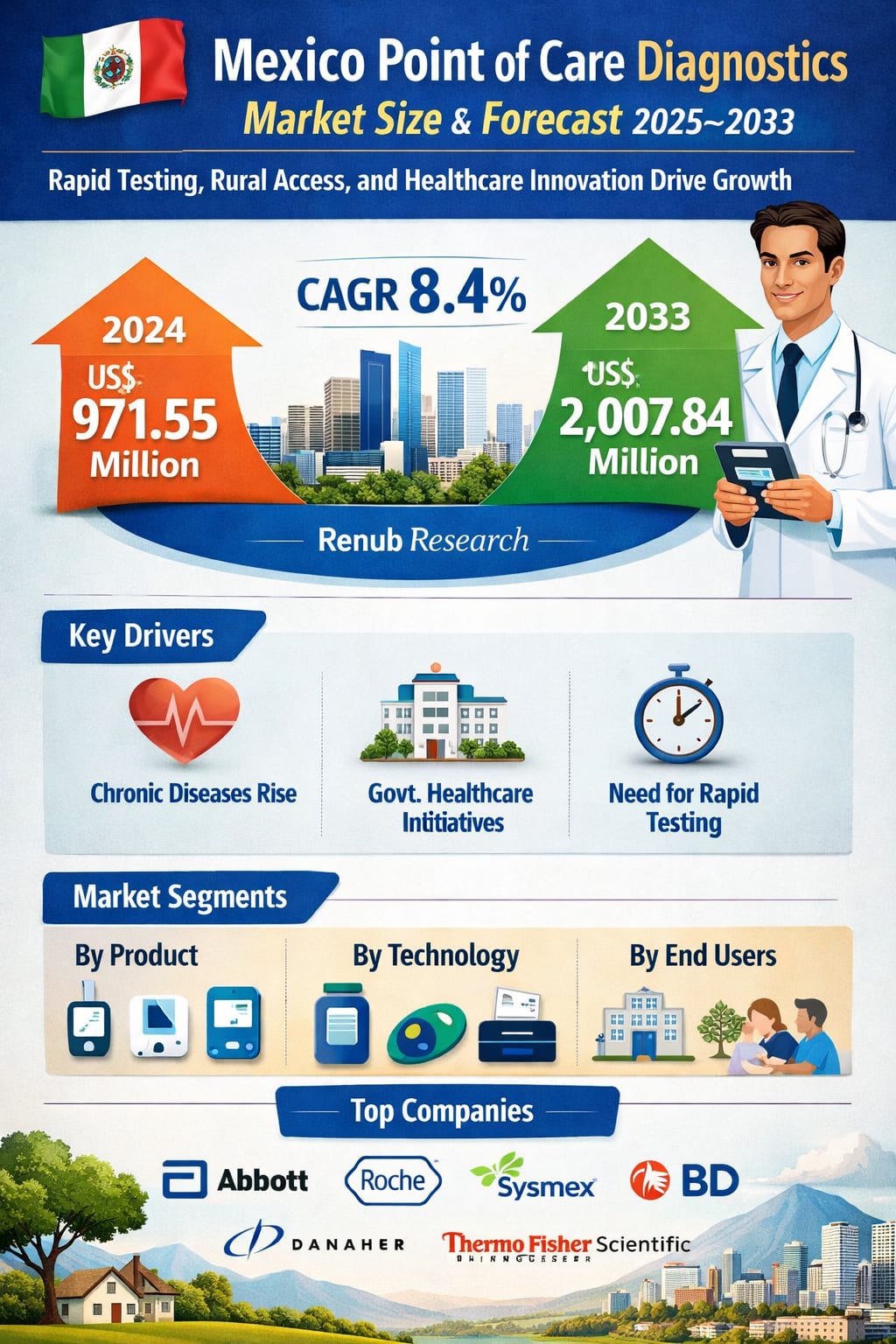
The Mexico Point of Care Diagnostics Market is entering a phase of strong and sustained growth, driven by the country’s rising healthcare needs, increasing burden of chronic and infectious diseases, and the urgent demand for faster, more accessible diagnostic solutions. According to Renub Research, the market is expected to reach US$ 2,007.84 million by 2033, up from US$ 971.55 million in 2024, expanding at a CAGR of 8.4% from 2025 to 2033.
Point of care (POC) diagnostics are transforming how healthcare is delivered in Mexico. Unlike conventional laboratory testing, which often involves delays due to sample transport and processing, POC testing allows healthcare professionals to obtain results at or near the patient site. This immediate availability of diagnostic information supports faster clinical decisions, earlier treatment initiation, and, in many cases, better patient outcomes.
Mexico’s healthcare system is facing a complex mix of challenges: an aging population, a high and growing prevalence of chronic diseases such as diabetes and cardiovascular conditions, and persistent gaps in healthcare access between urban and rural regions. In this context, POC diagnostics offer a practical and scalable solution. From glucose monitoring and pregnancy testing to infectious disease detection and cardiometabolic screening, these devices are becoming essential tools across hospitals, clinics, and even home care settings.
The COVID-19 pandemic further accelerated the adoption of point of care testing in Mexico, highlighting the importance of rapid, decentralized diagnostics during public health emergencies. Since then, the integration of POC solutions with telemedicine and mobile health platforms has continued to strengthen their role, particularly in extending healthcare services to remote and underserved communities.
At the same time, both domestic and international medical device companies are investing in innovative, user-friendly, and more accurate POC technologies tailored to the needs of the Mexican market. While challenges such as regulatory complexity, cost sensitivity, and training gaps remain, the long-term outlook for the Mexico Point of Care Diagnostics Market remains highly positive.
Key Factors Driving the Mexico Point of Care Diagnostics Market Growth
Rising Burden of Chronic Diseases
One of the most powerful drivers of growth in Mexico’s point of care diagnostics market is the increasing prevalence of chronic illnesses, including diabetes, hypertension, and cardiovascular diseases. These conditions require continuous monitoring, frequent testing, and long-term management, placing significant pressure on both patients and the healthcare system.
In 2024, cardiovascular diseases accounted for nearly 100,000 deaths in the first half of the year alone, making them the leading cause of mortality in the country—surpassing deaths from cancer, COVID-19, and diabetes combined, according to data from Mexico’s National Institute of Statistics and Geography (INEGI). This alarming trend has intensified the need for early detection, routine monitoring, and timely intervention.
Point of care diagnostics play a critical role in this scenario. Devices such as blood glucose monitors, lipid profile analyzers, and coagulation testing systems allow both healthcare providers and patients to track key health indicators in real time. This supports better disease management, improves treatment adherence, and helps reduce hospital admissions and complications.
As Mexico’s healthcare system increasingly shifts toward preventive care and patient self-monitoring, the demand for reliable and easy-to-use POC diagnostic tools is expected to rise steadily throughout the forecast period.
Government Initiatives to Strengthen Disease Surveillance
The Mexican government has been actively working to enhance public health preparedness and disease surveillance, especially in the aftermath of the COVID-19 pandemic. Strengthening diagnostic capacity has become a national priority, and point of care technologies are central to this strategy.
Federal healthcare initiatives aimed at expanding access to medical services and improving early disease detection are driving the procurement and deployment of POC diagnostic devices across primary and secondary care facilities. A notable example is the expansion of the IMSS Bienestar program in 2024, which aims to provide free medical care to more than 53 million uninsured citizens. This initiative includes completing previously unfinished hospitals and establishing 24/7 surgical teams in hundreds of rural hospitals.
In such settings, point of care diagnostics offer a practical solution for managing endemic diseases, monitoring infectious outbreaks, and improving maternal and child health outcomes. Their portability, speed, and ease of use make them especially suitable for community health programs and outreach initiatives, where access to full laboratory infrastructure may be limited.
As public investment in healthcare infrastructure and preventive care continues, the adoption of POC diagnostics is expected to grow further, reinforcing their role in Mexico’s broader public health strategy.
Growing Demand for Rapid and Decentralized Testing
Another major factor fueling market growth is the increasing demand for rapid, decentralized diagnostic testing. Mexico continues to face disparities in healthcare access between urban centers and rural or remote regions. In many areas, patients still experience long delays for laboratory results due to limited infrastructure, workforce shortages, or logistical challenges.
Point of care diagnostics address these issues by enabling testing directly at the patient’s location—whether in a clinic, emergency room, mobile health unit, or home setting. This reduces dependence on centralized laboratories, shortens turnaround times, and allows clinicians to make immediate treatment decisions.
The importance of rapid testing becomes even more evident during infectious disease outbreaks or public health emergencies, where early detection is crucial for containment and effective response. At the same time, in urban areas, POC testing is increasingly used in emergency departments, outpatient clinics, and private practices to improve workflow efficiency and patient throughput.
As Mexico continues to explore more localized and patient-centered healthcare delivery models, the demand for point of care diagnostic solutions is expected to expand nationwide.
Challenges in the Mexico Point of Care Diagnostics Market
Lack of Awareness and Education
Despite the clear benefits of point of care diagnostics, limited awareness among both healthcare professionals and patients remains a significant barrier to wider adoption in Mexico. In many cases, clinicians—particularly in rural or under-resourced areas—may not be fully familiar with the latest POC technologies or their potential to improve diagnostic speed and accuracy.
Similarly, patients who are unaware of the availability and advantages of point of care testing may be less likely to seek out or request these services. This lack of awareness can slow down adoption rates and limit the overall impact of these technologies on healthcare delivery.
Addressing this challenge will require targeted education and awareness campaigns, including training programs for healthcare providers and public health initiatives aimed at informing patients about the benefits of rapid, on-site diagnostics.
Limited Training for Healthcare Professionals
Another important obstacle is the shortage of adequate training for healthcare workers in the use and interpretation of point of care diagnostic devices. While many POC tests are designed to be user-friendly, accurate operation and correct result interpretation still require proper instruction and practice.
In underserved regions, where staffing constraints and limited resources are common, healthcare professionals may not have access to structured training programs. This can increase the risk of incorrect usage, misinterpretation of results, or inconsistent testing practices, ultimately reducing the clinical value of POC diagnostics.
To fully unlock the potential of these technologies, investments in training workshops, certification programs, and ongoing professional education will be essential. Strengthening human capacity is just as important as investing in the devices themselves.
Recent Developments in the Mexico Point of Care Diagnostics Industry
In 2024, the Mexican government launched a “door-to-door” senior healthcare initiative, under which medical teams visit elderly citizens in their homes. The program focuses on improving access to healthcare for vulnerable and often immobile populations, particularly in rural and underserved regions.
A key component of this initiative is the use of point of care diagnostic tools for basic health screenings, early disease detection, and routine monitoring. By bringing diagnostics directly to patients’ homes, the program highlights the growing importance of portable, easy-to-use POC technologies in expanding healthcare coverage and improving population health outcomes.
Such initiatives are expected to further boost the adoption of point of care diagnostics and demonstrate their value in community-based and preventive care models.
Market Segmentation
By Product
Glucose Monitoring Kits
Infectious Diseases Kits
Pregnancy & Fertility Testing Kits
Hematology Testing Kits
Cardiometabolic Monitoring Kits
Urinalysis Testing Kits
Cholesterol Test Strips
Drugs of Abuse Testing Kits
Others
Among these, glucose monitoring and infectious disease testing kits are expected to remain key revenue contributors, driven by the high prevalence of diabetes and the ongoing need for rapid infectious disease screening.
By Technology
Lateral Flow
Agglutination
Flow Through
Solid Phase
Biosensor
Others
Lateral flow and biosensor-based technologies are gaining strong traction due to their speed, simplicity, and suitability for decentralized testing environments.
By Mode of Prescription
Prescription-Based Devices
Over-the-Counter (OTC)-Based Devices
The OTC segment is expected to grow steadily as consumers become more proactive about health monitoring and self-testing, especially for conditions such as diabetes, pregnancy, and cholesterol levels.
By End Users
Professional Diagnostic Centers
Research Laboratories
Home Care
Others
Home care is emerging as a particularly fast-growing segment, supported by the rise of self-monitoring, telemedicine, and community-based healthcare programs.
Competitive Landscape
The Mexico Point of Care Diagnostics Market is highly competitive, with the presence of several global and regional players focusing on product innovation, partnerships, and geographic expansion. Key companies covered in the market include:
Sysmex
Abbott Laboratories
Becton, Dickinson and Company
Danaher Corporation
Quidel Diagnostics
F. Hoffmann-La Roche Ltd
Thermo Fisher Scientific Inc.
Bio-Rad Laboratories Inc.
These companies are actively investing in research and development to introduce more accurate, faster, and user-friendly diagnostic solutions, while also strengthening their distribution networks across Mexico.
Final Thoughts
The Mexico Point of Care Diagnostics Market is on a clear upward trajectory, supported by strong fundamentals such as rising chronic disease prevalence, government-backed healthcare initiatives, and a growing demand for rapid, decentralized testing solutions. With the market projected to more than double in value from 2024 to 2033, point of care diagnostics are set to become an increasingly vital component of Mexico’s healthcare ecosystem.
While challenges related to awareness, training, and implementation remain, ongoing investments in healthcare infrastructure, digital health, and community-based care models are expected to create a favorable environment for sustained growth. For healthcare providers, policymakers, and industry players alike, point of care diagnostics represent not just a technological advancement, but a critical tool in improving access, efficiency, and quality of care across Mexico.
About the Creator
Tom Shane
Tom Shane is a content writer specializing in SEO-driven blogs, product descriptions, and thought leadership. He crafts engaging, research-backed content that connects with audiences and drives results.
How White-Label Wallets Are Dominating the 2026 MVP Race
Digital assets are no longer a side topic. From crypto payments and NFTs to tokenized loyalty points and in-app assets, Web3 ideas are popping up everywhere. Businesses that once watched from the sidelines are now jumping in, and they want results fast. Waiting a year to test a product simply does not cut it anymore.
By Henry jamesabout 8 hours ago in Trader


Comments
There are no comments for this story
Be the first to respond and start the conversation.