
Mexico Carmine Market Size and Forecast 2025–2033
Natural Colorants Drive Steady Growth as Clean-Label Demand Reshapes Food, Cosmetics, and Pharma

Mexico Carmine Market Outlook
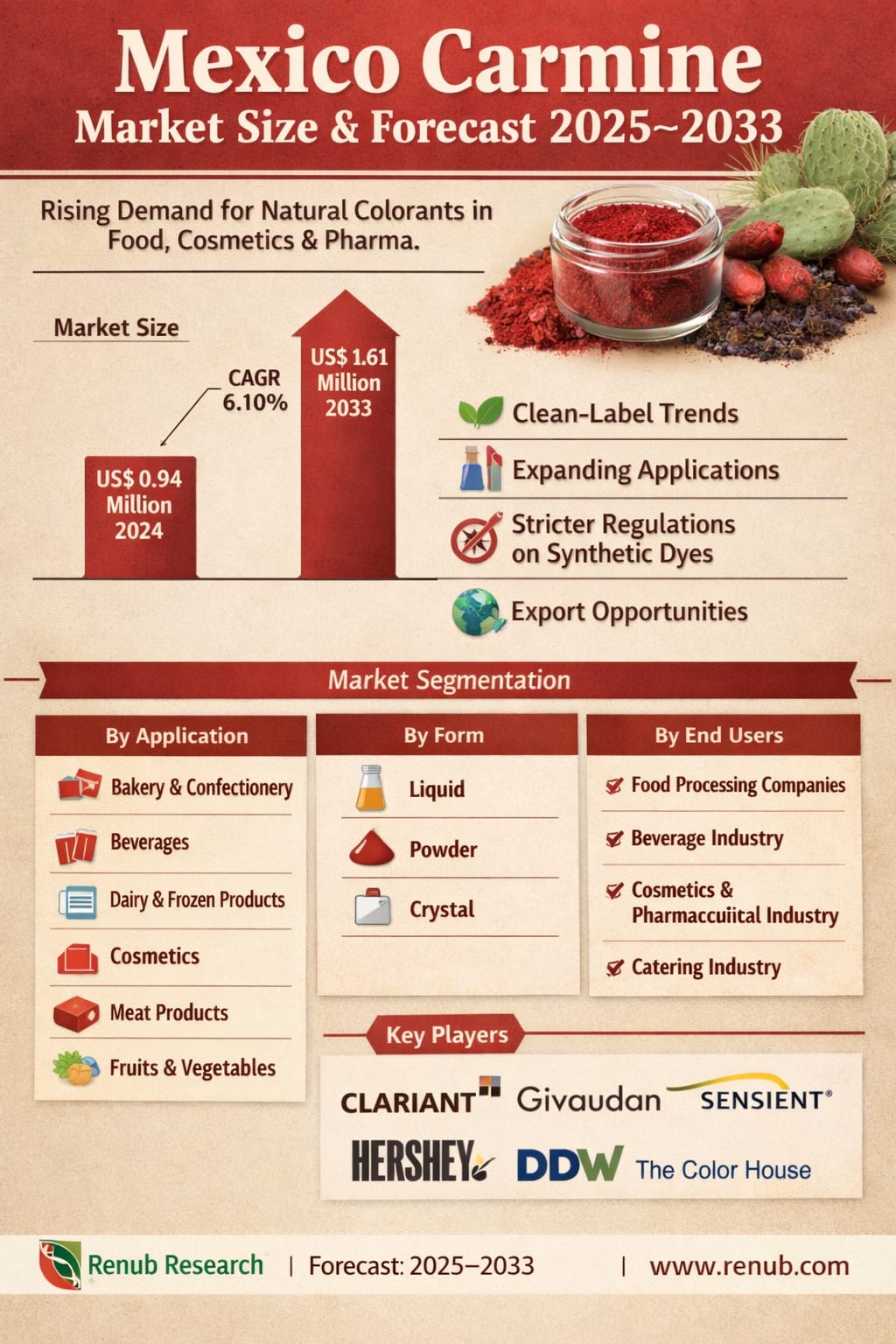
The Mexico Carmine Market is entering a period of steady and strategically important growth, supported by the global shift toward natural, sustainable, and clean-label ingredients. According to industry estimates, the Mexico Carmine Market is expected to reach US$ 1.61 million by 2033, up from US$ 0.94 million in 2024, growing at a CAGR of 6.10% from 2025 to 2033.
This growth trajectory reflects a broader transformation underway in the food, cosmetics, and pharmaceutical industries, where manufacturers are actively replacing synthetic dyes with naturally derived alternatives. Carmine, a red pigment derived from carminic acid extracted from cochineal insects, has emerged as one of the most reliable and stable natural colorants available in the global market.
Mexico occupies a uniquely important position in this value chain. With its long tradition of cochineal cultivation, favorable climate, and growing government support for sustainable agriculture and natural ingredient industries, the country is well placed to benefit from rising international demand. As consumers become more conscious about what goes into their food, cosmetics, and medicines, the appeal of naturally sourced colorants like carmine continues to strengthen.
At the same time, the market is not without challenges. Labor-intensive production methods, supply-side volatility, and ethical debates around insect-derived ingredients all shape the competitive and strategic landscape. Yet, when viewed in the context of tightening regulations on synthetic dyes and the rapid expansion of clean-label products, the long-term outlook for Mexico’s carmine industry remains positive and resilient.
Understanding Carmine and Its Importance
Carmine is a natural red pigment obtained from carminic acid, which is extracted from cochineal insects (Dactylopius coccus). These insects are primarily cultivated on prickly pear cacti, particularly in countries such as Mexico and Peru, where climatic conditions and traditional farming knowledge support efficient production.
The process involves harvesting the insects, drying them, and processing them to extract the pigment. The resulting dye is valued for its intense red color, excellent stability, and resistance to heat and light, making it suitable for a wide range of applications. Historically, carmine has been used in textiles and art, but in modern times its use has expanded significantly into food and beverages, cosmetics, and pharmaceuticals.
You will find carmine in products such as yogurts, candies, beverages, cosmetics like lipsticks and blushes, and even in certain medicines and supplements. Its natural origin gives it a strong advantage in an era where consumers are increasingly skeptical of artificial additives and chemical-sounding ingredients.
However, carmine is not without controversy. Because it is derived from insects, it raises concerns among vegans, vegetarians, and certain religious or allergy-sensitive consumer groups. Despite this, its functional benefits, regulatory acceptance, and strong performance characteristics have ensured that it remains one of the most widely used natural red colorants globally.
Mexico’s Strategic Role in the Global Carmine Supply Chain
Mexico has long been recognized as one of the traditional centers of cochineal cultivation. The combination of favorable climate, established farming practices, and generational expertise gives the country a competitive advantage in producing high-quality carmine.
In recent years, this advantage has become more commercially significant. As global demand for natural pigments rises, Mexico’s producers are increasingly serving not only domestic markets but also export destinations in North America, Europe, and parts of Asia. These regions are witnessing strong growth in clean-label foods, natural cosmetics, and pharmaceutical products, all of which rely on stable and safe natural colorants.
Government initiatives supporting sustainable agriculture, rural development, and natural ingredient industries further strengthen Mexico’s position. By encouraging environmentally responsible farming and value-added processing, these policies help ensure that carmine production remains both economically viable and environmentally sustainable over the long term.
Key Growth Drivers of the Mexico Carmine Market
Rising Demand for Natural and Clean-Label Products
One of the most powerful forces behind the growth of the Mexico carmine market is the global shift toward natural, clean-label, and transparent ingredient lists. Consumers today are more informed and more cautious about what they consume and apply to their bodies. Artificial colors, once widely accepted, are increasingly viewed with suspicion due to concerns about potential health risks and long-term effects.
Carmine, being naturally derived, fits neatly into this evolving consumer mindset. Food and beverage manufacturers, in particular, are under pressure to reformulate products using ingredients that sound familiar, natural, and trustworthy. The same trend is evident in cosmetics and personal care, where “clean beauty” and “green formulations” are no longer niche concepts but mainstream expectations.
Mexico, with its established cochineal farming infrastructure, is well positioned to capitalize on this shift. The country can meet both domestic and international demand, reinforcing its role as a key supplier of natural red pigments.
Expanding Applications Across Multiple Industries
Another major driver is the widening range of applications for carmine. Traditionally associated with food coloring, carmine is now used extensively in cosmetics, pharmaceuticals, and even certain specialty and artisanal products.
In the cosmetics industry, carmine is highly valued for its rich, vibrant red tones and excellent stability, making it a preferred ingredient in lipsticks, blushes, eyeshadows, and other color cosmetics. As consumers increasingly seek natural and ethically sourced beauty products, the demand for carmine-based formulations continues to rise.
In pharmaceuticals, carmine is used to color syrups, tablets, and capsules, improving product identification and patient acceptance. Meanwhile, in the food sector, it enhances the visual appeal of confectionery, dairy products, beverages, and processed foods, where color plays a crucial role in consumer perception and purchasing decisions.
This diversification of end-use industries strengthens overall market demand and reduces dependence on any single sector, making the Mexico carmine market more resilient to cyclical fluctuations.
Stricter Regulations on Synthetic Dyes
Regulatory pressure on synthetic colorants is another important catalyst for growth. Around the world, health authorities are re-evaluating the safety of artificial dyes, especially in food and products consumed by children. Concerns over links to hyperactivity, allergies, and other health issues have prompted tighter regulations and, in some cases, outright bans on certain synthetic colors.
In the United States, for example, regulatory agencies have increased scrutiny of artificial dyes such as Red 3 and Yellow 5, pushing manufacturers to explore natural alternatives. The European Union has also imposed strict safety standards on food additives, encouraging a gradual shift away from synthetic pigments.
These regulatory trends create a favorable environment for natural colorants like carmine. As one of the most stable and widely approved natural red pigments, carmine stands to benefit directly from this policy-driven transition, and Mexico, as a major producer, is well positioned to capture this rising demand.
Challenges Facing the Mexico Carmine Market
Labor-Intensive Production Process
Despite its advantages, the carmine industry faces significant structural challenges. One of the most notable is the labor-intensive nature of production. Cochineal cultivation, harvesting, and processing require careful, manual work at almost every stage of the value chain.
From tending cactus plants to collecting and drying the insects and extracting carminic acid, much of the process relies on skilled human labor rather than mechanized systems. This increases production costs and limits scalability, especially when compared to synthetic dyes or some plant-based alternatives that can be produced more efficiently on an industrial scale.
As global demand increases, this reliance on manual processes could constrain supply growth and put upward pressure on prices, potentially affecting competitiveness in price-sensitive markets.
Price Volatility and Supply Risks
Price volatility is another important challenge. Carmine prices are influenced by weather conditions, pest outbreaks, and fluctuations in cochineal insect populations. Since production is closely tied to agricultural cycles, any disruption—such as drought, disease, or climate-related stress—can quickly reduce supply and push prices higher.
In addition, rising labor costs in rural farming areas can further increase production expenses. For manufacturers and end users, this volatility makes budgeting and long-term planning more difficult and may encourage some to explore alternative colorants, even if they prefer natural options.
Managing these risks will require continued investment in better farming practices, supply chain resilience, and possibly technological innovations that can improve yields and efficiency without compromising quality.
Market Segmentation Overview
By Application
Bakery & Confectionery
Beverages
Dairy & Frozen Products
Meat Products
Fruits & Vegetables
Oil & Fat
Cosmetics
Other Food Products
Among these, food and beverages remain the largest application segments, driven by strong demand for natural colorants in confectionery, dairy, and drinks. Cosmetics represent a fast-growing segment due to the clean beauty movement and rising consumer interest in natural makeup products.
By Form
Liquid
Powder
Crystal
Each form serves different industrial needs. Liquid forms are widely used in beverages and dairy applications for ease of mixing, while powder and crystal forms are preferred in cosmetics, pharmaceuticals, and dry food formulations where stability and shelf life are critical.
By End Users
Food Processing Companies
Beverage Industry
Catering Industry
Cosmetics and Pharmaceutical Industry
Food processing and beverages dominate consumption, but the cosmetics and pharmaceutical industry segment is gaining importance as premium and natural formulations become more mainstream.
Competitive Landscape and Key Players
The Mexico carmine market features a mix of global ingredient suppliers and specialized colorant companies. These players compete on product quality, supply reliability, regulatory compliance, and application expertise.
Key companies covered in the market include:
Clariant AG
Naturex (Givaudan)
Sensient Technologies Corporation
The Hershey Company
Biocon
Amerilure
DDW Color House
All companies are analyzed from four key perspectives:
Company Overview
Key Persons
Recent Developments & Strategies
Sales Analysis
Competition in this space is increasingly shaped by the ability to offer customized solutions, traceable supply chains, and strong regulatory support, especially as customers demand greater transparency and sustainability in ingredient sourcing.
Future Outlook: A Market Built on Sustainability and Trust
Looking ahead, the Mexico carmine market is well positioned to benefit from long-term structural trends favoring natural, sustainable, and transparent ingredients. The forecast growth from US$ 0.94 million in 2024 to US$ 1.61 million by 2033 at a CAGR of 6.10% reflects not just rising volumes, but also the increasing strategic importance of natural colorants in global supply chains.
While challenges such as labor intensity and price volatility remain, they are unlikely to outweigh the powerful demand drivers coming from regulatory changes, consumer preferences, and industry reformulation efforts. Mexico’s historical expertise in cochineal cultivation, combined with growing export opportunities and supportive policy frameworks, provides a solid foundation for continued growth.
Final Thoughts
The Mexico carmine market stands at the intersection of tradition and modern consumer demand. Rooted in centuries-old agricultural practices yet driven by today’s clean-label and sustainability movements, carmine represents more than just a colorant—it symbolizes the broader shift toward natural, trustworthy, and responsible ingredients.
As food, cosmetics, and pharmaceutical companies continue to reformulate products and respond to stricter regulations and evolving consumer expectations, carmine’s role is set to become even more prominent. For Mexico, this creates not only economic opportunity but also a chance to reinforce its position as a global leader in natural ingredient supply.
With steady growth projected through 2033, the Mexico carmine market is poised to remain a small but strategically significant segment of the global natural colorants industry—one where quality, sustainability, and heritage combine to create lasting value.
About the Creator
Nike Stock Outlook: Investment Perspective and Growth Potential in 2026
Introduction Nike, Inc. is one of the world’s leading sportswear and athletic footwear companies, renowned for its innovation, global brand presence, and strong consumer loyalty. Nike’s stock has historically been a favorite among investors seeking exposure to the growing athletic apparel and footwear market.
By Hammad Nawazabout 20 hours ago in Trader
Twilio Stock Analysis: Is Twilio Positioned for Long-Term Growth in Cloud Communications?
Introduction Twilio stock is a prominent name in cloud communications and software development solutions. Twilio provides developers and businesses with APIs for messaging, voice, video, and customer engagement applications. As enterprises increasingly rely on digital communication and automation, Twilio stock has attracted investor attention. The key question is whether Twilio can sustain growth, expand its customer base, and maintain profitability in a highly competitive cloud communications market.
By Hammad Nawaz2 days ago in Trader
Part 2 Interview With Joe Patterson, Author Of Melanin Memoirs
This is my second interview with Joe Patterson. His 4th anniversary writing on Vocal will be in March 2026. He has one achievement on Vocal, The Other Foot. He has over 17,000 reads on Vocal since he started on Vocal in 2022. Joe Patterson is very creative poet and rapper. Joe is deep thinker and I feel it is reflected in his latest published book, Melanin Memoirs.
By Mariann Carroll7 days ago in Interview




Comments
There are no comments for this story
Be the first to respond and start the conversation.