
Europe Online Food Delivery Market Size and Forecast 2025
How Convenience, Technology, and Changing Lifestyles Are Reshaping Europe’s Dining Culture

Introduction: A New Era of Eating in Europe
The way Europeans eat has changed dramatically over the last decade. What was once a simple choice between dining out or cooking at home has evolved into a third, powerful option: ordering food online. With just a few taps on a smartphone or clicks on a website, consumers can now access thousands of restaurants, cloud kitchens, and grocery partners, all ready to deliver meals straight to their doors.
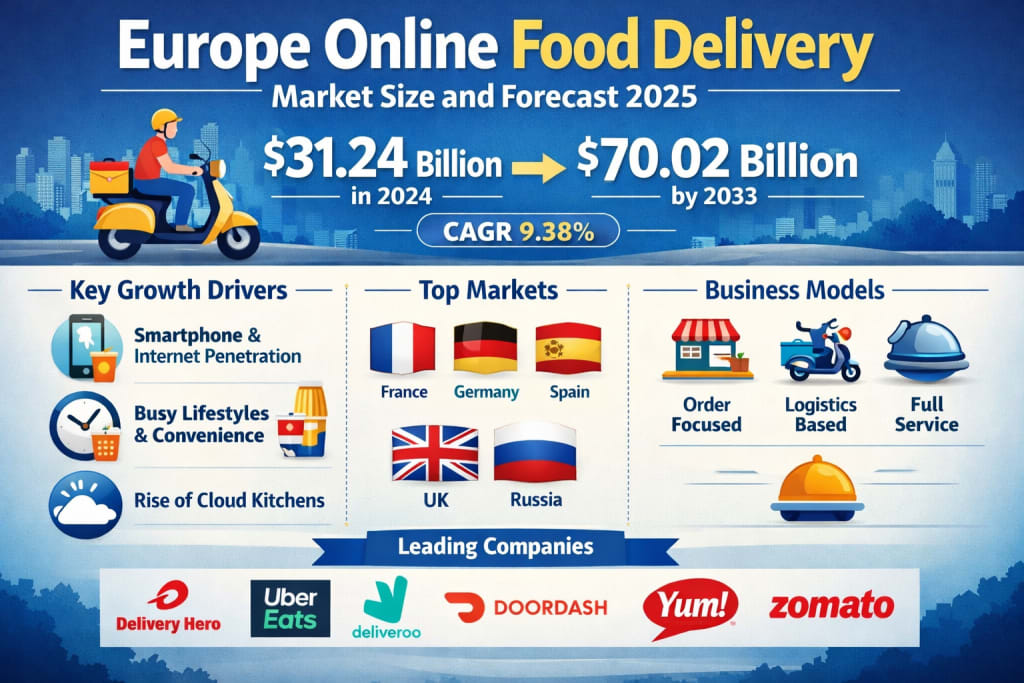
According to Renub Research, the Europe Online Food Delivery Market was worth USD 31.24 billion in 2024 and is projected to reach USD 70.02 billion by 2033, expanding at a compound annual growth rate (CAGR) of 9.38% from 2025 to 2033. This strong growth trajectory reflects not just changing consumer habits, but also the rapid evolution of digital platforms, logistics networks, and food service business models across the continent.
The expansion of third-party delivery platforms, the rise of restaurant-owned ordering systems, and the fast-growing cloud kitchen ecosystem have all played a crucial role in reshaping Europe’s food industry. Today, online food delivery is no longer a convenience reserved for big cities—it is becoming a standard part of everyday life for millions of Europeans.
Market Overview: What Is Online Food Delivery?
Online food delivery refers to the process of ordering meals, groceries, or beverages from restaurants, cloud kitchens, or supermarkets using mobile applications or websites. Customers can browse menus, customize their orders, make digital payments, and track deliveries in real time—all from a single platform.
In Europe, the popularity of online food delivery has surged due to increasing smartphone penetration, improved internet connectivity, and the widespread adoption of app-based services such as Uber Eats, Deliveroo, Just Eat, and Glovo. The COVID-19 pandemic acted as a major accelerator, pushing both consumers and restaurants toward contactless ordering and home delivery solutions.
Beyond convenience, online food delivery offers variety and flexibility. Consumers can choose from local favorites, international cuisines, health-focused meals, and specialty diets such as vegan or gluten-free options. For businesses, these platforms open access to a much broader customer base and create new revenue streams without the need for physical expansion.
With innovations like AI-powered recommendations, dynamic pricing, and real-time delivery tracking, the European online food delivery market continues to evolve, transforming not only how people eat, but also how food businesses operate.
Key Growth Drivers in the Europe Online Food Delivery Market
1. Rising Smartphone and Internet Penetration
One of the strongest drivers of market growth is the widespread availability of smartphones and high-speed internet across Europe. Consumers can now access food delivery platforms effortlessly through user-friendly mobile apps, making the ordering process faster and more intuitive than ever before.
In 2024, 94% of EU households were connected to the internet, with countries such as the Netherlands and Luxembourg reaching 99% penetration, followed by Finland and Denmark at 97%. Even countries that once lagged behind, such as Bulgaria and Romania, have now crossed the 90% mark. This digital inclusion has significantly expanded the potential customer base for online food delivery services, including in semi-urban and rural areas.
Better connectivity also enables features like real-time order tracking, seamless digital payments, and personalized recommendations, all of which enhance user experience and encourage repeat usage.
2. Changing Lifestyles and Consumer Preferences
Modern European lifestyles are faster and more demanding than ever. Longer working hours, busy schedules, and the rise of dual-income households have reduced the time available for home cooking. As a result, consumers—especially young professionals and students—are increasingly turning to online food delivery for quick and convenient meal solutions.
At the same time, consumer preferences are becoming more diverse and health-conscious. Many platforms now offer a wide range of options, including organic meals, vegan dishes, high-protein diets, and gluten-free alternatives. This growing variety has helped online food delivery move beyond fast food and into the realm of everyday, lifestyle-oriented dining.
3. Expansion of Cloud Kitchens and Restaurant Partnerships
The rise of cloud kitchens—also known as ghost kitchens or dark kitchens—has been another major catalyst for market growth. These kitchens operate without dine-in facilities and focus exclusively on fulfilling online orders, allowing them to reduce overhead costs and optimize operations for delivery efficiency.
Partnerships between restaurants and delivery platforms such as Uber Eats, Deliveroo, and Just Eat have also expanded rapidly. These collaborations help restaurants reach a wider audience without investing heavily in their own delivery infrastructure.
In April 2022, Growth Kitchen raised GBP 3 million in seed funding from PactVC to scale its delivery kitchen model across Europe. The company aims to help restaurants grow using technology and data science while retaining ownership, highlighting how innovation is reshaping the food delivery ecosystem.
Challenges Facing the Europe Online Food Delivery Market
1. Intense Competition and Price Wars
The European online food delivery market is highly competitive, with multiple platforms fighting for market share. To attract and retain customers, companies often rely on discounts, promotional offers, and free delivery campaigns. While these strategies boost order volumes, they also put pressure on profit margins.
For smaller players, surviving in this environment can be particularly challenging. Balancing competitive pricing with sustainable profitability remains one of the biggest hurdles in the industry.
2. Regulatory and Operational Complexities
Strict food safety regulations, labor laws, and environmental standards across different European countries add layers of complexity to operations. Each market has its own compliance requirements, making cross-border expansion more challenging.
Logistical issues such as ensuring timely deliveries, managing driver availability, and maintaining food quality during transit are also critical concerns—especially in densely populated urban areas where traffic and infrastructure constraints can impact delivery times.
Market Segmentation Insights
By Platform Type: Mobile Applications vs. Websites
Mobile Applications
Mobile apps dominate the European online food delivery market due to their convenience and advanced features. With personalized recommendations, GPS tracking, secure payment gateways, and push notifications, apps offer a seamless user experience. Platforms like Uber Eats, Glovo, and Just Eat continue to invest heavily in app development to improve customer engagement and retention.
Websites
Despite the rise of mobile apps, websites still play an important role. Many consumers prefer ordering through desktops or laptops, especially in office environments. Websites also provide a broader view of menus and easier customization options, making them popular for both individual and corporate orders.
By Business Model
Order-Focused Food Delivery System
In this model, platforms primarily handle online ordering, while restaurants manage their own delivery logistics. Many independent and local restaurants prefer this approach to avoid high commission fees charged by third-party delivery services. It allows businesses to maintain greater control over service quality and customer relationships.
Logistics-Based Food Delivery System
Here, platforms manage both ordering and delivery. Companies like Deliveroo and Uber Eats operate large fleets of delivery partners, offering end-to-end service. This model is highly convenient for customers and allows restaurants to focus solely on food preparation.
Full-Service Food Delivery System
This model combines ordering, delivery, and sometimes even kitchen infrastructure, offering a comprehensive solution for restaurants and food brands looking to scale quickly.
By Payment Method
Online Payment
Digital payments, including credit/debit cards, digital wallets, and buy-now-pay-later options, dominate the market. Secure and fast payment systems improve customer trust and encourage repeat purchases. Loyalty programs and app-based rewards further strengthen customer engagement.
Cash on Delivery
While declining in popularity, cash on delivery is still used in certain regions and by specific customer segments, particularly where digital payment adoption is slower.
Country-Level Market Insights
France
France has one of the most mature online food delivery markets in Europe, driven by high urbanization and widespread smartphone usage. Cities like Paris, Lyon, and Marseille are major hubs for platforms such as Uber Eats and Deliveroo. The market offers everything from traditional French cuisine to gourmet and organic meals, reflecting both culinary heritage and modern lifestyle trends.
Germany
Germany’s online food delivery market is growing steadily, supported by strong demand in urban areas. Platforms like Lieferando have gained popularity by offering diverse dietary options, including vegetarian and sustainable meals. In December 2022, Oda, a major European online grocery delivery player, raised 1.5 billion Norwegian crowns in a successful equity funding round, underlining strong investor confidence in the sector.
Spain
Spain has witnessed rapid growth in online food delivery due to increased digital adoption and a strong tourism sector. In February 2024, Pro a Pro Spain, part of the METRO group, announced plans to expand significantly by 2030, investing in multi-temperature warehouses and strengthening its logistics network. This move supports METRO’s broader strategy to grow its food service distribution business across the country.
United Kingdom
The UK is one of the most advanced online food delivery markets in Europe. Platforms like Just Eat, Deliveroo, and Uber Eats offer extensive restaurant choices and fast delivery options. In March 2023, Sainsbury’s partnered with Just Eat to provide rapid grocery delivery from 175 locations, highlighting the growing trend of collaborations between retailers and delivery platforms.
Russia
Russia’s online food delivery market has expanded rapidly, especially in major cities such as Moscow and St. Petersburg. In 2024, the country had 130.4 million internet users, with an internet penetration rate of 90.4%. This strong digital foundation has enabled platforms to reach more consumers and increase order frequency significantly.
Netherlands
The Netherlands has a strong and competitive market, led by platforms like Thuisbezorgd.nl. Sustainability is a key focus, with many companies adopting eco-friendly delivery practices. In November 2022, DPD Netherlands acquired Cool Runnings Transport BV, strengthening its position in both food and healthcare delivery and reflecting the ongoing evolution of the logistics landscape.
Competitive Landscape
Major companies operating in the European online food delivery market include:
Delivery Hero SE
Grab Holdings Inc.
Uber Technologies Inc.
Roofoods Ltd (Deliveroo)
Yum! Brands Inc.
DoorDash Inc.
Zomato Ltd.
These companies are analyzed based on their overviews, key personnel, recent developments, product portfolios, and revenue performance, highlighting a highly dynamic and innovation-driven competitive environment.
Final Thoughts: The Future of Food Delivery in Europe
The Europe online food delivery market is on a strong growth path, driven by digital transformation, changing consumer lifestyles, and continuous innovation in logistics and platform technologies. With the market expected to grow from USD 31.24 billion in 2024 to USD 70.02 billion by 2033, the sector represents one of the most dynamic segments of Europe’s digital economy.
While challenges such as intense competition and regulatory complexities remain, the long-term outlook is positive. As platforms continue to improve efficiency, expand partnerships, and enhance customer experience, online food delivery is set to become an even more integral part of everyday life in Europe.
In the coming years, the winners in this market will be those who can balance convenience, quality, sustainability, and profitability—while staying closely aligned with the evolving expectations of Europe’s digitally connected consumers.
About the Creator
Stanislav Kondrashov on How AI IPOs Will Reshape the Technology Sector in 2026
Three artificial intelligence companies—OpenAI, Anthropic (Claude), and xAI (Grok)—are preparing to go public in what could mark a turning point in the global technology sector. According to TELF AG founder Stanislav Kondrashov, these upcoming IPOs reflect more than a financial move—they highlight a significant shift in how technology is developed, organised, and scaled.
By Stanislav Kondrashov7 days ago in Trader




Comments
There are no comments for this story
Be the first to respond and start the conversation.