
Lessons from Warren Buffett’s 1957 Partnership Letter
A Rare Glimpse into His Early Investment Thinking


“I still consider the general market to be priced on the high side based on long-term investment value.”
— Warren Buffett, 1957
In his Second Annual Letter to Limited Partners, a 27-year-old Warren Buffett offered a surprisingly candid analysis of the market, his investing strategy, and his early results. While many today study the Oracle of Omaha through the lens of hindsight and success, Buffett’s 1957 letter reveals something even more valuable: how he thought before becoming a legend.
This essay breaks down key sections of that letter and provides timeless lessons for investors, businesspeople, and lifelong learners.
🧠 Buffett vs. the Market: Forecasting Gone Wrong?
Buffett opened the 1957 letter with this sober view:
“My view of the general market level is that it is priced above intrinsic value... I think the probability is very slight that current market levels will be thought of as cheap five years from now.”
He was wrong.
The Dow Jones Industrial Average, which stood around 435 at the end of 1957, climbed to nearly 600 by 1962 — an increase of close to 40%, despite a recession and brief bear markets in between. The S&P 500 didn't fall below 1957 levels again until 1974.
What Buffett Predicted:
• The market, especially blue-chip stocks, was overvalued.
• A decline in prices was possible.
• He saw little chance that 1957 levels would look cheap five years later.
• Yet, he expected his “work-out” investments to be resilient even in a downturn.
What Actually Happened:
• 1957 saw a recession and a ~13% market drop.
• But from 1958 to 1961, the market rebounded strongly.
• By 1962, despite a short-term dip, market levels were still well above 1957.
📉 In hindsight, Buffett’s market call was too cautious. But his discipline, humility, and focus on value still led to outperformance.
💡 Investing Lesson: Even Buffett Got the Market Wrong — And Still Won
This is one of the earliest examples of Buffett admitting that he doesn’t try to time the market. His takeaway?
“Primary attention is given at all times to the detection of substantially undervalued securities.”
Even back in 1957, Buffett was a bottom-up investor, not a market forecaster. He looked for mispriced businesses, not macroeconomic signals. He later sharpened this belief into a famous quote:
“The only value of stock forecasters is to make fortune tellers look good.”
The market’s rise didn’t invalidate his process — it reinforced it. He focused on what he could control: finding great businesses at fair prices.
🧩 Portfolio Allocation: Value First, Macro Second
Buffett did consider the general market environment when deciding how to allocate capital. But he made it clear:
“All of the above is not intended to imply that market analysis is foremost in my mind.”
His Strategy:
• If the market was cheap, he would invest in general stocks — even use leverage.
• If the market was expensive, he would shift toward “work-outs” — special situations like mergers, liquidations, and arbitrage.
• Regardless of the market, he always prioritized finding individual undervalued securities.
Key Insight:
He wasn’t against investing in the broader market — he was against overpaying. When the market wasn’t offering value, he went looking elsewhere.
📉 Was 1957 Really That Bad?
While the media portrayed 1957 as a painful bear market, Buffett thought otherwise:
“I stress the word ‘moderate’... the decline in stock prices has been considerably less than the decline in corporate earning power.”
He argued that although prices dropped ~12.8%, earnings dropped even more. That meant valuations didn’t improve — if anything, they got worse. The public, he said, was still too optimistic.
This kind of analysis — price vs. earnings power — became one of Buffett’s signature techniques.
🧪 Work-Outs, Concentration, and Control
Buffett explained a core part of his strategy: work-outs.
These were investments where profit came from a specific corporate event, not general market movement. They included:
• Mergers and acquisitions
• Liquidations
• Special tenders
At the start of 1957, Buffett's portfolio was 70% general stocks and 30% work-outs. By year-end, the ratio shifted to 85% general issues and 15% work-outs — because the downturn created more undervalued opportunities.
He also disclosed something remarkable:
“We have taken positions in two situations... we may expect to take some part in corporate decisions.”
In one case, the position represented 10–20% of the portfolio. In another, about 5%.
Translation?
Buffett was influencing companies — or at least preparing to. These early signs of control investing would later define his Berkshire Hathaway strategy.
He wasn’t just buying stocks. He was quietly becoming a capital allocator in the mold of Ben Graham, but with more boldness and concentration.
📊 1957 Results: Outperforming in a Down Year
While the Dow declined nearly 8.5% (including dividends), Buffett’s three partnerships posted returns of +6.2%, +7.8%, and +25%.
Why the huge spread?
“This performance emphasizes the importance of luck in the short run... the third partnership was started the latest... when several securities were particularly attractive.”
Key Takeaways:
• Buffett was transparent about why one fund performed better — it had better timing and more capital available at a market low.
• He didn’t claim superior skill. He credited timing luck.
• He assured partners that the strategy across funds was the same.
This honesty is one reason Buffett earned such deep trust from his partners — and later, Berkshire Hathaway shareholders.
🏁 The Long Game: Patience Over Performance
“I will be quite satisfied with a performance that is 10% per year better than the Averages.”
This was Buffett’s target. He didn’t promise the moon. He wasn’t chasing short-term results. He was aiming to beat the market by a meaningful, sustainable margin over time.
Even more telling was this comment:
“I can definitely say that our portfolio represents better value at the end of 1957 than it did at the end of 1956.”
Despite the market being down, he believed the portfolio had improved.
Why?
• Lower prices meant better entry points.
• He had more time to accumulate undervalued securities.
• He was slowly building a concentrated position in a high-conviction idea (which he hoped would eventually be 20% of the portfolio).
“Obviously during any acquisition period, our primary interest is to have the stock do nothing or decline rather than advance.”
Only a true value investor says that.
🧠 Final Lessons for Today’s Investor
Warren Buffett’s 1957 letter is a masterclass in how to think — not just how to invest. It offers lessons that still apply in 2025:
1. Even Buffett couldn’t forecast the market accurately — and that’s okay.
2. Disciplined stock selection outperforms prediction.
3. Market sentiment often distorts reality — look at earnings, not headlines.
4. Timing and luck affect short-term returns.
5. Humility builds trust — admit when luck plays a role.
6. Concentrated, patient investing wins over time.
About the Creator
Bergmond
I write Buffett-style investing stories — not about chasing trends, but seeing real value.
Long-term company analysis, timeless insights, and the slow path to wealth.
Keep reading
More stories from writers in Trader and other communities.
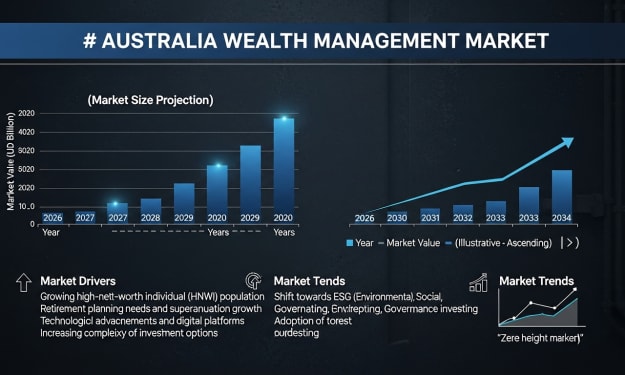
Australia Wealth Management Market Set for Strong Expansion as Digital Platforms and HNWI Demand Surge
The Australia wealth management market is experiencing robust growth as affluent individuals, corporates, and savers increasingly seek expert financial planning, personalized investment strategies, and digital advisory solutions. According to IMARC Group, the market was valued at USD 110.3 Million in 2024 and is expected to reach USD 213.2 Million by 2033, registering a compound annual growth rate (CAGR) of 7.60% between 2025 and 2033.
By Rashi Sharma5 days ago in Trader



Comments
There are no comments for this story
Be the first to respond and start the conversation.