
Japan Cataract Surgery Devices Market Size and Forecast 2025–2033
Aging Demographics, Surgical Innovation, and Premium Eye Care Technologies Propel Japan’s Vision Care Industry Forward

Japan Cataract Surgery Devices Market Overview
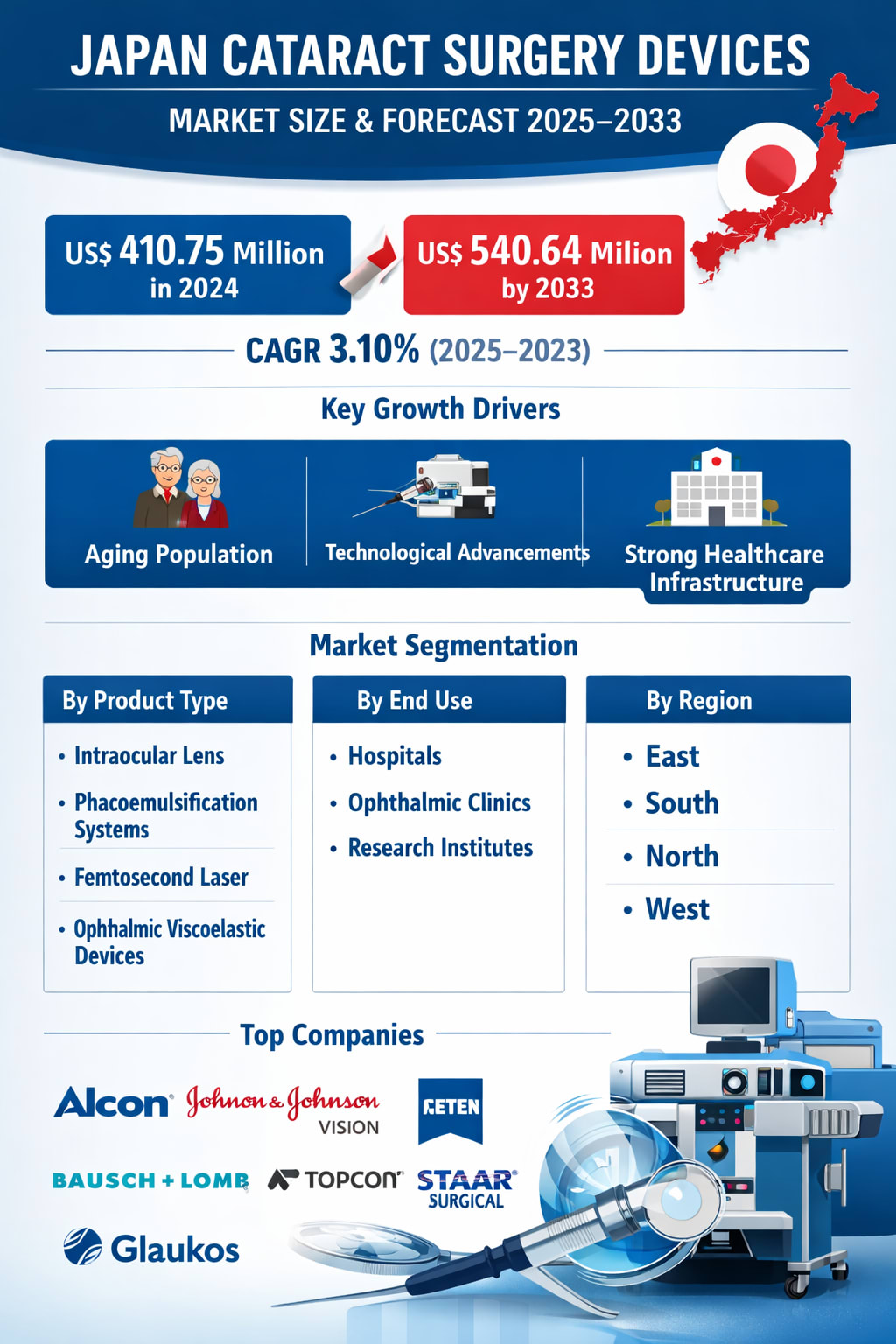
The Japan Cataract Surgery Devices Market is projected to reach US$ 540.64 million by 2033, up from US$ 410.75 million in 2024, growing at a CAGR of 3.10% from 2025 to 2033. This steady expansion is being driven by Japan’s rapidly aging population, rising prevalence of cataracts, continuous technological advancements in surgical equipment, increasing healthcare expenditure, and a growing preference for minimally invasive and precision-based eye surgeries.
Cataract surgery is one of the most commonly performed ophthalmic procedures worldwide, and Japan is no exception. The procedure involves removing the clouded natural lens of the eye and replacing it with an artificial intraocular lens (IOL) to restore clear vision. To perform this safely and efficiently, surgeons rely on a range of specialized devices, including phacoemulsification systems, femtosecond lasers, ophthalmic viscoelastic devices (OVDs), and various microsurgical instruments and consumables.
Over the past decade, cataract surgery has evolved from a standard procedure into a highly sophisticated, technology-driven intervention. Innovations such as femtosecond laser-assisted cataract surgery (FLACS), premium IOLs (including multifocal and extended depth-of-focus lenses), and advanced imaging and guidance systems have significantly improved surgical precision, reduced complication rates, and shortened patient recovery times. These advancements are particularly important in Japan, where expectations for healthcare quality and outcomes are exceptionally high.
With one of the most developed healthcare systems in the world, Japan has become an early adopter of cutting-edge ophthalmic technologies. Strong government support for senior healthcare, a well-trained medical workforce, and high public awareness of eye health are further strengthening the foundation for sustained growth in the cataract surgery devices market.
Japan Cataract Surgery Devices Industry Overview
Cataract surgery devices refer to the specialized medical tools and systems used to diagnose, plan, and perform cataract removal and lens implantation procedures. The core technologies include phacoemulsification machines, which use ultrasonic energy to break up and remove the clouded lens; femtosecond lasers, which enable bladeless, highly precise incisions; ophthalmic viscoelastic devices (OVDs), which protect delicate eye structures during surgery; and a wide range of intraocular lenses (IOLs) designed to correct vision after surgery.
In Japan, cataract surgery is not only a medical necessity but also increasingly a quality-of-life procedure. Many patients now opt for premium IOLs that can reduce dependence on glasses and improve overall visual performance. This shift from basic, functional treatment to outcome-focused, lifestyle-enhancing care is reshaping the demand pattern in the market.
The Japanese healthcare system’s emphasis on safety, precision, and long-term outcomes has encouraged hospitals and ophthalmic clinics to invest in advanced surgical platforms. As a result, the market is seeing a gradual but consistent transition from conventional techniques to more technologically advanced solutions. This trend is expected to continue throughout the forecast period, supported by demographic pressures and ongoing innovation in ophthalmic device manufacturing.
Growth Drivers for the Japan Cataract Surgery Devices Market
1. Aging Population
One of the most powerful growth drivers for Japan’s cataract surgery devices market is the country’s rapidly aging population. Japan is already one of the oldest societies in the world, and the proportion of elderly citizens continues to rise. In 2023, more than 10% of Japan’s population was aged 80 or above, and approximately one in three citizens was over the age of 65.
Cataracts are strongly age-related, with prevalence increasing significantly among older adults. As life expectancy rises and more people live well into their 80s and 90s, the number of individuals requiring cataract surgery is steadily growing. This demographic shift directly translates into higher demand for surgical procedures and, consequently, for advanced cataract surgery devices such as phacoemulsification systems, femtosecond lasers, and premium intraocular lenses.
Beyond sheer volume, the expectations of elderly patients are also changing. Today’s seniors are more active, more health-conscious, and more demanding when it comes to visual outcomes. They are increasingly willing to consider advanced surgical options and premium lenses that can improve both distance and near vision, further supporting market growth.
2. Technological Advancements
Technological innovation is another major force driving the expansion of the Japan cataract surgery devices market. Over the past few years, the introduction and refinement of femtosecond laser-assisted cataract surgery (FLACS) have transformed surgical workflows by enabling highly precise, reproducible, and minimally invasive procedures.
At the same time, advancements in intraocular lens technology have given surgeons and patients more choices than ever before. Multifocal, toric, and extended depth-of-focus (EDOF) lenses allow for personalized vision correction tailored to individual lifestyles and visual needs. This customization trend is particularly strong in Japan, where patients often seek premium healthcare solutions.
In addition, the integration of digital imaging, artificial intelligence, and surgical planning software is improving preoperative assessment and intraoperative guidance. These tools enhance accuracy, reduce variability in outcomes, and support better long-term results. As Japanese healthcare providers continue to prioritize precision and safety, the adoption of these advanced technologies is expected to rise steadily.
3. Strong Healthcare Infrastructure
Japan’s well-developed healthcare infrastructure plays a crucial role in supporting the growth of the cataract surgery devices market. The country is home to a large number of well-equipped hospitals and specialized ophthalmic clinics, many of which are early adopters of advanced surgical technologies.
Highly trained ophthalmic surgeons, strong clinical standards, and a culture of continuous medical education ensure that new devices and techniques are quickly integrated into practice once they are approved. Moreover, Japan’s regulatory framework, overseen by the Pharmaceuticals and Medical Devices Agency (PMDA), emphasizes safety and efficacy, which helps build trust among both physicians and patients.
Government initiatives aimed at improving senior care and maintaining high standards of healthcare quality further reinforce investment in advanced medical devices. Together, these factors create a supportive environment for sustained, long-term growth in the cataract surgery devices market.
Challenges in the Japan Cataract Surgery Devices Market
1. High Cost of Advanced Devices
Despite the positive outlook, the high cost of advanced cataract surgery equipment remains a significant challenge. Technologies such as femtosecond lasers, premium IOLs, and next-generation phacoemulsification systems require substantial capital investment. This can be a barrier for smaller hospitals and clinics, particularly those located outside major urban centers.
In addition, not all advanced options are fully covered by Japan’s national health insurance system. Patients who opt for premium IOLs or laser-assisted procedures often have to pay out of pocket, which can limit adoption among cost-sensitive groups. This creates a two-tier market, where access to the most advanced technologies is unevenly distributed.
2. Regulatory Hurdles
Japan’s regulatory environment, while essential for ensuring patient safety, can also slow the pace of innovation. The approval process for new medical devices is rigorous and time-consuming, involving extensive clinical data, documentation, and compliance requirements set by the PMDA.
For manufacturers, especially international companies, navigating these regulatory pathways can be complex and costly. Delays in approval can postpone market entry for new technologies, reducing competitive pressure and slowing the overall rate of technological diffusion in the market.
Japan Cataract Surgery Devices Market Segmentation
By Product Type
Intraocular Lens (IOL)
Phacoemulsification Systems
Femtosecond Laser
Ophthalmic Viscoelastic Devices and Other Consumables
By End Use
Hospitals
Ophthalmic Clinics
Research Institutes
By Region
East
South
North
West
Competitive Landscape and Key Players
The Japan cataract surgery devices market is characterized by the presence of both global and domestic players competing on technology, product quality, and clinical outcomes. Companies are focusing on innovation, strategic partnerships, and portfolio expansion to strengthen their market positions.
All companies are analyzed from four perspectives:
Company Overview
Key Persons
Recent Developments & Strategies
Sales Analysis
Key Players Include:
Alcon, Inc.
Johnson & Johnson
Carl Zeiss Meditec AG
Bausch & Lomb, Inc.
Topcon Corp
STAAR Surgical Co
Glaukos Corp
Abbott Laboratories
These companies are investing heavily in R&D, next-generation surgical platforms, and advanced IOL technologies to meet the evolving needs of surgeons and patients in Japan’s highly demanding healthcare environment.
Future Outlook
Looking ahead, the Japan cataract surgery devices market is expected to maintain steady growth through 2033. While the overall CAGR of 3.10% reflects a mature market, the underlying dynamics remain strong. The continued aging of the population, rising expectations for visual outcomes, and ongoing technological innovation will keep demand resilient.
At the same time, gradual improvements in affordability, workflow efficiency, and regulatory processes could further support wider adoption of advanced surgical technologies. The shift toward personalized, outcome-driven eye care is likely to remain a defining trend in the years to come.
Final Thoughts
The Japan Cataract Surgery Devices Market stands at the intersection of demographic necessity and technological progress. With market size expected to grow from US$ 410.75 million in 2024 to US$ 540.64 million by 2033, the industry reflects both the challenges and opportunities of delivering high-quality eye care in one of the world’s most rapidly aging societies.
While cost pressures and regulatory complexity remain, Japan’s strong healthcare infrastructure, commitment to innovation, and focus on patient outcomes ensure that cataract surgery devices will continue to play a vital role in improving vision and quality of life for millions of people. For manufacturers, healthcare providers, and investors alike, this market represents a stable, innovation-driven segment of the broader medical devices industry.
About the Creator
Gold Price Outlook: Third Week of February 2026
Introduction Gold has long been considered a safe-haven asset and a hedge against economic uncertainty. As we approach the third week of February 2026, investors are closely monitoring price trends to determine potential opportunities and risks. Global economic indicators, currency fluctuations, and geopolitical tensions all play a key role in shaping the precious metal’s short-term movements.
By Hammad Nawaza day ago in Trader
Australia Jewellery Market 2026: Shines With Rising Demand for Ethical, Customized & Premium Pieces
Australia Jewellery Market Overview The Australia jewellery market size is undergoing steady expansion as consumer tastes evolve toward personalized designs, premium pieces and ethically sourced materials. According to the latest IMARC Group research, the market was valued at approximately USD 3.3 billion in 2025 and is projected to grow to USD 4.7 billion by 2034, representing a compound annual growth rate (CAGR) of 4.03% between 2026 and 2034.
By Amyra Singh4 days ago in Trader



Comments
There are no comments for this story
Be the first to respond and start the conversation.