
Is the Dollar Losing Power?
How currencies, geopolitics, and silent economic wars are reshaping global power

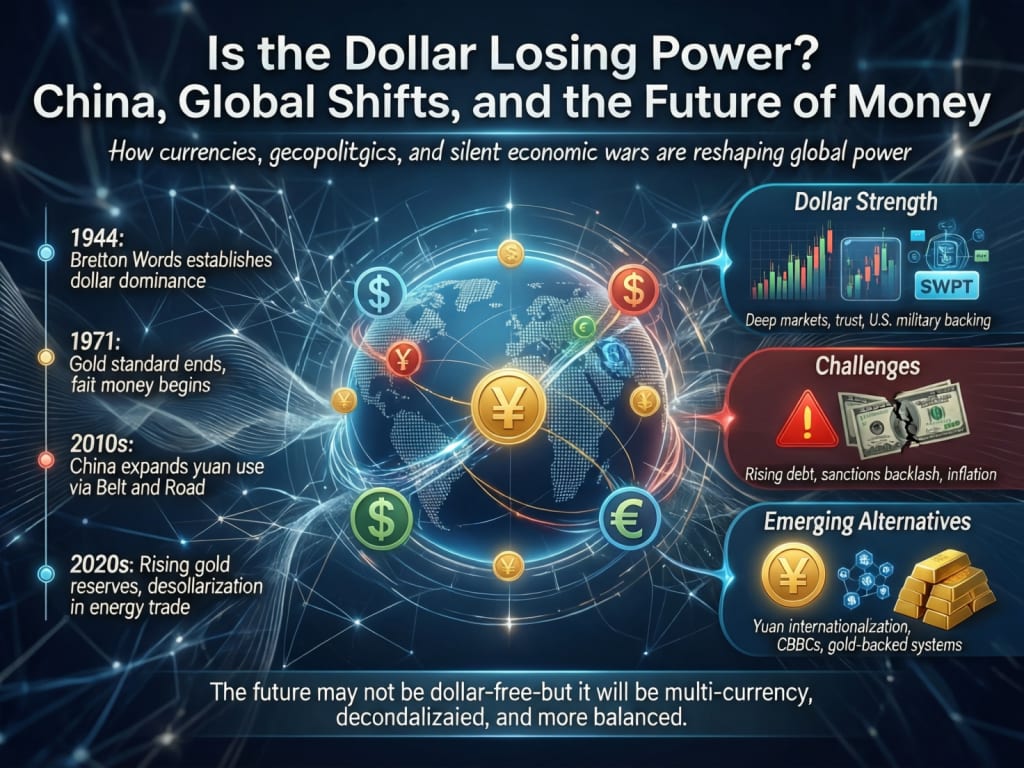
Is the Dollar Losing Power? China, Global Shifts, and the Future of Money
For more than seventy years, the United States dollar has been the most powerful currency in the world. After World War Two, the global financial system was rebuilt around the dollar, giving the United States enormous influence over international trade, banking, and politics. Oil was priced in dollars, global reserves were stored in dollars, and most international transactions passed through American-controlled systems. This made the dollar not just money, but a tool of global power.
However, today this system is facing serious pressure. Countries around the world are beginning to question whether the dollar should continue to dominate global finance. Rising debt in the United States, repeated financial crises, and the increasing use of economic sanctions have caused many nations to look for alternatives. The world is slowly entering a period of economic transition, and the center of financial power may no longer remain in one place.
China is leading this challenge. As the world’s second-largest economy and the largest trading nation, China believes its global role should be reflected in its currency. For years, Beijing has been quietly working to increase the international use of the Chinese yuan. Trade agreements, infrastructure investments, and financial partnerships are now being structured in ways that reduce dependence on the dollar. This is not a sudden move, but a long-term strategy.
One of the biggest weaknesses of modern currencies is that they are no longer backed by physical assets like gold. Since the early 1970s, most global currencies have been “fiat money,” meaning their value depends entirely on trust in governments and institutions. The dollar remains strong largely because of confidence in the U.S. economy, political stability, and military power. But trust can weaken, especially when debt rises and internal divisions grow.
China and several other countries are responding by increasing their gold reserves. Gold is seen as a safe asset that holds value even during political or financial turmoil. At the same time, nations such as Russia and Iran are moving parts of their trade away from the dollar, using local currencies or alternative payment systems. Energy trade, especially oil and gas, plays a key role in this shift. If major energy exporters stop using the dollar, the impact on the global system could be significant.
Sanctions have also changed global behavior. When the United States uses financial sanctions to pressure other countries, it sends a clear message about the power of the dollar system. But it also encourages those countries to build systems that avoid American control. Over time, this reduces the effectiveness of sanctions and weakens the central role of the dollar. What was once a strength is slowly becoming a vulnerability.
At the same time, technology is transforming finance. Digital payments, central bank digital currencies, and blockchain-based systems are changing how money moves across borders. China is already testing a digital version of its currency, designed to operate outside traditional Western financial networks. While these systems are still developing, they represent another challenge to the existing order.
Despite these changes, the dollar is not about to disappear. It remains the most trusted currency in the world, supported by deep financial markets, strong legal institutions, and global demand. Replacing it would require not just economic strength, but political trust, transparency, and stability. No single country currently offers all of these at the same level.
What is more likely is a gradual shift toward a multi-currency world. In this future, the dollar remains important, but it shares influence with other currencies such as the euro, the yuan, and possibly new regional or digital systems. Power becomes more balanced, and no single nation controls global finance alone.
This shift has real consequences for everyday people. Currency changes affect inflation, savings, employment, and the cost of living. When global systems change, uncertainty rises, and markets become unstable. Governments and institutions must manage this transition carefully to avoid economic shocks.
In the end, the struggle over currencies is not just about money. It is about trust, power, and control in a changing world. The question is no longer whether the global financial system will change, but how fast and how safely that change will happen. The coming years may define a new era in global economics, one where power is shared rather than concentrated, and where the rules of money are rewritten for a new century.
About the Creator
Wings of Time
I'm Wings of Time—a storyteller from Swat, Pakistan. I write immersive, researched tales of war, aviation, and history that bring the past roaring back to life
Keep reading
More stories from Wings of Time and writers in Trader and other communities.
Is the Dollar Losing Its Global Power?
Is the Dollar Losing Its Global Power? For many decades, the U.S. dollar has been the most powerful currency in the world. It has been used for global trade, oil sales, international loans, and foreign reserves. Countries trusted the dollar as a safe store of value. But today, many experts are asking an important question: Is the dollar entering its last strong phase?
By Wings of Time 2 days ago in Trader
Gaming Market: The Rise of Digital Entertainment Worldwide
Overview The global gaming market stands as one of the largest and most dynamic entertainment industries worldwide, spanning video games on consoles, PCs, mobile devices, cloud gaming, and esports. Fueled by technological innovation, expanding internet access, and a diverse global audience, revenue continues to rise year after year. In 2025 alone, industry estimates suggest the gaming market could approach near $200 billion in annual revenue, with mobile games accounting for more than half of that total.
By James Smith7 days ago in Trader



Comments
There are no comments for this story
Be the first to respond and start the conversation.