
India Wires and Cables Market Size and Forecast 2025–2033
India’s Power Backbone Gears Up for a High-Voltage Growth Decade

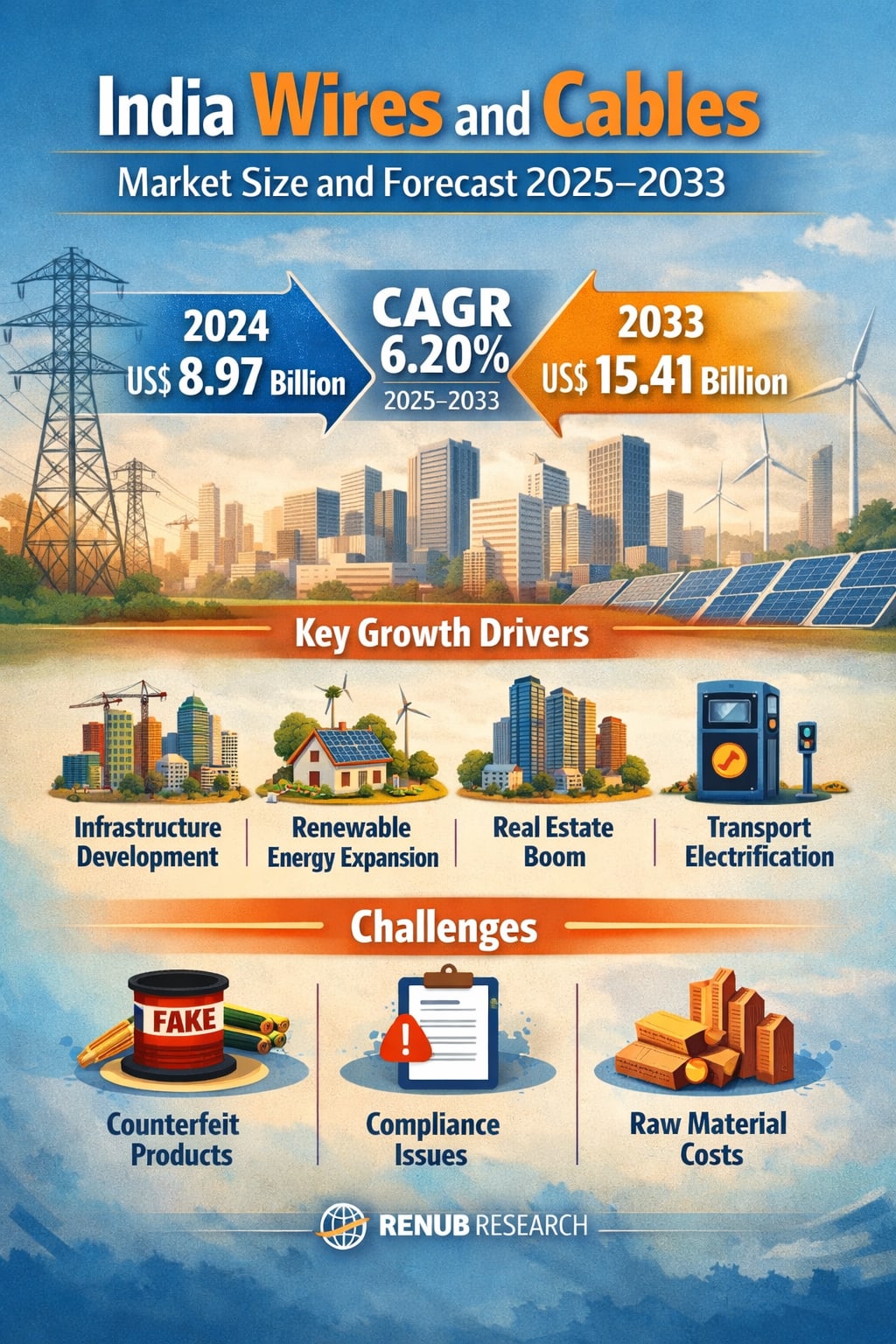
India Wires and Cables Market Overview
The India Wires and Cables Market is emerging as one of the most critical pillars supporting the country’s infrastructure, industrial, and digital transformation. According to Renub Research, the market is expected to reach US$ 15.41 billion by 2033, rising from US$ 8.97 billion in 2024, registering a CAGR of 6.20% from 2025 to 2033. This steady growth reflects India’s massive push toward urbanization, renewable energy integration, industrial expansion, and modernization of power and communication networks.
Wires and cables are no longer just passive components of electrical systems. Today, they form the backbone of power transmission, telecommunications, data networks, transportation systems, and smart infrastructure. From residential buildings and commercial complexes to factories, data centers, metro rail projects, and renewable energy plants, the demand for reliable, efficient, and safe cabling solutions is rising across every corner of the economy.
India’s rapid infrastructure development, supported by government initiatives such as Smart Cities Mission, Housing for All, Bharatmala, and large-scale electrification programs, has significantly boosted the need for advanced wiring and cabling systems. At the same time, the country’s digital push—driven by 5G rollout, fiber optic expansion, and data center investments—has further strengthened demand for high-performance cables.
The market is currently dominated by well-known organized players such as Havells, Polycab, Finolex, KEI, RR Kabel, and V-Guard, while a large unorganized segment continues to serve price-sensitive demand. Although competition is intense and raw material price volatility—especially copper and aluminum—remains a concern, the long-term outlook stays strongly positive due to India’s sustained infrastructure and energy transition agenda.
India’s Infrastructure Push Is Rewiring the Market
India is undergoing a major infrastructure transformation. In January 2024, the government announced plans to increase affordable housing funding by nearly 15% to around USD 12 billion for 2024–2025, reinforcing the scale of construction activity expected across the country. Every new home, metro line, highway tunnel, commercial complex, and industrial park requires extensive wiring and cabling—making this sector a direct beneficiary of public and private investment cycles.
Beyond housing and transport, the renewable energy sector has become a powerful growth engine for the wires and cables market. The Ministry of New and Renewable Energy has allocated USD 1.68 billion under the Production Linked Incentive (PLI) Scheme for high-efficiency solar PV modules. With production capacity projected to reach 7,400 MW by October 2024, 16,800 MW by April 2025, and an additional 15,400 MW by April 2026, the need for advanced power cables capable of handling variable loads and grid integration is rising sharply.
As India modernizes its transmission and distribution networks and integrates more renewable power, high-quality, durable, and efficient cables will play a crucial role in ensuring grid stability, safety, and performance.
Growth Drivers for the India Wires and Cables Market
1. Infrastructure Development
India’s aggressive infrastructure expansion and rapid urbanization remain the strongest growth drivers for the wires and cables market. Mega projects under initiatives such as Smart Cities Mission, Bharatmala, Housing for All, and metro rail expansions are creating massive demand for power, communication, and control cables.
Modern infrastructure projects increasingly prioritize safety, energy efficiency, and sustainability, which is pushing the adoption of fire-retardant, low-smoke, and environmentally friendly cable solutions. As cities expand and semi-urban regions modernize, the need for reliable electrical and data networks continues to surge, ensuring steady demand for advanced wiring and cabling systems.
2. Real Estate and Housing Demand
The growth of India’s real estate sector—across metros as well as tier 2 and tier 3 cities—is another major catalyst. Rising incomes, urban migration, and government housing schemes such as Pradhan Mantri Awas Yojana (PMAY) are fueling construction activity in both residential and commercial segments.
Modern buildings require sophisticated electrical infrastructure for lighting, power distribution, automation, safety systems, and communication networks. High-rise buildings and commercial complexes, in particular, are driving demand for premium, flame-retardant, and energy-efficient cables, strengthening the value segment of the market.
3. Electrification of Transportation
India’s push toward electrified and sustainable transportation is creating new growth avenues for the wires and cables industry. Large-scale investments in metro rail projects, railway electrification, and electric vehicle (EV) infrastructure are significantly increasing demand for specialized cables.
Government initiatives such as FAME (Faster Adoption and Manufacturing of Hybrid and Electric Vehicles) and the National Electric Mobility Mission are accelerating the deployment of EV charging stations and electric mobility solutions. These applications require cables that can safely handle high voltages, temperature variations, and heavy loads, opening up opportunities for high-performance and specialized cable products.
Challenges in the India Wires and Cables Market
1. Counterfeit Products
One of the biggest challenges facing the industry is the widespread presence of counterfeit and substandard cables. These low-cost alternatives often attract price-sensitive buyers but fail to meet safety and performance standards, increasing the risk of electrical fires, system failures, and safety hazards.
Beyond safety concerns, counterfeit products hurt the reputation and profitability of established manufacturers by creating unfair competition. Tackling this issue requires stricter quality enforcement, stronger regulatory oversight, and greater consumer awareness about certified products.
2. Compliance and Standardization Issues
Despite the existence of standards such as BIS and ISI certifications, non-compliant products still find their way into the market, especially in unorganized and rural segments. This weakens consumer trust and undermines companies that invest in quality and compliance.
Strengthening regulatory monitoring, industry audits, and end-user education will be crucial to improving market integrity, ensuring safety, and promoting long-term sustainable growth.
State-Level Market Highlights
Kerala Wires and Cables Market
Kerala’s wires and cables market is growing steadily, driven by infrastructure development, digital connectivity projects, and renewable energy initiatives. Projects such as the 400 kV HVDC station at Madakkathara by the Kerala State Electricity Board are expanding the transmission network and boosting demand for high-specification cables.
The development of Technopark Kollam and the proposed Electronics City in Kochi is further strengthening industrial demand, while the Kerala Fiber Optic Network (K-FON) project is increasing the need for communication cables across the state. Local manufacturers like ALIND KEL also play a role in supporting regional supply and growth.
Maharashtra Wires and Cables Market
Maharashtra stands as one of the most important hubs in India’s wires and cables industry. With a strong industrial base spanning manufacturing, automotive, IT, and infrastructure, cities like Mumbai, Pune, and Nashik serve as major demand centers.
The presence of leading players such as Finolex Cables and Polycab India reinforces the state’s dominance. Ongoing infrastructure investments and industrial expansion continue to support robust demand across residential, commercial, and industrial segments.
Uttar Pradesh Wires and Cables Market
Uttar Pradesh is witnessing rapid growth due to large-scale infrastructure and industrial projects such as the Defence Industrial Corridor and the Ganga Expressway. Government electrification schemes like Saubhagya and DDUGJY are boosting demand for low-voltage cables in rural areas, while industrial clusters in Kanpur, Agra, and Lucknow are driving demand for medium and high-voltage solutions.
With strong government support and rising industrial activity, Uttar Pradesh offers significant long-term opportunities for cable manufacturers and suppliers.
India Wires and Cables Market Segmentation
By Cable Type
Low Voltage Energy
Power Cable
Fiber Optic Cable
Signal and Control Cable
Other Cable Types
By Voltage
Low Voltage
Medium Voltage
High Voltage
Extra High Voltage
By Installation
Overhead
Underground
By End Users
Aerospace & Defense
Building & Construction
Oil & Gas
Energy & Power
IT & Telecommunication
Automotive
Others
By Region
East India
West India
North India
South India
By States
Maharashtra
Kerala
Gujarat
Tamil Nadu
Uttar Pradesh
Rajasthan
Punjab
Delhi NCR
Madhya Pradesh
Haryana
Rest of India
Competitive Landscape and Company Analysis
The Indian wires and cables market features a mix of strong domestic brands and global players competing on quality, innovation, distribution reach, and brand trust. Key companies covered include:
Finolex Cables Limited
KEI Industries Limited
Syska LED Lights Pvt. Ltd.
V-Guard Industries Ltd
Havells India Ltd
Polycab India Limited
RR Kabel Ltd
Panasonic
Plaza Wires & Cables
These players are focusing on capacity expansion, product innovation, premiumization, and distribution network strengthening to capture growing demand from infrastructure, housing, renewable energy, and industrial sectors. Strategic investments, new product launches, and branding initiatives continue to shape competition in this fast-evolving market.
Final Thoughts
The India Wires and Cables Market is entering a decisive growth phase, powered by infrastructure expansion, energy transition, urbanization, and digital transformation. With the market projected by Renub Research to grow from US$ 8.97 billion in 2024 to US$ 15.41 billion by 2033 at a CAGR of 6.20%, the sector is clearly positioned as a long-term beneficiary of India’s development story.
While challenges such as counterfeit products, compliance gaps, and raw material price volatility remain, the overall outlook stays firmly positive. Companies that prioritize quality, innovation, safety, and sustainability will be best placed to capitalize on rising demand across power, construction, transport, and telecom sectors.
In many ways, wires and cables are the silent enablers of India’s growth—and over the next decade, they will continue to play a crucial role in powering the country’s ambitions, quite literally.
About the Creator
Sakshi Sharma
Content Writer with 7+ years of experience crafting SEO-driven blogs, web copy & research reports. Skilled in creating engaging, audience-focused content across diverse industries.
Keep reading
More stories from Sakshi Sharma and writers in Trader and other communities.
GCC Wires and Cables Market Size and Forecast 2025–2033
GCC Wires and Cables Market Overview The GCC Wires and Cables Market was valued at USD 5.36 billion in 2024 and is expected to reach USD 9.87 billion by 2033, growing at a CAGR of 7.1% during 2025–2033. This strong growth trajectory is driven by rapid infrastructure development, rising investments in renewable energy, and the continuous expansion of power transmission and digital communication networks across the Gulf region, particularly in Saudi Arabia, the UAE, and Qatar.
By Sakshi Sharmaabout 5 hours ago in Trader
Same Salary, Same Job - One Person Retires Early, the Other Can't. Here's Why.
Let me introduce you to two people. We'll call them Person A and Person B. They work at the same company. Same title. Same salary. $80,000 a year. Same city. Same opportunities. Same starting point.
By Destiny S. Harris7 days ago in Trader
United States Handicrafts Market Size, Share, Industry Overview, Trends and Forecast 2026-2034
How the United States Handicrafts Market Is Preserving Creativity in a Mass-Produced World In a world dominated by factory production and global supply chains, handicrafts continue to hold a unique emotional and cultural value. The United States handicrafts market reflects a growing appreciation for handmade goods, local artistry, and objects that carry personal stories. While industrial manufacturing emphasizes efficiency, handicrafts highlight patience, skill, and human connection.
By Jackson Watsona day ago in Trader




Comments
There are no comments for this story
Be the first to respond and start the conversation.