
India Snacks Market Size & Forecast 2026–2034
From Street Corners to Supermarkets: How India’s Snacking Habit Is Powering a Multi-Crore Industry Boom

Introduction: India’s Love Affair with Snacking
Snacking in India is not just a food habit—it is a cultural ritual. From sharing bhujia with evening tea to grabbing a packet of chips during a commute, snacks have become woven into the daily rhythm of Indian life. What was once dominated by local street foods and home-prepared farsan is now a fast-evolving, organized, and innovation-driven packaged food industry.
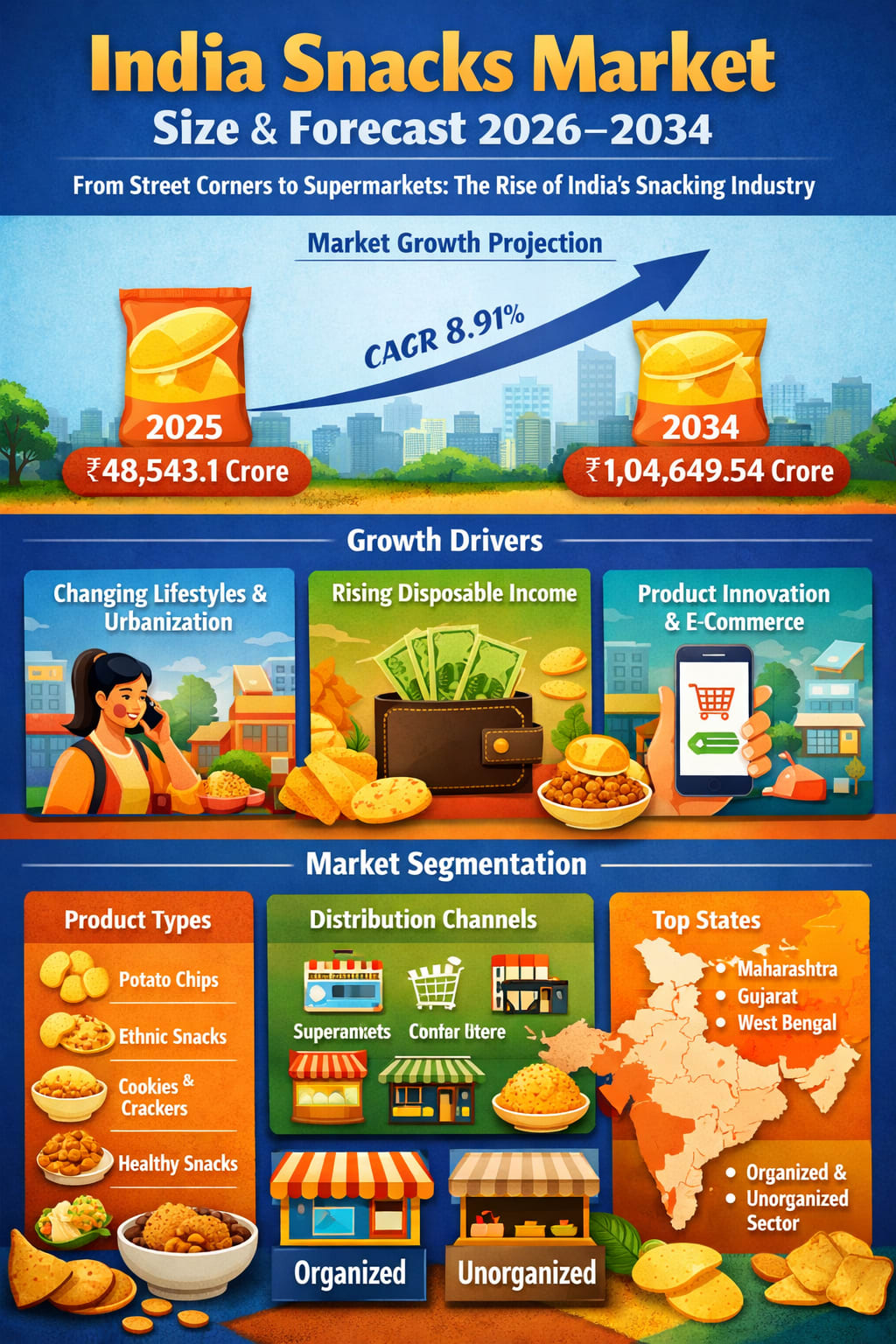
According to Renub Research, the India Snacks Market is expected to grow from INR 48,543.1 crores in 2025 to INR 1,04,649.54 crores by 2034, registering a compound annual growth rate (CAGR) of 8.91% from 2026 to 2034. This strong expansion reflects not just higher consumption, but also deeper structural changes in how Indians eat, shop, and live.
Urbanization, rising disposable incomes, busier lifestyles, and the explosive growth of modern retail and e-commerce are reshaping the snacking landscape. At the same time, innovation in flavors, formats, and healthier alternatives is widening the appeal of snacks across age groups and income segments.
In short, India’s snack market is no longer just about impulse buys—it is becoming a core part of the country’s fast-moving consumer goods (FMCG) growth story.
India Snacks Market Outlook
Snacks are small, convenient food items consumed between meals to curb hunger, boost energy, or simply for enjoyment. In India, this category includes a wide range of products such as savory snacks, cookies and crackers, chocolates, baked goods, ethnic namkeens, bhujia, and increasingly, healthier options like roasted snacks, millet-based products, and protein-rich items.
What makes snacks particularly attractive is their convenience, portability, long shelf life, and variety of flavors. These qualities align perfectly with modern lifestyles that prioritize speed, flexibility, and on-the-go consumption.
In India, snacking cuts across demographics and regions. Traditional items like samosa, chivda, sev, and regional namkeens coexist with Western-style chips, biscuits, and packaged snacks. Urbanization and changing consumption patterns have accelerated the shift toward branded and packaged snacks, especially among younger consumers and working professionals.
At the same time, there is a growing interest in regional flavors and healthier alternatives, creating space for both mass-market and premium products. This combination of cultural continuity and modern innovation is what makes the Indian snacks market uniquely dynamic—and highly attractive for manufacturers and investors alike.
Growth Drivers of the India Snacks Market
Changing Lifestyles, Urbanization, and Convenience Demand
One of the biggest forces behind the growth of the India snacks market is the rapid transformation of lifestyles. With more people living in cities, more nuclear families, and a steadily rising working population, the demand for quick, ready-to-eat, and easy-to-carry food options has surged.
Longer working hours and increased commuting time mean that many consumers now rely on snacks not just for indulgence, but also as mini-meals during the day. Snacks have become a staple in offices, colleges, travel, and even at home as meal replacements or in-between meal options.
India’s large vegetarian population also plays a role in shaping product portfolios. As highlighted in public discourse, a significant share of Indian consumers prefer vegetarian snacks, pushing manufacturers to innovate with plant-based, grain-based, and dairy-free options that still deliver on taste and convenience.
Rising Disposable Income and Expanding Middle Class
India’s expanding middle class is a major engine of growth for the snacks industry. Over the past two decades, the country has witnessed a steady rise in household incomes, leading to higher spending on branded and packaged food products.
As consumers move up the income ladder, they become more willing to pay extra for quality, hygiene, branding, and new experiences. This has fueled the trend of premiumization in snacks—seen in gourmet flavors, international formats, improved packaging, and value-added offerings.
Importantly, this trend is no longer limited to metros. With rising incomes in Tier I, II, and III cities, per capita snacking is increasing across a wider demographic base, significantly expanding the addressable market for organized players.
Product Innovation and Expansion of Distribution Channels
Innovation is at the heart of the Indian snacks market’s growth. Companies are constantly launching new flavors inspired by regional tastes, global cuisines, and fusion concepts to keep consumers engaged and loyal.
At the same time, health-focused innovation is gaining momentum. Baked snacks, low-fat options, millet-based products, and protein-enriched snacks are attracting health-conscious consumers who want to snack without guilt.
Distribution has also undergone a massive transformation. The rapid expansion of organized retail, e-commerce platforms, and quick-commerce services has made snacks more accessible than ever, even in smaller cities. Digital marketing and social media have further amplified brand visibility and consumer engagement.
A recent example of innovation-driven marketing is the launch of Parle’s “Nakli Bhujiya” under its Parle Chatkeens range in September 2024, showcasing how brands are using quirky concepts and bold flavors to stand out in a crowded market.
Challenges of the India Snacks Market
Health Concerns and Regulatory Pressure
Despite strong growth, the snacks market faces increasing scrutiny over high salt, sugar, and fat content in many products. Consumers are becoming more label-conscious and health-aware, which is gradually shifting preferences toward cleaner and healthier options.
Government-led health campaigns and potential regulatory actions on labeling, advertising, and product composition could pose challenges, especially for companies heavily dependent on traditional fried or high-calorie snacks.
Intense Competition and Price Sensitivity
The Indian snacks industry is intensely competitive, with a mix of large national brands, regional players, and countless small unorganized producers. Price sensitivity remains high, particularly in mass-market segments.
Frequent price wars, discounts, and promotional offers put pressure on margins, making brand differentiation, innovation, and distribution strength critical for long-term success.
India Unorganized Snacks Market
The unorganized snacks sector continues to play a major role, especially in rural areas and smaller towns. This segment includes locally produced namkeens, fried snacks, sweets, and street foods, often sold loose or in simple packaging.
Consumers are drawn to these products because of lower prices, familiarity, and local taste preferences. The absence of heavy branding and formal regulation helps keep costs low.
However, the organized sector is steadily gaining ground by offering better hygiene, standardized quality, attractive packaging, and longer shelf life. While growth in the unorganized segment is slower, it still commands a significant share of total snack consumption in India.
Key Product Segments
India Potato Chips Market
Potato chips remain one of the most popular and high-volume snack categories in India. Their easy availability, strong branding, affordable price points, and constant flavor innovation have made them a staple impulse purchase.
The rise of baked and low-calorie variants has further expanded their appeal among health-conscious consumers. This segment is highly competitive and innovation-driven, making it a focal point for major snack companies.
India Ethnic Namkeen & Snacks Market
Ethnic namkeens such as sev, mix, and chivda hold a deep emotional and cultural connection with Indian consumers. These snacks are part of everyday life—served with tea, offered to guests, and carried during travel.
Organized players are increasingly repackaging these traditional items into branded, hygienic, and widely distributed formats, especially for urban consumers who want authenticity with convenience.
India Ethnic Bhujia Market
Bhujia, originally from Rajasthan, has become a nationwide favorite thanks to its distinctive taste, texture, and versatility. It is consumed on its own and as part of snack mixes, and benefits from affordable pricing and long shelf life.
With organized brands scaling production and distribution, the bhujia segment continues to grow steadily, including in premium and flavored variants.
Distribution Channel Dynamics
Convenience Stores
Kirana shops, kiosks, and neighborhood stores remain the backbone of snack distribution in India. These outlets drive impulse and single-serve purchases, making them crucial for volume growth.
Manufacturers focus heavily on visibility, shelf placement, and small pack sizes to capture attention in these high-traffic locations.
Supermarkets and Hypermarkets
Modern retail formats are becoming increasingly important, especially in urban centers. These stores offer wider product ranges, including premium, imported, and health-focused snacks, and encourage bulk buying and brand experimentation.
While their overall reach is still smaller than kirana stores, their influence on premiumization and brand perception is growing rapidly.
Regional Market Highlights
Gujarat Snacks Market
Gujarat has a rich snacking culture built around items like farsan, dhokla, khakhra, and ganthiya. The state is also a major production hub for namkeens and packaged snacks.
While both organized and unorganized players coexist, demand for branded, hygienically packaged snacks is rising, especially in cities like Ahmedabad and Surat.
West Bengal Snacks Market
West Bengal’s snack market blends strong traditional preferences—such as chanachur and muri mixes—with growing urban demand for packaged snacks. Tea-time snacking is deeply ingrained in local culture, supporting steady demand.
Though the unorganized sector remains dominant, urban centers like Kolkata are seeing increasing acceptance of organized brands, particularly those that respect local flavor profiles.
Maharashtra Snacks Market
Maharashtra, driven by cities like Mumbai and Pune, represents one of India’s largest and most diverse snack markets. High urbanization, strong purchasing power, and advanced retail infrastructure support strong demand for both mass and premium snacks.
Health-conscious consumers here are also fueling growth in baked, low-fat, and protein-enriched snack categories, making the state a key testing ground for innovation.
Market Segmentation
By Sector:
Organized
Unorganized
By Type:
Cookies & Crackers
Potato Chips
Tortilla Chips, Flips & Pretzels
Ethnic Namkeen & Snacks
Ethnic Bhujia
Others
By Distribution Channel:
Supermarkets/Hypermarkets
Online Retail
Convenience Stores
Other Channels
By Top States:
Maharashtra
Tamil Nadu
Karnataka
Gujarat
Uttar Pradesh
West Bengal
Rajasthan
Telangana
Andhra Pradesh
Madhya Pradesh
Competitive Landscape
The Indian snacks market features a mix of strong domestic and multinational players. Key companies covered include:
Prataap Snacks
Nestlé
DFM Foods Ltd.
PepsiCo
ITC Limited
Britannia
Agro Tech Foods Ltd. (Conagra Brands)
These companies compete on product innovation, brand strength, distribution reach, pricing strategies, and marketing execution, with each adopting distinct approaches to capture market share.
Final Thoughts
The India snacks market is entering a decisive growth phase. With Renub Research projecting the market to nearly double from INR 48,543.1 crores in 2025 to INR 1,04,649.54 crores by 2034, the sector is clearly positioned as one of the most dynamic segments within India’s FMCG landscape.
While challenges around health, regulation, and competition remain, the long-term fundamentals—urbanization, rising incomes, changing lifestyles, and distribution expansion—continue to strongly favor growth. The future of Indian snacking will be shaped by a balance of tradition and innovation, where local flavors meet modern formats, and convenience meets evolving health consciousness.
For brands that can navigate this balance effectively, the next decade offers not just growth, but a chance to become an everyday part of India’s changing food story.
About the Creator
Stovex Global and the Art of Understanding the World Economy
In an era defined by rapid technological change, geopolitical uncertainty, and increasingly interconnected markets, understanding the global economy has never been more complex—or more essential. Against this backdrop, Stovex Global has emerged as a research-driven platform dedicated to analyzing worldwide economic trends and translating them into clear, actionable insights through timely publications. By combining macroeconomic research, regional market analysis, and forward-looking commentary, Stovex Global plays a meaningful role in helping investors, policymakers, and business leaders navigate an ever-evolving economic landscape.
By Stovex Globala day ago in Trader
Philippines Digital Payments Market: Fintech Adoption, Financial Inclusion & Cashless Transition
Philippines Digital Payments Market Overview The Philippines digital payments market growth is expanding rapidly as consumers, businesses and government institutions adopt electronic transaction methods to improve convenience, efficiency and financial inclusion. Digital payments encompass mobile wallets, online banking transfers, card-based transactions, QR code payments and peer-to-peer platforms. These solutions are gradually reducing reliance on cash and reshaping how money moves across the economy. The Philippines digital payments market size reached USD 616.3 Million in 2025. Looking forward, the market is expected to reach USD 1,867.6 Million by 2034, exhibiting a growth rate (CAGR) of 13.11% during 2026-2034. This strong growth reflects rising smartphone usage, expanding internet connectivity and supportive regulatory frameworks.
By Manisha Dixit3 days ago in Trader




Comments
There are no comments for this story
Be the first to respond and start the conversation.