
India Low Voltage Drives Market Size and Forecast 2025–2033
How Energy Efficiency, Industrial Automation, and Smart Manufacturing Are Powering the Next Phase of Growth

Introduction: Powering India’s Efficiency-First Industrial Future
India’s industrial sector is standing at a critical crossroads. With rising energy costs, stricter environmental regulations, and a strong national push toward smart manufacturing, industries are being forced to rethink how they consume and manage power. In this evolving landscape, Low Voltage Drives (LVDs) have emerged as one of the most practical and impactful technologies helping businesses optimize energy use, improve productivity, and reduce operational costs.
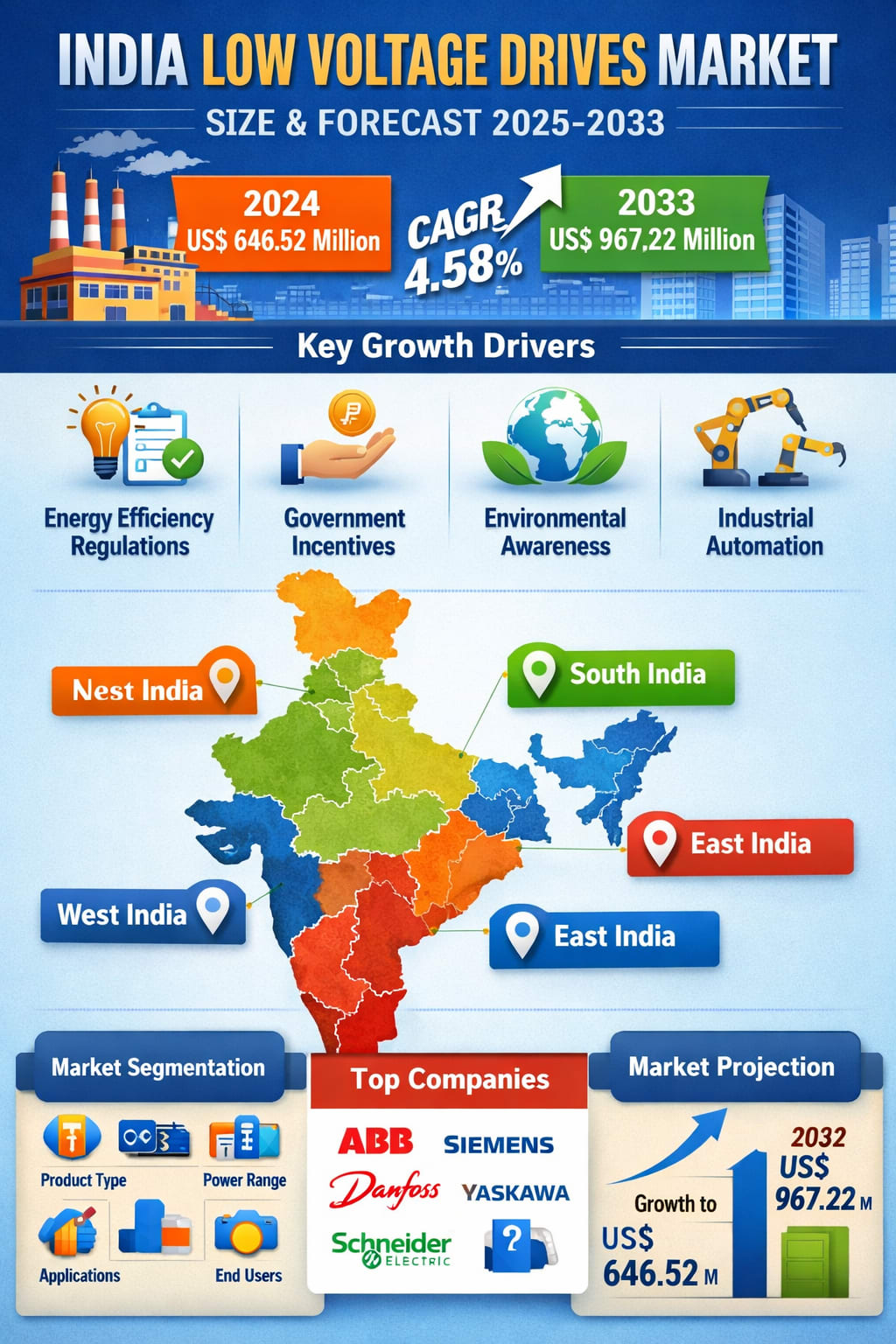
According to Renub Research, the India Low Voltage Drives Market is expected to grow from US$ 646.52 million in 2024 to US$ 967.22 million by 2033, registering a CAGR of 4.58% from 2025 to 2033. This steady growth reflects a deeper structural shift in Indian industry: a move toward energy-efficient motor control, higher automation, and data-driven operations.
Low voltage drives are no longer limited to niche industrial applications. Today, they are widely used across manufacturing plants, HVAC systems, water and wastewater facilities, oil & gas operations, power generation units, and automotive production lines. Their ability to control motor speed, torque, and direction with precision makes them essential for both cost savings and sustainability goals.
As India accelerates its journey toward becoming a global manufacturing hub, the low voltage drives market is quietly becoming one of the backbone technologies supporting this transformation.
Market Overview: Why Low Voltage Drives Matter More Than Ever
Low voltage drives play a crucial role in improving the efficiency of electric motors, which account for a significant share of industrial electricity consumption. By adjusting motor speed based on actual load requirements, these drives help reduce unnecessary energy use, minimize mechanical stress, and extend equipment life.
In sectors such as HVAC, pumps, conveyors, and compressors, energy consumption can be dramatically reduced with the use of variable frequency drives and other low voltage drive technologies. For industries operating on thin margins, even small efficiency gains translate into substantial long-term savings.
India’s growing focus on sustainable industrial development is also strengthening the case for LVD adoption. With rising awareness about carbon emissions and energy conservation, companies are increasingly viewing low voltage drives not just as cost-saving tools, but as strategic investments in long-term competitiveness and compliance.
The market is also benefiting from rapid industrial automation, increased digitization of manufacturing, and the adoption of Industry 4.0 practices, all of which rely heavily on precise motor control and intelligent drive systems.
Growth Drivers for the India Low Voltage Drives Market
1. Energy Efficiency Regulations
One of the strongest forces driving the adoption of low voltage drives in India is the government’s push for energy efficiency. Programs such as the Perform, Achieve, and Trade (PAT) scheme under the National Mission on Enhanced Energy Efficiency (NMEEE) have created a structured framework for industries to reduce their energy intensity.
These initiatives encourage companies to invest in energy-efficient technologies, including low voltage drives, to meet mandated energy-saving targets. By optimizing motor operations, LVDs help industries comply with regulations, reduce power consumption, and lower operating costs—all while contributing to India’s broader climate goals.
In a country where industrial energy demand continues to rise, such regulatory support plays a vital role in accelerating the adoption of advanced motor control technologies.
2. Rising Government Incentives
Beyond regulations, financial and policy incentives are also playing a major role in market expansion. The Indian government has introduced various schemes that promote energy efficiency, renewable energy adoption, and modernization of industrial infrastructure.
Initiatives like NMEEE and FAME (Faster Adoption and Manufacturing of Hybrid and Electric Vehicles) indirectly support the low voltage drives market by encouraging the use of efficient electrical systems and automation technologies. Subsidies, tax benefits, and grants for green technologies reduce the initial investment burden, making LVDs more accessible across industries such as manufacturing, HVAC, automotive, and power generation.
As these incentives continue and expand, they are expected to further strengthen the business case for investing in low voltage drive solutions.
3. Increasing Environmental Awareness
Sustainability is no longer just a buzzword—it is becoming a core business priority. Companies across India are under growing pressure from regulators, investors, and customers to reduce their carbon footprint and adopt cleaner production practices.
Low voltage drives directly support these goals by reducing energy waste, improving motor efficiency, and lowering greenhouse gas emissions. By enabling motors to operate only at the required speed and load, LVDs help eliminate unnecessary power consumption and improve overall system efficiency.
As more organizations align their strategies with global sustainability standards and ESG goals, the demand for energy-efficient technologies like low voltage drives is expected to rise steadily.
Challenges in the India Low Voltage Drives Market
1. High Initial Investment Costs
Despite their long-term benefits, low voltage drives come with high upfront costs, including equipment purchase, installation, system integration, and training. For small and medium-sized enterprises (SMEs), this initial investment can be a significant barrier.
While LVDs offer clear long-term savings through reduced energy consumption and lower maintenance costs, many smaller businesses struggle to allocate capital for such projects. This slows down adoption, particularly in price-sensitive segments of the market.
Bridging this gap will require more targeted financing options, leasing models, and continued government support to make advanced drive technologies more accessible.
2. Reliance on Imported Components
Another major challenge is India’s dependence on imported components, especially from countries like China. This reliance exposes the market to supply chain disruptions, geopolitical tensions, currency fluctuations, and import duty changes.
Such uncertainties can lead to price volatility and delays in project execution, which in turn affect overall market growth. For SMEs, which are already sensitive to cost changes, this can be a serious deterrent.
Strengthening domestic manufacturing and local sourcing of components will be critical for improving supply chain resilience and ensuring more stable market development in the long run.
Regional Market Insights
North India
North India holds a significant share of the low voltage drives market, supported by strong industrial activity in manufacturing, HVAC, textiles, and water treatment. Government initiatives like Make in India and the Smart Cities Mission are further boosting demand for energy-efficient and automated systems in the region.
While awareness of energy conservation is growing, challenges such as high upfront costs and the need for skilled personnel remain. Addressing these gaps through training programs and targeted incentives will be key to sustaining growth in this region.
South India
South India is one of the most dynamic markets for low voltage drives, thanks to its strong base in manufacturing, textiles, electronics, HVAC, and water treatment. States like Tamil Nadu, Karnataka, Telangana, Andhra Pradesh, and Kerala are leading adopters of energy-efficient technologies.
Chennai’s Electronics Manufacturing Services (EMS) corridor and industrial hubs like Coimbatore have created strong demand for automation and advanced motor control solutions. The region also benefits from a large pool of engineering talent, making it easier to integrate and maintain sophisticated LVD systems.
East India
East India, including West Bengal, Odisha, Bihar, Jharkhand, and the northeastern states, is gradually emerging as a promising market. Growth is being driven by industries such as steel, cement, food processing, and textiles, along with infrastructure projects linked to the East Coast Economic Corridor (ECEC).
However, challenges like lower awareness, high initial costs, and limited skilled manpower in tier-2 and tier-3 cities continue to slow adoption. Despite this, ongoing industrial development and government support for energy efficiency are expected to drive steady growth over the coming years.
Market Segmentation
By Product Type:
AC Drives
DC Drives
Servo Drives
Variable Frequency Drives
By Power Range:
Micro Drives
Low-End Drives
Medium-End Drives
High-End Drives
By Application:
HVAC
Pumps
Conveyors
Compressors
By End Users:
Manufacturing
Oil & Gas
Automotive
Chemicals
Power Generation
By Region:
East India
West India
North India
South India
Competitive Landscape and Company Analysis
The India low voltage drives market is highly competitive, with both global and domestic players focusing on technology innovation, localization, digital integration, and service excellence. Key companies covered in the market include:
ABB India Ltd
Siemens Limited
Danfoss A/S
Hitachi Hi-Rel Power Electronics Private Limited
Yaskawa India Private Limited
Rockwell Automation Inc.
Schneider Electric SE
Kirloskar Electric Company Ltd.
Amtech Electronics India Limited
These companies are competing across four main dimensions: Overview, Key Persons, Business Strategy, and Financial Insight. Their strategies increasingly focus on offering smart, connected drives, expanding local manufacturing, and providing end-to-end automation solutions tailored to Indian industrial needs.
Future Outlook: A Market Aligned with India’s Industrial Ambitions
Looking ahead, the India low voltage drives market is well-positioned for sustained growth. The convergence of energy efficiency goals, industrial automation, digital transformation, and sustainability priorities creates a strong long-term demand outlook.
As industries continue to modernize and optimize operations, low voltage drives will become even more central to achieving productivity gains, cost control, and environmental compliance. While challenges such as high initial costs and import dependence remain, increasing localization, policy support, and technological advancements are likely to gradually ease these constraints.
Final Thoughts
The journey of India’s industrial sector toward greater efficiency and sustainability is inseparable from the adoption of smarter motor control technologies. With the market projected to grow from US$ 646.52 million in 2024 to US$ 967.22 million by 2033, low voltage drives are clearly moving from being optional upgrades to essential components of modern industrial infrastructure.
Driven by energy efficiency regulations, government incentives, and rising environmental awareness, the India low voltage drives market is set to play a crucial role in shaping the country’s next phase of industrial growth. For businesses willing to invest in long-term efficiency and competitiveness, low voltage drives are no longer just a technical choice—they are a strategic one.
About the Creator
Europe Vitamin Fortified and Mineral Enriched Food & Beverage Market Size and Forecast 2025–2033
Europe’s Fortified Foods Boom: A Market Built on Health, Science, and Smart Consumption The Europe Vitamin Fortified and Mineral Enriched Food & Beverage Market is entering a decisive growth phase, driven by a powerful combination of health awareness, demographic change, and evolving consumer expectations. According to Renub Research, the market was valued at USD 22.8 billion in 2024 and is projected to reach USD 31.11 billion by 2033, expanding at a compound annual growth rate (CAGR) of 3.52% during the forecast period 2025–2033.
By Sakshi Sharma8 days ago in Trader
A Monk, The Om, A Metronome
David Harlann had spent 14 years as a field medic. The horrors of mangled bodies and shot-off limbs were commonplace to him. Just another Tuesday strewn with blood. Those who started with him had moved on. They wanted to use the experience as an impressive line on their CV, or to run a triage unit. David, though, didn’t know what he wanted. He just… stayed.
By Gabriel Shamesabout 22 hours ago in Fiction


Comments
There are no comments for this story
Be the first to respond and start the conversation.