
How will AI affect the kind of jobs that young people today are preparing for?
A short history of the fear of automation and the future with it.
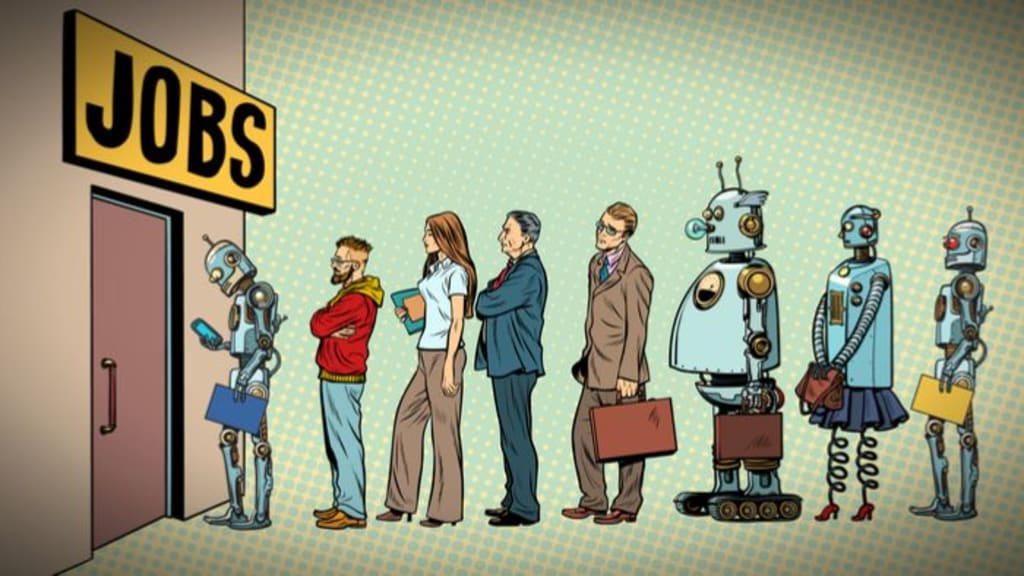
The fear of certain jobs being susceptible to automation seems to be growing amongst young people today.
Although this fear could have lingered way back in time, these concerns properly began in the 1970’s where many individuals feared that automation could replace factory workers. After the Second World War, industries in the USA, Europe, and Japan began adopting automated machinery to improve efficiency. What seemed to come out of nowhere, machines began doing tasks that previously required manual labor, such as machining and packaging. Many citizens began to notice how fewer workers were needed in the production line, which led to a fear of mass layoffs among individuals who worked in manual labour. Many wondered how sustainable their job was and acknowledged the preference in businesses choosing robots and machines that rarely made mistakes over humans. I encourage you to put yourself in the shoes of a labour worker back then, where out of nowhere, machines were replacing jobs of people you knew, making you fear for the safety of yours. By the late 1970s, computers were becoming more mainstream, which led to people who worked in accounting and bookkeeping fearing for the safety of their positions.
In this case, all the fear that people in these industries were experiencing turned out to be somewhat true,
Clerical and bookkeeping roles have declined significantly.
Bookkeeping, accounting, and auditing clerks: employment dropped steadily since the early 2000s. More than 50% just in the last 20 years (U.S. Bureau of Labor Statistics)
Warehouse and inventory management clerks declined as inventory management software.
Employment in machining has declined in advanced economies such as the U.S, Europe, and Japan
It is also portrayed that many of these jobs that have been talked about are still continuing to decline in personnel, where,
Word processors and typists are expected to lose 38% of their workforce by 2033
Data entry keyers are expected to lose 25% of their workforce by 2033
Surprisingly, jobs such as cooks and cashiers are projected to lose 10-14% of their workforce by 2033
Even computer programmes that have a median salary of 98,670$ are expected to lose up to 10% of their entire workforce. (“Occupations with the Largest Job Declines : U.S. Bureau of Labor Statistics”)
How could this be that, despite all these losses of jobs, the US total employment is still expected to increase from 167.8 million in 2023 to 174.6 million in 2033, an increase of 6.7 million jobs or 4.0% over the decade. (Colato,Javier;Ice,Lindsey;Laycock,Sofia)
This question cannot be answered simply, as there is a substantial number of factors that go into such a broad question. However, to put it simply, economies such as the US are constantly evolving and adapting. For example, when automation reduced jobs in manufacturing and clerical work back in the 1980s, the U.S. economy shifted toward services, especially healthcare, which might have narrowed down the workforce in one sector but expanded its workforce in other sectors. Unfortunately, the economy doesn't correct itself in a second, but this process of transformation of jobs idolized by young people today might take years and years, leading to certain generations being stuck in vanishing lines of work.
In conclusion, to answer my question best of my ability, automation certainly will reduce employment in some occupations, however this will lead to new jobs being created in either emerging sectors or even in some cases sectors that didnt exist before, ones that perhaps we cant even think of right now but will become common jobs in the future.
Works Cited
Colato,Javier;Ice,Lindsey;Laycock,Sofia. “Industry and Occupational Employment Projections Overview and Highlights, 2023–33.” Bureau of Labor Statistics, 7 Nov. 2024,www.bls.gov/opub/mlr/2024/article/industry-and-occupational-employment-projections-overview-and-highlights-2023-33.htm?utm_source=chatgpt.com.
“Occupations with the Largest Job Declines : U.S. Bureau of Labor Statistics.” Www.bls.gov, www.bls.gov/emp/tables/occupations-largest-job-declines.htm.
U.S. Bureau of Labor Statistics. “Bookkeeping, Accounting, and Auditing Clerks : Occupational Outlook Handbook: : U.S. Bureau of Labor Statistics.” Bls.gov, 6 Sept. 2018,www.bls.gov/ooh/Office-and-Administrative-Support/Bookkeeping-accounting-and-auditing-clerks.htm.
About the Creator
Keep reading
More stories from Garri Citrons and writers in Trader and other communities.
The Hidden Econometrics of Online Slots. How Casinos Always Win
Gambling has been around for millennials in one form or another. Although often frowned upon, it may be a key component of our society. Early methods of gambling date back thousands of years and often involved simple tools, objects of chance, and rituals. The oldest known gambling tools are six-sided dice found in ancient Mesopotamia, which were known to have been played over 5000 years ago. A casino is a facility for gambling. Casinos go way back to Venice in 1638, where the first casino opened. It was more than just a place to gamble; early casinos also hosted live entertainment, such as stand-up comedy, concerts, and sports.
By Garri Citrons9 months ago in Trader
Australia Wellness Tourism Market Set for Explosive Growth Fueled by Holistic Experiences
The Australia wellness tourism market reached USD 18.1 billion in 2024 and is forecast to expand to USD 67.6 billion by 2033, exhibiting a robust compound annual growth rate (CAGR) of 14.6% between 2025 and 2033. This rapid growth reflects strong consumer interest in wellness oriented travel that blends physical, mental and cultural well being with leisure and outdoor experiences. Eco conscious retreats, premium spa services, nature immersion activities and wellness focused itineraries are reshaping Australia’s travel landscape, attracting both domestic and international visitors.
By Rashi Sharma2 days ago in Trader
Philippines AI in Fintech Market: Intelligent Finance, Digital Growth & Risk Innovation
Philippines AI in Fintech Market Overview The Philippines AI in fintech market is rapidly gaining momentum as financial institutions, digital payment platforms and emerging fintech startups adopt artificial intelligence (AI) technologies to enhance service delivery, operational efficiency and customer experience. AI in fintech covers a range of intelligent systems including machine learning models, virtual assistants, fraud detection tools, behavioural analytics and credit scoring systems that optimise decision-making and reduce risks. The Philippines AI in fintech market size reached USD 79.38 Million in 2024. The market is projected to reach USD 419.35 Million by 2033, exhibiting a growth rate (CAGR) of 18.11% during 2025-2033 as AI becomes integral to financial innovation and digital transformation across banking, payments and financial services.
By Manisha Dixita day ago in Trader




Comments
There are no comments for this story
Be the first to respond and start the conversation.