
How to Invest Like Warren Buffett
Fundamental analysis the way Warren Buffett does it.

Photo by Lukas Blazek on Unsplash
Introduction
The Oracle of Omaha is famous for being a fundamental investor. One area where he differs from traditional Graham value investors is that he is in a company for the long haul (>10 years).
I would rather buy a good company at a fair price than a fair company at a good price. -Warren Buffett
So, the goal of fundamental analysis is to find valuable companies, not to buy a company at a value.
Mary Buffett (Warren’s daughter-in-law) wrote an interesting book (Warren Buffett and the Interpretation of Financial Statements) about his analysis of income statements, balance sheets, and cash flow. His main idea is to find a company with a durable competitive advantage. This allows the company to grow over long periods of time and continuously generate cash. It also eliminates the duds that you might otherwise buy through traditional value investing that are priced cheaply. This was one of the flaws that Warren saw with Graham’s approach. Some “cheap” companies ended up decreasing in value and turning a loss. Warren wants to avoid the duds.
Rules for Analyzing Company Fundamentals
The first set of things that Warren looks for in a company with a durable competitive advantage center around making money and being able to keep enough of it:
- Gross Profit Margin > 40%. A company needs to make enough money after the material costs.
- Net Earnings % of Profit > 40%. A company needs to have a decent amount of the profit converted to the bottom line.
- SG&A % of Gross Profit < 80%. You need to not spend all your profit on overhead.
- Retained Earnings Increasing at > 5% per year. A company with a durable competitive advantage is making money hand over fist, so it should have money left at the end of the quarter.
- Net Earnings % of Share Holder Equity > 20%. For a given amount of equity, the investor should receive income back in return
The second set of criteria looks at things like capital expense and interest payments. The idea here is that if a company has a durable competitive advantage it doesn’t need to continuously re-tool its manufacturing operations or take out loans and gobble up profit through interest payments. Some of the companies that don’t typically meet this criteria are automakers like GM. They need to build a “new” car each year so their capital expense is quite high as lines are retooled.
- Capital Expense % of Net Earnings < 50%. If a manufacturing company constantly needs to retool its operations, capital expenses will eat into earnings.
- Liabilities % of (Equity + Treasury Stock) < 80%. The company should have a net positive worth.
- Interest Payments % of Income <15%. The company should not need to take out lots of debt, because its durable competitive advantage should generate plenty of cash.
One of the few rules that focused around when to sell was the PE ratio. If the price-to-earnings ratio is above 40, maybe it’s time to think about selling as the capital might be more effectively used in another company.
The book contained lots of other rules that were less tangible. Treasury Share increase is important because it is a way for the company to increase its value by reducing the total number of shares. This is one of the classic ways good companies will spend “extra” revenue.
Some Deviations and Exceptions
Warren also points out that R&D in general is something that he avoids because it usually means the company’s competitive advantage isn’t durable. They have to continue to invest in R&D to stay ahead of competition. One of the example companies is Intel. The product they sell today will be obsolete in a few years, so if they don’t invest in technology development they become obsolete. A company like Coke will be selling its product for many years to come.
Originally Warren would stay away from tech companies because he doesn’t understand that sector very well. I think this has changed in recent years, because he has admitted that Amazon and Apple are both companies on which he missed out. Apple now is a large position for Berkshire Hathaway, so I am thinking he changed his tune on R&D and tech stocks in general.
Warren also makes it clear that not all of the rules mentioned above are not hard and fast. In the case of a leveraged buyout, the company’s revenue may violate the rules around the interest payments. This is because the borrower saw the value of the company, borrowed against its earnings potential in order to gain a controlling stake. This will be a momentary blip that will go away as the company pays off the debt and should not be counted against the company. Some of the rules mentioned previously may also vary by sector. In general, I think if a company is close to satisfying most of the rules and is close on the others, it probably has a durable competitive advantage.
Example Analysis
In a previous article I created a dashboard with Streamlit that highlights the relevant items green or red based on the rules above.
Build a Stock Screening Dashboard with Streamlit
An example output is below for one of Warren’s favorite companies: Moody’s (MCO). For the most part Moody’s is green in most quarters and only has an occasional bad quarter. Treasury stocks are on the rise, and R&D is zero.

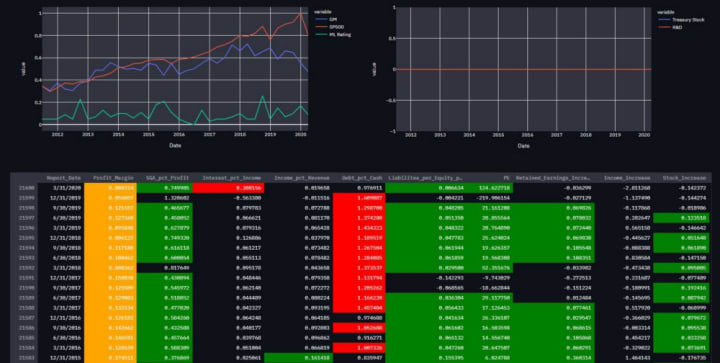
Here is an example of a bad company (GM). The profit margin is low, and the company is spending a lot of money on debt and capital expense.
Conclusion
Hopefully, by the end of this article you were able to wrap your head around the style of fundamental analysis that is used by Warren Buffett. You should now have an idea of what he looks for when picking a company. In a future article I hope to write about feeding this data into a machine learning model as a way to help pick stocks.
Note that this article does not provide personal investment advice, and I am not a qualified licensed investment advisor. All information found here is for entertainment or educational purposes only and should not be construed as personal investment advice.
About the Creator
Keep reading
More stories from Carl Westerby and writers in Trader and other communities.
Build a Stock Screening Dashboard with Streamlit
In my pursuit of researching companies for my own personal portfolio, I ended up needing a way to quickly look at a company and make a decision about its long term prospects. I started with something very clunky in Excel, but I quickly pivoted to something more elegant in Python.
By Carl Westerby4 years ago in Trader
Australia Mobile Device Management Market: Security, Mobility & Enterprise Transformation
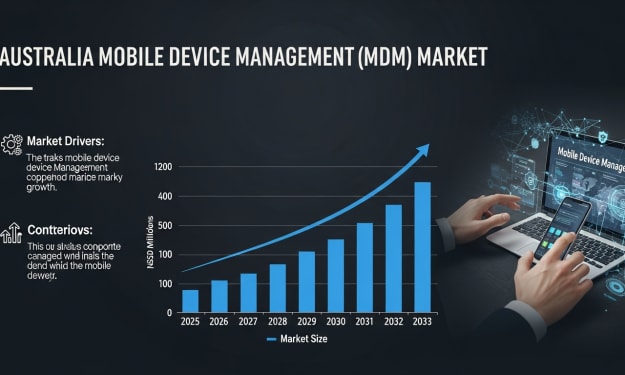
Australia Mobile Device Management Market Overview The Australia mobile device management (MDM) market is experiencing robust growth as organisations across sectors adopt digital workplaces, hybrid work models, and distributed device ecosystems. Mobile device management refers to software solutions and platforms that enable enterprises to secure, monitor, configure and manage mobile endpoints — including smartphones, tablets, laptops, wearables and Internet of Things (IoT) devices — from a centralised console. The Australia mobile device management (MDM) market size reached USD 266.0 Million in 2024. Looking forward, IMARC Group expects the market to reach USD 1,664.6 Million by 2033, exhibiting a growth rate (CAGR) of 22.60% during 2025-2033. This growth reflects heightened cybersecurity concerns, the proliferation of connected devices, increased adoption of bring-your-own-device (BYOD) policies, and regulatory imperatives that prioritise data protection and governance.
By Amyra Singh7 days ago in Trader
Philippines Computational Fluid Dynamics Market: Engineering Precision, Digital Simulation & Industrial Growth
Philippines Computational Fluid Dynamics Market Overview The Philippines computational fluid dynamics (CFD) market is expanding steadily as businesses, engineering firms and research institutions increasingly adopt simulation technologies to optimise fluid flow, heat transfer, aerodynamics and multiphysics systems. CFD — a branch of fluid mechanics that uses numerical analysis and algorithms to model fluid behaviour — enables organisations to reduce physical prototyping costs, accelerate product development, enhance performance, and improve safety across multiple industries. The Philippines computational fluid dynamics market size reached USD 11.93 Million in 2024. The market is projected to reach USD 19.59 Million by 2033, exhibiting a growth rate (CAGR) of 5.08% during 2025-2033. This growth reflects rising digital transformation initiatives, increased engineering complexity, and broader adoption of computational tools in sectors spanning automotive, aerospace, energy, manufacturing and academic research.
By Manisha Dixit7 days ago in Trader



Comments
There are no comments for this story
Be the first to respond and start the conversation.