
How to Become a Funded Trader When You're Broke: The Prop Trading Path Nobody Talks About
Guide For Beginner Prop Traders


I'll never forget the frustration of watching the markets move while my bank account sat at $237. Every YouTube guru was screaming about their latest winning trade, but nobody wanted to address the elephant in the room: what if you literally can't afford to start?
That's when I discovered proprietary trading firms, and everything changed.
The Secret Door to Professional Trading
Here's what nobody tells you about breaking into trading: you don't need your own money. Sounds like a scam, right? That's exactly what I thought when my mentor first mentioned prop firms. But after three months of grinding through evaluations and finally getting funded with a $100,000 account, I realized this was the most legitimate backdoor into professional trading that exists.
Proprietary trading firms are companies that put up their own capital for traders to manage. Think of it as the trading world's version of record labels signing unsigned artists. They're not doing it out of kindness, they're hunting for talent that can generate consistent returns.
Why Prop Firms Actually Want Broke Traders
This might blow your mind, but prop firms often prefer hungry traders without capital over trust fund kids. Why? Because when you've got nothing to lose and everything to prove, you trade differently. You respect risk management because you can't afford not to. You study harder because this is your shot, not your hobby.
I've watched wealthy beginners blow evaluation accounts in days because they treated it like a video game. Meanwhile, the guy working two jobs who saved up $99 for an evaluation? He's the one who makes it through.
The Real Cost of "Free" Money
Let's be brutally honest about what you're signing up for. Yes, you can access a funded account for as little as $50 (during sales), but here's what they don't advertise in bold letters:
The evaluation process will test everything about you. Most firms require you to hit a profit target (usually 8-10%) without breaking strict rules. Hit a daily loss limit? You're out. Trade during news events when you're not supposed to? You're out. Get emotional and revenge trade? You're definitely out.
During my first evaluation attempt, I was up 7.8% with two days left. All I needed was 0.2% more. I got greedy, overleveraged on EUR/USD, and watched three weeks of work disappear in twelve minutes. That $99 evaluation fee felt like $9,900 when I had to explain to my girlfriend why I needed another one.
The Evaluation Game: A Different Kind of Trading
Trading a prop firm evaluation isn't like trading a personal account. It's like taking your driving test, you're not trying to be a race car driver, you're trying to prove you can follow rules and stay safe.
Here's the framework that finally got me funded:
Week 1-2: Base hits, not home runs. I aimed for 0.5% daily gains maximum. Sounds pathetic? Maybe. But compound 0.5% over ten trading days and you're halfway to most profit targets.
The Middle Stretch: This is where most traders crack. You're sitting at 5-6% profit, and that finish line feels so close you can taste it. This is when you must become a robot. Same strategy, same risk, same discipline. The market doesn't know you're in an evaluation.
The Final Push: Never, ever try to hit your profit target in one trade. I watched a trader turn 9.8% profit into a blown account because he went all-in trying to hit that final 0.2%. Take your time. The best prop firms don't have maximum time limits anymore.
Choosing Your Prop Firm: The Minefield Nobody Maps
Not all prop firms are created equal, and the industry is flooded with questionable operations. After evaluating with seven different firms, here's my filter system:
Follow the Professional Traders: Where are the traders you respect getting funded? If a firm only has testimonials from complete beginners claiming they made $50,000 in their first month, run. Real traders share real struggles.
The Profit Split Reality Check: Most legitimate firms offer 80-90% profit splits. If someone's offering you 50%, they're either incredibly greedy or operating on shaky ground. Your skills are valuable, don't undersell them.
The Fine Print Treasure Hunt: Download and read every single rule document before paying a cent. I once failed an evaluation because I held a trade over the weekend, something buried on page 47 of their rules PDF. Expensive lesson.
Your First Funded Month: Welcome to the Pressure Cooker
Getting funded isn't the end, it's the beginning of the real challenge. Your first month with real capital will reveal everything about your psychological relationship with money.
My first funded week, I made $3,200. I was on top of the world. My second week, I gave back $3,800. The difference? Week one, I traded my plan. Week two, I traded my P&L. Every time I looked at that negative number, my decision-making got worse. I started taking trades I would never touch during evaluation.
Here's what saved me: I started covering my P&L with tape on my screen. Sounds ridiculous? Maybe. But it forced me to trade the charts, not my emotions. By month's end, I closed up $1,847. Not impressive by guru standards, but that $1,477 payout (after the 80% split) was the first real money I'd ever made from trading.
The Brutal Truth About Prop Trading Success Rates
Let me hit you with reality: roughly 95% of traders fail their first evaluation. Of those who get funded, about 70% lose their funded account within three months. These aren't stats prop firms advertise, but they're numbers you need to know.
But here's the flip side, the 5% who make it through? They often build legitimate trading careers. I know funded traders pulling $10,000+ monthly from multiple prop accounts. Not yacht money, but definitely quit-your-job money.
The difference between the 95% and the 5% isn't talent. It's the willingness to treat this like professional sports training, not a lottery ticket.
The Roadmap Nobody Gives You
After helping dozens of broke traders get their first funding, here's the exact path I recommend:
Month 1: Education Overdose. Before you pay for any evaluation, spend 30 days consuming every free resource available. Learn one strategy until you can explain it to a five-year-old. Paper trade it until you're bored.
Month 2: The Smallest Possible Start. Find the cheapest evaluation available (some firms offer $10,000 accounts for under $50). This isn't about the money, it's about experiencing real evaluation pressure without breaking the bank.
Month 3-4: The Grind. Expect to fail your first evaluation. Maybe your second. Each failure is data. What triggered the mistake? Was it a strategy issue or a psychology issue? Most traders quit here. That's why most traders stay broke.
Month 5-6: The Breakthrough. By your third or fourth evaluation, the patterns become clear. You know exactly what ruins accounts (overtrading, revenge trading, ignoring stops), and you've felt the pain enough times to actually avoid these mistakes.
The Psychology of Trading Without a Safety Net
When you're trading a prop account, you're always one bad day away from losing everything. There's no calling mom for more money. No credit card to max out. This pressure either breaks you or builds you into something bulletproof.
I developed a pre-trading ritual that sounds insane but kept me sane: Every morning, I would write "I can lose this account today" ten times in my journal. Not negative thinking, realistic thinking. Accepting the worst-case scenario somehow freed me to trade without fear.
Building Your Prop Trading Career
Once you get that first funded account, the game changes. Now you can scale. Most successful prop traders don't stop at one account. They get funded with multiple firms, diversifying their income streams.
I currently trade four funded accounts totaling $400,000 in capital. Even on conservative months where I only return 2-3% per account, that's real money. The kid who couldn't afford a $1,000 trading account now manages nearly half a million in capital.
The Hard Questions You Need to Answer
Before you jump into prop trading, be honest with yourself:
Can you handle failing publicly? Because you will post about getting funded, and then you'll have to explain why you lost it two weeks later.
Can you follow rules you don't agree with? Some prop firm rules feel arbitrary and frustrating. Doesn't matter. Break them and you're done.
Can you treat this like a business, not a casino? Prop trading isn't about hitting one massive trade. It's about consistent, boring profitability.
Your Next Move
If you're sitting there with more ambition than money, prop trading might be your path. But don't romanticize it. This isn't easy money or passive income. It's a demanding career that rewards discipline and punishes ego.
Start small. Research firms obsessively. Join communities of funded traders (avoid the ones full of people selling courses). Most importantly, give yourself permission to fail forward. Every blown evaluation teaches you something worth more than the evaluation fee.
Six months ago, I was googling "how to trade forex with no money" at 2 AM, convinced I'd missed my chance at financial markets. Today, I'm writing this from a coffee shop in Prague, funded by profit splits from prop trading. Not because I'm special, but because I was willing to fail seventeen times before succeeding once.
The door is open. The question isn't whether you have enough money to start. It's whether you have enough hunger to continue.
The Final Reality Check
Prop trading isn't a shortcut to wealth. It's a longer, harder road that just happens to be accessible to broke people. You'll work twice as hard for half the money (after profit splits) compared to trading your own capital. But when you don't have your own capital, half of something beats all of nothing.
Every funded trader started exactly where you are, scrolling through articles, wondering if this could actually work. The only difference between dreaming about it and doing it is submitting that first evaluation.
The markets are waiting. Your empty bank account isn't an excuse anymore.
What's your next move?
About the Creator
Keep reading
More stories from writers in Trader and other communities.
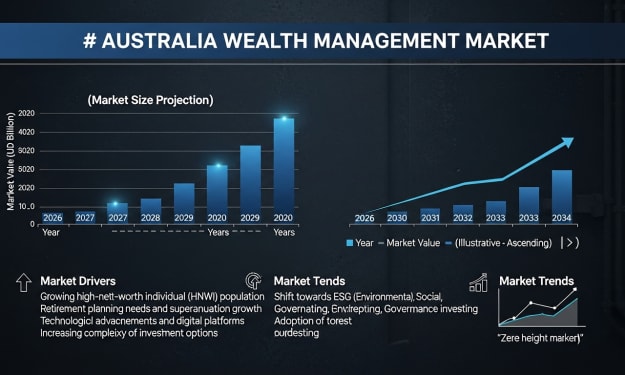
Australia Wealth Management Market Set for Strong Expansion as Digital Platforms and HNWI Demand Surge
The Australia wealth management market is experiencing robust growth as affluent individuals, corporates, and savers increasingly seek expert financial planning, personalized investment strategies, and digital advisory solutions. According to IMARC Group, the market was valued at USD 110.3 Million in 2024 and is expected to reach USD 213.2 Million by 2033, registering a compound annual growth rate (CAGR) of 7.60% between 2025 and 2033.
By Rashi Sharma5 days ago in Trader


Comments
There are no comments for this story
Be the first to respond and start the conversation.