
How Much of a Boeing 737 is Foreign-Made?
Trump Tariffs Cripple the Production of the Boeing's 737 MAX 8

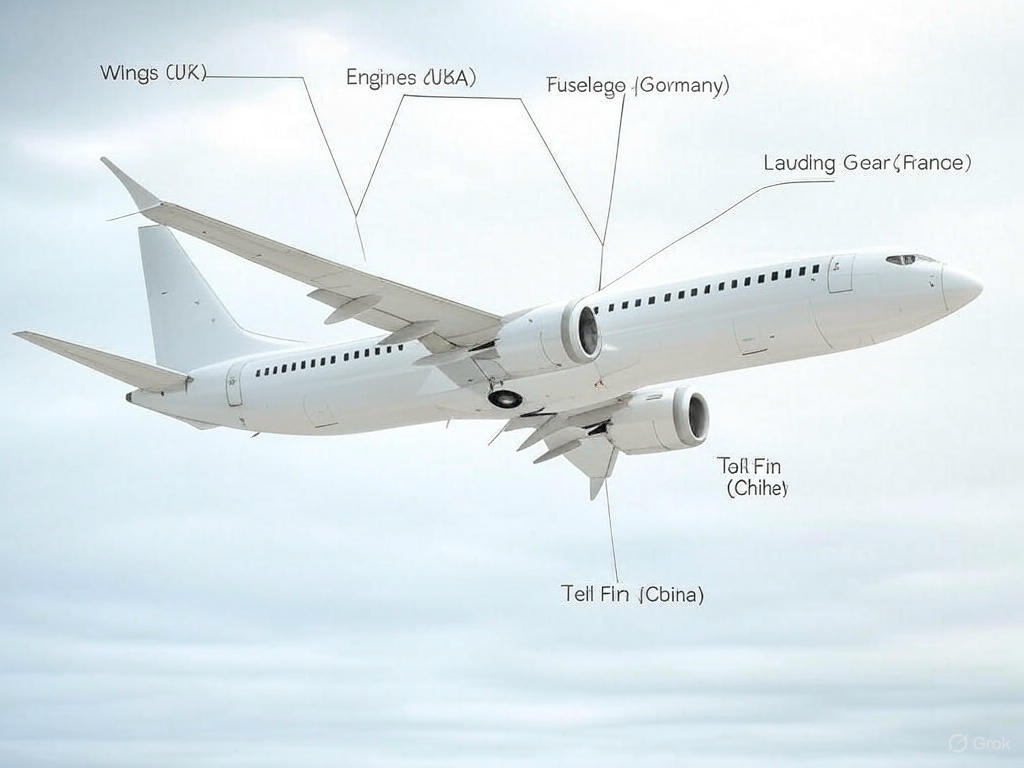
I will recycle a statement Peter Navarro made recently about Tesla.
Boeing is an assembler of airplanes, not a manufacturer.
In its vast factory in Seattle, Boeing collects airplane parts from around the world, and rivets them together.
40% — 50% of the parts of a Boeing 737 are obtained from foreign suppliers.
Trump's tariff plan, instead of creating jobs, in fact, threatens all 80,000 jobs in Boeing's commercial aviation line, which depend on the availability of 100,000 aerospace parts to keep its production line going.

This assembly line is one of the world's biggest examples of the “weakest link dilemma” — if one part is missing, the airplane simply can not function.
Without the easy availability of parts, and with supply delays and cost overruns, Boeing suffers, and is inevitably forced to layoff workers at Boeing's plants. Hurting the aerospace industry, one of the last globally competitive manufacturing sectors left in America.
Years will be needed to transition to American parts, and in the meantime, airlines will be forced to switch to Airbus, which being based in Europe, will retain the advantages of access to the best international vendors.
The Boeing 737 MAX 8 is the most international plane in Boeing's history.
Let's go through a breakdown of the foreign parts that keep the 737 MAX 8 flying, and why reshoring them would be a monumental challenge.
The French Heart of the Boeing 737 MAX-8
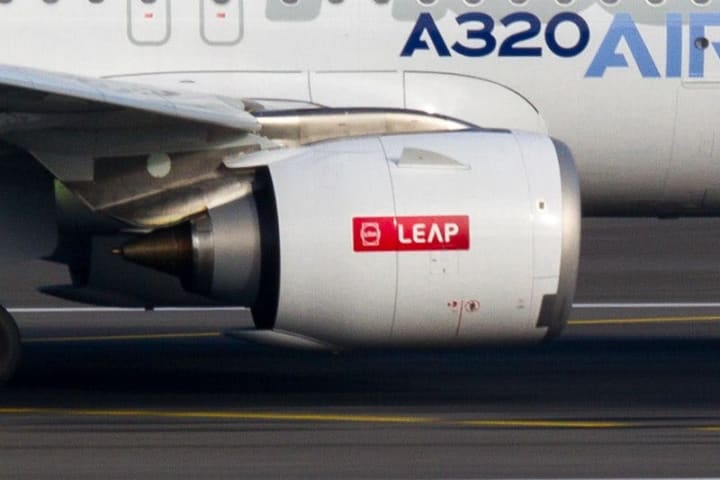
A critical design goal of the 737 MAX-8 wass to match the 15% lower fuel consumption of the Airbus A320.
In October 2019, the A320 family surpassed the Boeing 737 to become the world's best-selling aircraft and it is not powered by an American engine.
The last Pratt & Whitney American-made engine was installed into a 737 in 1989. (Today, P&W engines are used mainly for military aircraft such as the F-35.)
To compete with Airbus, Boeing transitioned to the LEAP engines made by CFM International. CFM engines offer better fuel burn, lower emissions, and quieter operation.
CFM International, the world's largest commercial aircraft engine manufacturer, is a joint venture between GE Aerospace and Safran Aircraft Engines of France.
By country, the component suppliers for CFM engines include:
- France (Safran): Turbofan core, nacelles, fuel system, Fan & Fan Case.
- United States (GE Aerospace): High-Pressure Compressor (HPC), High-Pressure Turbine (HPT), Combustor, Fuel Nozzles, Engine Control System
- Germany (MTU Aero Engines): High-pressure compressors
- Germany (Liebherr): Actuation systems
- Japan (IHI Corp): Turbine components and critical engine alloys
- Italy(Avio Aero): Gearbox components
- United Kingdom(Meggitt): Sensors & monitoring systems
- Canada (L3Harris): Engine health monitoring systems
- South Korea (Hanwha Aerospace): Structural components
Why It Can't Be Sourced in the U.S. Quickly:
- No American firm produces a comparable narrow-body engine.
- GE (the U.S. half of CFM) relies on Safran's advanced composites and nacelle designs.
- Retooling U.S. factories would take 5+ years and billions in R&D.
The European Brains of the Aircraft: Flight Controls & Avionics:
- Fly-by-Wire Systems (France - Thales)
- Autopilot & Flight Computers (France - Thales, Sweden - Saab)
- Hydraulic Actuators (Germany - Liebherr)
Why It Can't Be Replaced Overnight:
- - The FAA-certified software and hardware are **proprietary to European firms.
- U.S. alternatives (Honeywell, Collins) would need **years** to redesign and certify equivalent systems.
Wings & Aerostructures: UK, Italy, and Japan's Role
- Wing Leading Edges (UK - Spirit AeroSystems Scotland)
- Horizontal Stabilizers (Italy - Leonardo)
- Winglets & Composites (Japan - Mitsubishi, South Korea - KAI)
- Why Boeing Can't Just Reshore These Parts:
- Specialized tooling** exists only in these foreign plants.
- U.S. aerospace composites manufacturing lags behind Japan and South Korea.
Moving production would require new FAA certifications, delaying deliveries by 3+ years.
Landing Gear: A British-French-German Supply Chain
- Landing Gear Components (France - Safran, UK - Meggitt)
- Hydraulic Systems (Germany - Liebherr)
- Why the U.S. Would Struggle:
- No U.S. supplier** makes all the necessary landing gear parts at scale.
- Retraining American workers on European precision-forging techniques would take years.
Interiors: Europe & Mexico Dominate Cabin Systems
- Seats (Germany - Recaro)
- Galleys & Lavatories (France - Safran Cabin)
- Overhead Bins (Mexico - C&D Zodiac)
- Why Reshoring Would Ground Fleets:
- U.S. cabin suppliers lack capacity to meet Boeing's volume demands.
- Airlines would reject delays, possibly switching to Airbus (which also relies on global suppliers).
Electrical Systems: Ireland & Switzerland's Hidden Role
- Power Management (Switzerland - ABB)
- Circuit Breakers (Ireland - Eaton)
The Bottom Line: A “Made in America” 737 MAX Is Years Away
Production would halt for 3–5 years while Boeing scrambles to reshore supply chains.
Costs would skyrocket due to tariffs, R&D, and labor retraining.
Airlines would revolt, potentially killing the 737 MAX program as Airbus gains dominance.
A strict “America-only” tariff plan would cripple Boeing - not protect it. The 737 MAX 8 exists only because of globalization, and dismantling that would be economically catastrophic.
Update: Chinese Supplied Parts
As of 2025, China supplies several key components oF the Boeing 737 MAX 8. few parts are exclusively sourced from China due to Boeing's supply chain diversification efforts. However, the following parts are primarily (or in some cases, solely) supplied by Chinese manufacturers:
Vertical Tail Fin - Primary Supplier: AVIC (China)
AVIC Xi'an Aircraft Company has been the main supplier of vertical fins for the 737 family (including the MAX) for years.
While Boeing could shift production elsewhere, as of now, China remains the sole supplier in practice unless Boeing officially redesignates another manufacturer.
Horizontal Stabilizer - COMAC/AVIC
Certain subcomponents of the horizontal stabilizer are produced in China, though final assembly may occur elsewhere.
Interior & Cabin Components
Seat tracks, lavatory modules, and galley structures are supplied by Chinese aerospace firms (e.g., AVIC, Chengdu Aircraft).
These are not all sole-sourced from China, but Chinese suppliers dominate due to cost advantages.
Boeing's Efforts to Reduce Dependence on China
Due to U.S.-China trade tensions and supply chain risks, Boeing has explored moving some work to Japan (MHI), Korea (KAI), Italy (Leonardo), or back to the U.S. (Spirit AeroSystems).
However, no full transition has happened yet for major structures like the vertical fin.
Conclusion:
China is the primary (but not always exclusive) supplier for:
✅ Vertical fin (closest to sole-source)
✅ Select stabilizer & rudder components
✅ Certain interior & composite parts
Boeing is diversifying, but China remains deeply embedded in the 737 MAX supply chain.
About the Creator
Scott Christenson🌴
Born and raised in Milwaukee WI, living in Hong Kong. Hoping to share some of my experiences w short story & non-fiction writing. Have a few shortlisted on Reedsy:
https://blog.reedsy.com/creative-writing-prompts/author/scott-christenson/
Keep reading
More stories from Scott Christenson🌴 and writers in Trader and other communities.
The Ultimate Guide to the Fear and Greed Index
Markets aren’t purely logical — they’re driven by fear, greed, confidence, panic, and complacency. These psychological forces affect trends, volatility, breakouts, crashes, and bubbles. The Fear and Greed Index helps you quantify that emotional pressure.
By Beirman Capital6 days ago in Trader
Philippines Travel Bags Market: Mobility Trends, E-Commerce Growth & Consumer Spending
Philippines Travel Bags Market Overview The Philippines travel bags market is seeing significant growth propelled by a post-pandemic resurgence in travel, rising disposable incomes, and expanding retail and e-commerce channels. Travel bags — including suitcases, backpacks, duffel bags, wheeled luggage, laptop bags and premium travel accessories — play a key role in modern mobility lifestyles. The Philippines travel bags market size reached USD 86.40 Million in 2024. Looking forward, the market is expected to reach USD 182.09 Million by 2033, exhibiting a growth rate (CAGR) of 7.74% during 2025-2033. This growth reflects increasing domestic and international tourism, fashion-influenced demand, and the blending of utility and style in personal travel gear.
By Manisha Dixitabout 20 hours ago in Trader
Where's the Glory?
In breaking news, rehabilitated Republican Senator Johnnie Johnson (Pronouns: HE, HIM, HIS) called a press conference from the Men’s room of the New Orleans Louis Armstrong International Airport, Concourse B, across from the Ignatius Reilly’s Lucky Dog stand. The Senator had just returned from a sexual reorientation rehabilitation program in Memphis, TN after being publically disgraced at a Buckee’s Truckstop restroom soliciting sex from an undercover cop three months ago. He is a founding member of the Reformed Christians for Christ, a conservative, pro-family and ex-gay advocacy group. In the spirit of being reborn, Senator Johnson invited reporters to marvel at his plans for a major remodeling of airport bathrooms.
By Cathy Schieffelin5 days ago in Humor



Comments (2)
When I read articles like this and others it makes it more and more apparent that Donald Trump does not have a strategical game plan for any of this. Like how he is with the tariffs one day he’s on with them the next day off. I get a feeling that he’s doing this to manipulate the stock market so he and his billionaire buddies can make big dollars Real quick. After reading what you wrote here my estimate is that if it were to be taken very seriously, with a real game plan mapped out it would probably take 10 to 15 years to make even a partial transition.
I do not trust this airline at all