
Housing affordability in the Baltic Countries
History of housing affordability in the Baltic capitals of Vilnius, Riga and Tallinn Garri Citrons

Housing affordability in the Baltics
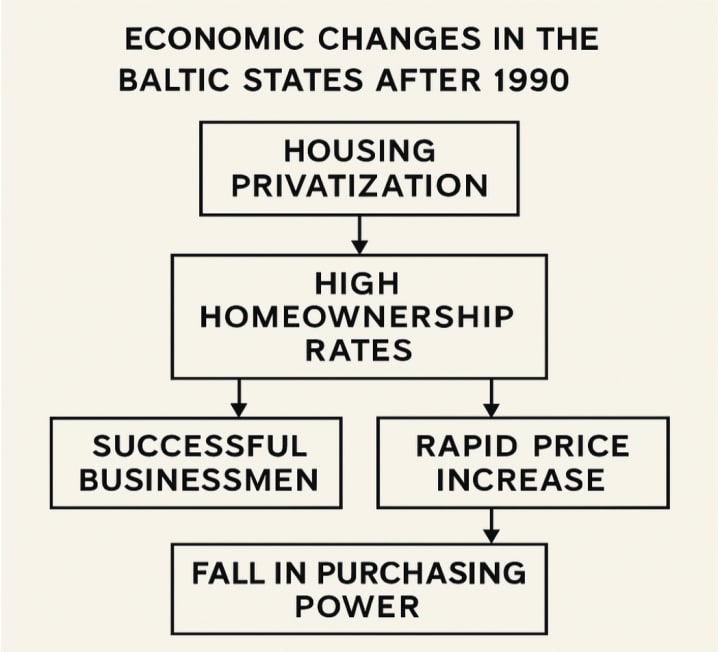
The Baltic countries include Latvia, Lithuania, and Estonia, all located on the east of the Baltic Sea. Throughout history, the Baltic states battled many wars and saw themselves integrate into the USSR in August of 1940 where they remained until the fall of the USSR in 1990. After the collapse, the Baltic states went through mass privatization of housing in the 1990s. Many residents inherited their apartments at very low cost or for free.
Emerging economies and house privatization(1990-2003)
This led to high homeownership rates at about 80-90%, much higher than Western Europe at the time. However, the privatized stock is aging and often poorly maintained, requiring costly renovations as affordability isn’t just about purchase price, but also maintenance and modernization costs. As primary data from my dad’s friend who was in Latvia during the soviet unioin collapse, he stated that ”it was like a huge pot of gold was rained on the country, everyone was scrambling for a piece of it” Basically, from a citizens perspective, many regulation and restrictions to economic transactions were lifted and many intuitive entrepreneurs in the country were scrambling on optimising their profit by going into to industries that were sanctioned in the past. My friend's father saw the economic opportunity that was available and decided to quickly get into the industry of Jeans as soon as the sanctions were lifted. What seems like a small sector of industry led to his team generating millions of euros from capitalizing quickly on this gold rush. Many individuals who decided to follow similar routes became successful businessmen, while the working class, who perhaps didn't have such intuitive ideas and remained at the jobs that they were already in, saw a rapid price increase and a fall in their purchasing power.
All this money flowing in also attracted international investors.
In Estonia, inflows rose from $82 million in 1992 to $300 million by 1997. In Latvia, inflows increased from $29 million in 1992 to $418 million in 1997. Lastly, in Lithuania, inflows grew from $31 million in 1993 to $355 million in 1997. An increase of over 655% in just 5 years
Many investors funded manufacturing, financial services, and trade sectors, making the economy more diverse from the heavily favored primary sector that it used to have.
EU Integration (2004-)
Since joining the EU in 2004, the Baltics experienced rapid housing price increases, especially in capital cities mainly driven by foreign investment, economic growth, and EU integration. The baltics achieving EU membership showed promise of economic and political stability which attracted foreign investemnt and speculative investment in real estate, especially in the capital cities where investors expected high returns in the long run. Investors from Scandinavia, Germany, and other EU countries saw opportunities for investment in many emerging markets in countries that have just transitioned from post soviet economies.
Government decision (2005-2010)
This rise in demand for property made the governments adjust by implementing shorter loan maturities and higher down payments compared to Western Europe countries. These strict lending policies made access harder for low income people and especially young buyers who were expected to carry the shifted economy of the baltics in the following generation.
Interest rates were historically low (2010s), but rising rates since 2022 which worsens affordability.
Furthermore, many people within and outside the countries migrated to the capital cities of Talinn, Riga and Vilnius, for better hob opportunities, pushing demand in the urban centers while rural areas in these countries saw stagnation with both population and economic growth. Lastly, with the integration with EU , this brought billions in EU structural funds, improving infrastructure, transport, and many public services, further boosting the attractiveness of Vilnius Riga and Talinn, for residents and investors.
Currency change (2011-2015)
Between 2011-2015, the baltic states integrated euros as their currency, Estonia in 2011, Latvia in 2014 and Lithuania in 2015. Driven by foreign investment, economic growth, and EU persuasion. Although this integration had many positive benefits, it also caused some problems, especially with the affordability of housing market.
After the implementation of euros, housing prices rose rapidly, particularly in capital cities This was fueled by several reasons such as
- increased foreign and domestic investment in real estate
- Growing urban populations
- Limited new housing supply
Meanwhile, wage growth lagged behind all these rising housing prices, leading to a decreasing in housing affordability, especially for young people and first time homebuyers.
Between 2010 and 2020, Tallinn apartment prices doubled, while wages grew at a much slower rate. Price-to-income ratios in the capital cities became among the highest in the EU.
Housing affordability for many households declined. The gap between those who already owned property and those trying to enter the market widened through time. This situation reflects a demand-pull inflation in housing, partly driven by foreign capital inflows and urbanization, while wages failed to keep pace. It also demonstrates a form of income inequality where asset owners gain more wealth, while wage earners struggle to keep up with rising living costs.

The economy initially starts at equilibrium point E₁, where income and housing prices allow for reasonable affordability for many households. However, as housing prices rise faster than wages, affordability declines. The red arrow shows a movement from E₁ → E₂, signaling higher price-to-income ratio The blue arrow shows only a small increase in wages over the same period. This diagram shows the difference in gradient/steepness between income and housing affordability. Yes its true that during this time income has been increasing, but it is clear that it hasnt matched the increase in housing. Housing prices doubled in Tallinn and similar trends in Riga and Vilnius.
Recent years(2016-2025)
The Baltic economies saw steady growth during this period, leading to increased household incomes. This economic prosperity boosted consumer confidence and demand for housing .In 2023 Lithuania s PPP was 57,200$, Estonias was 49,670$ and Latvia with 44,560$. Ranking 39th, 40th and 41st globally, surpassing countries such as Italy and the UK. These rankings highlight the Baltic states' successful economic transformations since leavin the USSR and their growing parity with established Western European economies. Lithuania particularly ranks amongst the highest in the world in terms of Global Entrepreneurship Index where they rank 2nd in the world, further promising mass migration to the city in the near future.
Furthermore, the region attracted substantial foreign direct investment, particularly in real estate. For instance, in 2017, Invest Lithuania secured 39 FDI projects, contributing to job creation and economic activity. Also, a trend toward urban living increased demand for housing in cities like Tallinn, Riga, and Vilnius, putting upward pressure on prices. Unfortunately for local individuals who are eager to get into the property market in th baltic capitals, the supply of new housing does not keep pace with demand, leading to increased competition and higher prices for available properties.
For example,
In Tallinn In January 2017, the average apartment price in Tallinn was €1,735 per square meter, a 12% increase from the previous year.
Between 2014 and 2019, house prices in Lithuania increased by 24.5%. In 2021, prices surged by 22.4%, followed by a 19.1% increase in 2022.
Apartment prices in Riga increased by 6% in 2017, reflecting steady growth in the housing market.
In recent years, the Baltic real estate markets have faced challenges such as high inflation and increased interest rates, leading to a slowdown in market activity. However, housing prices have remained relatively stable, with slight increases in Tallinn and Vilnius in 2023, while Riga experienced only a modest decline. Strong fundamentals, such as a robust labor market and relatively low household debt, have helped prevent a significant downturn in the housing market.
As an individual who spends his summers in the Baltic states, I have noticed that on paper, inflation rates have been quite stable but in reality, prices of groceries and coffee shops have increased significantly through recent years, especially after covid. I believe that this is because of the fixed basket of goods that measures the Consumer Price Index in lithuania is inaccurate to real prices. What may take up a large percentage of peoples incomes such as public transportation which the price hasn't risen much compared to coffee in coffee shops skyrocketing. The coffee is a smaller percentage of the basket of goods that people spend their income on compared to public transportation, which leads to improper data for the reality in living in the capital cities of these countries.
Conclusion
In conclusion, the story of housing affordability in the Baltic states is closely intertwined with their rapid economic transformation since the collapse of the Soviet Union. Mass privatization in the 1990s laid the foundation for high homeownership, but aging housing stock and rising maintenance costs quickly emerged as challenges. As the Baltics integrated into the EU and adopted the euro, foreign investment and urbanization fueled strong demand for property, especially in capital cities like Vilnius, Riga, and Tallinn. However, while housing prices soared, wage growth lagged behind, leading to a large difference in affordability of property for its citizens, particularly affecting young people and first-time buyers.
The region’s economic success, reflected in strong GDP per capita and other global rankings, has come with unintended consequences for housing equality. Asset owners have gained wealth through rising property values, while many wage earners struggle to enter an increasingly expensive housing market. The combination of limited housing supply, foreign investment, and rising living costs has created structural challenges that persist today. Moving forward, policy solutions balancing economic growth, investment incentives, and housing affordability will be crucial to ensure that the benefits of the Baltic economic miracle are shared more equally across society.
Works Cited
“Entrepreneurship in Lithuania.” GEM Global Entrepreneurship Monitor, GEM, 2024, www.gemconsortium.org/economy-profiles/lithuania-2. Accessed 10 May 2025.
“Estonia Foreign Direct Investment 1992-2025 | MacroTrends.” Macrotrends.net, 2025, www.macrotrends.net/global-metrics/countries/EST/estonia/foreign-direct-investment? Accessed 10 May 2025.
“Estonia GDP per Capita PPP.” Tradingeconomics.com, 2023, tradingeconomics.com/estonia/gdp-per-capita-ppp. Accessed 10 May 2025.
Guide, Global Property. “Lithuania’s Residential Real Estate Market Analysis 2024.” Global Property Guide, 16 Sept. 2024, www.globalpropertyguide.com/europe/lithuania/price-history?, https://www.globalpropertyguide.com/europe/lithuania/price-history?. Accessed 10 May 2025.
“Latvia GDP per Capita PPP.” Tradingeconomics.com, 2023, tradingeconomics.com/latvia/gdp-per-capita-ppp.
“Lithuania GDP per Capita PPP - 2021 Data - 2022 Forecast - 1990-2020 Historical.” Tradingeconomics.com, tradingeconomics.com/lithuania/gdp-per-capita-ppp.
News, ERR. “Statistics: Property Price Changes at Five-Year High to Q1 2020.” ERR, Eesti Rahvusringhääling | ERR, 19 June 2020, news.err.ee/1104262/statistics-property-price-changes-at-five-year-high-to-q1-2020. Accessed 10 May 2025.
“Standart Type Apartment Market Overview | SEPTEMBER - Dzīvoklis, Māja, Zeme, Birojs Vai Noliktava - Nekustamais Īpašums Latvijā, ARCO REAL ESTATE.” Arcoreal.lv, 2025, www.arcoreal.lv/en/news/2017/standart-type-apartment-market-overview--september-1280/?utm_source=chatgpt.com. Accessed 10 May 2025.
About the Creator
Keep reading
More stories from Garri Citrons and writers in Trader and other communities.
How will AI affect the kind of jobs that young people today are preparing for?
The fear of certain jobs being susceptible to automation seems to be growing amongst young people today. Although this fear could have lingered way back in time, these concerns properly began in the 1970’s where many individuals feared that automation could replace factory workers. After the Second World War, industries in the USA, Europe, and Japan began adopting automated machinery to improve efficiency. What seemed to come out of nowhere, machines began doing tasks that previously required manual labor, such as machining and packaging. Many citizens began to notice how fewer workers were needed in the production line, which led to a fear of mass layoffs among individuals who worked in manual labour. Many wondered how sustainable their job was and acknowledged the preference in businesses choosing robots and machines that rarely made mistakes over humans. I encourage you to put yourself in the shoes of a labour worker back then, where out of nowhere, machines were replacing jobs of people you knew, making you fear for the safety of yours. By the late 1970s, computers were becoming more mainstream, which led to people who worked in accounting and bookkeeping fearing for the safety of their positions.
By Garri Citrons9 months ago in Trader
Angelina Jolie News: Surprising Career Updates and Personal Life Moments
Angelina Jolie news continues to be a favorite topic for fans around the world. From exciting film projects to updates about her family and humanitarian work, there is always something new to explore. They will cover the latest Angelina Jolie news, her career milestones, personal life developments, and inspiring activities that fans may have missed.
By John.doe7983 days ago in Trader




Comments
There are no comments for this story
Be the first to respond and start the conversation.