
Hard Money for a Soft Economy
A Young Investor’s Guide to Precious Metals


In a world oversaturated with unstable crypto hype, Wall Street jargon, and fleeting digital trends, a growing number of Millennials and Gen Z are seeking refuge in something solid: precious metals. Gold and silver have outlasted empires, economic crashes, and fiat currencies. They aren’t just shiny trinkets — they’re time-tested tools of wealth preservation. Here’s a deeper dive into how to buy gold and silver smartly, securely, and strategically.
1. Understand Your Investment Goals
Before you start stacking coins or bars, ask yourself: Why gold? Why silver? Throughout history, gold has been a universal store of value; from Ancient Egyptian tombs to the U.S. Gold Reserve Act of 1934. Silver, once called “the poor man’s gold,” was used as legal tender in Rome, China, and even the American West. Whether you want to hedge against inflation, diversify your holdings, or prepare for financial instability, you need to define your intentions before bouncing into the business.
“In periods of crisis, gold and silver have remained trusted mediums of exchange” (Rickards 28).
2. Learn the Language of Precious Metals
Investing in metals means learning the trade’s terminology:
- Bullion = Pure metal bars or coins, valued by weight and purity.
- Spot Price = The real-time market price per troy ounce.
- Premium = The markup you pay above spot, covering minting and distribution.
- Troy Ounce = ~31.1 grams. The standard measurement for precious metals.
Knowing this vocabulary empowers you to distinguish between value and hype. For example, the spot price of silver may be $64/oz, but an American Silver Eagle or Canadian Silver Maple coin may cost $72 due to its premium and demand.
🖇️ Learn More: Investopedia: Spot Price
3. Start Small. Every Stack Begins With a Single Piece.
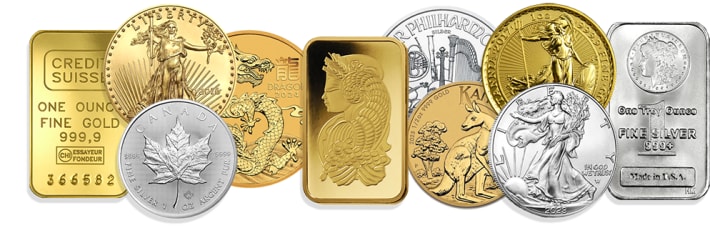
You don’t need $5,000 and a vault to begin stacking. Buy your first one ounce silver coin or a one gram gold bar. Many Gen Z stackers start by acquiring fractional ounce coins (1/2 ounce, 1/4 ounce, & 1/10 ounce) or smaller gram bars (1 gram, 5 grams, 10 grams, 50 grams, and 100 grams). The point is to build your collection slowly & gradually; dollar-cost averaging is your most reliable tool in the trade. In the 1925, a couple grams of gold bought you dinner & a show on date night. Today, those same gold grams (now worth ~$175 a gram) still could.
🖇️ Explore Starter Products: JM Bullion 1 Gram Gold Bar or Money Metals: 1 Ounce Silver Coin
4. Decide Between Physical and Digital Metals
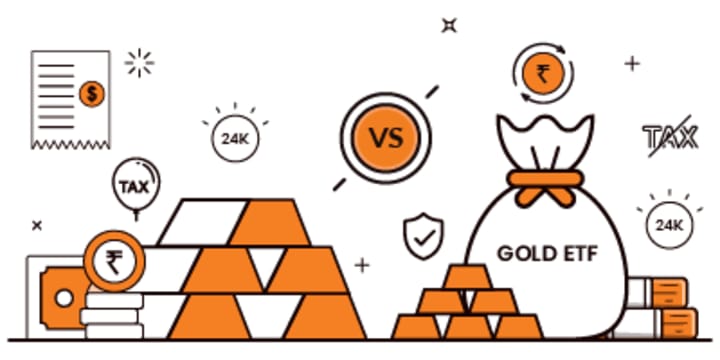
There are two main routes one can take when they choose to put their money into the precious metals market. The first being physical metals (bullion bars and coins). A tangible asset that lies in your control & is immune to cyberattacks; yet requires storage & security
The other method of lies in digital investments (ETFs or gold-backed cryptocurrencies): Unlike physical coins or bars, digital investments can more easily traded like stocks, and involves less hassle with storage. However, with that in mind, you don’t actually own the metal. It's only "in writing" that you do. Also, history tends to favor the physical. In every major economic collapse (from Weimar Germany to Venezuela) people have turned to gold and silver coins, not ETFs.
🖇️ Compare: Gold ETFs vs. Physical Gold: Pros and Cons of Each
5. Only Buy from Trusted Dealers
Gold & silver scams are nothing new. In the 1800s (be it in California, South Dakota, or the Yukon Territory) “salted” gold mines often tricked investors with fake dust. In more modern times, the scams are most commonly found online; where there is more vulnerability to deceive the customer and run with their money after the sale is made.
Stick with reputable dealers. Be them online or local dealers in your area:
Whatever place you ultimately do choose to buy from, always keep a eye out for the following.
- Secure payment options
- Clear return policies
- Transparent pricing
“Reputation and trust are everything in the precious metals market” (Maloney 112).
6. Understand Premiums, Spreads, and Dealer Markups
One of the most common mistakes made by amateurs in the precious metals market is assuming the price of a coin, bar, or a piece of jewelry is the spot price. Not true. That’s just the metal’s base value. You will also be paying a premium; and when you choose to sell, later on, dealers will often pay you below spot. That monetary difference is called "the spread".
For example:
- Spot price: $4,000/oz gold
- Buy price: $4,120
- Sell-back price: $3,970
Understanding these mechanics avoids you from experiencing "sticker shock" when it’s time to cash out (especially if you’re stuck with having to sell when the prices are down).
🖇️ Price tracker: Live Spot Prices on APMEX
7. Have a Secure Storage Plan
Gold and silver are valuable and portable, which makes them ideal for preppers and burglars.
Your storage options can vary based on your situation.
- Home Safe (fireproof, anchored)
- Bank Safe Deposit Box
- Private Vault Services (such as Brinks or SD Depository)
If you prefer to store them at home, tell one trusted person. That secret dies with you, otherwise.
8. Know the Tax Rules
The IRS considers gold and silver collectibles; meaning that any gains are subject to a 28% capital gains tax in the U.S.
Keep records:
- Date of purchase
- Price and weight
- Dealer info and receipts
Also, be aware of reporting thresholds. For example, selling 25+ 1 oz Gold Eagles may trigger IRS reporting by the dealers you sold to.
🖇️ IRS Guidelines on Precious Metals
9. Diversify Your Metal Holdings
A smart metals investor doesn’t just stack one kind:
- Gold = Long-term wealth storage.
- Silver = More volatile, but affordable and with industrial demand.
- Platinum & Palladium = Useful in automotive & green energy tech.

Also diversify:
- Government-minted coins (e.g., American Eagle, Canadian Maple Leaf)
- Bars (1 oz, 10 oz, 100 oz)
“Silver is the working-class metal. Gold is aristocratic. Owning both gives balance” (Rickards 33).
10. Keep Learning & Stay Metal-Savvy
This market evolves with inflation, central bank policy, and global demand. Educate yourself regularly via:
Literature: The New Case for Gold by James Rickards
Social Media: Silver Dragons, TraxNYC
Online News: Kitco News
🖇️ Bookmark: APMEX Knowledge Center
Final Word: Gold Is Old, but Your Future Is Young
While meme stocks come and go and crypto swings like a wrecking ball, gold and silver remain steady. These metals are more than relics; they’re recession-resistant, inflation-proof, and battle-tested stores of value. Whether you’re 19 or 39, investing in precious metals means investing in stability.
Works Cited (MLA)
- Maloney, Michael. Guide to Investing in Gold and Silver. Rich Dad Advisors, 2008.
- Rickards, James. The New Case for Gold. Portfolio, 2016.
- "Why Gen Z and Millennials Are Buying Gold and Silver." Fisher Precious Metals, 2023. https://fisherpreciousmetals.com
- "How to Buy Gold and Silver." APMEX, 2023. https://www.apmex.com
- U.S. Geological Survey. "Final List of Critical Minerals 2025." https://www.usgs.gov
About the Creator
Jacob Herr
Born & raised in the American heartland, Jacob Herr graduated from Butler University with a dual degree in theatre & history. He is a rough, tumble, and humble artist, known to write about a little bit of everything.
Keep reading
More stories from Jacob Herr and writers in Trader and other communities.
Profit, Plunder, and the Proletariat
The Threepenny Opera stands as one of the most scathing indictments of society ever to grace the stage. It is a darkly satirical masterpiece (one I had the opprotunity to perform in as a college theatre student), that strips away the exterior image of respectability to reveal an interior world; one where morality is for sale to the highest bidder. Born from the collaboration of playwright Bertolt Brecht and composer Kurt Weill in 1928, the work blurs the boundaries between high art and popular culture. Together they weaved together biting social critiques and revolutionary theatrical techniques. When their landmark production was first put to the silver screen, in 1931, the narrative became infused with a cinematic realism that further exposed the rot at the core of societal norms and contemporary human behavior. This analysis explores the historical background of The Threepenny Opera, while also examining how the stage play’s revolutionary approach to theater evolved in the new medium of cinema; as well as how future adaptations continue to resonate as powerful commentaries on pervasive social corruption.
By Jacob Herrabout a year ago in Art
Australia Oat Milk Market 2026: Plant-Based Beverage Growth, Health Trends & Sustainable Consumption
Australia Oat Milk Market Overview The Australia oat milk market is expanding rapidly as consumers increasingly embrace plant-based and dairy-free alternatives driven by health, environmental and lifestyle considerations. Oat milk—a plant-derived beverage made from oats and water—is gaining traction as a creamy, nutritious substitute for traditional dairy milk. It is widely used in coffee, tea, smoothies, breakfast cereals and baking, and has become a staple within the rising plant-based consumption trend across Australia’s urban and regional populations. Growth is supported by rising lactose intolerance awareness, a surge in vegan and flexitarian diets, and expanded availability across retail and foodservice channels.
By Amyra Singh4 days ago in Trader



Comments (1)
I like how you're breaking down the world of precious metals investing. Understanding the lingo is crucial. I remember when I first started looking into this, the terms were confusing. It's smart to start small, like you said. I'm curious, though. How do you think the current economic situation will affect the demand for gold and silver in the next few years? And which do you think is a better long-term investment right now?