
Algae Products Market Size and Forecast 2026–2034
Sustainable Nutrition, Clean-Label Ingredients, and the Rising Commercial Power of Algae-Based Solutions

Introduction
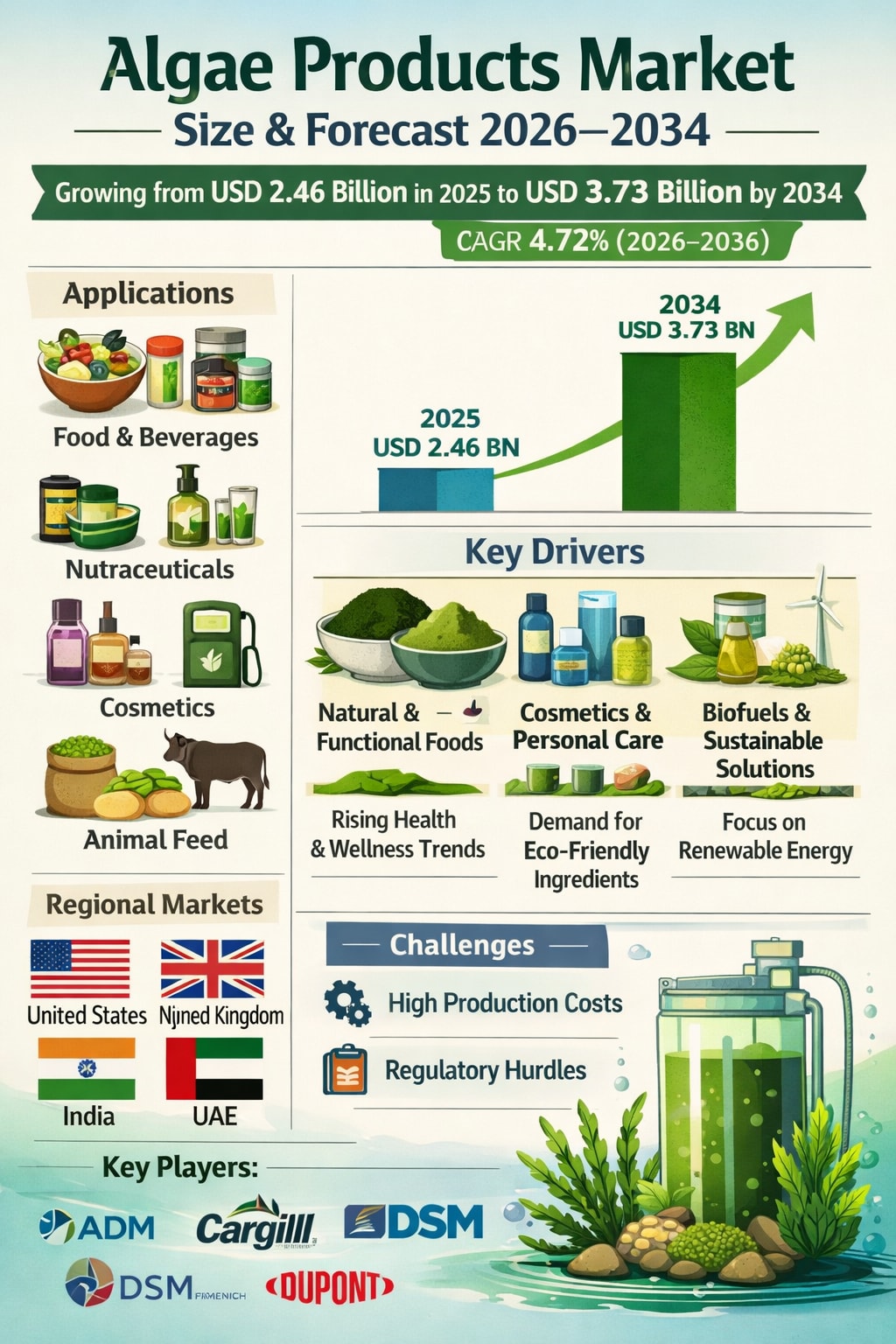
The global shift toward sustainability, health-conscious consumption, and eco-friendly industrial practices is reshaping multiple industries—and the algae products market stands at the center of this transformation. According to Renub Research, the Algae Products Market is expected to reach US$ 3.73 billion by 2034, rising from US$ 2.46 billion in 2025, at a CAGR of 4.72% from 2026 to 2034. This steady growth reflects the expanding role of algae in food and beverages, dietary supplements, cosmetics, pharmaceuticals, animal feed, and even renewable energy.
Once viewed primarily as a niche ingredient, algae have evolved into a strategic resource for companies seeking natural, functional, and sustainable alternatives to conventional raw materials. Rich in proteins, vitamins, minerals, antioxidants, pigments, and essential fatty acids, both microalgae and macroalgae (seaweed) offer a unique combination of nutritional density and environmental efficiency. Their ability to grow rapidly, require less land than traditional crops, and absorb carbon dioxide makes them especially attractive in a world increasingly focused on climate responsibility and resource efficiency.
As industries pursue cleaner labels, plant-based formulations, and greener supply chains, algae-based products are gaining commercial traction. From spirulina powders in health supplements to alginates in cosmetics and lipids in biofuel production, the versatility of algae is redefining how natural ingredients are sourced and applied across sectors.
Algae Products Industry Overview
The algae products industry has emerged as a dynamic and multi-sectoral segment within the global bio-based economy. Algae are broadly categorized into microalgae (such as spirulina and chlorella) and macroalgae (commonly known as seaweed), both of which are cultivated for their high-value biochemical components. These organisms are rich sources of proteins, omega-3 fatty acids, carotenoids, pigments, polysaccharides, and other bioactive compounds that support a wide range of commercial applications.
Technological progress has played a critical role in accelerating industry growth. Innovations such as photobioreactors, closed-loop cultivation systems, and advanced extraction techniques have improved yield consistency, product purity, and cost efficiency. These advancements allow manufacturers to scale production while meeting stringent quality standards required by the food, pharmaceutical, and personal care industries.
Beyond nutrition and wellness, algae are increasingly being explored for industrial and environmental applications, including biofuels, bioplastics, wastewater treatment, and carbon capture solutions. This broad applicability strengthens the industry’s long-term outlook and positions algae as a strategic resource in the global transition toward sustainable production models.
Moreover, supportive government policies, rising investments in biotechnology, and increasing consumer awareness of environmental issues continue to reinforce the market’s expansion. As a result, the algae products industry is not only growing in size but also in strategic importance across multiple value chains.
Key Growth Drivers of the Algae Products Market
Rising Demand for Nutritional and Functional Foods
One of the most powerful drivers of the algae products market is the global shift toward health, wellness, and preventive nutrition. Microalgae such as spirulina and chlorella are widely recognized for their high protein content, essential amino acids, vitamins, minerals, and antioxidants. These nutritional benefits make algae-based ingredients highly attractive for functional foods, fortified beverages, and dietary supplements.
Consumers today are increasingly seeking plant-based, clean-label, and nutrient-dense alternatives to traditional food ingredients. Algae fit perfectly into this trend, offering a natural solution for protein supplementation, immune support, and overall wellness. Additionally, bioactive compounds found in algae are associated with anti-inflammatory, cardiovascular, and antioxidant benefits, further strengthening their appeal in the nutraceutical sector.
As lifestyle-related health issues continue to rise globally, demand for functional and preventive nutrition solutions is expected to grow—providing sustained momentum for algae-based products in the food and supplement markets.
Expanding Use in Cosmetics and Personal Care
The cosmetics and personal care industry is another major growth engine for the algae products market. Algae-derived ingredients such as alginates, carrageenan, fucoidan, and carotenoids are widely used in skincare, haircare, and anti-aging formulations. These compounds are valued for their moisturizing, antioxidant, soothing, and skin-protective properties.
With consumers becoming more conscious of ingredient safety, sustainability, and ethical sourcing, brands are increasingly replacing synthetic chemicals with natural, vegan, and eco-friendly alternatives. Algae-based ingredients meet these expectations while also offering functional performance benefits, making them particularly attractive for premium and clean beauty product lines.
The global expansion of the beauty and personal care sector, combined with rising demand for sustainable and high-performance ingredients, continues to drive the adoption of algae-derived solutions across cosmetic applications.
Growing Interest in Biofuels and Sustainable Industrial Applications
Sustainability initiatives and the global push to reduce carbon emissions are fueling interest in algae-based industrial solutions. Algae are rich in lipids and carbohydrates, making them suitable for the production of biodiesel, bioethanol, and biogas. Compared to traditional biofuel crops, algae offer higher productivity per unit area and do not compete directly with food crops for arable land.
Beyond energy, algae are increasingly used in animal feed, bioplastics, fertilizers, and wastewater treatment, highlighting their versatility as a bio-based resource. Continued innovation in cultivation methods, including improved photobioreactors and closed-system production, has enhanced scalability and cost efficiency, making industrial applications more commercially viable.
As governments and corporations intensify their focus on renewable resources and circular economy models, algae-based industrial solutions are expected to play a more prominent role in sustainable manufacturing ecosystems.
Challenges Facing the Algae Products Market
High Production and Processing Costs
Despite its strong potential, the algae products market faces a significant challenge in the form of high cultivation, harvesting, and processing costs. Large-scale algae production often requires controlled environments, specialized equipment, and nutrient-rich water systems, all of which increase capital and operational expenditures.
Furthermore, the extraction and purification of high-value compounds such as proteins, oils, and pigments typically involve energy-intensive and technologically complex processes. These factors can make algae-derived products more expensive than conventional alternatives, particularly in price-sensitive markets.
For smaller producers and startups, achieving economies of scale remains difficult, which can limit competitiveness and slow market penetration. Reducing production costs while maintaining consistent quality and safety standards is therefore a critical priority for long-term industry growth.
Regulatory Compliance and Market Standardization
Regulatory complexity is another important barrier to faster market expansion. Different regions apply varying standards for food safety, dietary supplements, cosmetics, and biofuel products, requiring manufacturers to navigate a complex web of approvals, certifications, and compliance procedures.
In addition, the absence of universally standardized quality benchmarks for algae-derived products can lead to inconsistencies in nutrient content, bioactive compound concentration, and product performance. These inconsistencies may affect consumer trust and slow adoption in regulated industries such as pharmaceuticals and functional foods.
To overcome these challenges, companies must invest heavily in quality control systems, clinical validation, and regulatory documentation—steps that increase time-to-market and operational costs but are essential for building long-term credibility and global market access.
Regional Market Insights
United States Algae Products Market
The United States represents one of the most dynamic markets for algae-based products, driven by strong demand across food, beverages, dietary supplements, cosmetics, pharmaceuticals, and biofuels. American consumers are increasingly embracing plant-based diets, functional foods, and clean-label products, creating favorable conditions for algae-derived ingredients.
Technological innovation is a key strength of the U.S. market, with advanced cultivation systems and extraction technologies improving product quality and scalability. In addition, government initiatives supporting renewable energy, sustainable agriculture, and eco-friendly manufacturing further reinforce market growth. With continuous innovation and broad application potential, the U.S. algae products market is well positioned for sustained expansion.
United Kingdom Algae Products Market
In the United Kingdom, growing awareness of health, nutrition, and sustainability is driving steady adoption of algae-based products. Microalgae such as spirulina and chlorella are increasingly used in functional foods, dietary supplements, and beverages, supported by the rising popularity of plant-based and clean-label lifestyles.
The cosmetics and personal care sector also plays a significant role, as algae-derived ingredients gain traction for their antioxidant and anti-aging properties. Coupled with supportive policies for sustainable resources and increasing interest in bio-based industrial applications, the U.K. market is expected to maintain a positive growth trajectory over the forecast period.
India Algae Products Market
India’s algae products market is experiencing notable growth, fueled by rising demand for nutrient-rich, natural, and affordable health solutions. Spirulina and chlorella are widely recognized in India for their high protein and micronutrient content, making them popular in dietary supplements and functional foods.
Advancements in local cultivation techniques, including open-pond and photobioreactor systems, are improving production efficiency and supporting broader industrial use. Additionally, government initiatives promoting renewable energy, sustainable agriculture, and biofuels are strengthening the market foundation. With increasing health awareness and expanding applications, India is emerging as an important growth market for algae-based products.
United Arab Emirates Algae Products Market
The UAE algae products market is growing steadily, supported by rising interest in sustainable nutrition, eco-friendly ingredients, and renewable resources. Algae-based products are gaining popularity in functional foods, dietary supplements, and premium skincare formulations, driven by increasing health consciousness and demand for clean-label products.
Technological investments in controlled-environment agriculture and bioreactor systems are helping overcome regional climate constraints and improve production efficiency. With strong government support for sustainability and innovation, the UAE market is expected to continue expanding across both consumer and industrial segments.
Recent Developments in the Algae Products Market
May 2025: Galdieria extract blue, derived from the unicellular red algae Galdieria sulphuraria, received FDA certification as a certification-exempt color additive, expanding natural colorant options for food manufacturers.
October 2024: DSM-Firmenich launched Life’s DHA B54-0100, a high-potency algal oil designed to address omega-3 deficiencies and enable smaller supplement capsules, strengthening its position in North America.
October 2024: Algiecel secured EUR 6.5 million in equity funding to expand microalgae production for food and feed applications, focusing on CO₂-based bioreactor feedstock.
April 2024: The European Commission authorized beta-glucan from Euglena gracilis microalgae as a novel product, granting Kemin Foods five years of exclusivity for use in selected food and beverage products.
Market Segmentation
By Type: Lipids, Carrageenan, Carotenoids, Algal Protein, Alginate, Others
By Source: Brown Algae, Blue-Green Algae, Red Algae, Green Algae
By Form: Solid, Liquid
By Application: Food & Beverages, Nutraceuticals & Dietary Supplements, Personal Care, Feed, Pharmaceuticals, Chemicals, Others
By Geography: North America, Europe, Asia Pacific, Latin America, Middle East & Africa
Competitive Landscape
Key companies profiled in the market include Archer Daniels Midland Company, Cargill Incorporated, BASF SE, DuPont de Nemours Inc., Koninklijke DSM N.V., Yemoja Ltd., Progress Biotech BV, and Aliga Microalgae Companies, each analyzed across business overview, leadership, recent developments, SWOT, and revenue performance.
Final Thoughts
The global algae products market is steadily transforming from a niche segment into a strategic pillar of the sustainable bio-based economy. With Renub Research projecting growth from US$ 2.46 billion in 2025 to US$ 3.73 billion by 2034, the industry’s future is anchored in health-driven consumption, clean-label innovation, and environmentally responsible production models.
While challenges such as high production costs and regulatory complexity remain, continued technological innovation and expanding applications across food, cosmetics, energy, and industry are strengthening the market’s long-term outlook. As sustainability and wellness become central themes in global consumption and manufacturing, algae-based products are poised to play an increasingly influential role in shaping the future of multiple industries.
About the Creator
AI in Education Market Size and Forecast 2026–2034: Transforming Global Learning Through Intelligent Technologies
AI in Education Market: A Rapidly Expanding Global Industry The global AI in Education Market is entering a phase of remarkable expansion as digital transformation reshapes how knowledge is delivered, consumed, and managed. According to Renub Research, the market is expected to grow from US$ 5.21 billion in 2025 to US$ 61.34 billion by 2034, registering a robust compound annual growth rate (CAGR) of 31.52% from 2026 to 2034. This extraordinary growth reflects the rising role of artificial intelligence in making education more personalized, scalable, and efficient across the world.
By shibansh kumara day ago in Trader




Comments
There are no comments for this story
Be the first to respond and start the conversation.