
Global Vitiligo Market Size and Forecast: A Decade of Innovation, Awareness, and Expanding Care
How rising awareness, new therapies, and healthcare investments are reshaping the global vitiligo treatment landscape through 2033

Introduction: A Skin Condition with a Growing Global Voice
Vitiligo is a chronic skin disorder characterized by the loss of pigmentation, leading to white patches on different parts of the body. This happens when melanocytes—the cells responsible for producing melanin—are destroyed or stop functioning properly. While vitiligo is neither contagious nor life-threatening, its psychological and social impact can be profound, often affecting self-esteem, mental health, and quality of life.
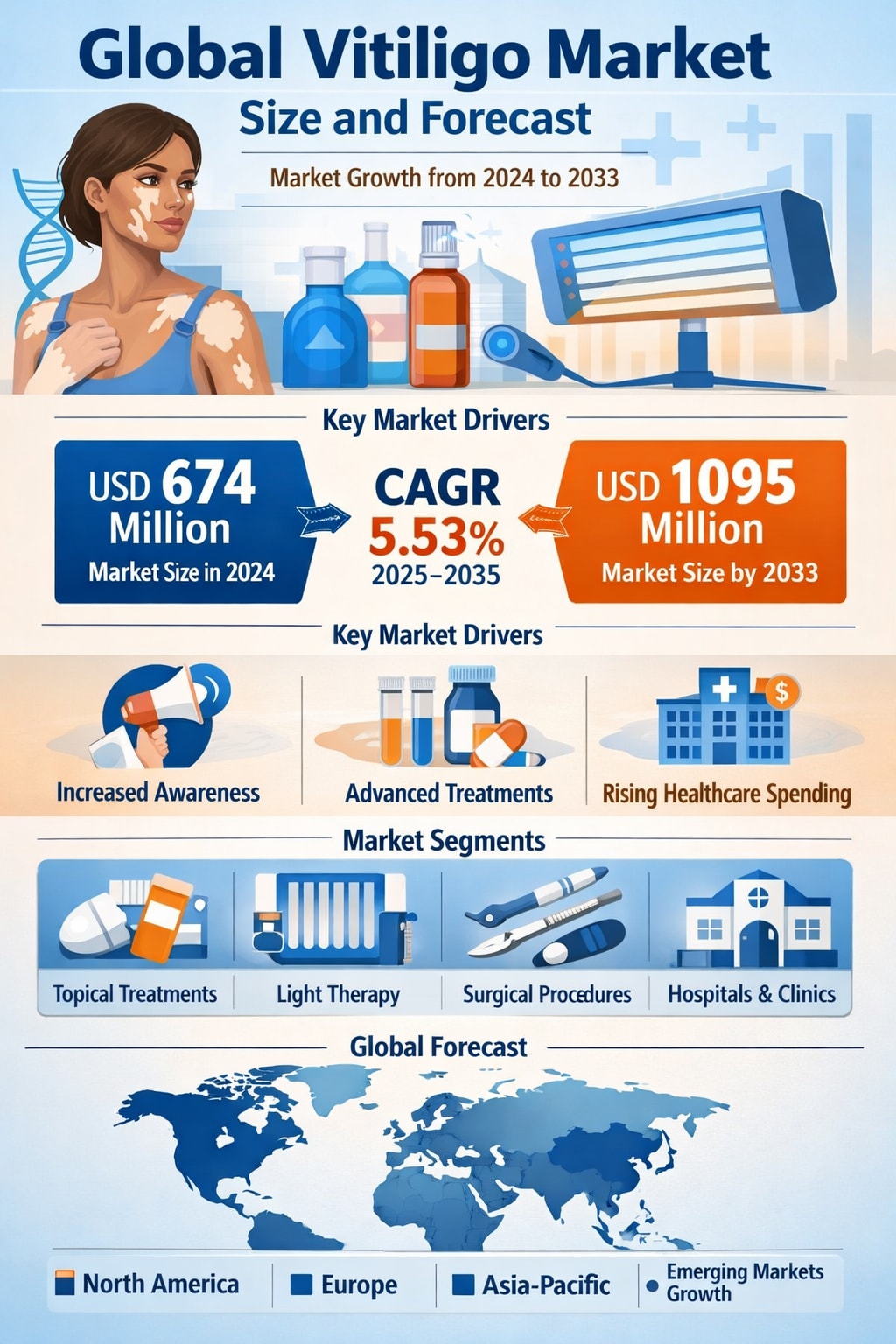
According to Renub Research, the Global Vitiligo Patient Market reached USD 674 million in 2024 and is expected to grow to USD 1,095 million by 2033, expanding at a compound annual growth rate (CAGR) of 5.53% from 2025 to 2033. This steady growth reflects not only the rising prevalence of autoimmune skin conditions but also significant progress in dermatological treatments, better awareness, and improved access to care across both developed and emerging economies.
Globally, vitiligo affects an estimated 1–2% of the population, making it one of the more common pigmentary disorders worldwide. Although there is still no definitive cure, modern medicine has made it increasingly possible to manage symptoms, improve skin appearance, and support patients psychologically. From topical therapies and light-based treatments to advanced surgical procedures and emerging biologics, the vitiligo treatment ecosystem is evolving rapidly.
As public conversations around skin health, diversity, and inclusivity grow louder, vitiligo is no longer a silent condition. It is becoming a visible part of the global healthcare narrative—and the market numbers reflect that shift.
Global Vitiligo Market Overview and Trends
The global vitiligo market is shaped by a combination of medical innovation, rising awareness, and expanding healthcare infrastructure. Historically, treatment options were limited mainly to topical corticosteroids and basic phototherapy. Today, the landscape looks very different.
Newer treatment approaches—such as topical JAK inhibitors, improved narrowband UVB (NB-UVB) phototherapy devices, and regenerative techniques like melanocyte transplantation—are transforming patient outcomes. These advances are not only improving clinical results but also increasing patient confidence in seeking treatment, which in turn fuels market growth.
Another important trend is the normalization of vitiligo in public discourse. Awareness campaigns, patient advocacy groups, and high-profile public figures living with vitiligo have helped reduce stigma and encourage early diagnosis. As a result, more patients are entering the healthcare system, expanding the addressable market for treatments and services.
Digital health is also playing a role. Teledermatology platforms are making specialist consultations more accessible, particularly in rural or underserved regions. This improved access is helping close treatment gaps and bringing more patients into long-term care pathways.
Key Drivers of Growth in the Global Vitiligo Market
1. Increased Awareness and Early Diagnosis
One of the strongest growth drivers is the rise in awareness and education around vitiligo. Healthcare organizations, dermatology associations, and patient advocacy groups are actively working to de-stigmatize the condition and promote early medical consultation.
Social media and digital platforms have amplified these efforts, making reliable information more accessible and helping patients connect with support communities. As awareness grows, so does the demand for both over-the-counter and prescription treatments.
In June 2024, for example, Glenmark Pharmaceuticals Ltd and the Indian Association of Dermatologists, Venereologists and Leprologists (IADVL) launched an awareness campaign focused on vitiligo. The initiative included creative outreach such as postcards and calendars featuring artwork from a painting contest held on World Vitiligo Day, aiming to promote understanding and treatment options.
Early diagnosis allows for earlier intervention, which often leads to better outcomes—further reinforcing patient trust in medical treatments and driving sustained market demand.
2. Advancements in Treatment Modalities
Scientific progress in dermatology is another major catalyst. The development of targeted therapies, especially topical JAK inhibitors, has opened new possibilities for patients who previously had limited or inconsistent responses to traditional treatments.
In parallel, phototherapy technologies have become more precise, safer, and increasingly available in both clinical and home-use formats. Regenerative approaches, including melanocyte transplantation, are also gaining attention for their potential to deliver longer-lasting repigmentation in selected patients.
Pharmaceutical and biotechnology companies are investing heavily in clinical trials and R&D, aiming to bring more effective, durable, and patient-friendly treatments to market. In October 2024, for instance, Kenvue Inc. announced multi-year collaborations for its Neutrogena® brand with leading dermatology experts, underscoring the growing commercial and scientific focus on advanced skincare and pigmentary disorders.
These innovations are not just improving outcomes—they are expanding the overall market by attracting patients who previously felt treatment options were too limited or ineffective.
3. Growing Healthcare Spending and Access
Rising healthcare expenditure worldwide, particularly in emerging economies, is significantly improving access to dermatological care. Governments are investing more in healthcare infrastructure, and insurance coverage for skin conditions is gradually expanding in many regions.
In March 2022, the Centers for Medicare & Medicaid Services (CMS) projected that U.S. national health spending would grow at an average of 5.1% per year between 2021 and 2030, reaching approximately USD 6.8 trillion. Medicare spending is expected to rise by 7.2% annually, while Medicaid spending is projected to grow by 5.6% per year. This broader increase in healthcare investment supports the adoption of advanced treatments, including those for chronic dermatological conditions like vitiligo.
Additionally, the growth of telemedicine and outpatient care models is making it easier for patients to receive consistent follow-up, which is crucial for long-term conditions that require ongoing management.
Challenges in the Global Vitiligo Market
1. Limited Long-Term Effectiveness and Risk of Recurrence
Despite significant progress, many vitiligo treatments still face limitations in long-term effectiveness. Complete and permanent repigmentation remains difficult to achieve for a large proportion of patients. Some therapies require months of consistent use before visible results appear, and outcomes can vary widely depending on skin type, disease stage, and individual response.
Phototherapy, while effective for many, can be time-consuming and carries risks such as skin irritation or uneven pigmentation. These challenges can reduce patient adherence and overall satisfaction, potentially slowing market growth in certain segments.
2. Psychological and Social Stigma
In many parts of the world, vitiligo continues to be surrounded by social stigma and misinformation. Some communities still incorrectly associate the condition with contagion or other diseases, which can discourage patients from seeking timely treatment.
The emotional burden—ranging from anxiety and low self-esteem to depression—can also affect treatment compliance. Until stigma is more widely addressed through education and advocacy, a portion of the potential market will remain underserved, especially in conservative or low-awareness regions.
Global Vitiligo Market Segmentation Overview
The global vitiligo market is segmented by:
Disease Type: Segmental, Non-Segmental
Treatment Type: Topical Treatments, Light Therapy, Surgical Procedures, Others
End User: Hospitals, Ambulatory Clinics, Others
Geography: North America, Europe, Asia-Pacific, Middle East & Africa, South America, and Rest of the World
Each segment plays a distinct role in shaping market dynamics. North America currently holds a significant share due to high awareness and advanced healthcare systems, while Asia-Pacific is expected to witness faster growth driven by rising investments, increasing awareness, and expanding access to care.
Focus on Key Market Segments
Topical Treatments Market
Topical therapies remain the first line of treatment for most vitiligo patients. Common options include corticosteroids and calcineurin inhibitors, which help reduce inflammation and stimulate repigmentation. The emergence of topical JAK inhibitors is adding a new layer of targeted treatment, with promising clinical results.
Because these treatments are non-invasive and relatively easy to use, they are widely preferred by both patients and dermatologists. Ongoing R&D and regulatory approvals for newer agents are expected to keep this segment on a steady growth trajectory.
Light Therapy Market
Light therapy—particularly narrowband UVB (NB-UVB) and excimer laser treatments—is crucial for moderate to severe cases. These therapies stimulate melanocyte activity and are often used in combination with topical medications for better results.
Technological advancements, including home-use phototherapy devices, are improving convenience and patient adherence. While cost and the need for repeated sessions can be barriers in low-income regions, overall demand is expected to grow as technology becomes more accessible.
Hospitals as Key End Users
Hospitals remain central to vitiligo diagnosis and treatment, especially for complex or severe cases. They offer access to specialized dermatologists, advanced diagnostic tools, and combination therapies, including surgical options.
Hospitals also play a major role in clinical research and trials, contributing to the development of next-generation treatments. With ongoing investments in healthcare infrastructure worldwide, hospitals will continue to be a cornerstone of the vitiligo treatment ecosystem.
Ambulatory Clinics Market
Ambulatory clinics are gaining importance due to their convenience, lower costs, and shorter waiting times. These settings are particularly well-suited for regular follow-ups, topical therapy management, and even certain phototherapy procedures.
As outpatient care continues to expand globally, ambulatory clinics are expected to capture a growing share of vitiligo treatment services, especially in urban and semi-urban areas.
Regional Market Highlights
United States
The U.S. represents the largest vitiligo treatment market, supported by advanced healthcare infrastructure, strong R&D activity, and broad insurance coverage. According to the National Institutes of Health (NIH), vitiligo affects about 0.5% of the U.S. population, or roughly 1.5 million people.
The availability of innovative therapies, including JAK inhibitors and biologics, combined with a strong clinical trial ecosystem, positions the U.S. market for continued growth.
United Kingdom
The UK market benefits from the National Health Service (NHS) and a well-established dermatology network. Awareness campaigns by organizations such as the British Association of Dermatologists are helping reduce stigma and promote early intervention. The expansion of teledermatology and personalized treatment approaches is further strengthening market prospects.
Germany
Germany’s market is supported by high healthcare spending, strong pharmaceutical research, and early adoption of innovative treatments. In 2023, Germany became the first European country to launch Opzelura (ruxolitinib cream) for non-segmental vitiligo following European Commission approval, highlighting its leadership in dermatological innovation.
Japan
Japan’s market is growing steadily, driven by advanced medical technology, rising awareness, and strong interest in aesthetic outcomes. In October 2024, Japan Tissue Engineering Co., Ltd. announced that its regenerative product JACEMIN for vitiligo would be covered by National Health Insurance, marking a significant step for regenerative dermatology in the country.
China
China is one of the fastest-growing markets, fueled by healthcare modernization, rising disposable incomes, and increasing awareness. In April 2024, Incyte and China Medical System Holdings announced a collaboration to develop and commercialize povorcitinib, a selective JAK1 inhibitor, across Greater China and parts of Southeast Asia—signaling strong momentum for advanced therapies in the region.
Middle East: Saudi Arabia and UAE
Both Saudi Arabia and the UAE are seeing growing demand due to healthcare reforms, rising cosmetic awareness, and investments in specialized dermatology services. Medical tourism, especially in the UAE, is also contributing to the adoption of advanced vitiligo treatments.
Competitive Landscape and Key Players
The global vitiligo market is moderately competitive, with key players including:
Incyte Corporation
Bristol-Myers Squibb
Clinuvel Pharmaceuticals Ltd
Astellas Pharma Inc.
Baxter International Inc.
Pfizer
Dr. Reddy’s Laboratories Ltd
These companies are focusing on product innovation, clinical trials, partnerships, and geographic expansion to strengthen their positions and capture emerging opportunities.
Final Thoughts: A Market Driven by Medicine and Mindset
The global vitiligo market is no longer just about managing a skin condition—it is about restoring confidence, improving quality of life, and reshaping how society views visible differences. With the market projected to grow from USD 674 million in 2024 to USD 1,095 million by 2033, the coming decade will likely bring even more innovation, accessibility, and patient-centered care.
While challenges such as treatment limitations and social stigma remain, the combined forces of medical progress, rising awareness, and expanding healthcare investment are steadily transforming the vitiligo landscape. For patients, clinicians, and industry stakeholders alike, this is a market defined not just by numbers—but by meaningful, visible change.
About the Creator
Europe Agricultural Equipment Market Size and Forecast 2025–2033
Introduction: A Market Driving Europe’s Food Security The Europe Agricultural Equipment Market stands at the heart of the continent’s food security, sustainability goals, and technological transformation. Valued at USD 46.86 billion in 2024, the market is expected to grow steadily to USD 67.68 billion by 2033, registering a CAGR of 4.17% from 2025 to 2033, according to Renub Research. This growth is not happening in isolation. It reflects a deeper structural shift in European farming—one shaped by rising labor costs, aging farmer populations, stricter environmental regulations, and the rapid adoption of precision agriculture technologies.
By Sakshi Sharmaa day ago in Trader




Comments
There are no comments for this story
Be the first to respond and start the conversation.