
Global Tilt Sensor Market Size and Forecast 2025–2033: Smart Sensing in a World That Never Stops Moving
From automotive safety to smart cities, tilt sensors are quietly becoming the backbone of modern orientation and stability systems worldwide.

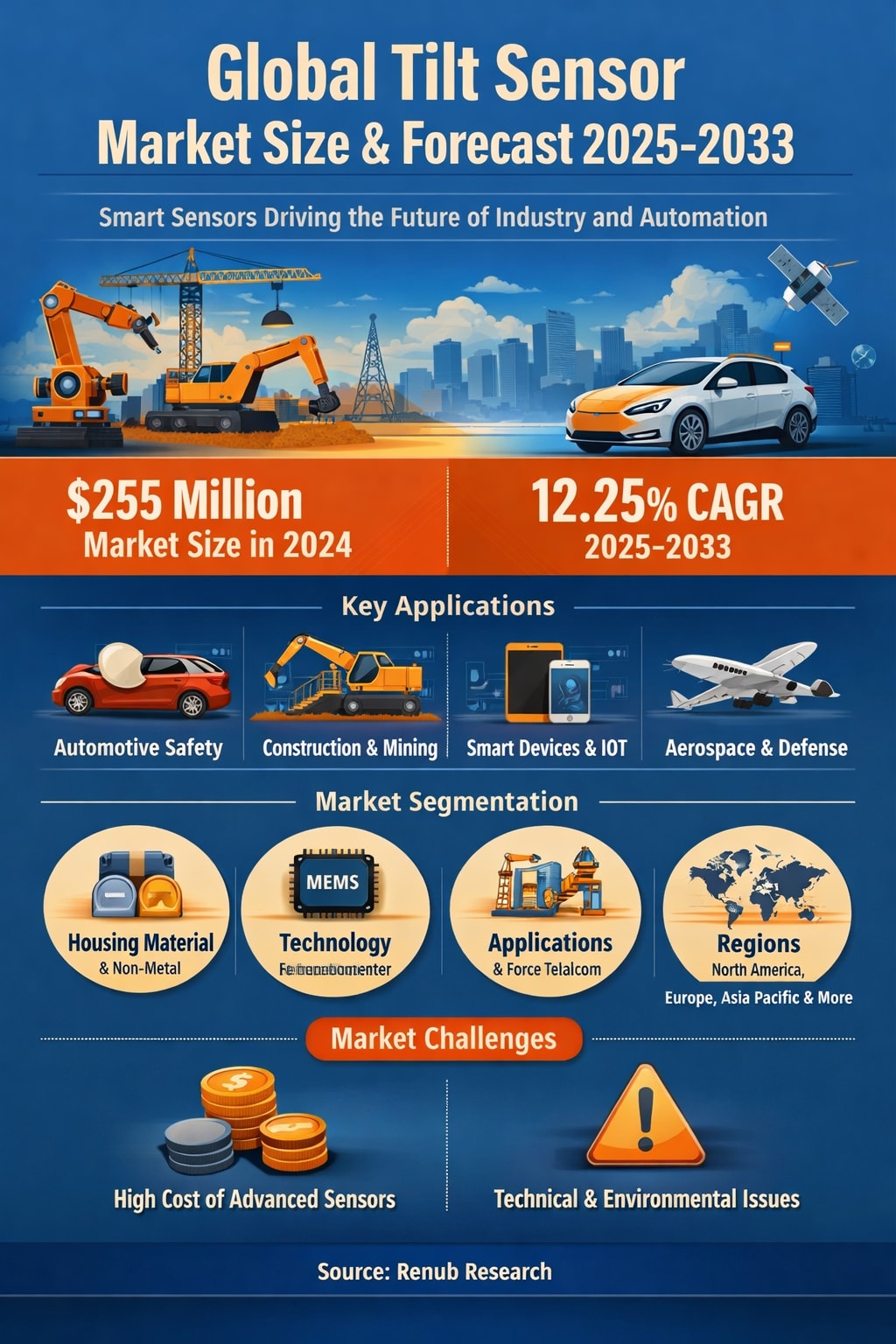
Global Tilt Sensor Market: A Market on the Move
The Global Tilt Sensor Market accounted for USD 255 million in 2024 and is anticipated to grow at a CAGR of 12.25% during the forecast period from 2025 to 2033. This strong growth trajectory reflects the rising application of tilt sensors across diverse industries such as automotive, construction, aerospace, consumer electronics, and industrial automation. Technological advancements, along with the rapid adoption of sensors in IoT-enabled devices, are further accelerating market expansion during the forecast period.
In an era where machines, vehicles, and infrastructure are becoming smarter and more autonomous, the ability to measure orientation, angle, and inclination accurately has become mission-critical. Tilt sensors—also known as inclinometers or tilt switches—play a crucial role in this transformation. Though often invisible to end users, these small components are increasingly responsible for keeping systems stable, safe, and responsive.
Understanding Tilt Sensors: Small Devices, Big Impact
A tilt sensor is a device that measures the angle or inclination of an object relative to gravity. It can detect movement or orientation across one or multiple axes and provide real-time data about positional changes. Depending on the design and application, tilt sensors may use accelerometers, force-balance mechanisms, MEMS technology, or fluid-filled systems to achieve accurate readings.
These sensors are already deeply embedded in everyday life. They enable screen rotation in smartphones, balance control in gaming consoles, and safety features in vehicles. In industrial and infrastructure environments, they monitor cranes, bridges, heavy machinery, and buildings, ensuring that even slight deviations from safe angles are detected early.
As industries increasingly rely on automation, remote monitoring, and predictive maintenance, tilt sensors are becoming essential components of modern engineering systems.
Key Growth Drivers in the Global Tilt Sensor Market
1. Rising Demand in Automotive Safety Systems
One of the most powerful drivers of the tilt sensor market is the global push for safer vehicles. Modern cars are now equipped with advanced driver assistance systems (ADAS), stability control, and rollover detection mechanisms—many of which rely on tilt and orientation data.
Tilt sensors help detect abnormal angular movement, which may indicate a rollover or loss of control. When such conditions are identified, safety systems can trigger airbags, braking assistance, or stability corrections in real time. As governments continue to enforce stricter vehicle safety standards and consumers demand smarter, safer cars, the integration of sensors—including tilt sensors—keeps increasing.
This trend is visible not only in passenger vehicles but also in commercial fleets, electric vehicles, and autonomous platforms, where precise orientation sensing is critical for both safety and performance.
2. Expansion of Smart Devices and IoT Applications
The rapid growth of smart devices and the Internet of Things (IoT) is another major catalyst for the tilt sensor market. From smartphones and wearables to smart home systems and industrial IoT platforms, orientation-aware functionality is becoming a standard feature.
In IoT deployments, tilt sensors are widely used for equipment monitoring, asset tracking, condition-based maintenance, and remote diagnostics. They help detect changes in position, misalignment, or instability—often before a serious failure occurs. This capability is especially valuable in smart cities, factories, and energy infrastructure, where real-time data can prevent costly downtime or accidents.
As digital transformation continues across industries, the demand for compact, low-power, and high-accuracy tilt sensors is expected to rise steadily.
3. Infrastructure Development and Heavy Machinery Monitoring
Global investments in infrastructure, construction, and mining are also fueling demand for tilt sensors. These sensors are commonly installed in cranes, excavators, bridges, tunnels, and high-rise buildings to monitor structural stability and equipment orientation.
In construction and mining environments, even small changes in angle can signal dangerous conditions. Tilt sensors provide real-time alerts that help operators take corrective action before accidents occur. This not only improves worker safety but also enhances operational efficiency and equipment lifespan.
With emerging economies in Asia, the Middle East, and Africa accelerating infrastructure development, the role of tilt sensors in ensuring safe and efficient operations is becoming more prominent than ever.
Challenges Facing the Global Tilt Sensor Market
1. High Cost of Advanced and High-Precision Sensors
Despite strong growth prospects, the market faces challenges—one of the most notable being the high cost of advanced tilt sensors. Applications in aerospace, defense, and high-end industrial automation often require extreme accuracy, long-term stability, and resistance to harsh environments. These requirements drive up both production and integration costs.
For small and medium-sized enterprises, especially in developing regions, these costs can limit adoption. Customization for specific environments or machinery further increases expenses, making price sensitivity a real barrier in some segments of the market.
2. Technical Limitations and Environmental Sensitivity
Another challenge lies in the technical limitations of certain sensor types, particularly low-cost models. Tilt sensors can be affected by vibration, temperature fluctuations, electromagnetic interference, and mechanical stress. In harsh or dynamic environments, inaccurate readings can lead to poor decisions—or even system failures.
In critical sectors such as aerospace, mining, or heavy industry, even minor errors in angle measurement can have serious consequences. Ensuring consistent accuracy and reliability under variable conditions requires continuous innovation, which adds to development complexity and cost.
Market Segmentation Insights
Non-Metal Tilt Sensor Market
Non-metal tilt sensors, typically made from plastic or composite materials, are gaining popularity due to their lightweight nature, corrosion resistance, and cost-effectiveness. These sensors are especially suitable for marine, medical, agricultural, and portable electronic applications, where resistance to moisture or chemicals is essential.
Their growing use in IoT devices and consumer electronics is further boosting demand. As industries seek environmentally resistant and economical components, the non-metal tilt sensor segment is expected to maintain steady growth.
Metal Tilt Sensor Market
Metal tilt sensors are known for their durability, robustness, and long-term reliability. They are widely used in industrial equipment, military systems, construction machinery, and oil & gas applications, where sensors must withstand mechanical stress, extreme temperatures, and harsh operating conditions.
Metal enclosures also provide better electromagnetic shielding, which enhances measurement accuracy and sensor lifespan. As industries continue to prioritize reliability in demanding environments, the metal tilt sensor segment remains a vital part of the global market.
Force Balance Tilt Sensor Market
Force balance tilt sensors represent the high-precision end of the market. These devices are used in applications that demand exceptional accuracy and stability, such as geotechnical monitoring, aviation, and structural health assessment.
Although more expensive, force balance sensors are indispensable for long-term monitoring and critical infrastructure projects, especially in regions prone to earthquakes or structural risks. Growing awareness of disaster prevention and infrastructure safety is driving increased adoption of these advanced sensors worldwide.
Industry-Wise Market Outlook
Construction & Mining
The construction and mining sectors are among the largest end-users of tilt sensors. In construction, these sensors help control the angle and movement of cranes, scaffolding, and heavy equipment, reducing the risk of accidents and structural failures.
In mining, tilt sensors support the safe operation of drilling rigs, loaders, and underground machinery, where precise orientation is critical. As automation and safety regulations become stricter, the reliance on real-time monitoring systems—and tilt sensors in particular—continues to grow.
Aerospace & Defense
In aerospace and defense, tilt sensors are essential for navigation, guidance systems, targeting, and structural monitoring. These applications demand extreme precision and reliability, often under harsh environmental conditions.
Tilt sensors help ensure stable flight, accurate payload deployment, and proper alignment of critical systems in both aircraft and spacecraft. With rising defense budgets and renewed global interest in space exploration, this segment is expected to remain a strong driver of market growth.
Regional Market Perspectives
United States
The United States remains a leading market for tilt sensors, supported by its strong presence in automotive, aerospace, defense, and industrial automation. The country’s emphasis on safety standards, innovation, and electric vehicle adoption continues to drive sensor integration across multiple sectors.
A mature construction and infrastructure ecosystem also supports steady demand. With robust R&D capabilities and leading sensor manufacturers, the U.S. plays a central role in shaping global tilt sensor technology trends.
Germany
Germany, often considered the industrial powerhouse of Europe, holds a significant position in the tilt sensor market. Its automotive, manufacturing, and engineering sectors rely heavily on precision sensing technologies.
The country’s focus on Industry 4.0, automation, robotics, and renewable energy is further expanding the use of tilt sensors. Strong regulatory support for workplace safety and equipment monitoring also encourages widespread adoption.
India
India’s tilt sensor market is growing rapidly, driven by infrastructure development, mining, and increasing industrial automation. Government initiatives such as smart cities, railway modernization, and digital transformation are creating new opportunities for sensor deployment.
While high-end applications are still limited, demand for cost-effective and reliable mid-range sensors is rising. With increasing domestic manufacturing and foreign investment, India offers a promising long-term growth landscape for the tilt sensor industry.
Saudi Arabia
Saudi Arabia is emerging as a key market, supported by its Vision 2030 initiatives and large-scale infrastructure projects. Mega developments, smart city projects, and modernization of the oil and gas sector are all increasing the need for accurate monitoring and safety systems.
Tilt sensors are being adopted in construction, industrial equipment, and mining operations, particularly where equipment must operate under extreme desert conditions. As economic diversification continues, demand for advanced sensor technologies is expected to rise strongly.
Market Segmentation
By Housing Material Type:
Non-Metal
Metal
By Technology:
Force Balance
Solid State (MEMS)
Fluid Filled
By Application:
Construction & Mining
Automotive & Transportation
Aerospace & Defense
Telecommunications
Others
By Region:
North America (United States, Canada)
Europe (France, Germany, Italy, Spain, UK, Belgium, Netherlands, Turkey)
Asia Pacific (China, Japan, India, South Korea, Thailand, Malaysia, Indonesia, Australia, New Zealand)
Latin America (Brazil, Mexico, Argentina)
Middle East & Africa (Saudi Arabia, UAE, South Africa)
Competitive Landscape
The market features several prominent players, each analyzed across four viewpoints: Overview, Key Persons, Recent Developments & Strategies, and Revenue Analysis. Key companies include:
TE Connectivity
Sick AG
Murata Manufacturing Co., Ltd.
Pepperl+Fuchs Vertrieb GmbH & Co. KG
Level Developments Ltd
IFM Electronic GmbH
Balluff GmbH
Jewell Instruments LLC
These companies continue to invest in innovation, product reliability, and application-specific solutions to maintain their competitive positions in a rapidly evolving market.
Final Thoughts
The Global Tilt Sensor Market is on a clear upward trajectory, driven by automation, safety requirements, smart devices, and infrastructure development. With the market valued at USD 255 million in 2024 and projected to grow at a CAGR of 12.25% from 2025 to 2033, tilt sensors are set to become even more deeply embedded in the fabric of modern technology.
From keeping vehicles safe and machines stable to enabling smarter cities and more resilient infrastructure, tilt sensors are proving that sometimes the smallest components make the biggest difference. As technology continues to evolve, so too will the role of these quiet but indispensable sensors—guiding the world, quite literally, in the right direction.
About the Creator
META Stock Today: Tech Giant Shows Mixed Movements Amid Market Volatility
META Stock Today Overview In today’s trading session, META stock today is displaying mixed movements as investors process recent earnings reports and broader market trends. META, a global leader in social media, digital advertising, and emerging AI technologies, continues to draw attention from both retail and institutional investors. While the company’s long-term growth prospects remain strong, short-term volatility is evident as traders react to revenue updates, cost pressures, and global market sentiment.
By Hammad Nawaza day ago in Trader


Comments
There are no comments for this story
Be the first to respond and start the conversation.