
Global Smart Speaker Market Size and Forecast 2025–2033
How Voice AI, Smart Homes, and Everyday Convenience Are Redefining the Way the World Listens

Introduction: The Rise of Voice-First Technology
The way people interact with technology has undergone a dramatic transformation over the past decade. From typing commands and tapping screens, users are increasingly shifting toward voice-driven interfaces that feel more natural, faster, and more intuitive. At the heart of this change lies the global smart speaker market, a sector that has quickly evolved from a novelty category into a central pillar of the smart home and digital lifestyle ecosystem.
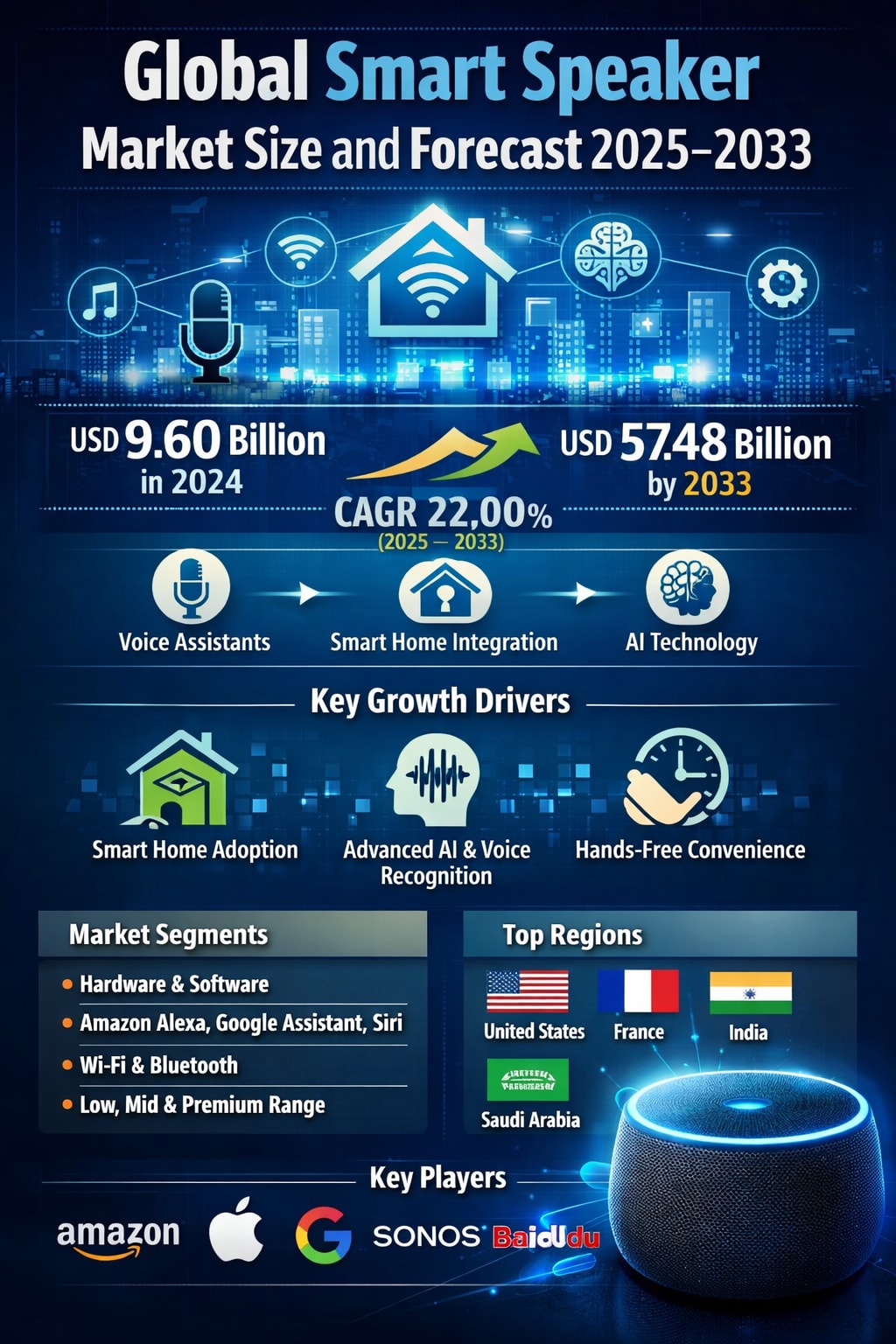
According to industry estimates, the Global Smart Speaker Market, valued at USD 9.60 billion in 2024, is projected to surge to USD 57.48 billion by 2033, expanding at a robust CAGR of 22.00% during 2025–2033. This impressive growth trajectory is being fueled by the rapid adoption of voice assistants, deeper smart home integration, and continuous advances in artificial intelligence (AI). Consumers worldwide are increasingly embracing hands-free convenience—whether it’s controlling lights, playing music, checking the weather, or managing daily schedules—making smart speakers a staple in modern homes and businesses alike.
What Is a Smart Speaker? A Quick Market Overview
A smart speaker is an AI-powered, voice-controlled device equipped with virtual assistants such as Amazon Alexa, Google Assistant, and Apple Siri. These devices allow users to perform a wide range of tasks using simple voice commands, including playing music, setting reminders, controlling smart home devices, answering questions, and accessing real-time information such as news updates and weather forecasts.
Smart speakers have gained massive popularity due to their seamless integration with smart home ecosystems. They serve as central hubs for controlling lighting systems, thermostats, security cameras, and other connected appliances, significantly improving automation and user convenience. Beyond utility, smart speakers are also entertainment companions, widely used for streaming music, podcasts, and audiobooks.
With the expanding influence of the Internet of Things (IoT) and rising consumer demand for hands-free digital assistance, smart speakers have become an essential part of contemporary living spaces. From North America and Europe to Asia-Pacific and the Middle East, manufacturers continue to enhance these devices with more powerful AI capabilities, better sound quality, and broader language support—cementing their place in both residential and commercial environments.
Market Growth Drivers: What’s Powering the Boom?
1. Increasing Use of Smart Home Technology
One of the most powerful drivers of the smart speaker market is the rapid adoption of smart home devices. Smart speakers act as the command center for connected ecosystems, enabling users to control everything from lighting and air conditioning to security systems and entertainment units with simple voice commands.
As IoT and AI technologies continue to mature, the smart home ecosystem is expanding at an unprecedented pace. The number of connected IoT devices globally has been rising steadily and is expected to reach 40 billion by 2030, according to industry estimates. This explosion of connected devices naturally boosts demand for smart speakers, which offer a simple, user-friendly interface to manage complex digital environments.
2. Improvements in Voice Recognition and AI Technology
The evolution of AI-driven virtual assistants—such as Amazon Alexa, Google Assistant, and Apple Siri—has significantly improved the performance and usability of smart speakers. Advances in speech recognition, natural language processing (NLP), and machine learning have made voice interactions more accurate, contextual, and personalized.
These improvements are also expanding the role of smart speakers beyond entertainment and basic home control. In March 2024, for example, BrainBox AI introduced ARIA (Artificial Responsive Intelligent Assistant), designed to optimize building efficiency using generative AI. Such innovations highlight how voice-based AI is moving into commercial, retail, and enterprise environments, opening new growth avenues for the smart speaker ecosystem.
3. Growing Consumer Demand for Hands-Free Convenience
Modern consumers value speed, simplicity, and multitasking—and smart speakers deliver all three. From managing schedules and setting reminders to playing music and providing real-time news updates, these devices integrate effortlessly into daily routines.
Voice-controlled technology is also gaining traction in cars, hotels, offices, and retail spaces, further expanding the market’s footprint. Globally, a significant share of internet users now rely on voice search, and the number of voice assistant users continues to rise, particularly in tech-savvy markets like the United States. This growing comfort with voice interfaces is accelerating smart speaker adoption across age groups and professions.
Key Challenges: What Could Slow the Market?
Privacy and Data Security Concerns
Despite their popularity, smart speakers face ongoing scrutiny over privacy and data security. Because these devices are always listening for wake words, consumers worry about unauthorized data collection, storage, and potential misuse of voice recordings. High-profile data privacy incidents have only intensified these concerns.
To maintain consumer trust, manufacturers must invest heavily in stronger encryption, transparent data policies, and user-controlled privacy settings. Addressing these concerns effectively will be critical for sustaining long-term market growth.
Limited Language and Regional Support
While major brands have made progress, language and regional dialect support remains uneven. Most smart speakers perform best in English and a handful of major languages, leaving users in linguistically diverse markets with less reliable experiences.
Expanding language support requires massive datasets and continuous AI training, which is both time-consuming and costly. Companies that fail to localize effectively may struggle to gain traction in emerging markets with diverse linguistic landscapes.
Market by Component: Hardware vs. Software
Global Smart Speaker Hardware Market
Hardware forms the physical backbone of smart speakers, including microphones, processors, speakers, and connectivity modules. Continuous improvements in sound quality, noise cancellation, and design aesthetics are enhancing user experiences. Manufacturers are also focusing on sleeker designs, better durability, and improved battery life—especially for portable models—making smart speakers more versatile and visually appealing.
Smart Speaker Software Market
Software is where the real intelligence lives. AI-powered virtual assistants, cloud services, and speech recognition systems enable smooth and intuitive user interactions. Companies are investing heavily in machine learning and NLP to improve command recognition, personalize responses, and introduce predictive features. Regular software updates also expand device capabilities through new skills, third-party integrations, and broader language support.
Market by Virtual Assistant: The Battle of Ecosystems
Amazon Alexa Smart Speaker Market
Amazon Alexa remains the market leader, supported by a wide range of Echo devices—from the Echo Dot and Echo Show to the Echo Studio. Alexa’s extensive compatibility with smart home devices and third-party applications has helped Amazon build a powerful ecosystem. Continuous upgrades in AI features, sound quality, and speech recognition keep Alexa at the forefront of the market.
Siri Smart Speaker Market
Apple’s Siri-powered HomePod and HomePod Mini focus on premium sound quality and deep integration within the Apple ecosystem. These devices appeal strongly to loyal Apple users who value seamless connectivity and strong privacy protections. However, compared to rivals, Siri’s more limited third-party compatibility remains a competitive challenge.
Market by Connectivity: Wi-Fi and Beyond
Wi-Fi Smart Speaker Market
Wi-Fi-enabled smart speakers dominate the market due to stable connectivity, faster streaming, and broader device compatibility. They support advanced features such as multi-room audio and deep smart home integration, making them the preferred choice for connected households. Brands like Sonos, Bose, and Google Nest leverage Wi-Fi to deliver premium audio and intelligent assistant features.
Offline Smart Speaker Market
Offline smart speakers cater to privacy-conscious consumers and regions with unstable internet connectivity. These devices rely on local processing for basic commands, reducing dependence on cloud services. While their functionality is more limited, advances in edge computing and AI are steadily improving their performance and appeal.
Market by End User: Personal vs. Commercial
Personal Smart Speaker Market
Personal smart speakers are typically compact, portable, and designed for individual use. They appeal to students, professionals, and travelers who want hands-free assistance for productivity and entertainment. Mini smart speakers and wearable voice assistants are expanding this segment’s reach even further.
Commercial Smart Speaker Market
In commercial settings, smart speakers are increasingly used in hotels, offices, retail stores, and healthcare facilities. They help streamline operations, enhance customer experiences, and support smart building management systems—signaling strong growth potential in the years ahead.
Regional Spotlight: Key Markets Around the World
United States Smart Speaker Market
The U.S. leads the global market, driven by high consumer adoption, advanced smart home infrastructure, and the strong presence of tech giants like Amazon, Google, and Apple. Demand for voice-driven home control and AI-powered assistance continues to fuel innovation and competition.
France Smart Speaker Market
France’s market is expanding steadily, supported by improved French-language support and growing interest in connected devices. Smart home automation and voice-controlled entertainment are key demand drivers, although data privacy concerns and language nuances remain challenges.
India Smart Speaker Market
India represents one of the fastest-growing markets, powered by affordable devices, high smartphone penetration, and rising smart home adoption. The introduction of Hindi and regional language support is accelerating uptake, especially for local services such as e-commerce and entertainment. However, price sensitivity and internet connectivity issues still pose hurdles.
Saudi Arabia Smart Speaker Market
Saudi Arabia’s market is gaining momentum as AI adoption increases across the Middle East. Demand is particularly strong in luxury homes, hospitality, and corporate environments, supported by improved Arabic-language support and growing interest in smart living solutions.
Market Segmentation Snapshot
By Component:
Hardware
Software
By Intelligent Virtual Assistant:
Amazon Alexa
Google Assistant
Siri
Cortana
Others
By Connectivity:
Wi-Fi
Bluetooth
By Price Range:
Low-range (Less than $100)
Mid-range ($101 to $200)
Premium (Above $200)
By Distribution Channel:
Online
Offline
By End User:
Personal
Commercial
By Countries:
United States, Canada, France, Germany, Italy, Spain, United Kingdom, Belgium, Netherlands, Turkey, China, Japan, India, Australia, South Korea, Thailand, Malaysia, Indonesia, New Zealand, Brazil, Mexico, Argentina, South Africa, Saudi Arabia, UAE
Company Landscape: Key Players in Focus
Major companies shaping the global smart speaker market include:
Alibaba Group Holding Limited
Amazon.com Inc.
Apple Inc.
Baidu Inc.
Bose Corporation
Lenovo Group Limited
LG Electronics Inc.
Panasonic Corporation
Sonos Inc.
These players compete across product innovation, ecosystem integration, AI capabilities, sound quality, and pricing strategies, continually pushing the market forward.
Final Thoughts: The Future Sounds Smart
The global smart speaker market is no longer just about playing music or setting alarms—it’s about building a voice-first digital lifestyle. With the market expected to grow from USD 9.60 billion in 2024 to USD 57.48 billion by 2033, the sector is poised for a decade of rapid innovation and expansion.
As AI becomes smarter, smart homes become more connected, and consumers continue to seek effortless, hands-free convenience, smart speakers will only become more deeply embedded in everyday life. While challenges around privacy and localization remain, the overall outlook is unmistakably optimistic. In the coming years, the world won’t just get smarter—it will listen, respond, and adapt, one voice command at a time.
About the Creator
Keep reading
More stories from shibansh kumar and writers in Trader and other communities.
North America Smart Home Security Camera Market Trends & Summary (2025–2033)
Introduction: A Smarter Eye on Home Security Home security in North America is no longer limited to locks, gates, and alarm sirens. Over the last decade, the region has witnessed a rapid transformation toward intelligent, connected, and AI-powered surveillance systems. At the center of this evolution stands the smart home security camera—compact, internet-enabled devices that allow homeowners to monitor, protect, and manage their properties from anywhere in the world.
By shibansh kumara day ago in Trader
Royal Enfield Bike Maker Eicher Motors Share Price Jumps 7% After Strong Q3 Results
Shares of Eicher Motors, the parent company of iconic motorcycle brand Royal Enfield, surged nearly 7% in early trade after the company reported strong Q3 financial results. The upbeat earnings performance exceeded market expectations and reinforced investor confidence in the company’s growth trajectory, premium brand positioning, and improving margins.
By Hammad Nawazabout 4 hours ago in Trader
Saudi Arabia E-Commerce Market Size and Forecast 2025–2033
Introduction: A Digital Retail Revolution in the Kingdom Saudi Arabia’s retail landscape is undergoing a powerful transformation. Once dominated by traditional brick-and-mortar stores, the Kingdom is now witnessing a rapid shift toward digital commerce, fueled by technology adoption, government-backed digital reforms, and changing consumer behavior. According to Renub Research, the Saudi Arabia E-Commerce market was valued at US$ 24.67 billion in 2024 and is projected to grow at a compound annual growth rate (CAGR) of 12.10% from 2025 to 2033, reaching an impressive US$ 68.94 billion by 2033.
By Sakshi Sharmaabout 12 hours ago in Trader




Comments
There are no comments for this story
Be the first to respond and start the conversation.