
Global Nebulizer Market Size and Forecast 2025–2033
Smart Respiratory Care, Home Healthcare Boom, and the Future of Inhalation Therapy

Global Nebulizer Market Outlook: A Breathing Space for Innovation
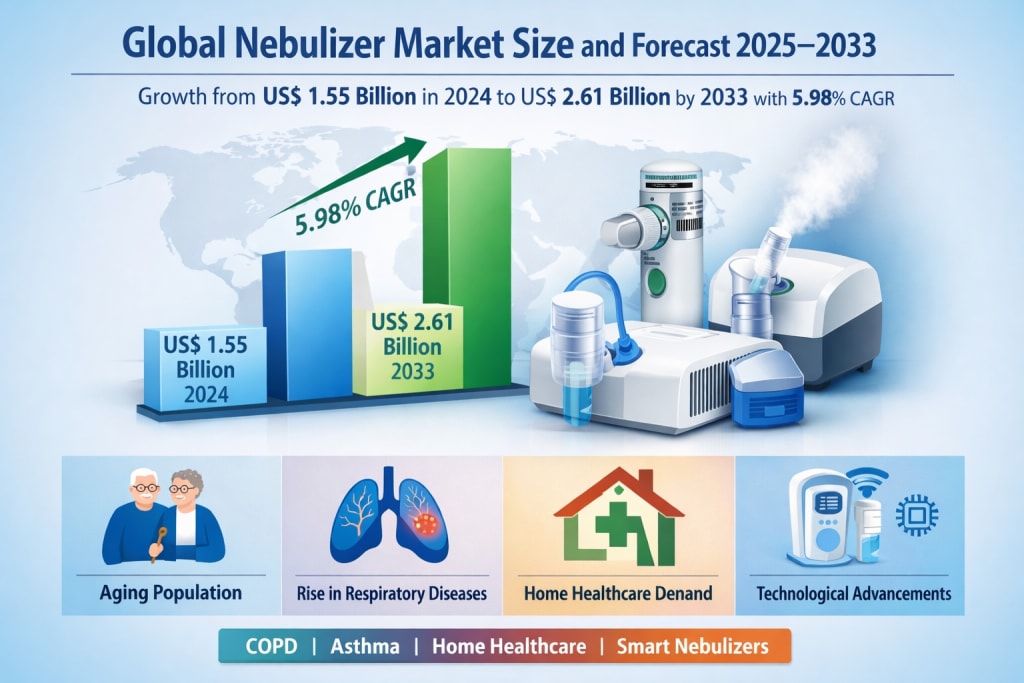
The Global Nebulizer Market is projected to reach US$ 2.61 billion by 2033, up from US$ 1.55 billion in 2024, expanding at a CAGR of 5.98% from 2025 to 2033. This steady growth reflects a powerful mix of demographic, clinical, and technological trends shaping modern respiratory care.
Rising life expectancy across both developed and emerging economies has increased the global elderly population—one of the most vulnerable groups to chronic respiratory diseases. At the same time, the prevalence of asthma, chronic obstructive pulmonary disease (COPD), cystic fibrosis, and other pulmonary disorders continues to climb, driven by urbanization, air pollution, smoking, and lifestyle-related risk factors.
Nebulizers, long recognized as a reliable method for delivering medication directly to the lungs, are benefiting from a new wave of innovation. Today’s market is no longer limited to bulky hospital devices. Instead, it is being reshaped by portable, battery-operated, and smart nebulizers that offer better patient comfort, improved compliance, and greater flexibility—especially in home healthcare settings.
The increasing shift toward home-based treatment is another major catalyst. Healthcare systems worldwide are under pressure to reduce hospital stays and cut long-term care costs. Nebulizers fit perfectly into this transition, enabling patients to manage chronic conditions safely and effectively at home while maintaining clinical outcomes.
Despite challenges such as device costs and competition from alternative inhalation methods, the overall outlook remains positive. Continuous innovation, supportive healthcare policies, and rising awareness of respiratory health are expected to keep the nebulizer market on a stable growth trajectory over the next decade.
Global Health Trends Fueling Market Expansion
According to the Centers for Disease Control and Prevention (CDC), smoking and secondhand smoke exposure are responsible for around half a million deaths annually in the United States. Meanwhile, the World Health Organization (WHO) reported that COPD caused 3.23 million deaths globally in 2019, underlining the massive burden of chronic respiratory diseases worldwide.
Environmental factors such as worsening air quality, industrial emissions, and urban pollution are further increasing the incidence of breathing-related disorders, particularly in rapidly urbanizing regions of Asia and the Middle East. In response, governments and health organizations have launched initiatives like the Global Alliance against Chronic Respiratory Diseases (GARD) to improve diagnosis, treatment, and long-term disease management.
These global health realities directly support the growing demand for nebulizers, which are especially useful for children, elderly patients, and individuals who struggle to use traditional inhalers effectively.
Technology Is Redefining the Nebulizer Experience
One of the most transformative forces in this market is technological innovation. The latest generation of nebulizers is quieter, faster, more efficient, and increasingly connected.
Mesh nebulizers offer faster drug delivery, minimal noise, and higher efficiency compared to traditional jet models.
Portable nebulizers allow patients to continue treatment while traveling or working, significantly improving adherence.
Smart nebulizers, integrated with IoT and AI, enable real-time monitoring, dose tracking, and data sharing with healthcare providers.
Companies like Sensosan BCorp are already exploring AI-enabled respiratory devices, while established medical suppliers continue to refine performance and usability. In May 2024, Medline introduced the Hudson RCI TurboMist small-volume nebulizer, designed to deliver medication in as little as three minutes—reportedly administering 2.5 times more medicine per minute than conventional models.
Such innovations are not only improving clinical outcomes but also strengthening patient engagement, a crucial factor in chronic disease management.
Key Factors Driving the Nebulizer Market
1. Shift Toward Home Healthcare
The global healthcare landscape is undergoing a fundamental shift toward home-based care. Patients with chronic conditions increasingly prefer treatment options that minimize hospital visits, reduce costs, and offer greater comfort.
Modern nebulizers are now designed with ease of use, portability, and low maintenance in mind, making them ideal for at-home therapy. This trend was further accelerated by the COVID-19 pandemic, which highlighted the importance of remote care, self-management, and decentralized treatment models.
For patients with asthma or COPD, home nebulization not only improves convenience but also enhances treatment adherence, leading to better long-term outcomes. As healthcare systems continue to prioritize outpatient and home-based solutions, nebulizers are expected to remain a core component of respiratory care strategies.
2. Government Support and Reimbursement Policies
Public health policies play a critical role in shaping medical device adoption. In many countries, government-backed reimbursement programs and insurance coverage have made nebulizer therapy more accessible, especially for patients with chronic respiratory diseases.
Supportive regulations encouraging home healthcare, telemedicine, and remote monitoring further strengthen the case for nebulizer adoption. When healthcare providers are confident that treatments will be reimbursed, they are more likely to prescribe nebulizer therapy, boosting overall market demand.
These policies are particularly impactful in aging societies, where long-term respiratory care is becoming a significant public health priority.
3. Increasing Awareness of Respiratory Diseases
Public awareness of conditions such as asthma, COPD, and cystic fibrosis has improved substantially due to educational campaigns, media coverage, and proactive healthcare outreach. As patients become more informed, they are more likely to seek early diagnosis and consistent treatment.
This growing awareness directly benefits the nebulizer market. Patients who understand the importance of effective medication delivery are more inclined to adopt nebulizer therapy, especially when other inhalation methods prove difficult or less effective.
Early intervention, supported by reliable treatment devices, also helps reduce hospitalizations and long-term healthcare costs—another factor encouraging wider adoption.
Challenges Facing the Nebulizer Market
High Cost of Advanced Devices
While innovation is driving the market forward, it also comes with a price tag. Smart and portable nebulizers, equipped with advanced features like connectivity and battery operation, are often significantly more expensive than traditional models.
In price-sensitive markets, especially in developing countries, this cost barrier can limit adoption. Even where insurance coverage exists, reimbursement policies may not always fully cover premium devices, pushing patients toward cheaper alternatives.
This pricing challenge remains one of the key obstacles to broader market penetration.
Competition from Alternative Inhalation Devices
Nebulizers face strong competition from metered-dose inhalers (MDIs) and dry powder inhalers (DPIs). These devices are typically:
More compact and portable
Easier to use on the go
Lower in upfront cost
Less demanding in terms of maintenance
For many patients, especially those with mild to moderate conditions, MDIs and DPIs offer a convenient and cost-effective solution. As a result, nebulizers must continue to differentiate themselves through efficiency, ease of use, and suitability for complex or severe cases.
Regional Market Overview
United States
The U.S. nebulizer market is driven by a high prevalence of asthma, COPD, and other chronic respiratory diseases, combined with strong healthcare infrastructure and rapid technology adoption.
The Asthma and Allergy Foundation of America (AAFA) estimates that over 28 million Americans suffer from asthma. This large patient pool, along with an aging population, continues to support strong demand for nebulizer devices.
In March 2021, AAFA partnered with OMRON Healthcare, a global leader in respiratory technology, to promote better asthma management and improve access to respiratory care tools. Such collaborations highlight the active role of both industry and advocacy groups in expanding the market.
With favorable reimbursement policies and rising acceptance of home healthcare, the U.S. market is expected to remain one of the most influential globally.
Germany
Germany’s nebulizer market benefits from a well-established healthcare system, strong reimbursement frameworks, and a growing elderly population. The increasing prevalence of asthma and COPD continues to drive demand for efficient and patient-friendly respiratory devices.
Technological advancements have improved treatment compliance, while the growing popularity of home healthcare solutions is reducing pressure on hospitals. Government support and insurance coverage further enhance accessibility, ensuring steady market growth in the coming years.
China
China represents one of the fastest-growing nebulizer markets, fueled by rising air pollution, a rapidly aging population, and increasing awareness of respiratory health.
Urbanization and industrialization have significantly increased the incidence of respiratory disorders, creating strong demand for effective treatment solutions. Government healthcare initiatives and expanding insurance coverage are also improving access to medical devices, including nebulizers.
As technology becomes more affordable and distribution networks expand, China’s nebulizer market is expected to show sustained long-term growth.
Saudi Arabia
In Saudi Arabia, the nebulizer market is growing steadily due to the rising prevalence of asthma, COPD, and respiratory infections, along with increasing healthcare investment.
Air quality challenges, lifestyle changes, and demographic shifts are contributing to higher demand for respiratory care devices. Government healthcare programs and reimbursement support are helping improve access, while technological upgrades are making devices more efficient and user-friendly.
Together, these factors are positioning Saudi Arabia as an important growth market in the Middle East & Africa region.
Market Segmentation Snapshot
By Type:
Jet
Mesh
Ultrasonic
By Modality:
Tabletop
Portable
By Application:
COPD
Asthma
Others
By End Use:
Hospitals & Clinics
Emergency Centers
Home Healthcare
By Region:
North America (United States, Canada)
Europe (France, Germany, Italy, Spain, United Kingdom, Belgium, Netherlands, Turkey)
Asia Pacific (China, Japan, India, Australia, South Korea, Thailand, Malaysia, Indonesia, New Zealand)
Latin America (Brazil, Mexico, Argentina)
Middle East & Africa (South Africa, Saudi Arabia, United Arab Emirates)
Competitive Landscape
The global nebulizer market features a mix of established medical device giants and specialized respiratory care companies. Key players include:
OMRON Corporation
GE Healthcare
Boston Scientific Corporation
Koninklijke Philips N.V.
Vectura Group Plc.
Aerogen
DeVilbiss Healthcare LLC
Beurer GmbH
These companies compete on the basis of technology, product reliability, distribution reach, and innovation, with a growing focus on smart and portable solutions.
Final Thoughts
The global nebulizer market is entering a new phase of growth—one defined not just by rising disease burden, but by innovation, accessibility, and patient-centered care. With the market projected to grow from US$ 1.55 billion in 2024 to US$ 2.61 billion by 2033, the outlook remains solid.
While challenges such as high device costs and competition from alternative inhalers persist, the long-term drivers—aging populations, chronic respiratory diseases, home healthcare adoption, and technological progress—continue to strengthen the market’s foundation.
In a world where breathing clean air is becoming harder and managing chronic illness more complex, nebulizers are proving to be more than just medical devices—they are becoming essential tools for sustaining quality of life.
About the Creator
Tom Shane
Tom Shane is a content writer specializing in SEO-driven blogs, product descriptions, and thought leadership. He crafts engaging, research-backed content that connects with audiences and drives results.
infosys share price today: should investors buy or wait?
The infosys share price is grabbing attention today. After recent ups and downs, investors are asking whether it is the right time to buy or hold. Understanding the reasons behind its movement is key for making informed decisions. This article examines the current infosys share price trend, expert opinions, key factors influencing the stock, and strategies for investors. By reading this, you can get a clear view of the market situation.
By John.doe798about 3 hours ago in Trader
Mexico Digital Twin Market Size, Opportunities & Investment Trends 2026–2034 | IMARC Analysis
Mexico Digital Twin Market Growth, Trends, Forecast, Key Players, and Opportunities Mexico Digital Twin Market Overview The Mexico Digital Twin Market is witnessing strong expansion as organizations across industries accelerate digital transformation initiatives. Digital twin technology, which enables the creation of virtual replicas of physical assets, systems, and processes, is increasingly being adopted to improve operational efficiency, predictive maintenance, and real-time decision-making.
By Kim Soo hyun4 days ago in Trader



Comments
There are no comments for this story
Be the first to respond and start the conversation.