
Global Medical Adhesives Market Size and Forecast 2025–2033
From Wound Care to Wearables: How Medical Adhesives Are Becoming a Silent Backbone of Modern Healthcare

Introduction
The healthcare industry is undergoing a quiet but powerful transformation, driven not only by advanced medical devices and breakthrough treatments, but also by the materials that hold these innovations together. Among these, medical adhesives have emerged as an indispensable component of modern medicine, supporting everything from wound dressings and surgical procedures to wearable medical devices and advanced diagnostics.
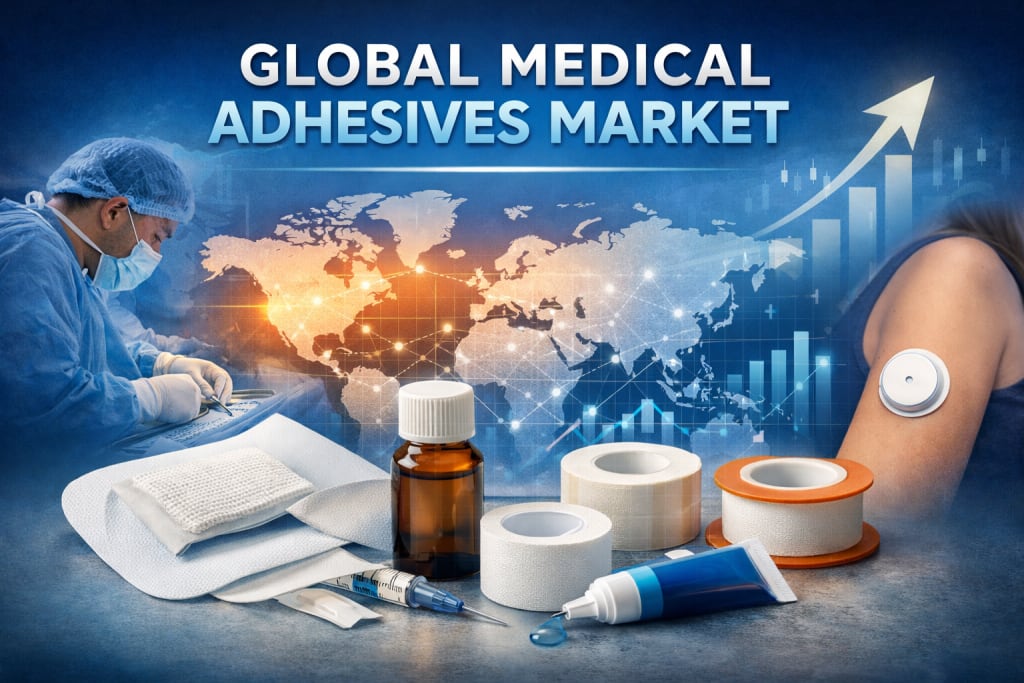
According to Renub Research, the Global Medical Adhesives Market is expected to reach US$ 20.09 billion by 2033, rising from US$ 10.74 billion in 2024, growing at a compound annual growth rate (CAGR) of 7.21% from 2025 to 2033. This strong growth trajectory reflects the expanding role of medical adhesives across healthcare systems worldwide.
The rising demand for effective wound care solutions, the growing aging population, increasing healthcare applications, rapid technological advancements, and the shift toward minimally invasive procedures are some of the key factors propelling the market forward. What was once a niche supporting material has now become a strategic component in improving patient outcomes, reducing recovery times, and enabling new forms of medical technology.
Medical Adhesives Market Overview
Medical adhesives are specialized materials used in healthcare settings to securely bond medical components, dressings, or devices to the body or skin. They are designed to be safe for use on delicate skin and wounds while providing strong, reliable adhesion. These adhesives are widely used in surgical procedures, wound care management, and for anchoring devices such as catheters, sensors, and monitoring equipment.
Unlike conventional industrial adhesives, medical adhesives must meet strict standards of biocompatibility, durability, and skin-friendliness. Many are hypoallergenic, moisture-resistant, and engineered to maintain performance under challenging clinical conditions. Their ability to offer secure adhesion without damaging the skin makes them critical for patient comfort, proper device placement, and faster healing.
The market is expanding due to several interconnected factors. The rising number of surgical procedures, increasing prevalence of chronic diseases, and growing demand for advanced wound care products are all contributing to higher adoption. At the same time, the global aging population and increasing healthcare expenditure are accelerating market growth. Technological advancements in adhesive formulations—especially those focused on better skin compatibility and performance—are further strengthening demand. In addition, the rapid rise of wearable medical devices and minimally invasive surgeries is creating new and sustained opportunities for medical adhesive manufacturers.
Key Growth Drivers Shaping the Market
Growing Need for Medical Equipment and Devices
Medical adhesives play a critical role in the assembly and performance of modern medical devices. From disposable syringes and catheters to complex diagnostic equipment, adhesives ensure structural integrity, safety, and reliability. The medical sector demands exceptionally high-quality adhesives that meet strict regulatory and performance standards, making this a specialized and high-value application area.
Rising consumer spending on healthcare and expanding access to medical services have fueled growth in the medical device industry. As hospitals and clinics adopt more advanced equipment to diagnose and treat a wide range of conditions, the demand for reliable bonding solutions continues to increase. This, in turn, is driving sustained growth in the medical adhesives market.
Another important trend is the increasing use of single-use medical products. These products offer advantages over traditional reusable instruments, including reduced risk of infection, improved efficiency, and better regulatory compliance. The automated manufacturing processes used to produce single-use medical items rely heavily on high-quality adhesives. As demand for these products grows, so does the need for advanced medical adhesive solutions.
Rising Demand for Soft-Skin Adhesives
Soft-skin adhesives are gaining significant traction in healthcare environments due to their ability to provide strong adhesion while remaining gentle on the skin. These adhesives are specifically designed to be easy to remove without causing irritation, pain, or skin damage—an essential feature for elderly patients, children, and individuals with sensitive skin.
They are widely used for securing bandages, wound dressings, and wearable medical devices. In recent years, soft-skin adhesives have become the preferred choice for skin attachment applications. The growing adoption of wearable medical technology, along with the increasing focus on patient comfort and long-term monitoring, is further boosting demand in this segment.
As healthcare providers place greater emphasis on patient-centric care, the role of skin-friendly and biocompatible adhesives is becoming even more important. This trend is expected to continue supporting market expansion over the coming years.
Technological Advancements in Adhesive Formulations
Innovation is one of the most powerful forces driving the medical adhesives market. Advances in material science have led to the development of bio-based and skin-friendly polymers that improve comfort, safety, and performance. These new formulations offer better moisture resistance, stronger adhesion, and improved durability, making them suitable for a wide range of medical applications.
One of the most exciting emerging areas is the development of smart adhesives. These advanced materials can incorporate features such as drug delivery, wound monitoring, or antimicrobial properties. Such innovations are opening up new possibilities in wound care management and post-surgical recovery.
At the same time, improvements in adhesion strength and environmental resistance are making medical adhesives more reliable in demanding clinical environments. These technological advancements are not only expanding the range of applications but are also accelerating the adoption of medical adhesives in wearable technology, surgical procedures, and advanced wound care solutions.
Challenges Facing the Medical Adhesives Market
Rising Healthcare Costs
Despite strong growth prospects, the medical adhesives market faces challenges related to the rising cost of healthcare. The pricing of medical supplies is influenced heavily by raw material costs, which have been increasing in many regions. While manufacturers can absorb some of these costs, there is a limit to how much can be controlled without affecting product quality or availability.
Although healthcare access has improved in many parts of the world, affordability remains a concern, especially in low-income and developing regions. Higher costs can limit the adoption of advanced medical products, including premium adhesive solutions, thereby restraining overall market growth to some extent.
Regulatory Compliance and Approval Processes
Regulatory compliance represents another significant hurdle. Medical adhesives must meet strict standards set by authorities such as the FDA, EMA, and other regional regulatory bodies. Manufacturers are required to demonstrate the safety, effectiveness, and quality of their products through extensive testing and documentation.
The approval process for new products can be lengthy, complex, and expensive. Additionally, variations in regulatory requirements across different countries make global market entry more challenging. These factors increase both the time and cost associated with launching new medical adhesive products, creating barriers especially for smaller players.
Regional Market Overview
The global medical adhesives market is expanding across all major regions, driven by healthcare modernization and rising medical needs.
North America leads the market due to its advanced healthcare infrastructure and strong demand for surgical adhesives and wound care products.
Europe follows closely, supported by an aging population and increasing healthcare expenditure.
The Asia-Pacific region is experiencing rapid growth, fueled by expanding healthcare infrastructure, rising medical awareness, and growing patient populations.
Latin America and the Middle East & Africa are also witnessing accelerating growth due to improving healthcare access and increasing awareness of advanced medical solutions.
United States Medical Adhesives Market
The United States represents one of the largest medical adhesives markets in the world. An aging population, rising number of medical procedures, and a highly developed healthcare system are key factors supporting demand. Medical adhesives are widely used in wound care, surgical dressings, and the rapidly growing field of wearable medical devices.
Technological innovation plays a major role in shaping the U.S. market, with increasing adoption of hypoallergenic and bio-friendly adhesive solutions. Higher healthcare spending and supportive government healthcare programs further enhance market potential. The growing prevalence of chronic diseases and the rising number of minimally invasive procedures are expected to keep demand strong in the coming years.
In July 2021, Baxter International Inc. acquired the PerClot Polysaccharide Hemostatic System, strengthening its advanced surgery portfolio and highlighting the ongoing strategic activity within the sector.
Germany Medical Adhesives Market
Germany’s medical adhesives market is driven by rising demand for advanced wound care, surgical procedures, and medical devices. The country’s aging population, high healthcare standards, and strong focus on technological innovation support steady growth.
Medical adhesives are widely used in surgical tapes, bandages, dressings, and prosthetic devices. The shift toward minimally invasive surgeries and the development of skin-friendly, biocompatible adhesives are further contributing to market expansion. German manufacturers and suppliers continue to focus on product innovation to meet strict safety and regulatory requirements.
India Medical Adhesives Market
India is emerging as a fast-growing market for medical adhesives due to expanding healthcare needs, a large and aging population, and rapid technological progress in the medical sector. Medical adhesives are increasingly used in wound care, surgical procedures, diagnostic devices, and prosthetics.
The rising incidence of chronic diseases such as diabetes is boosting demand for effective wound care solutions. At the same time, the adoption of minimally invasive procedures and advancements in biocompatible adhesive technologies are shaping market trends. Government initiatives aimed at strengthening healthcare infrastructure and increasing investment in the medical sector are expected to further support market growth in the years ahead.
Saudi Arabia Medical Adhesives Market
Saudi Arabia’s medical adhesives market is growing in response to increasing healthcare demand, particularly in wound care, surgical applications, and medical devices. The country’s aging population, rising prevalence of chronic diseases, and ongoing investments in healthcare infrastructure are key growth drivers.
Government efforts to modernize healthcare services and improve access to advanced medical treatments are also contributing to market expansion. Skin-friendly and biocompatible adhesives are gaining popularity as healthcare providers focus more on patient comfort and safety.
Market Segmentation Overview
By Resin Type:
Acrylic
Silicone
Polyurethane
Epoxy
Others
By Application:
Dental
Medical Device & Equipment
External
Internal
Others
By Technology:
Water-Based
Solvent-Based
Hot-Melt
Reactive
Others
By Region and Countries:
North America: United States, Canada
Europe: France, Germany, Italy, Spain, United Kingdom, Belgium, Netherlands, Turkey
Asia-Pacific: China, Japan, India, South Korea, Thailand, Malaysia, Indonesia, Australia, New Zealand
Latin America: Brazil, Mexico, Argentina
Middle East & Africa: Saudi Arabia, UAE, South Africa, Rest of World
Competitive Landscape
The market features several major global players, each analyzed across five key viewpoints:
Overview
Key Persons
Product Portfolio
Recent Developments & Strategies
Revenue Analysis
Key Companies Include:
H.B. Fuller Company
Henkel AG & Co. KGaA
Avery Dennison Corporation
Ashland Global Holdings Inc.
The Dow Chemical Company
3M Co
PPG Industries
DuPont de Nemours, Inc.
These companies continue to invest in research and development, strategic acquisitions, and product innovation to strengthen their positions in the global market.
Final Thoughts
The global medical adhesives market is no longer just a supporting segment of the healthcare industry—it has become a critical enabler of modern medical practice. With the market expected to grow from US$ 10.74 billion in 2024 to US$ 20.09 billion by 2033 at a CAGR of 7.21%, the future outlook remains strong and resilient.
Driven by the rising demand for advanced medical devices, improved wound care solutions, growing use of wearable technologies, and continuous technological innovation, medical adhesives are set to play an even more important role in healthcare delivery. While challenges such as rising costs and regulatory complexities remain, the long-term fundamentals of the market are firmly positive.
About the Creator
Vanguard FTSE Canadian High Dividend Yield Index ETF: Your Guide to Steady Income and Smart Investing
Investing can be simple if you choose the right tools. The Vanguard FTSE Canadian High Dividend Yield Index ETF is designed to provide steady income while helping your portfolio grow over time. Focusing on Canadian companies with consistent dividend payments, this ETF is a smart choice for investors who want reliable returns without constantly monitoring the market. They will break down how this ETF works and why it could fit perfectly into your investment strategy.
By John.doe798about 19 hours ago in Trader



Comments
There are no comments for this story
Be the first to respond and start the conversation.