
Global Electric Vehicles Market Size and Forecast 2026–2034
Why the EV Revolution Is Accelerating Faster Than Ever

Global Electric Vehicles Market Overview
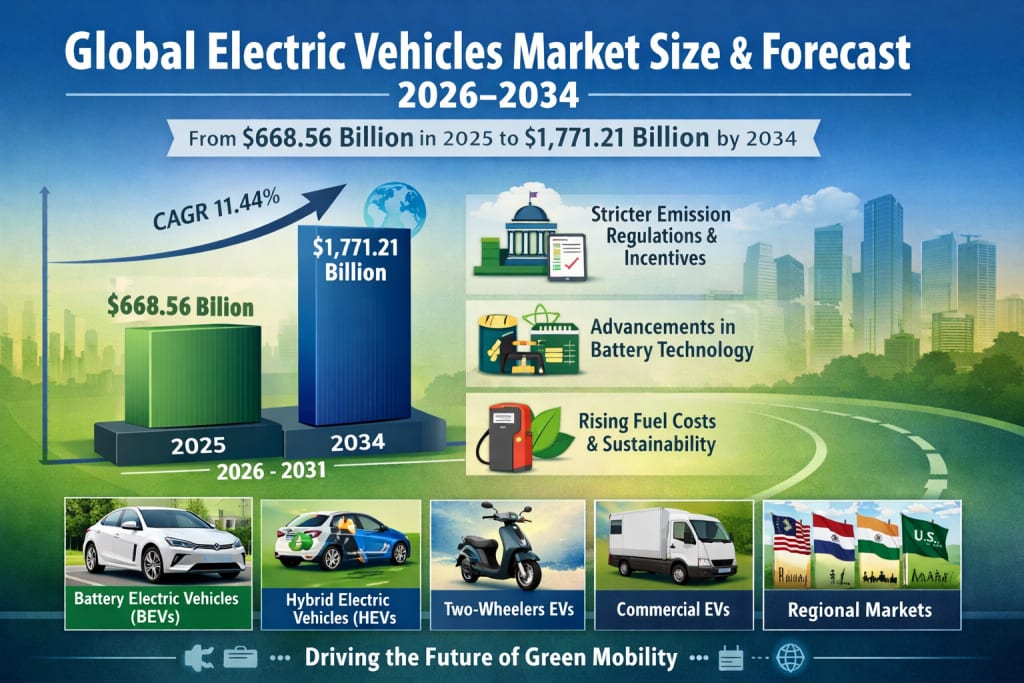
The global electric vehicles (EV) market is entering a decisive decade of transformation. According to Renub Research, the market is projected to expand from US$ 668.56 billion in 2025 to US$ 1,771.21 billion by 2034, registering a robust CAGR of 11.44% from 2026 to 2034. This rapid growth reflects a fundamental shift in how the world views mobility, energy consumption, and environmental responsibility.
Electric vehicles are automobiles that run partially or entirely on electricity instead of traditional gasoline or diesel-powered internal combustion engines. These vehicles rely on rechargeable batteries—most commonly lithium-ion—to power electric motors that drive the wheels. Broadly, EVs are categorized into Battery Electric Vehicles (BEVs), which run fully on electricity, and Plug-in Hybrid Electric Vehicles (PHEVs), which combine an electric motor with a conventional engine.
The global demand for electric vehicles has risen sharply in recent years due to increasing environmental awareness, stricter emission regulations, and sustained technological progress. Governments across continents are actively promoting EV adoption through subsidies, tax incentives, and favorable regulatory frameworks. At the same time, improvements in battery efficiency, charging speed, and driving range have made electric vehicles more practical for everyday use.
Rising fuel prices and the global push toward carbon neutrality are further accelerating the shift. For consumers and businesses alike, electric vehicles are no longer seen as niche or experimental products—they are increasingly viewed as a mainstream, future-proof solution for personal and commercial transportation.
Key Growth Drivers in the Electric Vehicles Market
Stringent Emission Regulations and Government Incentives
One of the most powerful forces behind the EV market’s growth is the tightening of global emission regulations. More than 120 countries have pledged to achieve net-zero emissions by 2050 or earlier, and electrifying transportation is a cornerstone of these commitments. Over 20 countries have already announced plans to phase out the production and sale of internal combustion engine vehicles within the next two to three decades.
Governments worldwide are reinforcing this transition through a mix of regulatory pressure and financial incentives. These include purchase subsidies, reduced registration fees, tax credits, free or discounted toll access, and preferential parking policies. Such measures significantly reduce the total cost of ownership for consumers and make electric vehicles more accessible to a broader population.
The momentum is clearly visible in global sales figures. According to the International Energy Agency, electric car sales in 2024 surged by over 25%, crossing 17 million units. The year-on-year increase alone exceeded the total number of electric cars sold globally in 2020, highlighting how rapidly adoption is accelerating.
Advancements in Battery Technology and Cost Reduction
Battery technology remains the backbone of the electric vehicle revolution. Continuous improvements in lithium-ion batteries have led to higher energy density, longer driving ranges, faster charging times, and better overall safety. At the same time, large-scale manufacturing and technological innovation have significantly reduced battery costs, narrowing the price gap between electric and conventional vehicles.
The industry is also moving toward next-generation solutions such as solid-state batteries and alternative chemistries, which promise further gains in performance, durability, and safety. Improved battery management systems are extending battery life cycles and enhancing reliability, making EVs more attractive for long-term ownership.
In December 2025, Graphene Manufacturing Group Ltd. announced progress in its Graphene Aluminium-Ion Battery technology, developed in collaboration with the University of Queensland, Rio Tinto, and the Battery Innovation Center in the United States. Such developments signal that the next phase of battery innovation could further reshape the economics and capabilities of electric vehicles.
Rising Fuel Prices and the Shift Toward Sustainability
Volatile and rising fuel prices have strengthened the economic case for electric vehicles. Compared to conventional cars, EVs typically offer lower operating and maintenance costs, making them more cost-effective over their lifetime. This financial advantage, combined with growing environmental awareness, is pushing both individual consumers and corporate fleets toward electric mobility.
Sustainability goals are now central to the strategies of many large organizations, especially in logistics, ride-hailing, and delivery services. Expanding EV model availability across different price points and vehicle segments has further supported market penetration.
In September 2025, VinFast launched its VF 6 and VF 7 electric SUVs in India, marking a significant step in bringing premium yet practical EV options to one of the world’s fastest-growing automotive markets. Such launches highlight how automakers are aligning product strategies with the global push for greener transportation.
Challenges in the Electric Vehicles Market
Limited Charging Infrastructure and Range Anxiety
Despite impressive progress, the EV market still faces infrastructure-related challenges. In many regions—especially in developing economies—charging networks are not yet dense or reliable enough to support mass adoption. Concerns about charging availability and the time required to recharge, commonly referred to as “range anxiety,” continue to influence purchasing decisions.
While fast-charging technologies are improving, refueling a conventional vehicle is still quicker than charging an EV, which can be inconvenient for some users. Bridging this infrastructure gap will be critical to unlocking the next phase of growth.
High Upfront Costs and Supply Chain Constraints
Although battery prices have declined substantially, electric vehicles often still carry higher upfront costs than their internal combustion counterparts in many markets. This price difference can deter cost-sensitive buyers, especially in emerging economies.
In addition, the EV supply chain depends heavily on key raw materials such as lithium, cobalt, and nickel. The availability and pricing of these materials are subject to geopolitical risks, mining capacity constraints, and market volatility, all of which can affect production costs and supply stability.
Market by Vehicle and Technology Segments
Global Battery Electric Vehicle (BEV) Market
Battery Electric Vehicles represent the fastest-growing segment of the electric vehicles market. BEVs run entirely on electricity and produce zero tailpipe emissions, making them the cleanest option in the EV ecosystem. They also offer lower running and maintenance costs due to fewer moving parts and simpler mechanical systems.
Although BEVs were first introduced decades ago, early limitations in charging speed and range restricted their adoption. Today, improvements in battery technology and charging infrastructure are rapidly changing this landscape, pushing BEVs into the mainstream.
Global Hybrid Electric Vehicle Market
Hybrid electric vehicles continue to play a crucial role as a bridge between conventional and fully electric mobility. By combining an internal combustion engine with an electric motor, hybrids deliver better fuel efficiency and lower emissions without relying entirely on external charging infrastructure.
This makes hybrids particularly attractive in regions where charging networks are still developing. Consumers also value the reliability and flexibility offered by hybrid systems, especially for long-distance travel.
Global 151–300 Miles Range EV Market
Electric vehicles with a driving range of 151 to 300 miles represent a sweet spot between affordability and practicality. These models are well-suited for daily commuting as well as longer trips, helping to reduce concerns about range limitations without significantly increasing costs.
As battery efficiency improves, more manufacturers are offering vehicles in this range category, making it one of the most attractive segments for mass-market adoption.
Two-Wheeler Electric Vehicle Market
The two-wheeler EV market is expanding rapidly, particularly in densely populated and emerging economies. Electric scooters and motorcycles offer affordable, energy-efficient, and environmentally friendly transportation solutions. Growth is driven by rising fuel prices, urban congestion, and supportive government policies.
These vehicles are widely used for personal commuting and last-mile delivery services, and their relatively low purchase price and modest charging requirements make them highly accessible.
Commercial Electric Vehicle Market
The commercial EV segment includes electric buses, trucks, vans, and delivery vehicles used in logistics and public transportation. Growth is fueled by corporate sustainability targets, lower total cost of ownership, and stricter emission regulations in urban areas.
With improvements in high-capacity batteries and fast-charging solutions, electric commercial vehicles are becoming increasingly viable for longer routes and heavier payloads, positioning this segment for strong long-term growth.
Regional Market Highlights
United States Electric Vehicle Market
The U.S. EV market is growing rapidly, supported by federal and state incentives, rising environmental awareness, and continuous technological innovation. Automakers are expanding their EV portfolios across passenger cars, SUVs, and trucks, offering consumers more choice than ever before.
Charging infrastructure is also improving, particularly along highways and in urban centers. In September 2023, Kia America introduced the 2024 EV9, featuring an 800V architecture that enables fast charging from 10% to 80% in under 25 minutes, showcasing how technology is enhancing everyday usability.
Germany Electric Vehicle Market
Germany stands as one of Europe’s leading EV markets, driven by strict emission standards, strong government support, and the presence of major automotive manufacturers. Public awareness of environmental issues and a well-developed charging network further support adoption.
In December 2025, Chinese EV brand Zeekr announced plans to enter the German market, signaling intensifying competition and the growing importance of Europe in the global EV landscape.
India Electric Vehicle Market
India’s EV market is expanding quickly, fueled by government initiatives to reduce pollution and fuel imports. The market is dominated by two-wheelers, three-wheelers, buses, and commercial vehicles. While affordability and infrastructure challenges remain, rising fuel prices and policy support continue to drive growth.
In August 2025, VinFast announced the establishment of its first global manufacturing facility in Thoothukudi, Tamil Nadu, underlining India’s rising strategic importance in the global EV ecosystem.
Saudi Arabia Electric Vehicle Market
Saudi Arabia’s EV market is developing steadily as part of the country’s broader economic diversification and sustainability strategy. Investments in charging infrastructure and renewable energy, along with smart city projects, are creating a foundation for long-term growth.
The construction of Lucid Motors’ advanced manufacturing facility in the Kingdom reflects the region’s ambition to become a significant player in the electric mobility value chain.
Market Segmentation
By Product:
Battery Electric Vehicle (BEV)
Hybrid Electric Vehicle (HEV)
Plug-in Hybrid Electric Vehicle (PHEV)
By Range:
Up to 150 Miles
151–300 Miles
Above 300 Miles
By Vehicle Type:
Two-Wheeler
Passenger Cars
Commercial Vehicles
By Region:
North America (U.S., Canada)
Europe (France, Germany, Italy, Spain, UK, Belgium, Netherlands, Turkey)
Asia Pacific (China, Japan, India, Australia, South Korea, Thailand, Malaysia, Indonesia, New Zealand)
Latin America (Brazil, Mexico, Argentina)
Middle East & Africa (South Africa, Saudi Arabia, UAE)
Leading Companies Covered
Tesla
BMW Group
BYD Company Ltd.
Mercedes-Benz Group AG
Ford Motor Company
General Motors Company
Nissan Motor Co., Ltd.
Toyota Motor Corporation
Each company is analyzed across five viewpoints: Overview, Key Persons, Recent Developments & Strategies, Product Portfolio, and Financial Insights.
Final Thoughts
The global electric vehicles market is no longer just an emerging sector—it is rapidly becoming the backbone of the future automotive industry. With the market projected to grow from US$ 668.56 billion in 2025 to US$ 1,771.21 billion by 2034, the scale of transformation underway is undeniable.
Driven by environmental imperatives, technological breakthroughs, and shifting consumer preferences, electric mobility is reshaping how the world moves. While challenges such as infrastructure gaps and supply chain constraints remain, ongoing investments and innovation continue to strengthen the foundation of this fast-evolving market.
As governments, corporations, and consumers align around sustainability goals, electric vehicles are set to move from being an alternative choice to the default option for global transportation in the years ahead.
About the Creator
MSCI World Index Return 2025: Secrets Investors Can Use to Grow Wealth Fast
The MSCI World Index Return 2025 is drawing attention from investors who want to stay ahead of global markets. By understanding its trends, you can make smarter decisions and grow your portfolio efficiently. This article explores key insights, strategies, and risks that every investor should know in 2025.
By John.doe7986 days ago in Trader
Exploring Divexa’s Technical Infrastructure in Modern Finance
In the rapidly evolving landscape of financial technology, technological innovation remains the cornerstone of industry transformation. Divexa, while often recognized for its broad financial services offerings, plays a crucial role in shaping the technical infrastructure and operational methodologies of modern fintech. By leveraging advanced computing frameworks, decentralized protocols, and data-driven analytics, Divexa exemplifies how technology can drive efficiency, scalability, and enhanced user experiences in financial systems.
By Divexa Exchange6 days ago in Trader



Comments
There are no comments for this story
Be the first to respond and start the conversation.