
Global Electric Cargo Bike Market Size Forecast 2025–2033
How E-Cargo Bikes Are Redefining Urban Logistics, Sustainable Mobility, and Last-Mile Delivery

The Rise of a Quiet Urban Revolution
The global transportation landscape is undergoing a subtle yet powerful transformation. As cities struggle with congestion, pollution, and the rising cost of fuel, a new class of vehicle is emerging as a practical hero of urban mobility: the electric cargo bike. Once seen as a niche alternative for eco-enthusiasts, e-cargo bikes are now becoming a serious solution for last-mile delivery, small businesses, municipal services, and even families looking to replace their second car.
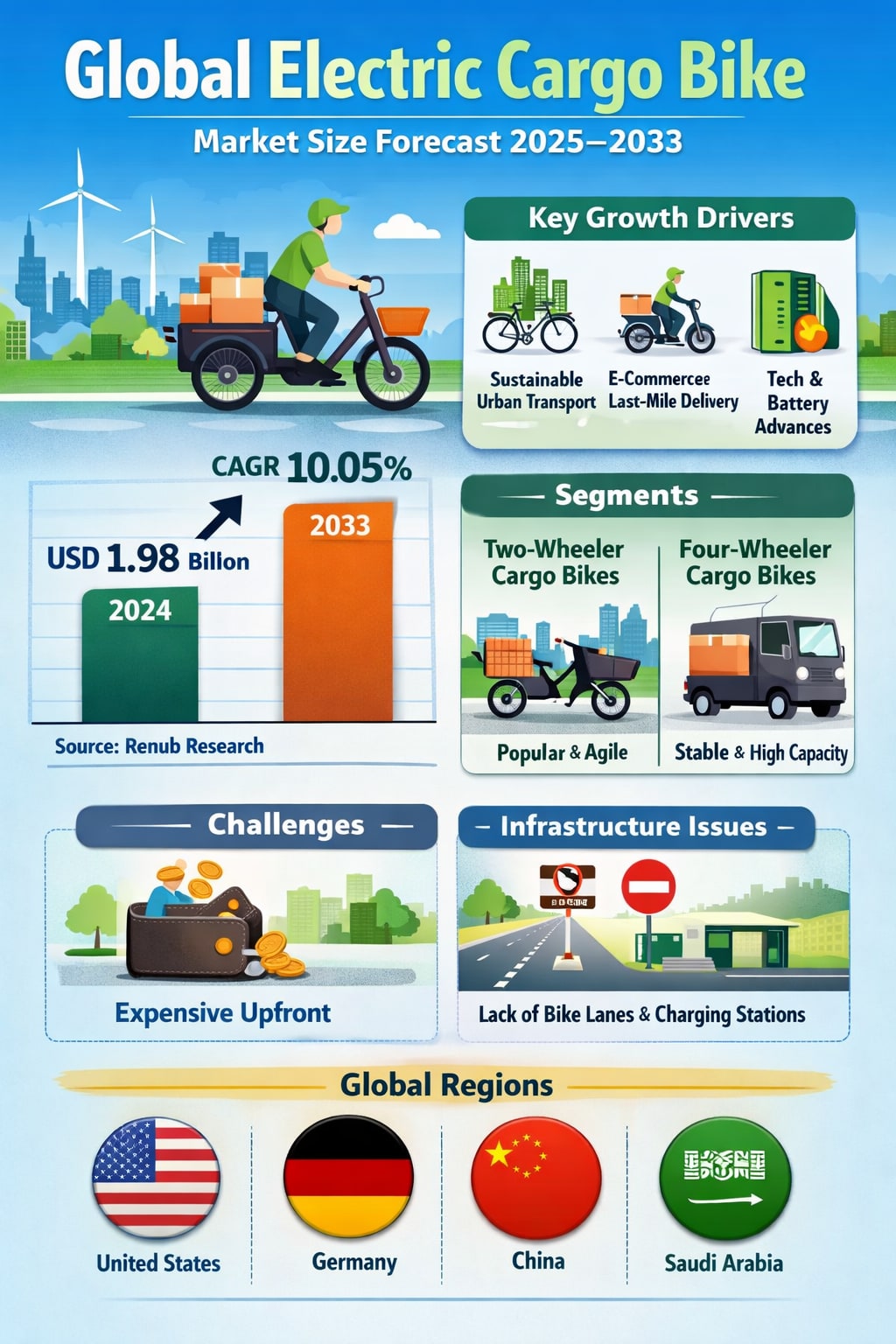
According to Renub Research, the Electric Cargo Bike market was valued at USD 1.98 billion in 2024 and is expected to reach USD 4.69 billion by 2033, growing at a compound annual growth rate (CAGR) of 10.05% over the forecast period. This strong growth reflects more than just a trend—it signals a structural shift in how goods and people move through crowded urban spaces.
Urban delivery needs, sustainability targets, and rising fuel prices are pushing both businesses and consumers toward cost-effective and environmentally friendly alternatives. In this context, electric cargo bikes are no longer a novelty; they are becoming a strategic tool in the global push for cleaner, smarter, and more efficient cities.
What Exactly Is an Electric Cargo Bike?
An electric cargo bike is a bicycle equipped with an electric motor and a built-in cargo space designed to carry heavy loads, goods, or even passengers. Unlike conventional bicycles, these bikes provide pedal assistance, making it far easier to transport weight over longer distances or up steep inclines. They come in various configurations, including front-loaders, rear-loaders, and trikes, each designed to serve different transport needs.
In practice, e-cargo bikes are being used by logistics companies for last-mile delivery, by couriers for parcel and food distribution, and by small businesses as mobile vending platforms. At the same time, families are adopting them for school runs, grocery shopping, and daily commuting—especially in cities where traffic congestion and parking costs make car ownership increasingly unattractive.
Governments and urban planners are also playing a role in accelerating adoption. Subsidies, dedicated bike lanes, and low-emission zones are making electric cargo bikes a more appealing choice. With low operating costs, zero tailpipe emissions, and improving battery range and load capacity, these bikes offer a compelling alternative to traditional vans and cars for short-distance transport.
Key Drivers Fueling Market Growth
Sustainable Urban Transport Initiatives
One of the strongest forces behind the growth of the electric cargo bike market is the global push toward sustainable urban transportation. Cities around the world are introducing low-emission zones, tightening pollution regulations, and investing in cycling infrastructure. In this environment, e-cargo bikes fit perfectly into the vision of cleaner, quieter, and less congested urban centers.
Unlike fuel-powered vehicles, electric cargo bikes produce no direct emissions, reduce noise pollution, and take up far less road space. Policy measures such as purchase subsidies, tax incentives, and the expansion of bike lanes are encouraging both businesses and individuals to make the switch. As governments pursue long-term carbon neutrality goals, demand for low-emission transport solutions is expected to rise steadily.
The International Energy Agency (IEA) has projected a significant increase in the adoption of low-emission vehicles, including e-bikes, by 2030. This broader shift toward green mobility is creating a favorable environment for the electric cargo bike market to flourish.
The Boom in Last-Mile Delivery and E-Commerce
The explosive growth of e-commerce has fundamentally changed how goods move within cities. Consumers now expect faster deliveries, often on the same day, which has put enormous pressure on last-mile logistics networks. Traditional delivery vans, however, face serious challenges in urban areas—traffic congestion, limited parking, and rising fuel and maintenance costs.
Electric cargo bikes offer a smart alternative. They can navigate narrow streets, bypass traffic jams, and park in tight spaces, all while keeping operating costs low. For food delivery, parcel services, and grocery distribution, these bikes are proving to be faster and more efficient for short-distance routes.
The International Transport Forum (ITF) has highlighted that last-mile delivery volumes are set to increase dramatically by 2030. In this context, cargo bikes are not just a green choice—they are becoming a competitive necessity for logistics operators looking to improve efficiency and reduce costs.
Battery Efficiency and Technological Progress
Technological advancements, particularly in lithium-ion battery technology, are another major growth driver. Modern electric cargo bikes now offer longer ranges, higher payload capacities, faster charging times, and better overall performance than earlier models. Features such as regenerative braking, GPS tracking, modular cargo systems, and improved weather resistance are making these bikes more attractive for both commercial and personal use.
As battery prices continue to fall and energy density improves, the total cost of ownership for electric cargo bikes is becoming increasingly competitive. The rapid growth in global e-bike sales over the past few years is a strong indicator of rising consumer confidence in electric two-wheelers as a reliable mode of transport.
Challenges Holding the Market Back
High Initial Cost and Limited Financing Options
Despite their long-term cost advantages, electric cargo bikes still come with a relatively high upfront price compared to traditional bicycles or even some scooters. The cost of batteries, electric motors, and reinforced frames adds up, making these bikes less accessible to small businesses and lower-income consumers in many regions.
In addition, financing options such as leasing or installment plans are not yet widely available in all markets. Without strong subsidy programs or flexible payment solutions, adoption—especially in developing economies—remains slower than it could be.
Infrastructure Gaps and Regulatory Uncertainty
Another major challenge is the lack of adequate infrastructure in many cities. Wide and safe bike lanes, secure parking facilities, and accessible charging points are still missing in large parts of the world. Without this support system, operating e-cargo bikes at scale becomes more difficult and less attractive.
Regulatory inconsistency also creates obstacles. Different countries and even cities classify electric cargo bikes differently in terms of speed limits, size restrictions, and usage rights. This lack of standardization complicates large-scale deployment for manufacturers and logistics companies operating across multiple markets.
Market Segmentation Insights
Two-Wheeler Electric Cargo Bikes: The Volume Leader
Two-wheeler electric cargo bikes remain the most popular and widely used category. Their lightweight design, affordability, and maneuverability make them ideal for dense urban environments where speed and parking flexibility are crucial. Food delivery services, courier companies, and small retailers are the biggest users of this segment.
These bikes are also easier to maintain and more accessible for personal use, which further supports their dominance in global sales volumes, particularly in Europe and Asia.
Four-Wheeler Electric Cargo Bikes: Built for Heavy Duty
Four-wheeler models, often referred to as cargo e-quads, are gaining attention for applications that require greater stability and higher load capacity. They are increasingly used in city services, industrial parks, and large-scale delivery operations. With enclosed cargo compartments, they offer better protection for goods and can operate reliably in different weather conditions.
Although more expensive than two-wheelers, these vehicles present a cleaner alternative to small delivery vans, especially in regions with strict emission regulations.
Battery Types: Lithium-Ion vs. Lead-Based
Lithium-ion batteries dominate the market due to their superior energy density, longer lifespan, and lighter weight. They support longer ranges and faster charging, making them the preferred choice for commercial fleets and high-usage scenarios. As prices continue to fall and battery management systems improve, this segment is expected to maintain strong growth.
Lead-based batteries, on the other hand, remain relevant in price-sensitive markets. They are heavier and less efficient but cheaper and easier to manufacture and repair. However, environmental concerns and shorter lifespans are gradually pushing the market toward cleaner battery technologies.
Application Trends: Service Delivery and Personal Use
The service delivery sector is currently the backbone of the electric cargo bike market. Logistics, food delivery, and courier services are rapidly adopting these bikes to reduce costs, improve delivery times, and meet sustainability targets. Major retailers and logistics companies are already testing and expanding e-cargo bike fleets in key urban centers.
At the same time, personal use is emerging as a strong growth segment. Families and individuals are increasingly using electric cargo bikes for daily errands, school runs, and commuting. In cities with well-developed cycling infrastructure, these bikes are becoming a realistic substitute for cars, offering lower ownership costs and a smaller environmental footprint.
Regional Market Highlights
United States
The U.S. electric cargo bike market is gaining momentum, driven by growing interest in eco-friendly mobility and last-mile delivery solutions. Cities like New York, Portland, and San Francisco are leading adoption through pilot programs and local incentives. While car-centric infrastructure remains a challenge, increasing awareness and investment in cycling facilities are supporting steady growth.
In April 2025, Tenways entered the U.S. cargo bike market with the launch of the Tenways Cargo One, a front-loading electric cargo bike positioned as a cost-effective family transport solution, competing with established brands such as Urban Arrow.
Germany
Germany stands out as one of Europe’s strongest markets for electric cargo bikes, supported by excellent cycling infrastructure and generous government incentives. E-cargo bikes are widely used by both families and businesses, and many cities have integrated them into municipal services and urban logistics.
In September 2023, Maxion Wheels partnered with German manufacturer Antric to supply wheels for the heavy-duty Antric One cargo bike, highlighting the growing industrial focus on urban logistics solutions.
China
China remains a massive market for electric two-wheelers, and cargo bikes are evolving rapidly within this ecosystem. While low-cost models dominate, higher-end e-cargo bikes are gaining traction in major cities, driven by the booming e-commerce and food delivery sectors. Local manufacturers continue to innovate, although regulatory challenges and quality variations persist.
In May 2025, Honda introduced its first electric motorcycle, the E-VO, in China in collaboration with Guangzhou, reflecting the broader momentum behind electric mobility in the region.
Saudi Arabia
Saudi Arabia represents an emerging market for electric cargo bikes, aligned with the country’s Vision 2030 focus on sustainability and smart cities. Pilot projects in urban logistics and university campuses are laying the groundwork for future growth, although climate conditions and limited cycling culture remain challenges.
Competitive Landscape
The global electric cargo bike market features a mix of established bicycle manufacturers and innovative mobility startups. Key players include:
Butchers & Bicycles Ltd.
Accell Group N.V.
Mahindra & Mahindra Limited
Amsterdam Bicycle Company
Xtracycle Cargo Bikes
Riese & Müller GmbH
CERO Inc.
Kalkhoff Werke GmbH
Giant Bicycles
Rad Power Bikes Inc.
These companies compete on design innovation, battery performance, durability, and total cost of ownership, while also expanding their presence in both commercial and consumer segments.
Final Thoughts: A Market Riding Toward the Future
With the global electric cargo bike market projected to grow from USD 1.98 billion in 2024 to USD 4.69 billion by 2033 at a CAGR of 10.05%, the message is clear: e-cargo bikes are no longer a niche product—they are becoming a core component of modern urban mobility.
As cities continue to battle congestion, pollution, and rising logistics costs, electric cargo bikes offer a rare combination of efficiency, sustainability, and economic sense. While challenges around cost, infrastructure, and regulation remain, ongoing technological progress and supportive public policies are steadily clearing the road ahead.
About the Creator
Mexico Green Hydrogen Market: Size, Share, Industry Trends Analysis and Forecast
Why the Mexico Green Hydrogen Market Is Emerging as a Clean Energy Leader: Trends & Future Outlook Mexico is entering a pivotal moment in its energy transition. As the world races to reduce carbon emissions, green hydrogen is gaining attention as a powerful solution for decarbonizing heavy industry, transportation, and electricity generation. The Mexico green hydrogen market is still in its early stages, but momentum is building rapidly as investments, policy discussions, and technological advancements align.
By Jackson Watson7 days ago in Trader
Stanislav Kondrashov on Partners Group and Belimo: How AI Is Forcing a Rethink of Software and Physical Infrastructure
Artificial intelligence is often described as a purely digital revolution. Faster models. Smarter automation. More efficient software. But that view only tells half the story. According to Stanislav Kondrashov, founder of TELF AG, the real transformation is happening beneath the surface—inside energy systems, data centres, and industrial supply chains. Recent developments at Partners Group and Belimo Holding AG highlight how AI is reshaping both corporate strategy and operational priorities.
By Stanislav Kondrashovabout 14 hours ago in Trader




Comments
There are no comments for this story
Be the first to respond and start the conversation.