
Global Crab Market Size and Forecast 2025–2033
Rising Seafood Demand, Premiumization, and Aquaculture Investments Reshape the Global Crab Industry

Global Crab Market at a Glance
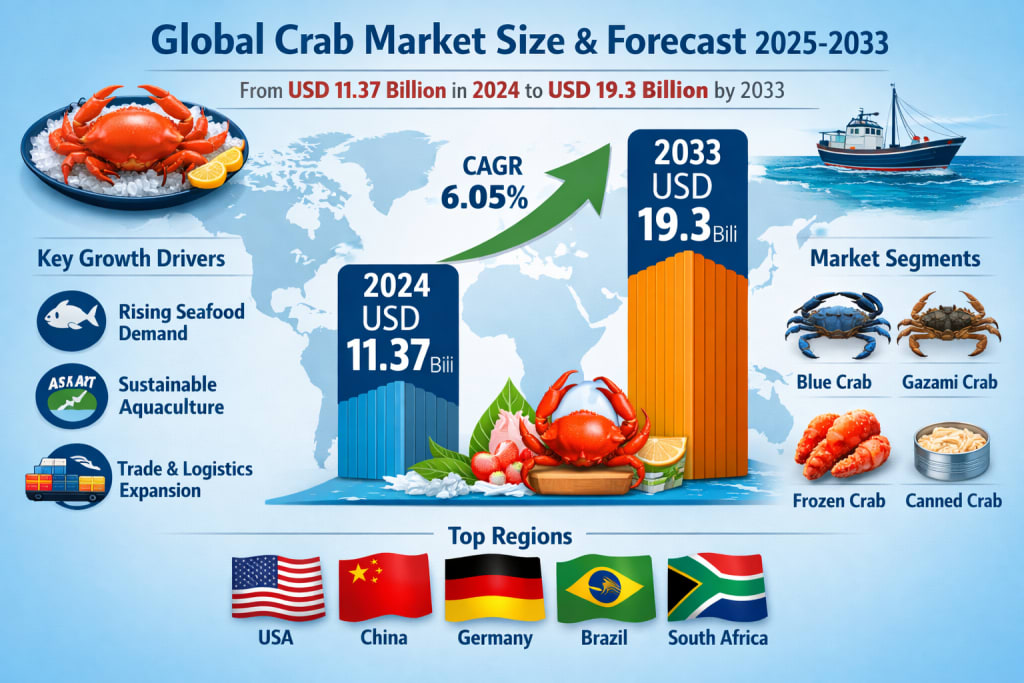
The Global Crab Market is entering a dynamic growth phase, supported by changing food habits, rising health awareness, and continuous improvements in seafood supply chains. According to industry estimates, the global crab market was valued at USD 11.37 billion in 2024 and is projected to reach USD 19.3 billion by 2033, expanding at a compound annual growth rate (CAGR) of 6.05% from 2025 to 2033.
This growth is being fueled by multiple converging trends: increasing global seafood consumption, rising demand for premium and value-added seafood products, the expansion of aquaculture, and better cold-chain logistics that allow crab to reach markets far from coastal regions. In addition, greater awareness of the nutritional benefits of crab—rich in protein, omega-3 fatty acids, zinc, and selenium—is reinforcing its position as a high-value protein choice in both developed and emerging economies.
From street food stalls in Asia to fine-dining restaurants in Europe and North America, crab has become a versatile and globally appreciated seafood product. As a result, the industry is no longer limited to local fishing communities; it is now a truly global business shaped by trade agreements, sustainability policies, and evolving consumer lifestyles.
Understanding the Global Crab Market Landscape
Crabs are crustaceans found in oceans, coastal regions, and freshwater ecosystems. They are widely used across global cuisines in dishes such as crab cakes, soups, curries, stir-fries, sushi, and gourmet seafood platters. The appeal of crab lies not only in its delicate taste and texture but also in its strong nutritional profile, making it attractive to health-conscious consumers.
Countries such as the United States, China, and Japan are among the world’s largest consumers of crab, but demand is also rising steadily in Europe, the Middle East, and parts of Latin America. The expansion of sustainable aquaculture and improvements in freezing, packaging, and transportation technologies have made crab more accessible to inland and non-coastal markets, significantly widening its consumer base.
At the same time, the market is seeing a shift toward value-added formats such as frozen, canned, and ready-to-cook or ready-to-eat products. These formats cater to busy urban consumers who want convenience without compromising on quality or nutrition.
Key Growth Drivers of the Global Crab Market
1. Rising Global Demand for Seafood
One of the strongest drivers of the crab market is the steady increase in global seafood consumption. Consumers are increasingly turning toward seafood as a healthier alternative to red meat, driven by concerns over heart health, obesity, and lifestyle-related diseases. Crab, with its high protein content and beneficial fatty acids, fits perfectly into this trend.
Additionally, rising disposable incomes in emerging economies and the rapid expansion of seafood restaurants and quick-service chains have further boosted demand. While the overall growth rate of global fish production is moderating compared to the previous decade, aquaculture continues to expand and is expected to overtake capture fisheries in terms of total output. This structural shift supports a more stable and scalable supply of crab for global markets.
2. Expansion of Sustainable Aquaculture
Sustainability has become a central theme in the global seafood industry, and crab farming is no exception. Governments and private investors are increasingly focusing on sustainable aquaculture practices that ensure consistent supply while reducing pressure on wild crab populations.
Technological advancements in breeding, feeding, disease control, and water management have improved productivity and reduced risks in crab farming. International guidelines and best practices—supported by organizations and regulatory bodies—are also helping standardize operations and promote environmentally responsible growth. Over time, this is expected to stabilize prices, improve product quality, and enhance long-term market confidence.
3. Growth in International Trade and Cold-Chain Logistics
The global crab market has benefited enormously from improvements in cold-chain infrastructure and international trade frameworks. Modern freezing, storage, and transportation systems allow crabs to be shipped across continents while maintaining freshness and quality.
Export-oriented seafood producers such as Indonesia, Vietnam, and the United States are increasingly serving distant markets in Europe, the Middle East, and parts of Asia-Pacific. Trade agreements and tariff reductions among certain regions have further improved market access, making crab more affordable and widely available to consumers around the world.
Challenges Facing the Global Crab Industry
1. Overfishing and Declining Wild Stocks
Despite the progress in aquaculture, overfishing remains a serious concern for the global crab industry. Several crab species face pressure from excessive harvesting, leading governments to impose stricter quotas, seasonal bans, and sustainability regulations. While these measures are essential for long-term ecological balance, they can also create short-term supply constraints and price volatility.
2. Price Fluctuations and Trade Barriers
Crab prices are highly sensitive to seasonal availability, climate conditions, fuel costs, and geopolitical factors. Trade restrictions, tariffs, and supply chain disruptions can quickly impact availability in key consumer markets. In addition, intense competition among seafood suppliers puts pressure on margins, especially in price-sensitive regions.
Spotlight on Key Market Segments
Global Blue Crab Market
Blue crabs are among the most popular crab varieties globally, prized for their sweet, tender meat. They are commonly found in the Atlantic Ocean and the Gulf of Mexico, with the United States being a major producer and consumer. Blue crabs are widely used in both fresh and processed forms and are especially popular in premium seafood restaurants and retail seafood counters.
Global Gazami Crab Market
Gazami crabs, also known as Japanese swimming crabs, are widely consumed across Asia and the Middle East. Known for their firm texture and high meat yield, these crabs are increasingly traded in both fresh and frozen forms. Countries such as China, South Korea, and Vietnam play a significant role in the export market for Gazami crabs.
Global Frozen Crab Market
Frozen crab represents one of the fastest-growing segments due to its longer shelf life and ease of transportation. This format has made crab accessible to inland regions and non-coastal countries, significantly expanding the consumer base. Demand for frozen crab is particularly strong in Europe and North America, where packaged and convenience seafood products are gaining popularity.
Global Canned Crab Market
Canned crab products cater to consumers seeking convenient, ready-to-use seafood options. Widely used in salads, soups, sandwiches, and pasta dishes, canned crab has become a staple in many households and foodservice operations. The segment is especially strong in North America and Europe, where processed and shelf-stable foods remain in high demand.
Regional Market Highlights
United States
The United States is both a major producer and consumer of crab, with blue crabs from the Chesapeake Bay and Dungeness crabs from the Pacific Northwest being particularly well known. A strong seafood culture, combined with growing health awareness, continues to support demand for fresh, frozen, and processed crab products. Innovation in product formats, including ready-to-cook and specialty offerings, is also helping expand the market.
Germany
Germany has seen rising demand for seafood, including crab, driven by a growing preference for high-protein, low-fat diets. Imports of frozen and canned crab have increased, and retailers are expanding their seafood assortments to meet evolving consumer tastes. Quality, sustainability, and traceability are becoming increasingly important purchasing factors in this market.
China
China is one of the world’s largest consumers of crab, particularly hairy crabs, which are considered a delicacy. The country is also a major exporter of crab products. Rising incomes, urbanization, and a growing middle class are boosting demand for premium and imported seafood, including value-added crab products designed for festive and family occasions.
Brazil
Brazil’s crab market is expanding due to strong domestic consumption and rising seafood exports. Coastal regions provide a solid supply base, while increasing health awareness and the growth of seafood restaurants are supporting demand. Brazil is also strengthening its position in international seafood trade, adding a new dimension to its crab industry.
South Africa
South Africa’s seafood sector is growing steadily, with crab consumption benefiting from rising tourism and improving disposable incomes. Both wild-caught and farmed crabs contribute to the market, and future growth will depend heavily on expanding aquaculture capacity to meet rising national seafood demand.
Saudi Arabia
Saudi Arabia relies heavily on imports for crab and other seafood products due to limited domestic production. However, strong demand from hotels, restaurants, and premium retail outlets is driving growth. Investments in cold-chain infrastructure, processing facilities, and aquaculture training programs are gradually strengthening the country’s seafood ecosystem.
Global Crab Market Segmentation
By Type:
Blue Crab
Chinese Mitten
Gazami Crab
Other Crab Types
By Form:
Frozen
Canned
Other Forms
By Region:
North America: United States, Canada
Europe: France, Germany, Italy, Spain, United Kingdom, Netherlands
Asia Pacific: China, Japan, India, Australia, South Korea, Malaysia, Indonesia, Israel
Latin America: Brazil, Mexico, Argentina, Colombia
Middle East & Africa: South Africa, Saudi Arabia, UAE, Rest of World
Competitive Landscape and Company Overview
The global crab market features a mix of established seafood processors, regional specialists, and export-focused suppliers. Companies are typically evaluated across several dimensions, including key leadership, company overview, sales performance, product portfolio, and recent strategies or developments.
Notable players in the market include:
Bumble Bee Foods LLC
Supreme Crab & Seafood Inc.
Maine Lobster Now
Millennium Ocean Star Corporation
Phil-Union Frozen Foods Inc.
JM Clayton Seafood Company
RGE Agridev Corporation
Siam Canadian Group Limited
Handy Seafood
These companies are increasingly focusing on product innovation, sustainable sourcing, brand positioning, and expansion into high-growth international markets.
Final Thoughts: A Market with Strong Long-Term Potential
The Global Crab Market is clearly on a solid growth trajectory, supported by rising seafood consumption, premiumization trends, and continuous improvements in aquaculture and logistics. With the market expected to grow from USD 11.37 billion in 2024 to USD 19.3 billion by 2033 at a CAGR of 6.05%, opportunities are emerging across the value chain—from farming and processing to packaging, branding, and international distribution.
While challenges such as overfishing, price volatility, and trade uncertainties remain, the long-term outlook is positive. Companies that invest in sustainability, supply chain efficiency, and value-added products are likely to be the biggest winners in this evolving global seafood landscape.
About the Creator
Tom Shane
Tom Shane is a content writer specializing in SEO-driven blogs, product descriptions, and thought leadership. He crafts engaging, research-backed content that connects with audiences and drives results.
Maharashtra Police Hall Ticket 2026: Easy Guide to Download and Check Details
The Maharashtra Police Hall Ticket is the most important document for candidates appearing in the 2026 recruitment exam. It allows entry into the exam hall and contains crucial information such as your name, roll number, exam date, and center. Downloading it on time is important to avoid stress. This guide will show you how to check, download, and verify your hall ticket easily.
By John.doe7984 days ago in Trader


Comments
There are no comments for this story
Be the first to respond and start the conversation.