
Global Cardiac Bio Implant Devices Market Trends & Summary (2025–2033)
How Innovation, Aging Populations, and Minimally Invasive Cardiac Care Are Reshaping a US$ 74 Billion Industry

Introduction: A Market Built Around the Heart
The human heart has always been at the center of medical innovation, but in recent decades, few fields have advanced as rapidly as cardiac implant technology. From life-saving pacemakers to sophisticated cardiac resynchronization therapy devices, cardiac bio implant devices are transforming how physicians treat complex cardiovascular conditions. These innovations are not only extending life expectancy but also significantly improving the quality of life for millions of patients worldwide.
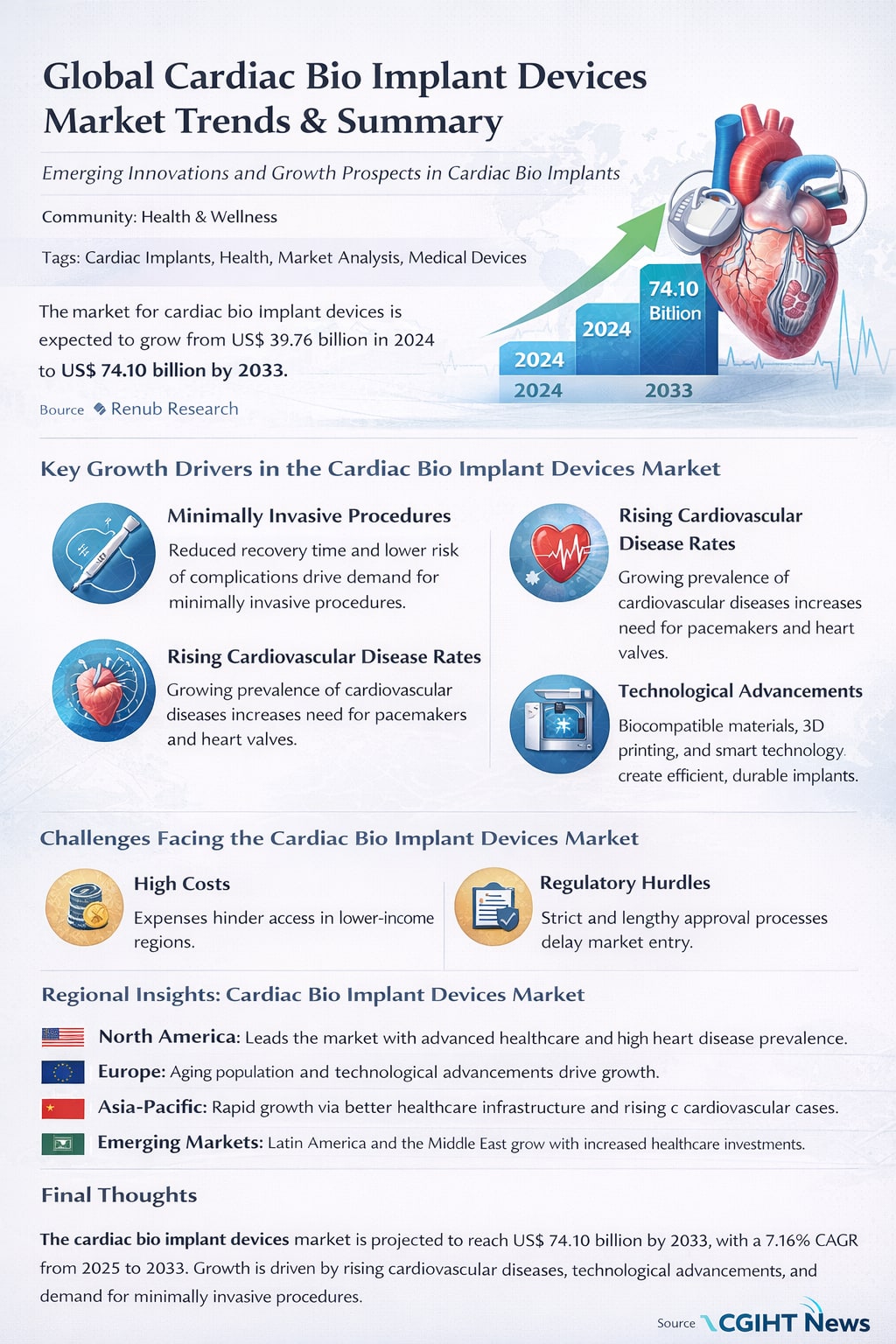
According to Renub Research, the Global Cardiac Bio Implant Devices Market is expected to grow from US$ 39.76 billion in 2024 to US$ 74.10 billion by 2033, registering a compound annual growth rate (CAGR) of 7.16% from 2025 to 2033. This strong growth trajectory reflects a convergence of powerful forces: aging populations, rising cardiovascular disease prevalence, rapid technological advancements, and the global shift toward minimally invasive treatment options.
In an era where cardiovascular diseases remain the leading cause of death globally, cardiac bio implant devices are no longer niche medical tools. They are becoming essential components of modern healthcare systems, shaping the future of cardiology and redefining how heart disease is managed across both developed and emerging markets.
Understanding Cardiac Bio Implant Devices
Cardiac bio implant devices are medical implants designed to support, regulate, or replace damaged or malfunctioning components of the heart. These devices include pacemakers, implantable cardioverter defibrillators (ICDs), cardiac resynchronization therapy (CRT) devices, heart valves, stents, and artificial cardiac pumps. Manufactured using advanced biocompatible materials, these implants are engineered to integrate smoothly with the human body, reducing the risk of rejection and long-term complications.
Clinically, these devices play a crucial role in treating conditions such as arrhythmias, heart failure, myocardial ischemia, acute myocardial infarction, and aortic stenosis. Over the years, continuous improvements in design, materials, and implantation techniques have made these devices more durable, more precise, and less invasive. As a result, patients today benefit from shorter recovery times, lower surgical risks, and significantly improved long-term outcomes.
What makes cardiac bio implants particularly important is their ability to shift cardiac care from reactive to proactive. Instead of merely managing symptoms, these devices actively regulate heart function, prevent sudden cardiac events, and, in many cases, save lives in real time.
Market Outlook: Growth Fueled by Global Health Trends
The growth of the cardiac bio implant devices market is closely tied to global health and demographic trends. Cardiovascular diseases continue to rise worldwide, driven by aging populations, sedentary lifestyles, poor dietary habits, smoking, obesity, and genetic factors. As life expectancy increases, so does the number of people living with chronic heart conditions that require long-term medical intervention.
At the same time, healthcare systems are increasingly prioritizing early diagnosis, preventive care, and long-term disease management, all of which favor the adoption of implantable cardiac devices. Strong reimbursement frameworks in developed markets, expanding healthcare infrastructure in emerging economies, and growing patient awareness are further accelerating market expansion.
The result is a dynamic and fast-evolving global market where innovation, accessibility, and clinical effectiveness are becoming the key competitive differentiators.
Key Growth Drivers
1. The Rise of Minimally Invasive Procedures
One of the most significant drivers of the cardiac bio implant devices market is the global shift toward minimally invasive medical procedures. Traditional open-heart surgeries, while effective, are associated with longer hospital stays, higher complication risks, and extended recovery periods. In contrast, modern implant procedures often require smaller incisions, shorter operation times, and faster patient recovery.
Advances in catheter-based implantation techniques, imaging technologies, and precision surgical tools have made it possible to implant devices such as pacemakers, stents, and valves with minimal trauma to the patient. This has not only improved clinical outcomes but has also expanded the pool of patients who are eligible for these treatments, including elderly and high-risk individuals.
As healthcare systems continue to prioritize efficiency, safety, and patient comfort, minimally invasive cardiac procedures are expected to remain a major catalyst for market growth.
2. Rising Prevalence of Cardiovascular Diseases
The growing global burden of cardiovascular disease is another powerful engine behind the expansion of the cardiac bio implant devices market. Conditions such as coronary artery disease, heart failure, arrhythmias, and ischemic heart disease are becoming increasingly common across both developed and developing countries.
In the United States alone, millions of adults live with some form of heart disease, and the incidence of heart attacks remains alarmingly high. As populations age and lifestyle-related risk factors become more widespread, the demand for long-term, reliable cardiac interventions continues to rise.
Bio implant devices offer durable and effective solutions for managing chronic cardiac conditions, preventing sudden cardiac events, and improving survival rates. As a result, their adoption is expected to increase steadily in the coming years, especially as healthcare providers focus more on long-term disease management rather than short-term symptom control.
3. Rapid Technological Advancements
Technology is at the heart of this market’s evolution—quite literally. Innovations in materials science, device miniaturization, battery technology, digital monitoring, and manufacturing techniques have transformed cardiac bio implant devices into highly sophisticated medical tools.
Modern implants are smaller, more precise, and more customizable than ever before. The integration of smart technologies, wireless monitoring, and data analytics allows physicians to track patient health in real time and adjust treatment strategies proactively. Meanwhile, advances in 3D printing and personalized medicine are opening the door to patient-specific implants that offer better compatibility and improved performance.
These technological breakthroughs are not only enhancing clinical outcomes but also increasing physician confidence and patient acceptance, further driving market adoption worldwide.
Challenges Facing the Market
1. High Costs of Devices and Procedures
Despite their life-saving potential, cardiac bio implant devices remain expensive. The high cost is driven by advanced materials, complex manufacturing processes, rigorous quality standards, and the need for specialized surgical expertise. For many patients, especially in low- and middle-income countries, these costs can be a significant barrier to access.
High prices also place pressure on healthcare providers and insurance systems, sometimes limiting the widespread adoption of these technologies. While ongoing innovation and economies of scale may gradually reduce costs, affordability remains one of the most critical challenges facing the market today.
2. Regulatory Hurdles
The cardiac bio implant devices industry operates under strict regulatory oversight, which is essential for ensuring patient safety and device effectiveness. However, the lengthy and complex approval processes for new devices can delay market entry and increase development costs.
For smaller manufacturers and emerging innovators, navigating these regulatory pathways can be particularly challenging, potentially slowing down innovation and limiting competition. While regulations are necessary, balancing safety with timely access to new technologies remains an ongoing industry challenge.
Regional Market Overview
The global cardiac bio implant devices market shows strong growth across all major regions, though the pace and drivers vary.
North America leads the market, supported by advanced healthcare infrastructure, high disease prevalence, strong research activity, and favorable reimbursement policies.
Europe follows closely, driven by aging populations, technological adoption, and robust public healthcare systems.
The Asia Pacific region is experiencing rapid growth due to improving healthcare infrastructure, rising awareness, and increasing cardiovascular disease burden.
Meanwhile, Latin America and the Middle East & Africa are emerging as promising markets, supported by rising healthcare investments and expanding access to advanced medical technologies.
Country-Level Insights
United States
The United States remains one of the most important markets for cardiac bio implant devices, driven by high rates of heart disease, strong clinical research, and rapid adoption of new technologies. Innovations such as advanced implantable pulse generators and next-generation pacing systems continue to strengthen the country’s leadership position. Favorable reimbursement policies and a well-established healthcare ecosystem further support market growth.
Germany
Germany is a major European hub for cardiac bio implant devices, backed by a strong healthcare system, a large elderly population, and a strong focus on medical research and innovation. The country’s commitment to technological advancement and patient care continues to drive demand for pacemakers, stents, and cardiac valves.
India
India represents one of the fastest-growing markets in the Asia Pacific region. With cardiovascular diseases accounting for a significant share of total deaths, the need for effective and affordable cardiac treatments is rising rapidly. Government healthcare initiatives, growing medical tourism, and expanding access to advanced medical technologies are all contributing to increased adoption of cardiac bio implants.
Saudi Arabia
Saudi Arabia’s market is expanding due to rising lifestyle-related diseases, increasing healthcare investments, and a strong focus on modernizing medical infrastructure. The growing emphasis on specialized cardiac care is driving higher demand for advanced implantable devices across the country.
Market Segmentation
By Type:
Pacemakers
ICDs (Implantable Cardioverter Defibrillators)
CRT (Cardiac Resynchronization Therapy)
By Application:
Arrhythmias
Myocardial Ischemia
Acute Myocardial Infarction
Heart Failure
By End User:
Hospitals
Ambulatory Surgical Centers
Cardiac Catheterization Laboratories
Others
By Geography:
North America (United States, Canada)
Europe (France, Germany, Italy, Spain, UK, Belgium, Netherlands, Turkey)
Asia Pacific (China, Japan, India, South Korea, Thailand, Malaysia, Indonesia, Australia, New Zealand)
Latin America (Brazil, Mexico, Argentina)
Middle East & Africa (Saudi Arabia, UAE, South Africa)
Rest of the World
Competitive Landscape
The global cardiac bio implant devices market is highly competitive, with leading players focusing on innovation, strategic partnerships, and portfolio expansion. Key companies covered include:
Abbott Laboratories
F. Hoffmann-La Roche
Thermo Fisher Scientific
Illumina, Inc.
Natera Inc.
Eurofins Scientific
Quest Diagnostics
Agilent Technologies
These companies are evaluated across multiple dimensions, including company overview, key personnel, product portfolio, recent developments and strategies, and revenue analysis, highlighting the strategic depth and innovation driving this industry forward.
Final Thoughts: The Future of Cardiac Care Is Implantable
The global cardiac bio implant devices market is entering a transformative era. With the market projected to reach US$ 74.10 billion by 2033, the role of implantable cardiac technologies in modern healthcare will only continue to grow. Aging populations, rising cardiovascular disease prevalence, and relentless technological innovation are reshaping how heart conditions are treated worldwide.
While challenges such as high costs and regulatory complexity remain, the overall direction is clear: cardiac bio implants are becoming more accessible, more advanced, and more integral to long-term cardiac care. For patients, this means better outcomes and longer, healthier lives. For healthcare systems, it means more effective tools to manage one of the world’s most pressing health challenges.
In many ways, the future of cardiology is not just about treating the heart—it’s about rebuilding, supporting, and enhancing it from within. And cardiac bio implant devices are at the very center of that revolution.
About the Creator
Asia Stocks Pull Back From Record Highs on AI Disruption Fears; KOSPI Slips Nearly 4%
Asian equity markets retreated sharply today as growing concerns around artificial intelligence (AI) disruption, global rate uncertainty, and sector-specific volatility triggered a broad selloff across the region. After touching record highs in recent sessions, major Asian indices witnessed profit-booking and increased risk aversion, signaling that investors may be reassessing the sustainability of the recent rally.
By Hammad Nawaza day ago in Trader
Jio Finance Share: Evaluating Growth and Investment Potential
Introduction Jio Finance Share has emerged as a prominent investment option in India’s rapidly evolving financial sector. As Reliance Jio expands its digital ecosystem to include payments, lending, and insurance, investors are increasingly interested in the stock’s potential for long-term growth.
By Hammad Nawaz7 days ago in Trader
from death into life
Young Aldin of Wiloh had never contemplated death. It was almost strange — so many around him had the tendency to obsess over it, to clamor and claw almost desperately at their own perceptions of the end to know death as much as they could: when it would come, why it would come, where it would take them when it did.
By angela hepworth3 days ago in Fiction



Comments
There are no comments for this story
Be the first to respond and start the conversation.