
Amniotic Membrane Market Size and Forecast 2025: Regenerative Medicine’s Quiet Revolution
Rising demand for minimally invasive therapies, chronic wound care, and ophthalmic surgeries is accelerating the global amniotic membrane market toward a US$ 7.38 billion future by 2033.

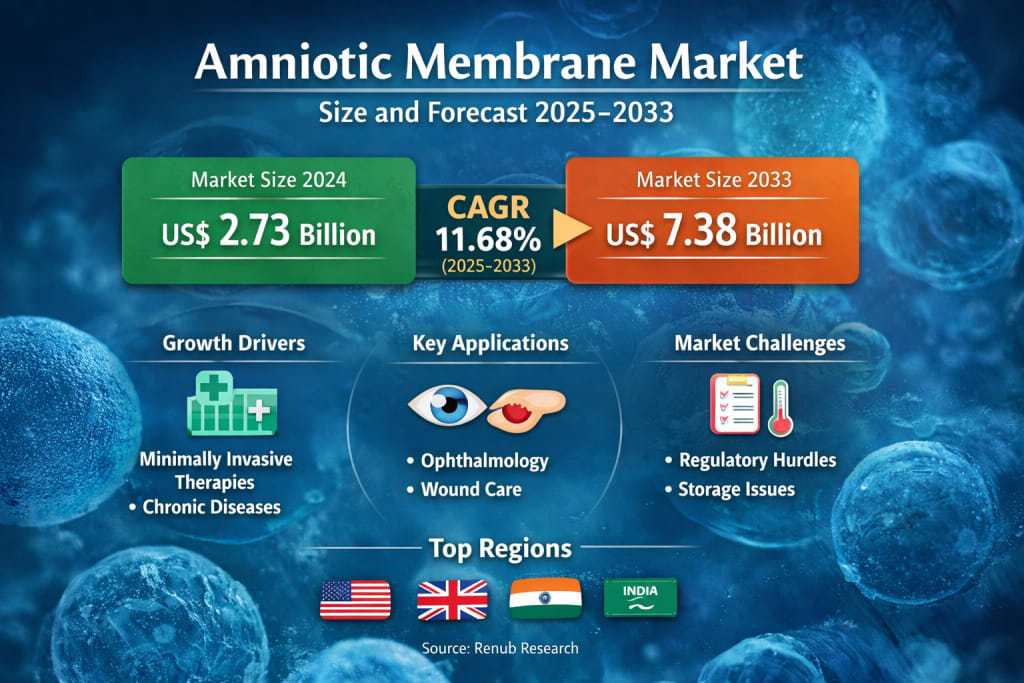
Global Amniotic Membrane Market Overview
The amniotic membrane, the innermost layer of the placenta, is composed of a thick basement membrane and an avascular stromal matrix. This unique biological tissue has found increasing importance in modern medicine because of its remarkable therapeutic properties. It helps reduce inflammation, limits tissue fibrosis and scarring, accelerates healing, and provides a protective, soothing effect on wounds and burns. Due to its low immunogenicity and high safety profile, it is widely accepted in clinical practice, especially in ophthalmology and wound care.
Clinically, amniotic membranes are used in two main ways: as a biological bandage or as a surgical graft. When applied as a graft, the membrane acts as a scaffold that supports re-epithelialization and tissue regeneration. Its anti-inflammatory and anti-scarring properties make it particularly valuable in treating burn injuries, chronic wounds, and post-surgical complications, where patient comfort and faster healing are critical outcomes.
One of the most prominent areas of application is ophthalmology. Amniotic membrane therapy is frequently used to treat ocular surface disorders such as corneal ulcers, bullous keratopathy, corneal degeneration, bacterial keratitis, ocular dystrophy, and in procedures related to glaucoma, cataracts, and eyelid reconstruction. With the global population aging and the number of ophthalmic surgeries rising steadily, the demand for tissue-based products like amniotic membranes is growing at a rapid pace.
According to Renub Research, the Amniotic Membrane Market is expected to reach US$ 7.38 billion by 2033, up from US$ 2.73 billion in 2024, expanding at a CAGR of 11.68% from 2025 to 2033. This impressive growth reflects the expanding role of regenerative medicine, the rising burden of chronic diseases, and the healthcare industry’s shift toward minimally invasive and biologic-based therapies.
Innovation and education are playing a crucial role in accelerating adoption across clinical specialties. In February 2024, Verséa introduced a point-of-care platform for amniotic membrane transplantation, designed to deliver faster diagnostics and more efficient treatment options in ophthalmology. This kind of innovation highlights how technology is making amniotic membrane therapies more accessible and easier to integrate into everyday clinical workflows.
Earlier, in December 2023, Woo University and NovaBay Pharmaceuticals collaborated to train eye care providers on the clinical application of amniotic membranes. Their initiative included a free educational webinar covering clinical use cases, patient selection, and billing practices, with a specific focus on NovaBay’s Avenova Allograft. Such initiatives are critical for expanding physician awareness and building confidence in using biologic therapies in routine practice.
Growth Drivers for the Amniotic Membrane Market
Technological Developments in Healthcare
Advancements in medical technology are significantly enhancing the effectiveness and usability of amniotic membrane products. Modern processing and preservation techniques ensure that essential growth factors and therapeutic properties are retained, improving clinical outcomes across multiple applications.
Moreover, the compatibility of amniotic membranes with cutting-edge fields such as stem cell therapy and three-dimensional (3D) bioprinting is opening new commercial and clinical opportunities. These integrations support more personalized and targeted treatments, which are increasingly becoming the standard of care in advanced healthcare systems. Improved preservation methods also extend shelf life and facilitate wider distribution, helping drive adoption across different regions and healthcare infrastructures.
Favorable Regulatory Framework
Regulatory authorities in many countries now recognize the medical value of amniotic membranes and have established clearer guidelines for their extraction, processing, preservation, and clinical use. These frameworks help ensure product quality, safety, and consistency across the industry.
In addition, ongoing oversight through audits, inspections, and reporting requirements helps maintain market integrity and builds trust among healthcare providers and patients. Many governments are also supporting research and development through grants, incentives, and public-private partnerships, encouraging innovation and speeding up the introduction of advanced products into the market.
Growing Interest in Regenerative Medicine
The rising prevalence of chronic diseases such as diabetes and rheumatoid arthritis has increased the number of patients suffering from chronic wounds, ulcers, and tissue damage. Amniotic membranes offer an effective solution by promoting faster healing and reducing inflammation and scarring.
At the same time, the aging global population is creating stronger demand for therapies that support tissue regeneration and quicker recovery. Beyond ophthalmology and wound care, amniotic membranes are also gaining traction in fields such as orthopedics and dentistry. Their ability to stimulate cellular growth and modulate inflammation is positioning them as a cornerstone material in the broader regenerative medicine ecosystem.
Challenges in the Amniotic Membrane Market
Regulatory Hurdles
Despite supportive frameworks, regulatory compliance remains complex. Amniotic membrane products often fall under both medical device regulations and human tissue laws, making approval and commercialization a lengthy and expensive process. Companies must adhere to strict rules related to donor screening, tissue processing, labeling, and traceability, which can vary significantly by region.
These regulatory differences increase operational costs and can delay market entry, especially for companies aiming to expand globally. The need for extensive documentation and quality control further adds to the burden, making regulatory navigation one of the key challenges for industry players.
Storage and Shelf-Life Concerns
As biological materials, amniotic membranes have limited shelf life and require specialized storage conditions such as freezing or cryopreservation. This adds complexity and cost to the supply chain, particularly in terms of transportation and long-term storage.
The need for temperature-controlled infrastructure restricts availability in resource-limited regions and increases overall operational expenses. Addressing these logistical challenges will be essential for expanding access and ensuring consistent supply, especially in developing markets.
Regional Market Insights
United States Amniotic Membrane Market
The United States represents one of the most advanced and dynamic markets for amniotic membrane products, driven by strong demand in wound healing, ophthalmology, and tissue regeneration. The rising prevalence of chronic diseases, combined with the healthcare system’s emphasis on minimally invasive and regenerative therapies, continues to fuel market growth.
However, challenges such as high production costs, regulatory complexity, and ethical considerations around human tissue use persist. Despite these hurdles, U.S. companies are actively investing in research, product innovation, and strategic partnerships to maintain growth momentum.
In March 2023, Amaro Law Firm reported that approximately 7.3 million motor vehicle accidents occur annually in the United States. This high incidence of trauma-related injuries is expected to further boost demand for advanced wound care solutions, including amniotic membrane products, over the forecast period.
United Kingdom Amniotic Membrane Market
In the UK, the market is expanding steadily due to advances in regenerative medicine and rising demand in wound care and ophthalmology. The increasing prevalence of chronic conditions such as diabetic ulcers and eye disorders is supporting adoption of biologic therapies.
Nevertheless, regulatory complexity, high production costs, and limited donor tissue availability remain key challenges. Ethical considerations also influence market dynamics. Even so, the UK’s strong healthcare infrastructure and growing clinical awareness continue to support market expansion.
According to the Primary Care Dermatology Society, more than 500,000 people in the UK suffer from venous ulcers, a number that has doubled over the past decade. This surge has significantly increased demand for advanced wound care treatments, with amniotic membranes playing a vital role due to their ability to accelerate healing and reduce infection risk.
India Amniotic Membrane Market
India’s amniotic membrane market is being driven by growing demand for regenerative therapies in ophthalmology, wound care, and tissue repair. Rising rates of diabetes, diabetic ulcers, and eye infections are key factors supporting this trend.
Challenges include regulatory complexity, high production costs, and limited donor tissue availability, along with ethical concerns in certain regions. Despite this, India’s expanding healthcare infrastructure and increasing awareness of advanced treatments are creating strong growth opportunities.
In August 2023, Hindustan Times reported a significant rise in eye infections following heavy rains and floods, with a 70% increase in cases. This situation highlighted the growing need for amniotic membrane products in treating ocular surface disorders, further strengthening market demand.
Saudi Arabia Amniotic Membrane Market
Saudi Arabia’s market is being supported by rising healthcare spending, a growing number of hospitals, and increasing adoption of advanced regenerative therapies. Chronic diseases such as diabetes and eye disorders are major contributors to demand.
While regulatory complexity, high costs, and donor tissue shortages remain challenges, the country’s strong healthcare investments and focus on medical modernization are expected to drive long-term growth. Healthcare spending in Saudi Arabia reached approximately USD 50.4 billion in 2023, according to the U.S. Department of Commerce and the International Trade Administration, underscoring the scale of opportunity in this market.
Amniotic Membrane Market Segmentation
By Product:
Cryopreserved Amniotic Membranes
Lyophilized Amniotic Membrane
By Application:
Surgical Wounds
Ophthalmology
Others
By End User:
Hospitals
Ambulatory Surgical Centers
Specialty Clinics
Research & Academic Institutes
By Country:
United States, Canada, Germany, United Kingdom, France, Italy, Netherlands, Spain, China, South Korea, Japan, India, Indonesia, Malaysia, Argentina, Brazil, Mexico, Colombia, Saudi Arabia, South Africa, Israel, Australia, UAE, and Rest of the World.
Competitive Landscape
Key players in the global amniotic membrane market are focusing on innovation, clinical education, and strategic partnerships to strengthen their market positions. The major companies covered include:
Stryker Corporation
Smith & Nephew plc
Integra LifeSciences Holdings
MiMedx
Organogenesis
Wright Medical Group Inc
Applied Biologics LLC
FzioMed Inc
Katena, Inc.
Tissue-Tech Inc
These companies are analyzed across multiple dimensions, including company overview, key leadership, recent developments, and financial insights, reflecting the competitive and innovation-driven nature of the market.
Final Thoughts
The global amniotic membrane market is entering a powerful growth phase, driven by the convergence of regenerative medicine, rising chronic disease burden, and increasing demand for minimally invasive and biologic-based therapies. With the market projected to grow from US$ 2.73 billion in 2024 to US$ 7.38 billion by 2033, the coming decade is set to redefine how tissue-based therapies are integrated into mainstream healthcare.
While regulatory complexity and logistical challenges remain, continuous innovation, supportive policy environments, and expanding clinical acceptance are paving the way for broader adoption. As healthcare systems worldwide continue to prioritize faster healing, better patient outcomes, and advanced regenerative solutions, amniotic membranes are poised to become a cornerstone technology in modern medicine’s quiet but transformative revolution.
About the Creator
CBA Shares Jump as Profit Beats Market Expectations
CBA Shares Jump as Profit Beats Market Expectations Shares of Commonwealth Bank of Australia (CBA) recorded a strong upward move after the country’s largest lender posted profits that exceeded market expectations. The better-than-expected financial performance boosted investor confidence and pushed CBA shares higher in early trading, reinforcing the bank’s position as one of the most resilient players in Australia’s financial sector.
By Hammad Nawazabout 10 hours ago in Trader
Nazara Technologies Limited: A Leader in Gaming and Digital Entertainment
Introduction Nazara Technologies Limited has emerged as a prominent player in the global gaming and digital entertainment space. Based in India, the company has expanded rapidly into mobile gaming, esports, and gamified learning platforms. With a focus on innovation and global expansion, Nazara is positioning itself as a key player in the evolving digital economy.
By Hammad Nawaz7 days ago in Trader
📢 Raise Your Voice Thread: 02/05/2026
Our “Raise Your Voice Threads” are hosted most alternating Thursdays at 12PM ET to offer creators more avenues to uncover exceptional stories on Vocal. As we are continuously searching for fresh creators and inspiring stories, this thread provides an opportunity to exchange and discuss the stories that have moved and motivated us on Vocal.
By Raise Your Voice by Vocal6 days ago in Resources




Comments
There are no comments for this story
Be the first to respond and start the conversation.