
Bioplastics Market Trends & Summary 2025–2033
Sustainable Materials Take Center Stage as Global Demand for Eco-Friendly Plastics Accelerates

Introduction: The Turning Point for Plastics
The global plastics industry is standing at a historic crossroads. For decades, petroleum-based plastics have powered growth across packaging, automotive, construction, consumer goods, and countless other industries. Yet, mounting environmental concerns, stricter regulations, and changing consumer preferences are now forcing a fundamental rethink. In this context, bioplastics have emerged as one of the most promising alternatives, offering a pathway toward sustainability without compromising performance.
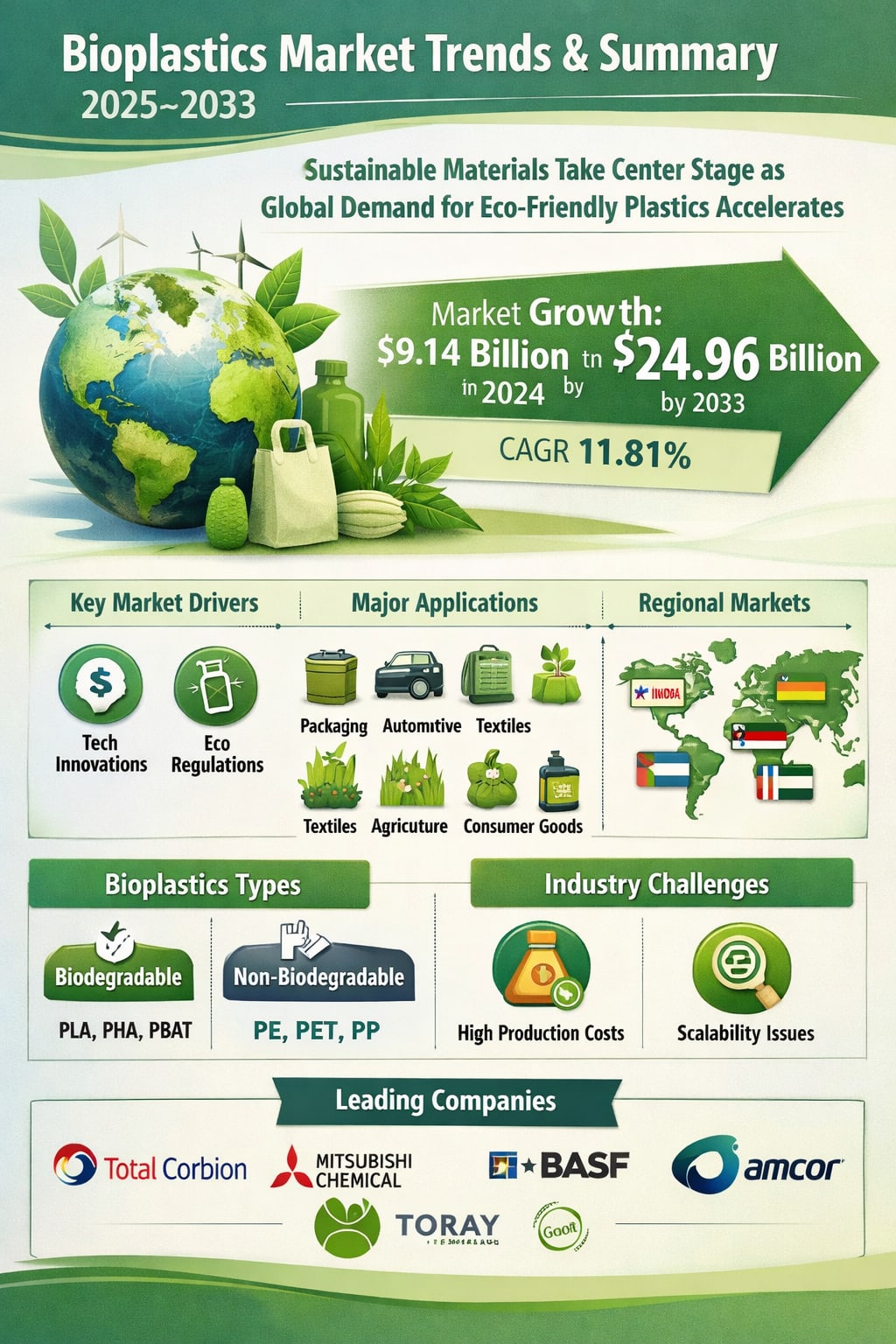
According to Renub Research, the Bioplastics Market is expected to grow from US$ 9,143.28 million in 2024 to US$ 24,961.25 million by 2033, expanding at a CAGR of 11.81% from 2025 to 2033. This strong growth trajectory reflects more than just a passing trend—it signals a structural transformation in how materials are produced, used, and disposed of worldwide.
Bioplastics, derived from renewable resources such as sugarcane, corn, vegetable oils, and plant starches, are increasingly being adopted across packaging, agriculture, automotive, textiles, consumer goods, and construction. While challenges remain, especially around cost and scalability, the long-term outlook points toward a steadily expanding role for bioplastics in the global materials ecosystem.
What Are Bioplastics and Why Do They Matter?
Bioplastics are broadly categorized into biodegradable and non-biodegradable bio-based plastics. Unlike conventional plastics that rely entirely on fossil fuels, bioplastics either originate from renewable biological sources, are designed to biodegrade under specific conditions, or combine both features.
From a sustainability perspective, their importance lies in three key areas:
Reduced dependence on fossil fuels, helping diversify raw material sources.
Lower carbon footprint, particularly for certain bio-based plastics that can significantly reduce greenhouse gas emissions over their life cycle.
Improved waste management potential, especially for compostable and biodegradable variants when supported by proper infrastructure.
These benefits are driving interest not only from environmentally conscious consumers but also from governments and large corporations under pressure to meet sustainability targets and ESG commitments.
Global Bioplastics Industry Overview
The global bioplastics industry has witnessed notable expansion in recent years, fueled by growing environmental awareness, sustainability goals, and the desire to reduce reliance on petroleum-based materials. Today, bioplastics are used in a wide range of applications including packaging, medical devices, agricultural films, automotive components, textiles, and consumer goods.
Major companies are investing heavily in innovation, R&D, and capacity expansion to improve performance, durability, heat resistance, and cost competitiveness. At the same time, collaborations and strategic partnerships are becoming more common as firms seek to scale up production and accelerate commercialization of new materials.
Despite their advantages, bioplastics still face structural challenges. Production costs remain higher than conventional plastics, and in many regions, recycling and composting infrastructure is not yet fully developed. However, regulatory pressure and shifting consumer preferences are steadily improving the business case for bioplastics.
In Europe, for example, nearly 48% of all bioplastics produced in 2022 were intended for packaging, highlighting how sustainability goals are reshaping one of the largest plastic-consuming sectors. Meanwhile, the U.S. Environmental Protection Agency has reported that certain bio-based products, such as bio-based PET, can deliver over 65% greenhouse gas emissions savings, reinforcing the environmental rationale behind market growth.
Strategic collaborations are also shaping the industry. A notable example is Neste’s partnership with ENEOS, Suntory, and Mitsubishi Corporation in August 2023 to develop renewable PET resin, underlining the strong interest of major industrial players in scaling sustainable plastics.
Bioplastics in the Automotive Industry: A Growing Opportunity
Beyond packaging, the automotive sector is becoming a significant consumer of bioplastics. Automakers are under increasing pressure to reduce vehicle weight, improve fuel efficiency, and lower overall environmental impact. Bioplastics offer a compelling solution by enabling lighter components while supporting sustainability goals.
Global vehicle production reached 85,016,728 units in 2022, reflecting a 6% increase, and this scale creates substantial demand for advanced materials. Major brands such as Mercedes, Fiat, and Toyota are already integrating bioplastic components into various vehicle parts, from interior trims to under-the-hood applications.
In September 2023, Danimer Scientific and Chevron Phillips Chemical announced a collaboration to explore the development and commercialization of high-volume biodegradable plastics, further signaling the automotive and industrial sectors’ growing commitment to sustainable materials.
Key Growth Drivers for the Bioplastics Market
1. Constant Improvements in Technology
Technological innovation is one of the strongest pillars supporting bioplastics market growth. Advances in polymer chemistry, material engineering, and manufacturing processes are steadily closing the performance and cost gap between bioplastics and conventional plastics.
A growing number of companies are forming strategic partnerships to accelerate technology adoption. For instance, in March 2024, Sulzer Ltd. agreed to provide Balrampur Chini Mills Limited (BCML) with advanced polylactic acid (PLA) production technology, supporting the development of India’s first large-scale bioplastics facility. This plant is expected to produce 75,000 tons of biodegradable, fully recyclable bioplastic annually using sugarcane as a feedstock.
At the same time, companies are experimenting with waste-based feedstocks. PlantSwitch, for example, produces around 50 million pounds of bioplastic pellets annually from agricultural waste, demonstrating how circular economy principles are being integrated into bioplastics manufacturing.
2. Growing Environmental Concerns
Rising environmental awareness is fundamentally reshaping consumer behavior and corporate strategies. Governments worldwide are implementing stricter regulations on single-use plastics, waste management, and carbon emissions, creating a strong policy-driven push toward sustainable alternatives.
Initiatives such as the U.S. 2030 Food Loss and Waste Reduction Goal are increasing demand for compostable and bio-based bags for organic waste collection. Similarly, bans on single-use plastics in many countries and India’s ambitious biomanufacturing and sustainability programs are acting as strong catalysts for bioplastics adoption.
For many companies, shifting to bioplastics is no longer just a branding exercise—it has become a strategic necessity to remain compliant, competitive, and aligned with long-term sustainability goals.
3. Rising Cost of Petroleum-Based Plastics
Another critical factor accelerating the transition is the volatile and often rising cost of petroleum-based plastics. Fluctuating crude oil prices, combined with the environmental costs of fossil fuel dependency, are making traditional plastics less attractive in the long run.
Bioplastics, derived from renewable resources such as plants and algae, offer a more stable and environmentally responsible alternative. As production technologies improve and economies of scale begin to take effect, the cost gap between bioplastics and conventional plastics is gradually narrowing, making bioplastics increasingly viable for mass-market applications.
Challenges in the Bioplastics Market
1. Higher Production Costs
One of the most significant barriers to wider adoption remains higher production costs. Raw materials like plant starches, sugars, and vegetable oils are often more expensive than fossil-based feedstocks, and the manufacturing processes can be more complex.
Although technological progress and scale are slowly bringing costs down, bioplastics still tend to be more expensive than traditional plastics. This price difference can discourage adoption, especially in industries with tight margins such as packaging and consumer goods.
2. Limited Scalability
Scalability is another major challenge. Compared to conventional plastics, bioplastics are still produced in relatively limited volumes, and the supporting infrastructure—ranging from feedstock supply chains to specialized manufacturing facilities—remains underdeveloped in many regions.
This creates concerns around supply security, price stability, and consistent availability, particularly for large-volume users such as packaging and automotive manufacturers. Overcoming this barrier will require significant investment in capacity expansion, supply chain optimization, and infrastructure development.
Regional Market Outlook
United States Bioplastics Market
The U.S. bioplastics market is expanding steadily, driven by stricter environmental regulations and rising consumer demand for sustainable products. Packaging remains the largest application area, followed by healthcare and automotive uses. While challenges such as high costs and limited recycling infrastructure persist, government incentives, technological innovation, and growing awareness of plastic pollution are expected to support continued market growth.
Germany Bioplastics Market
Germany stands as one of Europe’s leading bioplastics markets, supported by strong environmental policies and high consumer awareness. Packaging dominates demand, but automotive and agriculture are also important growth areas. Despite challenges related to costs and recycling systems, government support and technological leadership position Germany as a key driver of bioplastics adoption in Europe.
India Bioplastics Market
India’s bioplastics market is growing rapidly, fueled by rising environmental awareness, supportive government policies, and abundant agricultural feedstocks such as corn, sugarcane, and starch. Packaging is the largest end-use sector, followed by agriculture and automotive. Although infrastructure and cost challenges remain, regulatory pressure and sustainability initiatives are expected to unlock significant long-term growth.
United Arab Emirates Bioplastics Market
In the UAE, bioplastics are gaining traction as part of the country’s broader sustainability and economic diversification strategy. Demand is rising in packaging, food service, and consumer goods. While local production capacity and recycling infrastructure are still limited, investments in green technology and innovation are positioning the UAE as an emerging player in the Middle Eastern bioplastics market.
Market Segmentation Overview
By Material Type:
Biodegradable: PBAT, PBS, PLA, PHA, Starch Blends, Others
Non-Biodegradable: PE, PET, PA, PP, PTT, Others
By Application:
Packaging
Agriculture
Consumer Goods
Textile
Automotive & Transportation
Building & Construction
Others
By Geography:
North America (U.S., Canada), Europe (France, Germany, Italy, Spain, UK, Netherlands), Asia Pacific (China, Japan, India, Australia, South Korea, Malaysia, Indonesia), Latin America (Brazil, Mexico, Argentina, Colombia), Middle East & Africa (South Africa, Saudi Arabia, UAE, Israel), Rest of the World.
Competitive Landscape and Key Players
Leading companies are focusing on innovation, partnerships, and capacity expansion to strengthen their positions in the global bioplastics market. Key players include:
Total Corbion
Mitsubishi Chemical Holding Corporation
Toray Industries
BASF SE
Green Dot Bioplastics
Amcor Limited
These companies are активно investing in new materials, improved production technologies, and strategic collaborations to meet rising global demand.
Final Thoughts: The Road Ahead for Bioplastics
The bioplastics market is no longer a niche segment—it is becoming a core pillar of the global transition toward sustainable materials. With the market projected to grow from US$ 9.14 billion in 2024 to nearly US$ 25 billion by 2033, the direction of travel is clear.
While challenges around cost, scalability, and infrastructure remain, technological innovation, regulatory support, and shifting consumer preferences are steadily strengthening the business case for bioplastics. As industries from packaging to automotive continue to integrate sustainable materials into their value chains, bioplastics are poised to play an increasingly central role in shaping a more circular, low-carbon future.
In the coming decade, the success of bioplastics will not only be measured by market size, but by how effectively they help reduce environmental impact while supporting global economic growth—a balance that is fast becoming one of the defining challenges of modern industry.
About the Creator
BTC USD Surge: How to Predict the Next Big Price Move
The BTC USD market is fast-moving and full of surprises. Traders are always searching for clues about the next price jump or drop. While experts share tips, some important truths remain hidden. In this article, we reveal insights about BTC USD that can help you stay ahead of the curve and make smarter trading decisions.
By hamza mirza6 days ago in Trader
Super Bowl LX Recap: A Team Called Hawks
Sixty. The Super Bowl turned 60! Still amazes me that this was the sixtieth Super Bowl played in NFL history. It seems like yesterday that I watched Super Bowl XXVII, the first SB I ever watched. The QB who won Super Bowl XXVII has since called a few SBs, and will call next year's game, but that's another story. Super Bowl LX took place at Levi's Stadium in Santa Clara, California, the home stadium of the San Francisco 49ers. However, it was one of their division foes who represented the NFC, as the Seattle Seahawks faced off against the New England Patriots.
By Clyde E. Dawkins2 days ago in Unbalanced



Comments
There are no comments for this story
Be the first to respond and start the conversation.