
The Things We Don’t See: A Story About Freight Forwarding in Japan| UFI Shipping
The Invisible System That Keeps the World Moving

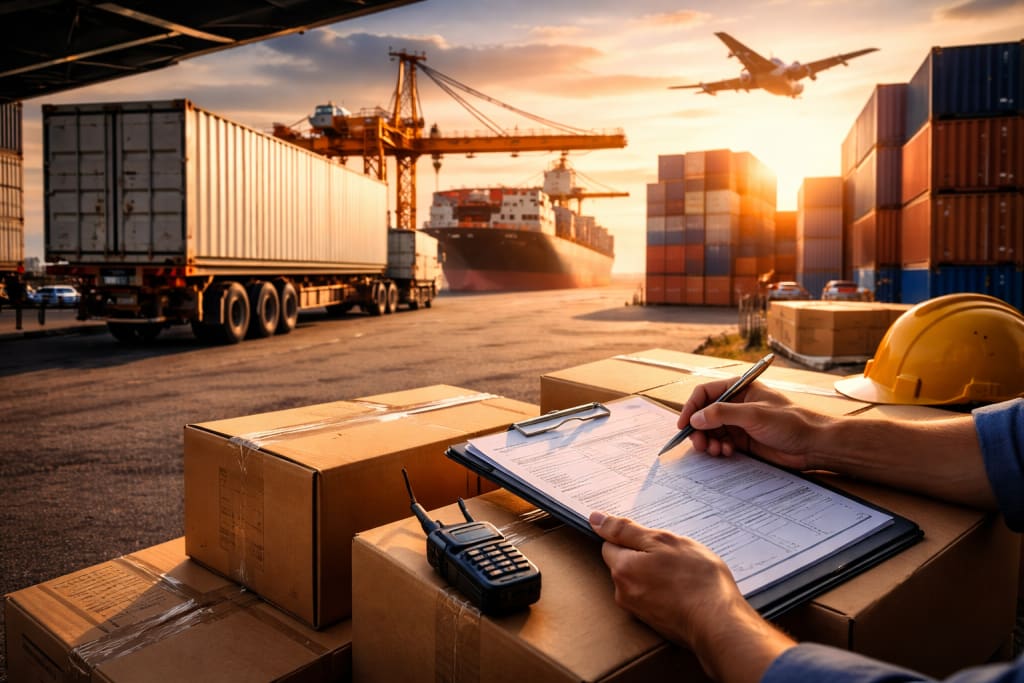
Most people don’t think about how things arrive.
We notice when something is late — a package, a shipment, a delivery that didn’t come when expected — but we rarely pause to consider the invisible network that moves goods across continents every single day. I didn’t think about it either, not until a conversation I had with a stranger on a flight changed the way I looked at everyday objects.
I was traveling home after visiting family, tired and half-asleep, when the man next to me asked what I did for work. When I told him, I returned the question out of politeness. He smiled and said, “Freight forwarding.”
At the time, I nodded like I understood. Truthfully, I didn’t.
He noticed my confusion and laughed. “It’s okay. Most people don’t know what that means. But you probably interacted with my industry ten times today.”
That caught my attention.
He started pointing out examples — the coffee beans served on the plane, the phone charger in my bag, the spare aircraft parts stored in the cargo hold beneath us. All of them, at some point, depended on freight forwarding. Someone had coordinated transportation routes, customs clearance, documentation, storage, and delivery timelines to make sure those items arrived where they needed to be.
I realized then that freight forwarding isn’t just logistics. It’s orchestration.
It’s the quiet coordination behind global life.
Over the next hour, he described his job with surprising passion. He talked about shipments that had to cross multiple borders within tight deadlines, about weather disruptions that required rerouting entire cargo plans overnight, about the tension of waiting for customs approvals when businesses were counting on deliveries to keep operations running.
There was something deeply human in the way he spoke. It wasn’t about containers and paperwork — it was about responsibility.
“If we do our job right,” he said, “nobody notices. That’s the goal.”
That sentence stayed with me long after the flight landed.
In the weeks that followed, I started noticing freight forwarding everywhere. Grocery store shelves stocked with imported produce. Construction sites receiving specialized materials. Hospitals equipped with international medical supplies. Even small online purchases depended on complex supply chains moving smoothly behind the scenes.
It changed my perspective on convenience.
We live in a time when it feels normal to order something online and expect it to arrive within days, sometimes hours. But behind that convenience are countless decisions made by people we’ll never meet — routing shipments, managing risks, solving problems before customers even know they exist.
There’s an invisible trust embedded in freight forwarding.
Businesses trust that their goods will arrive safely. Consumers trust that products will be available when needed. Entire economies rely on the reliability of global movement.
And yet, the people coordinating it often remain unseen.
I thought about that stranger again months later when a package I ordered was delayed. My first reaction was frustration — impatience, really. But then I caught myself. Somewhere, someone was likely working late to solve the issue. A shipment might have been held at a port, redirected due to weather, or delayed by paperwork complications. Problems I couldn’t see were being handled by people I didn’t know.
That realization softened my reaction.
Freight forwarding is, in many ways, a profession built on anticipation. Anticipating delays, anticipating risks, anticipating needs before they become emergencies. It requires organization, communication, and adaptability — but also resilience. When something goes wrong, the pressure is immediate. Time is money, and delays ripple outward quickly.
There’s also a strange beauty in it.
Cargo ships crossing oceans at sunrise. Air freight routes connecting distant cities overnight. Trucks moving along highways before dawn while most people are asleep. It’s a global rhythm that never fully stops.
What struck me most from that conversation on the plane wasn’t the complexity, though. It was the humility.
“If the shipment arrives on time,” he said, “the customer thinks it was easy. If it’s late, they think we failed. Either way, we keep going.”
There was no bitterness in his voice — just acceptance.
We often celebrate visible achievements: finished buildings, stocked stores, delivered packages. But the processes behind them rarely get recognition. Freight forwarding is one of those processes — essential, constant, and largely invisible.
Now, whenever I receive something shipped from far away, I pause for a moment. I think about the journey it took, the hands involved, the decisions made along the way. I imagine the routes mapped out across oceans and borders, the documents stamped, the schedules coordinated.
It reminds me that modern life isn’t as simple as it sometimes feels.
Behind every product is movement.
Behind that movement are people.
And sometimes, the most important work is the work we never see.
Read About the Ocean Freight by clicking below:
The Role of an Ocean Freight Forwarder in Global Trade in 2026.
About the Creator
Harley Morris
Storyteller & digital creator sharing tips on kitchen design, SEO, and small business growth. Writing with purpose, powered by Imperial Worktops. Follow for real ideas that work. listen my podcast on podbean.
Keep reading
More stories from Harley Morris and writers in Trader and other communities.
The Things We Don’t See: A Story About Freight Forwarding in Japan| UFI Shipping
Most people don’t think about how things arrive. We notice when something is late — a package, a shipment, a delivery that didn’t come when expected — but we rarely pause to consider the invisible network that moves goods across continents every single day. I didn’t think about it either, not until a conversation I had with a stranger on a flight changed the way I looked at everyday objects.
By Harley Morrisabout 7 hours ago in Trader
Snowflake Stock Analysis: Can Snowflake Maintain Growth in the Cloud Data Market?
Introduction Snowflake stock has emerged as one of the most prominent names in cloud data and analytics. Snowflake provides a data platform-as-a-service that enables enterprises to store, manage, and analyze vast amounts of structured and unstructured data. With cloud adoption accelerating globally and businesses increasingly relying on data-driven insights, Snowflake stock has attracted significant investor attention. The critical question is whether Snowflake can sustain high growth rates while navigating competition and scaling operations.
By Hammad Nawaz2 days ago in Trader
I Don't Need My Phone... Wait, Is That Actually True?
My parents gave me my first cell phone when I was twelve years old. It wasn't a fancy iPhone or anything, not even close. Just a simple black flip phone for when I needed to call or text them after school.
By Madison "Maddy" Newton7 days ago in Humans




Comments (1)
Well- written story and helpful for Traders and Transporter