
Global Building Materials Market Size and Forecast 2025–2033
Sustainability, Urban Expansion, and Smart Construction Reshape a US$ 2 Trillion Industry

Global Building Materials Market: Editorial Overview
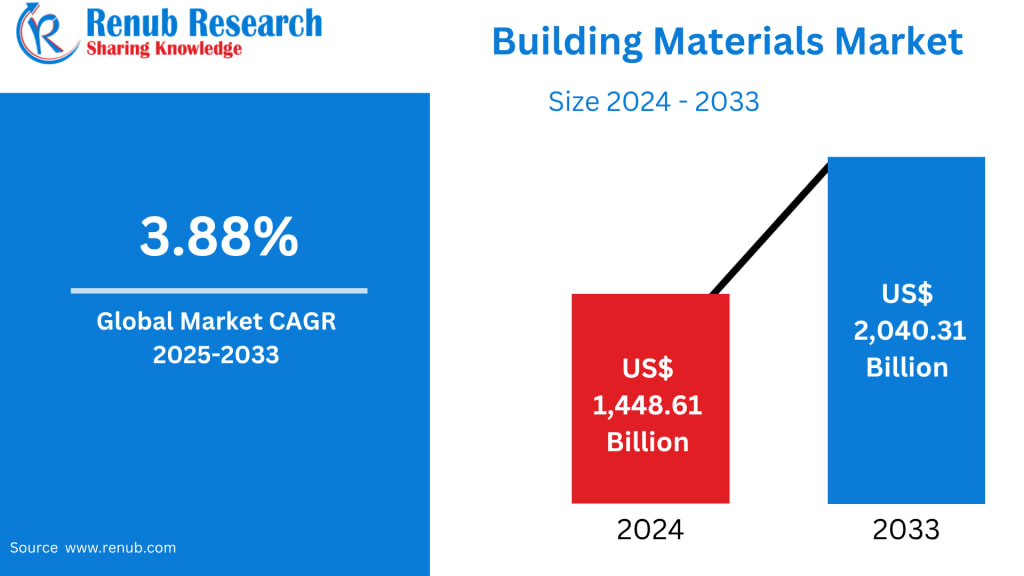
The Global Building Materials Market stands at the core of modern economic development, forming the backbone of residential, commercial, and industrial construction worldwide. According to Renub Research, the market is projected to expand from US$ 1,448.61 billion in 2024 to US$ 2,040.31 billion by 2033, growing at a CAGR of 3.88% during 2025–2033.
This steady expansion reflects a powerful convergence of trends: rapid urbanization, infrastructure modernization, sustainability-driven material innovation, and the digital transformation of construction practices. From megacities in Asia-Pacific to energy-efficient retrofits across Europe, building materials are no longer just structural components—they are strategic assets in climate resilience, smart cities, and long-term economic planning.
What Are Building Materials?
Building materials encompass a broad range of natural and manufactured substances used in construction. Traditional materials include wood, stone, clay, and sand, while industrially processed products such as cement, steel, glass, bricks, and composites dominate large-scale projects.
In recent years, the industry has undergone a major shift toward green and advanced materials, including recycled metals, fly ash cement, insulated panels, bamboo, and self-healing concrete. These materials support energy efficiency, reduce lifecycle emissions, and align with global sustainability goals.
Key Growth Drivers Shaping the Global Market
Urbanization and Infrastructure Expansion
Urbanization remains the single most influential driver of building material demand. Over 4 billion people currently live in urban areas, a figure expected to rise sharply by 2050. Emerging economies across Asia, Africa, and Latin America are investing heavily in housing, transportation networks, energy systems, and public infrastructure.
Smart city initiatives, metro rail projects, highways, and industrial corridors require vast quantities of cement, aggregates, metals, and advanced composites—creating sustained demand for building materials across decades.
Surging Demand for Sustainable and Green Materials
Environmental accountability is redefining the construction industry. Governments and developers are prioritizing low-carbon, recyclable, and energy-efficient materials to meet climate targets and green certification standards such as LEED and BREEAM.
Materials like low-carbon cement, recycled aggregates, insulated panels, and bio-based products are seeing accelerated adoption. In May 2025, India’s CemHack for Green Infra, initiated by DPIIT, underscored how innovation and sustainability are becoming central to building material development.
Technological Advancements in Construction Methods
Innovations such as modular construction, 3D printing, prefabrication, and AI-driven project management are transforming how materials are produced and used. These methods demand lighter, stronger, and precision-engineered materials that reduce waste and construction time.
In May 2024, Buildots launched an AI-powered Delay Forecast feature, highlighting how digital construction tools are improving efficiency and reshaping material specifications across projects.
Challenges Facing the Global Building Materials Industry
Volatility in Raw Material Prices
The industry remains highly sensitive to fluctuations in the prices of cement clinker, steel, aggregates, and energy. Geopolitical tensions, supply chain disruptions, and fuel price volatility can significantly affect production costs and margins. These uncertainties complicate long-term infrastructure planning and pricing strategies for manufacturers and contractors alike.
Environmental Regulations and Carbon Emissions
Cement and steel production are among the largest industrial sources of carbon emissions. As governments tighten environmental regulations, manufacturers face mounting pressure to decarbonize operations. While large players can invest in clean technologies, small and medium enterprises may struggle with compliance costs, potentially reshaping competitive dynamics within the market.
Market Insights by Major Segments
4
Global Building Aggregates Market
Aggregates—including sand, gravel, and crushed stone—are essential for roads, bridges, and building foundations. Rising urban development and transport infrastructure projects are driving strong demand. Increasing adoption of recycled aggregates, supported by government waste-reduction policies, is enhancing sustainability while maintaining structural performance.
Global Cement Market
Cement remains the cornerstone of construction worldwide. Demand is rising in developing economies due to housing and infrastructure growth, while developed regions focus on retrofitting and modernization. Low-carbon and blended cement variants are gaining traction as producers respond to emission reduction mandates and sustainability goals.
Commercial Building Materials Market
Commercial construction—offices, hospitals, retail centers, and hotels—demands premium, energy-efficient, and aesthetically advanced materials. The rise of smart buildings has increased demand for high-performance insulation, advanced glazing, HVAC-integrated materials, and antimicrobial surfaces, especially in the post-pandemic environment.
Residential Building Materials Market
Population growth and rising homeownership continue to fuel residential construction. Alongside traditional materials like bricks and concrete, demand for green housing solutions—such as insulated concrete blocks, solar roofing, and fly ash cement—is rising. Renovation and remodeling activities in developed economies further support sustained demand.
Regional Market Highlights
United States Building Materials Market
The U.S. market benefits from strong federal and state infrastructure spending, a resilient housing sector, and robust renovation activity. Sustainability and modular construction are shaping material choices, particularly in fast-growing Sun Belt regions. In March 2023, CEMEX announced a US$ 250 million investment to expand its Texas cement plant, underscoring strong regional demand.
Germany Building Materials Market
Germany leads Europe in sustainable construction, driven by stringent energy efficiency regulations and green building standards. Demand is strong for insulation, eco-cement, and precision-engineered materials. In January 2024, Heidelberg Materials introduced evoBuild, a global brand for low-carbon and circular construction products.
India Building Materials Market
India’s construction boom is powered by urbanization and flagship government initiatives such as Smart Cities Mission and Pradhan Mantri Awas Yojana. Cement, aggregates, and steel dominate demand, while green materials are gradually gaining ground. In February 2025, Shree Cement launched Bangur Marble Cement, highlighting innovation in premium construction materials.
Saudi Arabia Building Materials Market
Saudi Arabia’s Vision 2030 megaprojects—NEOM, The Line, and tourism infrastructure—are transforming regional demand. Sustainability and localization of production are priorities. In December 2024, Al Jouf Cement Company approved plans to construct a green cement facility dedicated to NEOM projects.
Market Segmentation Snapshot
By Type:
Aggregates
Cement
Bricks
Metals
Others
By Application:
Residential
Commercial
Industrial
By Geography:
North America, Europe, Asia Pacific, Latin America, Middle East & Africa
Key Players Shaping the Competitive Landscape
Leading companies are focusing on sustainability, capacity expansion, and digital transformation. Key players include:
CEMEX
Boral Limited
LafargeHolcim
Dyckerhoff AG
Buzzi Unicem SpA
CSR Limited
CRH Plc
Aditya Birla Group
Ambuja Cements
USG Corporation
Each company is analyzed across overview, leadership, recent developments, SWOT analysis, and revenue performance, offering a comprehensive competitive perspective.
Final Thoughts
The Global Building Materials Market is entering a transformative era where sustainability, technology, and urban growth intersect. While challenges such as price volatility and environmental regulations persist, innovation in green materials and smart construction methods is unlocking long-term opportunities.
With infrastructure spending accelerating and climate-conscious construction becoming the norm, building materials will remain a critical pillar of global economic development through 2033 and beyond.
About the Creator
Marthan Sir
Educator with 30+ years of teaching experience | Passionate about sharing knowledge, life lessons & insights | Writing to inspire, inform, and empower readers.
Keep reading
More stories from Marthan Sir and writers in Trader and other communities.
Australia O-Ring Seals Market Size and Forecast 2025–2033
Australia O-Ring Seals Market Outlook According to Renub Research, the Australia O-ring seals market is projected to grow from US$ 290.08 million in 2024 to US$ 394.67 million by 2033, registering a CAGR of 3.48% during 2025–2033. This steady expansion is driven by Australia’s robust mining and energy sectors, rising automotive production and maintenance needs, increasing infrastructure investments, and continuous innovation in high-performance and sustainable sealing materials.
By Marthan Sir21 days ago in Trader
Australia Stearic Acid Market: Industrial Demand, Sustainability Trends & Functional Applications
Australia Stearic Acid Market Overview The Australia stearic acid market is witnessing robust growth driven by rising demand from end-use industries such as personal care, cosmetics, detergents, rubber processing, pharmaceuticals and industrial chemicals. Stearic acid — a saturated fatty acid typically derived from vegetable fats (such as palm oil, coconut oil) or animal fats — serves as a versatile ingredient in lubricants, surfactants, emulsifiers, stabilisers, and texturising agents across a wide range of applications. The Australia stearic acid market size reached 0.19 Million Tons in 2024. Looking forward, IMARC Group expects the market to reach 0.30 Million Tons by 2033, exhibiting a growth rate (CAGR) of 5.20% during 2025-2033. This growth mirrors steady industrial activity, increasing consumer goods production, and a growing emphasis on functional and sustainable raw materials in manufacturing and formulations.
By Amyra Singha day ago in Trader
Australia Switchgear Market: Power Reliability, Grid Expansion & Industrial Demand
Australia Switchgear Market The Australia switchgear market is experiencing robust growth as the nation expands its power infrastructure, modernises electricity networks and integrates renewable energy sources. Switchgear — electrical equipment used to control, protect and isolate electrical circuits — plays a critical role in ensuring reliable power distribution across residential, commercial, industrial and utility sectors. According to IMARC Group, The Australia switchgear market size reached USD 1.5 Billion in 2025. Looking forward, the market is expected to reach USD 2.4 Billion by 2034, exhibiting a growth rate (CAGR) of 5.29% during 2026-2034.
By Amyra Singha day ago in Trader




Comments
There are no comments for this story
Be the first to respond and start the conversation.