
GCC Chia Seed Market Size and Forecast 2025–2033
Rising Health Awareness and Plant-Based Nutrition Trends Fuel Strong Growth Across the Gulf Region

GCC Chia Seed Market Outlook
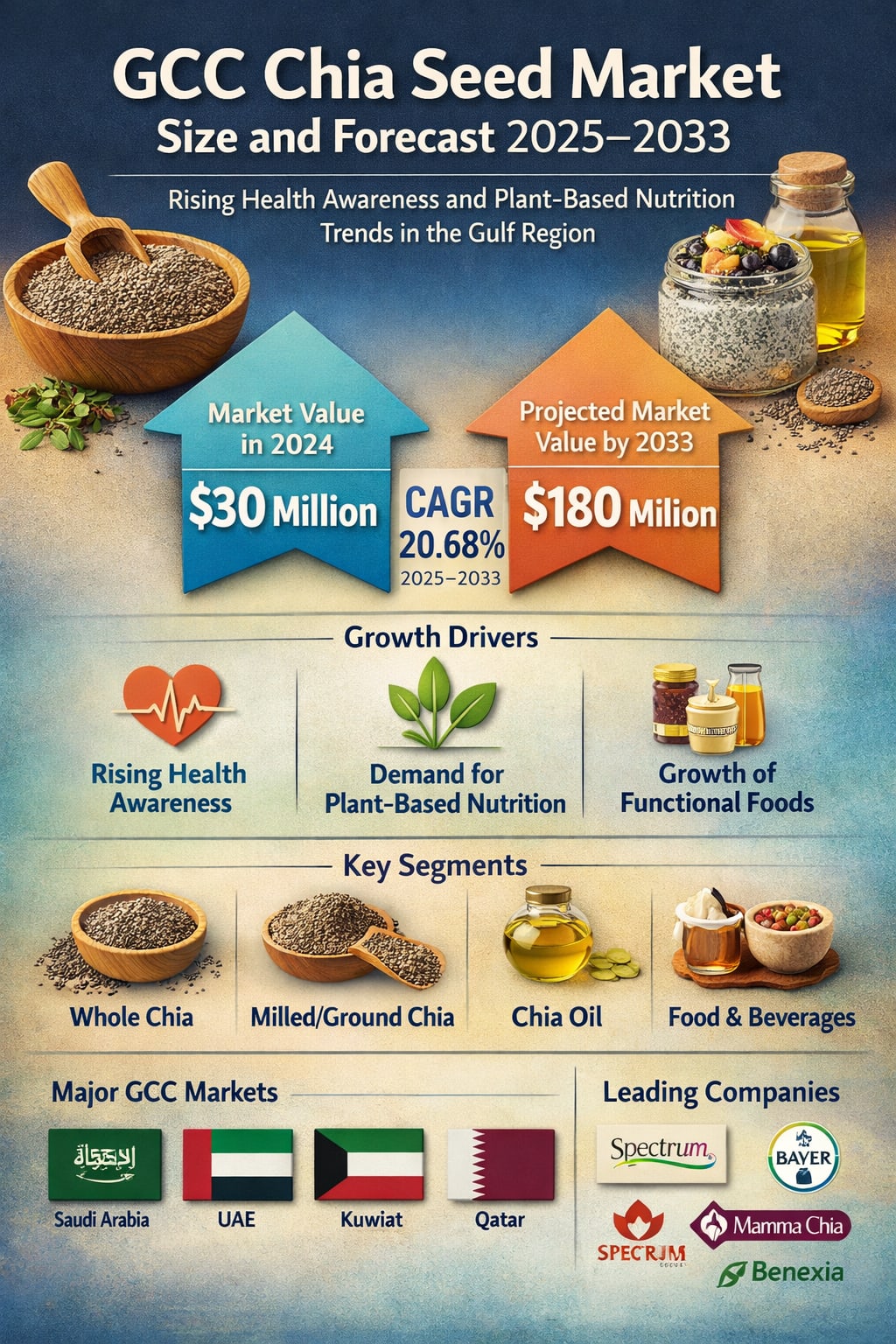
The GCC chia seed market was valued at USD 30 million in 2024 and is expected to reach USD 180 million by 2033, growing at a robust CAGR of 20.68% from 2025 to 2033. This remarkable growth is being driven by rising health awareness, increasing demand for plant-based nutrition, and the expanding use of chia seeds in food, beverages, dietary supplements, and wellness products across the Gulf region.
Chia seeds are small yet highly nutrient-dense seeds derived from the Salvia hispanica plant, native to Central America. Despite their tiny size, they are widely recognized as a nutritional powerhouse, rich in omega-3 fatty acids, dietary fiber, protein, antioxidants, and essential minerals such as calcium, magnesium, and iron. Over the past decade, chia seeds have transitioned from being a niche health product to a mainstream superfood ingredient across global markets, including the GCC.
In countries such as Saudi Arabia and the UAE, consumers are becoming increasingly conscious about preventive healthcare, weight management, and overall wellness. This shift in mindset is pushing demand for natural, functional, and minimally processed foods. Chia seeds, with their clean-label appeal and multiple health benefits, fit perfectly into this evolving dietary landscape. They are now commonly added to smoothies, yogurts, cereals, salads, baked goods, and beverages, while their ability to absorb water and form a gel-like texture has made them popular in vegan cooking and as an egg substitute in plant-based recipes.
The growing visibility of chia seeds in supermarkets, specialty health stores, cafes, and online platforms across the GCC reflects a broader transformation in food consumption patterns. As health trends continue to influence purchasing decisions, chia seeds are expected to play an increasingly important role in the region’s functional food and nutrition ecosystem.
Growth Drivers in the GCC Chia Seed Market
Rising Demand for Superfoods and Health-Conscious Diets
Health-conscious consumers across the GCC are actively incorporating so-called “superfoods” into their daily diets, and chia seeds are among the biggest beneficiaries of this trend. Their high fiber content supports digestive health, while omega-3 fatty acids are associated with heart health and anti-inflammatory benefits. As awareness grows around lifestyle diseases such as obesity, diabetes, and cardiovascular disorders, many consumers are proactively seeking nutrient-dense foods that support long-term wellness.
Urban populations, in particular, are driving this shift. Busy lifestyles, higher disposable incomes, and greater exposure to global health trends have accelerated the adoption of functional ingredients like chia seeds in daily meals, snacks, and beverages. The rising popularity of plant-based and flexitarian diets is further boosting demand, as chia seeds are widely used as a natural protein and fiber source in vegan and vegetarian recipes.
Product quality and safety certifications are also strengthening consumer trust. For instance, in August 2022, Nutiva, a leading brand in plant-based organic superfoods, announced that its Organic Chia Seeds had become Glyphosate Residue Free following certification by The Detox Project. Such developments reinforce the clean and natural image of chia seeds and support their growing acceptance in premium health food segments.
Expansion of the Functional Food and Beverage Industry
The rapidly expanding functional food and beverage industry in the GCC is another major driver of the chia seed market. Food manufacturers are increasingly incorporating chia seeds into breakfast cereals, energy bars, protein snacks, juices, dairy alternatives, and fortified beverages. These products cater to consumers who are looking for convenient yet nutritious options that fit into active and health-oriented lifestyles.
The region’s young demographic profile, combined with rising disposable incomes and growing fitness culture, is creating strong demand for value-added, nutrient-rich food products. Chia seeds are particularly attractive to manufacturers because they enhance nutritional profiles without significantly altering taste, making them easy to integrate into a wide range of formulations.
Innovation is also reshaping the market. In November 2023, Benexia launched encapsulated chia oil as part of its strategy to expand applications of chia-based ingredients. The company, which initially focused on selling whole seeds, has since diversified into a portfolio of chia-derived components, demonstrating how the value chain is evolving beyond raw seed sales toward more specialized, high-margin ingredients.
Government Support for Healthy and Organic Products
Government initiatives promoting healthier lifestyles and better nutrition are playing an increasingly important role in supporting the chia seed market across the GCC. Public health campaigns aimed at reducing obesity, diabetes, and other lifestyle-related diseases are encouraging consumers to adopt more balanced and nutrient-rich diets. As part of this broader policy direction, there is growing support for the import and distribution of natural and organic food products.
In some countries, efforts are also being made to explore local cultivation possibilities. In March 2025, the Ministry of Environment, Water, and Agriculture in Saudi Arabia confirmed the successful localization of chia cultivation in relatively favorable regions, particularly around Makkah. While large-scale commercial production is still limited, such initiatives highlight the strategic interest in reducing import dependence and strengthening food security over the long term.
Together, these policy measures and awareness campaigns are helping create a more favorable environment for the growth of the chia seed market in the region.
Challenges in the GCC Chia Seed Market
High Import Dependence and Price Volatility
One of the main challenges facing the GCC chia seed market is its heavy dependence on imports, primarily from South and Central America. Since chia seeds are not yet produced on a large commercial scale within the region, supply chains remain exposed to global price fluctuations, currency exchange movements, logistics costs, and changes in export availability from producing countries.
This dependence can lead to price volatility, which may affect profit margins for distributors, retailers, and manufacturers, particularly smaller players with limited purchasing power. In times of global supply disruptions or rising transportation costs, these challenges can act as a restraint on market expansion and product diversification.
Limited Awareness in Rural and Traditional Markets
While awareness of chia seeds is relatively high in major urban centers such as Riyadh, Dubai, and Doha, it remains limited in rural and more traditional areas of the GCC. Many consumers in these regions are either unfamiliar with chia seeds or hesitant to incorporate foreign “superfoods” into their diets due to cultural preferences and limited exposure.
The lack of localized education campaigns and recipe integration slows broader market penetration. However, as modern retail channels expand and digital platforms continue to influence food choices, this gap is expected to narrow gradually over the coming years.
Market Segmentation Insights
GCC Whole Chia Seed Market
Whole chia seeds currently dominate the GCC market due to their versatility, longer shelf life, and minimal processing. Consumers often prefer whole seeds for mixing into smoothies, yogurts, salads, and cereals. Their natural, unprocessed image appeals strongly to health-conscious buyers seeking organic and non-GMO products. The strong presence of whole seeds in both retail and foodservice channels makes this segment a key contributor to overall market revenues.
GCC Milled/Ground Chia Seed Market
Milled or ground chia seeds are gaining popularity because they are easier to digest and more convenient for certain applications, particularly in bakery products, smoothies, and infant food formulations. They provide a smoother texture and are suitable for recipes where whole seeds may not blend well. However, their shorter shelf life compared to whole seeds requires more careful inventory management by manufacturers and retailers.
GCC Chia Seed Food & Beverage Market
Food and beverages represent the largest application segment for chia seeds in the GCC. From breakfast cereals and dairy alternatives to bottled juices, energy bars, and health snacks, chia seeds are increasingly used as a nutritional enhancer. The growing interest in plant-based, high-protein, and functional diets is a major factor supporting this trend, and continued product innovation is expected to further expand this segment.
GCC Chia Seed Pharmaceuticals & Nutraceuticals Market
The pharmaceutical and nutraceutical sectors are also emerging as important growth areas. Chia seeds are used in powdered health mixes, capsules, and therapeutic food products due to their perceived benefits for heart health, digestion, and inflammation. With rising demand for preventive healthcare and natural supplements, this segment holds strong potential, particularly in premium wellness markets in Saudi Arabia, the UAE, and Qatar.
Country-Level Market Overview
Saudi Arabia
Saudi Arabia leads the GCC chia seed market, supported by its large population, expanding middle class, and growing focus on healthy lifestyles under Vision 2030. Chia seeds are increasingly incorporated into daily diets, supported by the expansion of health-focused retail chains and greater consumer awareness of nutrition and fitness.
United Arab Emirates
The UAE has positioned itself as a hub for premium and international health foods. Chia seeds are widely available in supermarkets, specialty stores, and online platforms. High expatriate populations, strong fitness culture, and rising disposable incomes are driving steady demand, especially in Dubai and Abu Dhabi, where cafes and restaurants actively integrate chia-based items into their menus.
Kuwait
Kuwait’s chia seed market is growing steadily as consumers become more health-conscious and open to plant-based diets. While smaller than Saudi Arabia and the UAE, Kuwait benefits from high purchasing power and an urban population that is increasingly adopting superfoods as part of a modern lifestyle.
Qatar
In Qatar, rising awareness of healthy eating and government efforts to address lifestyle diseases are reshaping food consumption patterns. Chia seeds are gaining popularity in functional foods, sports nutrition, and wellness-focused dining, supported by strong retail and online distribution channels.
GCC Chia Seed Market Segmentation
By Form:
Whole Chia
Milled/Ground Chia
Pre-hydrated Chia
Chia Oil
By Application:
Food & Beverages
Pharmaceuticals & Nutraceuticals
Personal Care & Cosmetics
Others
By Country:
Saudi Arabia
UAE
Kuwait
Qatar
Oman
Bahrain
Rest of GCC
Competitive Landscape
Key players operating in the GCC chia seed market include:
Spectrum Organic Products LLC, Bayer AG, The Chia Co., Mamma Chia, Benexia Chia, Chiatrition Chia Seeds, Glanbia Nutritionals, and Health Works Chia Seeds.
Companies are analyzed across four main dimensions: Company Overview, Key Personnel, Recent Developments, and Revenue Performance, reflecting an increasingly competitive and innovation-driven market environment.
Final Thoughts
The GCC chia seed market is entering a phase of rapid and sustained growth, driven by health awareness, the rise of functional foods, and shifting consumer preferences toward plant-based nutrition. With the market expected to grow from USD 30 million in 2024 to USD 180 million by 2033, chia seeds are set to become a mainstream ingredient across food, beverage, and wellness industries in the region.
While challenges such as import dependence and uneven consumer awareness remain, ongoing innovation, supportive government initiatives, and expanding retail and foodservice channels are likely to strengthen market fundamentals. As the Gulf region continues its transition toward healthier lifestyles, chia seeds are well positioned to move from a niche superfood to a staple component of modern, nutrition-focused diets.
About the Creator
Asia Pacific Data Centre Market Size and Forecast 2025
Introduction: The Digital Backbone of Asia-Pacific’s Future The Asia-Pacific data center market is entering a golden era of expansion as the region accelerates its digital transformation journey. Valued at US$ 26.95 billion in 2024, the market is projected to grow at a robust CAGR of 12.70% from 2025 to 2033, reaching an impressive US$ 79.05 billion by 2033. This growth reflects not just rising data consumption, but a fundamental shift in how businesses, governments, and consumers across the region operate in an increasingly digital-first world.
By Sakshi Sharma4 days ago in Trader
Major Indian Stocks in Focus as Q3 Earnings Season Continues: Airtel, Nykaa, and LIC Set to Report Results
The Indian stock market remains in sharp focus as the Q3 earnings season gathers momentum, with several high-profile companies scheduled to announce their quarterly results today. Among the most closely watched names are Bharti Airtel, Nykaa, and Life Insurance Corporation of India (LIC). These companies operate in very different sectorstele communications, e-commerce beauty retail, and insurance but together they offer a broad snapshot of India’s economic and consumer trends during the third quarter of the financial year.
By Hammad Nawaz5 days ago in Trader
The Salt in her Voice
The myth says mermaids sing to lure sailors to their death. But why? The ocean is huge. Only 5 percent has been discovered by man. Why would a creature of the sea with that much space to roam ever care about the fate of men on ships? The answer, as it turns out, is not a simple one at all. The truth about the myth is older than the tides. Long ago before the first ship ever cut across the surface, the sea made a pact with the sky. The sky would take the souls of the drowned. Anyone who died in storms or any quiet accidents of the deep would have their soul lifted upward to the Heavens while the bodies would remain below, feeding the oceans endless hunger. The greedy sea however wanted more souls than the sky would claim. So it created mermaids. It gave them beautiful voices woven from currents and moonlight. It commanded them to sing. "Bring forth the ones who float where they should sink." it instructed them. So they did. They never killed out of malice but out of obligation. They sung to summon, not to seduce. A mermaid's voice could loosen the tether between the body and soul, making any man step willingly into the water. The sea would take the body and the sky would take the soul. Balance maintained.
By Sara Wilson4 days ago in Fiction



Comments
There are no comments for this story
Be the first to respond and start the conversation.