
Europe Neonatal Intensive Care Market Trends & Summary (2025–2033)
Rising preterm births, rapid medical innovation, and expanding hospital infrastructure push Europe’s NICU market toward US$ 1.60 billion by 2033

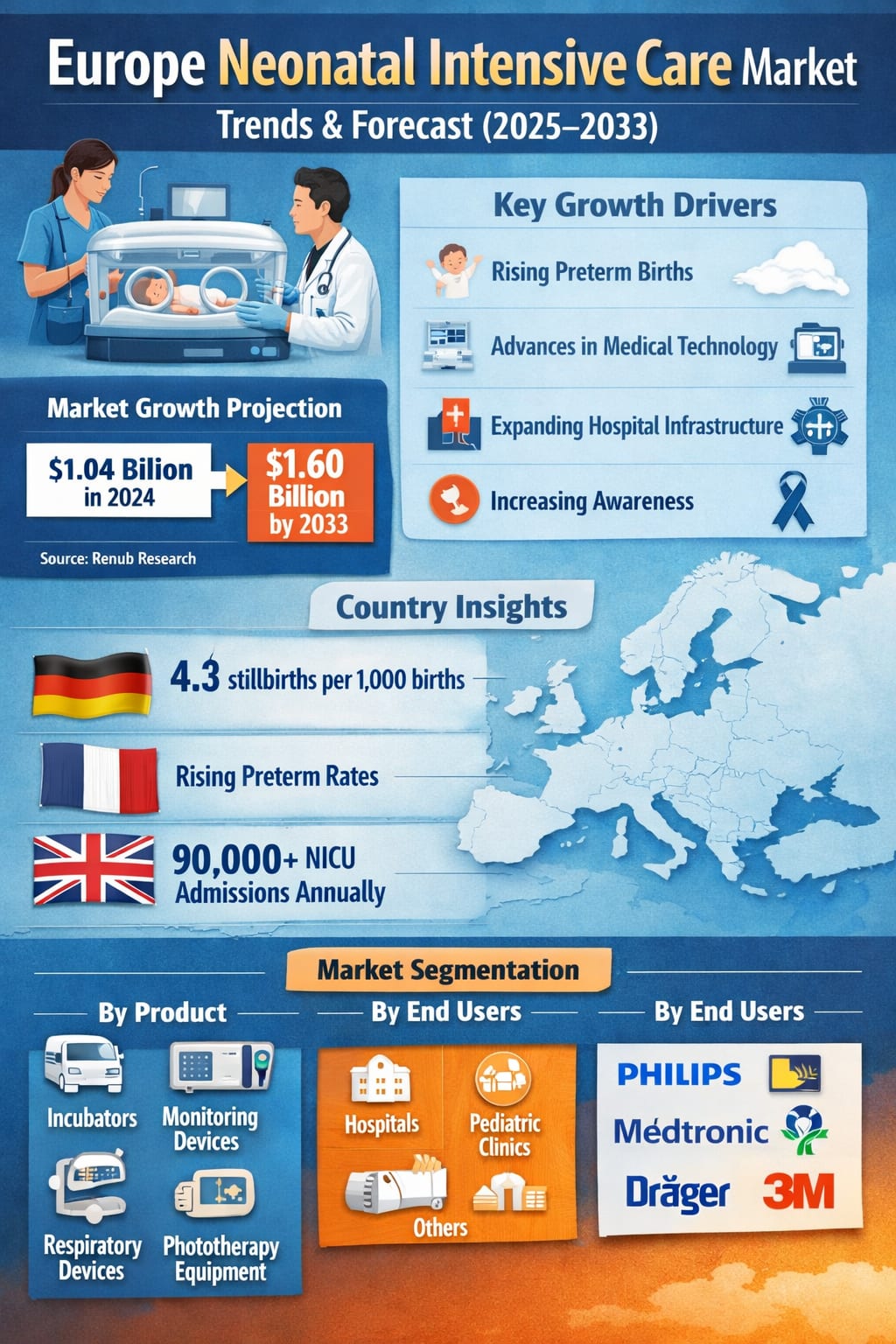
Europe Neonatal Intensive Care Market Overview
The Europe Neonatal Intensive Care Market is witnessing steady and meaningful growth as healthcare systems across the region place stronger emphasis on saving and improving the lives of vulnerable newborns. According to Renub Research, the market is expected to reach US$ 1.60 billion by 2033, rising from US$ 1.04 billion in 2024, and expanding at a CAGR of 4.96% from 2025 to 2033.
Neonatal intensive care refers to specialized medical treatment provided to premature or critically ill newborn infants. These babies often require advanced medical support to breathe, feed, maintain body temperature, and fight infections. Neonatal Intensive Care Units (NICUs) are equipped with sophisticated technologies such as incubators, ventilators, phototherapy systems, and continuous monitoring devices, and are staffed by trained neonatologists, nurses, and specialized healthcare professionals.
Conditions commonly treated in NICUs include low birth weight, respiratory distress syndrome, infections, congenital anomalies, and complications related to premature birth. The primary objective of neonatal intensive care is not only to stabilize these infants during their most vulnerable days but also to improve their long-term survival, growth, and developmental outcomes.
Across Europe, the demand for neonatal intensive care is being shaped by several powerful trends: rising preterm birth rates, advancements in neonatal technology, increasing healthcare expenditure, supportive government policies, and expanding hospital infrastructure, particularly in parts of Eastern Europe. Together, these factors are creating a strong foundation for sustained market growth over the coming decade.
Market Size and Growth Outlook
As per Renub Research, the Europe Neonatal Intensive Care Market’s growth trajectory reflects both medical necessity and technological progress. The jump from US$ 1.04 billion in 2024 to US$ 1.60 billion by 2033 highlights how critical neonatal care has become within modern healthcare systems.
This nearly 5% annual growth rate is being driven by:
A steady rise in the number of premature and high-risk births
Greater investment in advanced NICU equipment
Increasing awareness among parents and healthcare professionals about early neonatal intervention
Ongoing improvements in hospital and specialty care infrastructure
Unlike many short-term healthcare trends, neonatal intensive care represents a long-term structural need. As maternal age increases, lifestyle-related health issues become more common, and assisted reproductive technologies lead to higher rates of multiple births, the demand for NICU services is expected to remain strong across Europe.
Europe Neonatal Intensive Care Industry: A Closer Look
Neonatal intensive care sits at the intersection of high-tech medicine and compassionate care. Modern NICUs are no longer just about keeping infants alive; they are increasingly focused on improving outcomes, reducing complications, and supporting healthy development.
Technologies such as advanced incubators, high-frequency ventilators, real-time monitoring systems, and non-invasive respiratory support devices have transformed how neonatal care is delivered. At the same time, better infection control practices, improved nutrition management, and family-centered care models are reshaping the NICU environment.
In Europe, public healthcare systems and private providers alike are investing in:
Upgrading NICU infrastructure
Expanding capacity in high-demand regions
Training specialized neonatal healthcare staff
Integrating digital and AI-assisted monitoring tools
These efforts are particularly visible in countries with aging populations, advanced healthcare systems, and strong government support for maternal and child health programs.
Key Growth Drivers for the Europe Neonatal Intensive Care Market
Rising Preterm Birth Rates
One of the most important drivers of the European neonatal intensive care market is the increase in preterm births. Preterm infants—defined as babies born before 37 weeks of pregnancy—often face serious health challenges, including underdeveloped organs, breathing difficulties, infections, and feeding problems. These conditions typically require prolonged stays in NICUs and continuous medical monitoring.
Research published in the European Journal of Pediatrics has highlighted preterm birth as one of the leading contributors to infant mortality in Europe. Several factors are behind this trend, including:
Higher maternal age
Lifestyle-related health conditions such as diabetes and hypertension
Increased use of fertility treatments, which often result in multiple births
Greater prevalence of high-risk pregnancies
As the number of preterm and high-risk births rises, so does the demand for incubators, ventilators, monitoring systems, feeding support devices, and skilled neonatal staff, directly fueling market growth.
Advancements in Medical Technology
Technological innovation is another major force shaping the Europe Neonatal Intensive Care Market. Today’s NICUs are far more advanced than they were even a decade ago. Hospitals are increasingly adopting:
High-frequency and non-invasive ventilators
Smart incubators with precise temperature and humidity control
Continuous, real-time vital sign monitoring systems
AI-assisted and digital health solutions for early detection of complications
Point-of-care diagnostic tools for faster clinical decision-making
These innovations not only improve survival rates but also reduce complications, shorten hospital stays, and enhance long-term outcomes for newborns. Less invasive treatment methods and better infection control measures have further improved the quality of neonatal care.
As European hospitals continue to modernize their NICUs, demand for advanced neonatal equipment and related services is expected to remain strong throughout the forecast period.
Growing Awareness and Education
Awareness plays a surprisingly powerful role in driving the neonatal intensive care market. Across Europe, parents, healthcare professionals, and policymakers are increasingly aware of the importance of early and specialized neonatal care.
Government initiatives, public health campaigns, and educational programs have helped:
Improve prenatal care and early risk detection
Encourage timely hospital deliveries for high-risk pregnancies
Promote faster referrals to specialized neonatal centers
Enhance training and skill development among healthcare professionals
As a result, more families are seeking high-quality neonatal care, and more hospitals are investing in NICU capabilities. This rising awareness directly translates into higher utilization of neonatal intensive care services and equipment, supporting steady market expansion.
Challenges in the Europe Neonatal Intensive Care Market
High Cost of NICU Equipment and Care
Despite its strong growth prospects, the Europe Neonatal Intensive Care Market faces a significant challenge: cost. Advanced NICU equipment such as ventilators, incubators, and monitoring systems requires substantial capital investment. In addition, the ongoing cost of operating NICUs—staffing, maintenance, consumables, and specialized care—places a heavy financial burden on healthcare systems.
For countries with tighter healthcare budgets, this can lead to:
Slower adoption of the latest technologies
Uneven access to high-quality neonatal care across regions
Capacity constraints in public hospitals
While long-term benefits often justify the investment, cost pressures remain a key obstacle, especially in less-developed parts of Europe.
Stringent Regulatory Approvals
Another major hurdle is the strict regulatory environment governing medical devices and therapies used in neonatal care. While these regulations are essential to ensure safety and effectiveness, they can also:
Delay the introduction of new technologies
Increase development and compliance costs for manufacturers
Complicate market entry due to varying regulations across European countries
For companies operating in this space, navigating multiple regulatory frameworks can slow innovation and limit the speed at which new solutions reach NICUs. This, in turn, can restrain short-term market growth, even as long-term demand remains strong.
Country-Level Market Insights
Germany Neonatal Intensive Care Market
Germany plays a central role in the European neonatal intensive care landscape, supported by a strong healthcare system and well-equipped NICUs. The market is being driven by rising preterm births, technological advancements, and continued government support for maternal and child health.
According to Germany’s Federal Statistical Office (Destatis), there were 3,420 stillbirths in 2021, equivalent to 4.3 stillbirths per 1,000 births, highlighting the ongoing need for specialized neonatal care. Investments in modern equipment, staff training, and hospital infrastructure continue to position Germany as a key contributor to the regional market.
France Neonatal Intensive Care Market
In France, the neonatal intensive care market is being propelled by the growing number of preterm births, one of the leading causes of infant mortality. Hospitals and specialized neonatal centers are increasingly investing in advanced ventilators, incubators, and monitoring systems to meet rising demand.
The focus on improving newborn health outcomes, combined with strong public healthcare support, is expected to keep France’s NICU market on a steady growth path throughout the forecast period.
United Kingdom Neonatal Intensive Care Market
The United Kingdom represents one of the most active neonatal care markets in Europe. Each year, over 90,000 babies are treated in neonatal units across the UK, meaning nearly one in seven newborns requires some form of specialized neonatal care.
The National Health Service (NHS) plays a crucial role in delivering comprehensive neonatal services, supported by government initiatives aimed at improving maternal and child health. Continuous upgrades in respiratory support equipment, monitoring systems, and care protocols have significantly improved survival rates for premature infants, further strengthening market demand.
Europe Neonatal Intensive Care Market Segmentation
By Product
Warmers
Incubators
Monitoring Devices
Respiratory Devices
Phototherapy Equipment
Others
By End User
Hospital & Neonatal Pediatric Hospitals
Pediatric Clinics & Childcare
Others
By Country
France
Germany
Italy
Spain
United Kingdom
Belgium
Netherlands
Russia
Poland
Greece
Norway
Romania
Portugal
Rest of Europe
Competitive Landscape
The Europe Neonatal Intensive Care Market is moderately competitive, with several global and regional players focusing on innovation, product quality, and strategic partnerships. According to industry analysis, companies are typically evaluated across four key dimensions: overview, key persons, recent developments, and financial insights.
Some of the leading players in the market include:
Masimo Corporation
3M Company
Medtronic PLC
Koninklijke Philips N.V.
Siemens Healthcare GmbH
Terumo Corporation
AngioDynamics
Drägerwerk AG & Co. KGaA
These companies continue to invest in R&D, product launches, and technological upgrades to strengthen their positions in the European neonatal care ecosystem.
Final Thoughts
The Europe Neonatal Intensive Care Market stands at a crucial intersection of medical necessity, technological progress, and healthcare policy. With the market projected by Renub Research to grow from US$ 1.04 billion in 2024 to US$ 1.60 billion by 2033 at a CAGR of 4.96%, the outlook remains solid and sustainable.
Rising preterm birth rates, continuous innovation in neonatal technology, and expanding hospital infrastructure are ensuring that NICUs remain a top priority across Europe. While challenges such as high costs and regulatory complexity persist, the long-term drivers—saving infant lives and improving health outcomes—are simply too important to ignore.
In the years ahead, Europe’s neonatal intensive care sector is likely to see smarter technologies, more specialized facilities, and even greater emphasis on early intervention, reinforcing its role as one of the most critical pillars of modern healthcare.
About the Creator
Cellulose Acetate Market Set to Soar to 2.70 Million Tons by 2033 | CAGR 3.07%
Overview Cellulose Acetate Market Cellulose acetate is a thermoplastic material produced through the chemical modification of cellulose. It is commonly used in manufacturing fibers, films, filtration membranes, cigarette filter tow, and molded plastics. Its biodegradability, strength, thermal stability, and transparency make it suitable for diverse applications across multiple industries. Increasing focus on green chemistry and circular economy initiatives is encouraging manufacturers to adopt cellulose-derived materials. Additionally, advancements in production technology and increasing R&D investments are expanding the scope of cellulose acetate in medical and filtration applications.
By James Smithabout 16 hours ago in Trader




Comments
There are no comments for this story
Be the first to respond and start the conversation.