
Gap Trading Explained: How Price Gaps Create Trading Opportunities
Understanding market gaps, their types, and how traders use them for short-term strategies

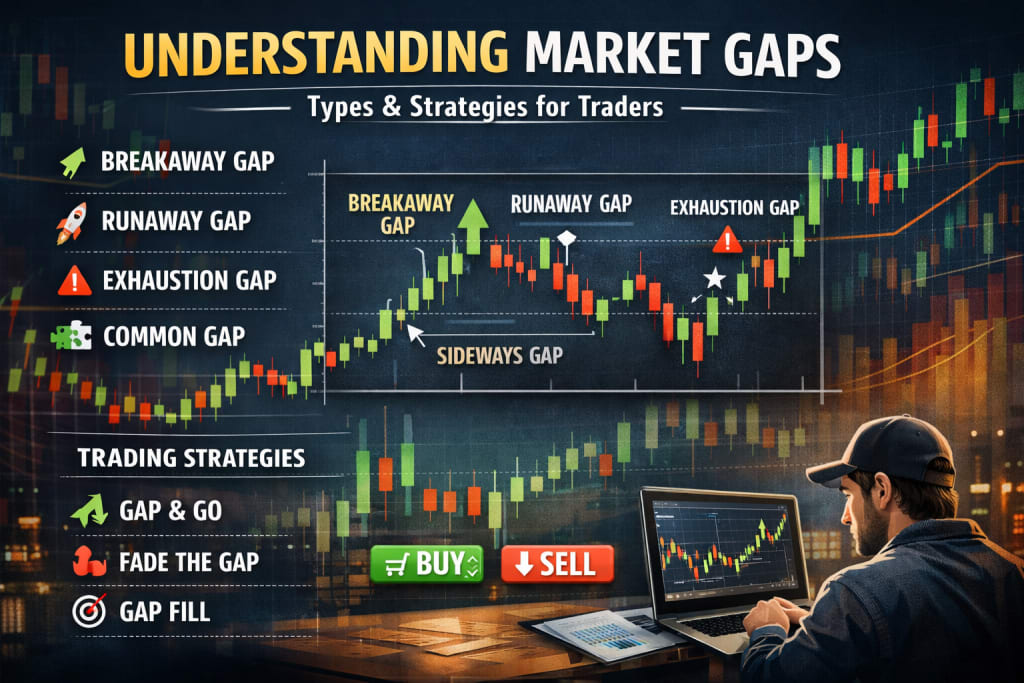
Financial markets often move in unpredictable ways, especially during periods of high volatility or major news events. One such movement that attracts the attention of traders is known as a price gap. Gap trading is a strategy that seeks to profit from these sudden jumps or drops in price that occur with little to no trading activity in between. When understood correctly, gap trading can offer unique short-term opportunities for traders who know how to analyze price behavior and market psychology.
What is a Gap in Trading?
A gap occurs on a price chart when an asset opens significantly higher or lower than its previous closing price, leaving an empty space on the chart where no trades took place. This visual “gap” represents a sudden shift in market sentiment. Gaps are common in stocks, especially overnight, when markets are closed but information such as earnings reports, economic data, or breaking news continues to flow.
Gaps can form due to fundamental reasons, such as a company reporting earnings far above or below expectations. For example, if a company posts much stronger profits than analysts predicted, buyers may rush in when the market opens, causing the stock to open much higher than the previous close. Gaps can also be driven by technical factors, including algorithmic and program trading. When a key price level is broken, trading algorithms may trigger large buy or sell orders, creating enough momentum to force the price to gap.
The Four Main Types of Gaps
Not all gaps are the same. Traders generally classify gaps into four categories, each with different implications for price behavior.
- Breakaway gaps signal the beginning of a new trend. They usually appear at the end of a consolidation or price pattern and suggest that the market is committing to a new direction. These gaps are often supported by strong volume.
- Continuation gaps, also called runaway gaps, appear in the middle of an existing trend. They indicate strong agreement among buyers or sellers and often suggest that the current trend is likely to continue.
- Exhaustion gaps occur near the end of a price trend. They represent a final push to new highs or lows before momentum fades. These gaps often warn traders that a reversal may be approaching.
- Common gaps are the least informative. They do not signal trend beginnings or endings and simply reflect temporary price imbalances. Because they lack strong directional meaning, they are harder to trade reliably.
Gap Filling and Why It Happens
A gap is said to be filled when the price returns to the level where it traded before the gap occurred. Gap fills are common and can happen for several reasons.
One reason is irrational exuberance or pessimism. The market may initially overreact to news, pushing prices too far too fast. Once emotions settle, prices often retrace, filling the gap. Another reason is technical resistance or support. Rapid price movements leave little historical price structure behind, making it easier for prices to fall back into the gap zone.
Price patterns also play a role. Exhaustion gaps are the most likely to be filled because they signal the end of a trend. In contrast, breakaway and continuation gaps are less likely to fill quickly, as they tend to confirm the strength of the ongoing move.
When a gap fills within the same trading session, it is known as fading the gap. Day traders often use this strategy during earnings season. For example, a stock may gap higher after strong earnings, but as traders examine weaknesses in other financial metrics, selling pressure can emerge and drive the price back toward the previous close.
How Traders Use Gaps Strategically
Gaps are challenging because they occur suddenly and without warning, making it difficult to position ahead of time. However, they can still be beneficial. Traders who already hold a position in the direction of the gap may experience quick gains. Others look to enter trades after the gap forms, either by trading in the direction of the gap or by anticipating a gap fill.
Technical analysis plays a key role in gap trading. Chart patterns, candlestick formations, volume, and trend context all help traders determine whether a gap is likely to hold or fill. In many cases, the gap area itself becomes an important price zone, acting as support or resistance in future price action.
Why Gaps Matter
Gaps represent significant changes in market perception. As seen in real-world examples like Apple Inc.’s daily chart movements, gaps often coincide with reversals, trend accelerations, or signs of exhaustion. Even when gaps fill quickly, they frequently leave behind important technical levels that influence future price behavior.
In conclusion, gap trading is not about predicting the future with certainty, but about understanding how markets react to sudden information and imbalances. For traders willing to study price action and manage risk carefully, gaps offer valuable insights and potential short-term trading opportunities worth watching closely.
About the Creator
Ethan Cole
Technical & Finance Writer| Forex Trader|
I am a seasoned trader with nearly a decade of experience navigating global currency markets, specializing in technical analysis.
Keep reading
More stories from Ethan Cole and writers in Trader and other communities.
Is Forex Trading Halal or Haram?
In Islam, halal means permissible and haram means forbidden. These concepts are not limited to food; they govern every aspect of life, including finance, business, and trade. Islamic economic principles aim to promote fairness, transparency, real ownership, and social responsibility—while strictly prohibiting exploitation and unjust gain.
By Ethan Cole4 days ago in Trader




Comments
There are no comments for this story
Be the first to respond and start the conversation.