
From Confusion to Clarity: How I Stopped Mixing Blvck Sigma, Black Network, and Every “Crypto Scam” in My Head
A beginner’s guide to telling apart real mining businesses, risky brokers, and the noise in between — when all you see are horror stories and similar names online.

Why every “Blvck” looked like a scam to me
If you had asked me a year ago what I thought about anything “Blvck-something” in the crypto world, my answer would have been simple: probably a scam.
My feeds were full of horror stories about people losing their savings to shady online brokers, and one name kept popping up over and over again: Black Network.
I didn’t really understand what it was, but I understood enough to feel scared.There were reviews warning that it wasn’t a trustworthy broker, red flags about regulation, and complaints about people having trouble withdrawing their money.
So my brain did what most human brains do when they feel overwhelmed: it started to generalise.
At some point, every “Blvck” in the finance or crypto space landed in the same mental folder: dangerous, probably fraudulent, better not touch it.
It didn’t matter if it was a broker, a mining company, or something else entirely, the combination of crypto, internet, and similar names was enough to shut me down.
Standing in a server room didn’t magically fix my fears
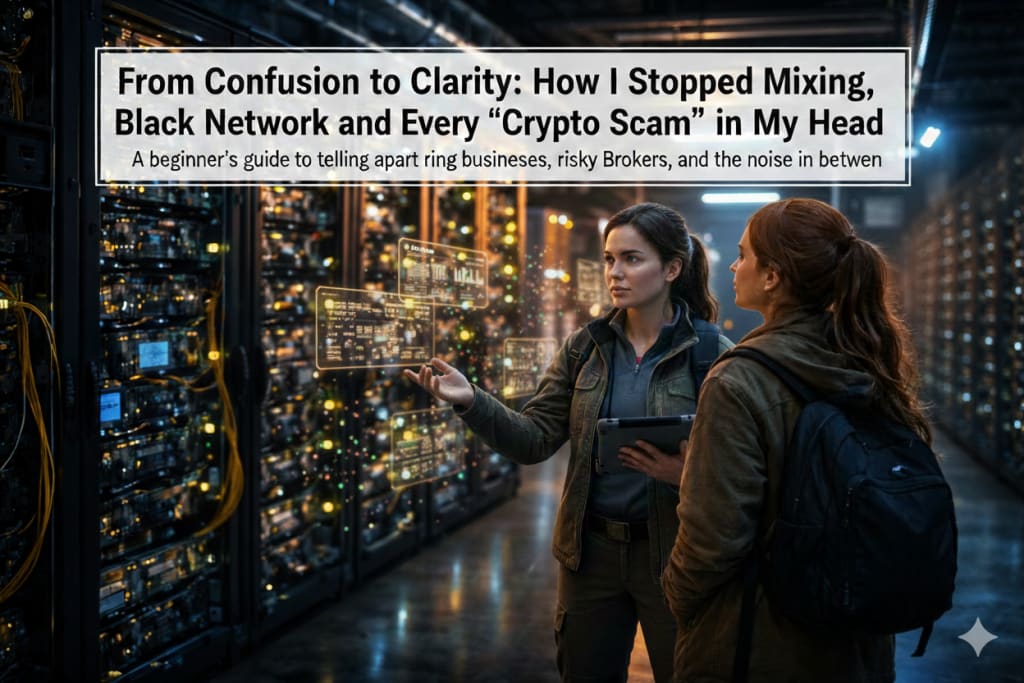
If you read my previous story, you know that my first contact with Blvck Sigma started with a screenshot and ended in a server room in Bulgaria, surrounded by cables, machines, and the constant white noise of fans.
Seeing physical infrastructure changed something important for me: it broke the idea that everything in crypto is just a website, a promise, and a logo.
But here’s the honest part: standing in front of racks of hardware did not delete my fears overnight.
I still had the word “Blvck” stuck in my head, and my brain still remembered those Black Network stories where people felt misled and unprotected.
What changed was the kind of questions I started asking.
Instead of “Is this crypto? Then it’s all the same”, I began to ask: What exactly is this business? Who regulates it, if anyone? Where does the money actually come from?
And that shift — from panic to curiosity — is really what this article is about.
Blvck Sigma vs. Black Network: same letters, different realities
The first big thing I had to learn was embarrassingly simple: similar names do not mean the same business.
Black Network is described as a high‑risk online broker, offering trading products to retail clients without the kind of strong, top-tier regulation you’d expect from a safe financial intermediary.
Analysts explicitly recommend avoiding it because of concerns about supervision, transparency, and how hard it might be to get your money back if things go wrong.
Blvck Sigma, on the other hand, is not a broker at all.
It’s a European mining and data‑infrastructure company, headquartered in Sofia, Bulgaria, operating physical data centers that host high‑performance servers for blockchain, AI, and cloud computing.
On their official Spanish site, they describe their activity as independent mining and infrastructure services rather than online trading.
Their day-to-day reality is closer to an industrial energy and IT operation than to a trading platform: power contracts, hardware procurement, cooling, uptime, and risk management around real machines.
There are also press pieces covering their expansion in Europe, focusing on regulated and independent mining operations rather than speculative brokerage.
That difference matters.
A broker like Black Network lives mostly on your trading activity: deposits, positions, spreads, and, in the worst cases, conflict of interest if the platform benefits when you lose.
A mining and infrastructure business like Blvck Sigma earns money by running machines that perform computation and by structuring contracts and products around that capacity.
From the outside, though, if you only see the word “Blvck” and some crypto jargon, it all blends into one big blurred shape.
Part of my clarity came from forcing myself to separate these layers:
- What is the actual business model here? Broker, mining, software, or something else?
- Is there physical infrastructure, or is it all just numbers on a screen?
- Who, if anyone, is supervising this activity?
Once I started answering those questions, Blvck Sigma and Black Network stopped living in the same mental folder.
The checklist I now use before calling something “a scam”
I still see the word “scam” thrown around every day on social media.
Sometimes it’s justified; sometimes it’s just panic, frustration, or lack of information.
I’m not an investigator, and I’m definitely not a regulator, but I’ve built a simple checklist that helps me avoid mixing everything together.
- What exactly are they offering?
If a company is a broker, it offers you access to trading products: CFDs, forex, crypto pairs, derivatives.
If a company is a mining or infrastructure provider, it talks about machines, energy, uptime, and data centers.
When a website uses vague wording like “investment opportunities” with no clear business underneath, my alarm bells start ringing.
2. Who regulates them, if anyone?
In Europe, the MiCA regulation and national supervisors like the CNMV in Spain are gradually bringing crypto‑related services under a licence-based, supervised regime.
That doesn’t magically make every licensed firm safe or every unlicensed one evil, but it does change the level of transparency and accountability they must have.
A platform that claims to be “regulated” without naming the authority, the licence, or appearing in any official register is a big red flag for me.
3. Where does the money actually come from?
If the “returns” depend mostly on bringing in new people, not on any clear underlying activity (like trading with clear risk disclosure or running hardware), that looks dangerously close to a pyramid or Ponzi structure.
If the company can explain, in simple terms, how it earns revenue — and that explanation matches what you see (offices, data centers, hardware, audited contracts) — it feels very different.
4. What do independent sources say?
Before, I would just scroll past reviews and lump everything together.
Now I try to distinguish: are people complaining about normal market losses, or are they describing being blocked from withdrawing, pressured to deposit more, or misled about regulation?
Black Network, for example, appears in detailed reviews where the conclusion is clear: it is not a safe or recommended broker.
This checklist doesn’t guarantee I’ll never be wrong.
But it has already prevented me from calling “scam” something that was simply different from what I imagined, and from ignoring red flags just because a website looked professional.
What regulation taught me (and what it didn’t)
Digging into regulation was the most unglamorous part of this journey, but also the most grounding.
The EU’s MiCA framework is turning many crypto‑asset service providers into fully supervised, licence‑based businesses, with rules on transparency, governance, and investor protection.
Supervisors like the CNMV keep reminding retail investors that crypto remains high‑risk, even under MiCA, and that you should be ready to lose everything you invest, as they state in this official warning.
Regulation taught me two important things:
- “Not regulated” is a warning sign, but “regulated” is not a guarantee.
Some firms are still in a transitional phase; others operate from outside the EU altogether.
What matters is whether the regulation they claim is real, relevant to what they do, and visible in official registers.
- There is no law that can replace the questions I need to ask for myself.
No framework can fully protect someone who doesn’t know what they’re buying or who they’re sending money to.
Seeing how a mining and infrastructure company like Blvck Sigma works, with physical data centers, contracts, and a narrative about aligning with European standards — helped me appreciate the difference between “crypto as a logo” and “crypto as an actual operation”.
At the same time, reading warnings and analyses about brokers like Black Network reminded me that not every “Blvck” is trying to do the same thing, and not every offer deserves the same level of trust.
A small conclusion from a small investor
I’m still not a whale, a day trader, or a regulation expert.
I’m just someone who didn’t want to spend the next decade paralysed between fear of scams and fear of missing out.
Today, instead of throwing everything with a similar name into the same mental bin, I try to separate: business model, regulation, infrastructure, incentives.
Sometimes, after asking those questions, I still walk away — and that’s okay.
Other times, I feel comfortable enough to explore further, knowing that I’m not blindly mixing a mining company in Bulgaria with an online broker accused of being unsafe just because they share a few letters.
None of this is financial advice.
It’s just the story of how I went from “every Blvck is probably a scam” to a more nuanced way of seeing things — one that, hopefully, helps me protect my small savings a little better
About the Creator
Chloe R. Labs
Curious mind who writes about money, tech and how people in Spain try to save and invest, from classic funds to Bitcoin mining and tokenized projects. Here to share what I learn, not to give investment advice.
Keep reading
More stories from Chloe R. Labs and writers in Trader and other communities.
From a screenshot to a server room: My first encounter with Blvck Sigma and Sigmine
The first time I saw the name Blvck Sigma it was on a screenshot in a group chat. Someone had forwarded a picture of an app interface, full of numbers and a small graph that looked like a heartbeat. Underneath, a message I’ve seen too many times: “This project is going to change everything.”
By Chloe R. Labs6 days ago in Trader
As U.S.-European trade tensions cause a "Transatlantic Tantrum," global markets fall.
This week, geopolitical tensions between the United States and key European allies grew, causing a broad sell-off in stocks, increased demand for safe-haven assets, and increased volatility across major asset classes in global financial markets. A contentious dispute involving the United States is at the center of the chaos. President Donald Trump’s aggressive tariff threats against eight European nations in connection with his bid to influence control over Greenland — a move that has quickly escalated into a flashpoint for transatlantic relations and market sentiment.
By Raviha Imranabout 4 hours ago in Trader



Comments
There are no comments for this story
Be the first to respond and start the conversation.