
Europe Pyridine Market Size and Forecast 2025–2033
From Agrochemicals to Pharmaceuticals: Why Pyridine Is Becoming a Strategic Chemical Across Europe

Introduction: A Quiet but Crucial Chemical on the Rise
The European chemical industry is often associated with massive petrochemical complexes, advanced polymers, and high-performance materials. Yet, behind many everyday products—from medicines and pesticides to dyes and food additives—there lies a group of smaller, highly functional compounds that quietly keep multiple industries running. Pyridine is one of them.
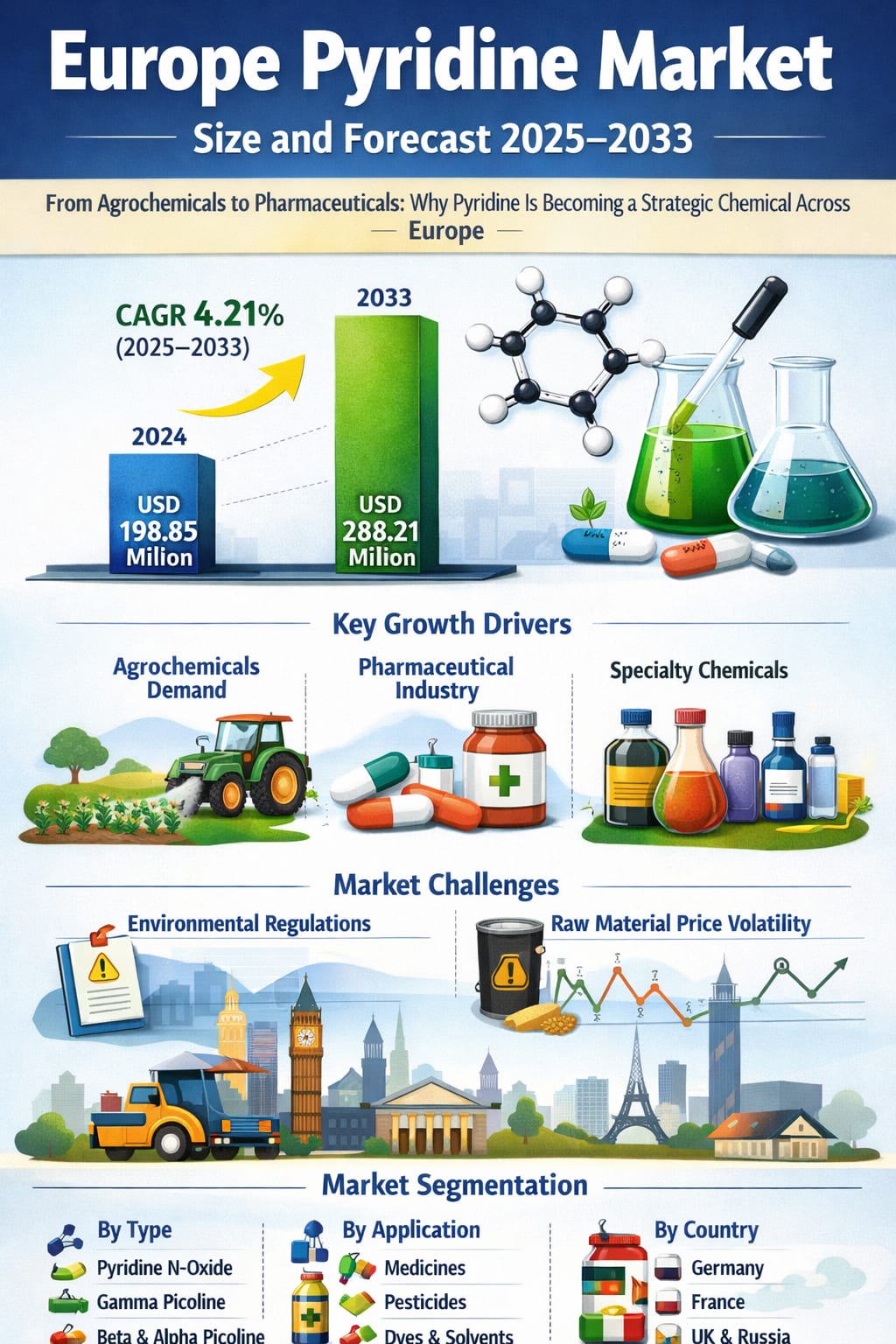
According to Renub Research, the Europe Pyridine Market was valued at USD 198.85 million in 2024 and is projected to reach USD 288.21 million by 2033, expanding at a compound annual growth rate (CAGR) of 4.21% from 2025 to 2033. This steady growth reflects rising demand from agrochemicals, pharmaceuticals, food processing, and specialty chemical industries, along with the expanding role of pyridine as a solvent and chemical intermediate across Europe.
In an era where sustainability, regulatory compliance, and innovation are reshaping industrial chemistry, pyridine and its derivatives are increasingly seen not just as basic building blocks, but as strategic inputs for high-value applications.
What Is Pyridine and Why Does It Matter?
Pyridine is a basic heterocyclic organic compound with the chemical formula C₅H₅N. It is a colorless liquid with a strong, distinctive odor and high solubility in water. Chemically, it behaves similarly to benzene but with a nitrogen atom replacing one of the carbon atoms in the ring—an alteration that gives pyridine its unique reactivity and usefulness.
In practical terms, pyridine is:
A key intermediate in the synthesis of pharmaceuticals and agrochemicals
A solvent and reagent in many chemical reactions
A building block for vitamins, pesticides, dyes, adhesives, and rubber chemicals
Across Europe, pyridine is widely used in the production of insecticides, fungicides, and herbicides, supporting the region’s strong agricultural base. In pharmaceuticals, it plays a vital role in manufacturing antihistamines, anti-tuberculosis drugs, antiseptics, and vitamin B3 (niacin). The food and chemical industries also rely on pyridine derivatives for flavorings, dyes, and rubber processing chemicals.
Its versatility, combined with Europe’s strong industrial and research ecosystem, makes pyridine a consistently in-demand compound despite its relatively modest market size.
Market Outlook: Steady Growth with Strategic Importance
The projected growth from USD 198.85 million in 2024 to USD 288.21 million by 2033 highlights a market that is not explosive, but structurally strong and resilient. A CAGR of 4.21% indicates:
Stable demand from core industries like pharmaceuticals and agrochemicals
Gradual expansion of specialty chemical applications
Ongoing R&D-driven innovation in formulations and derivatives
Continued importance of pyridine in high-value chemical supply chains
Unlike commodity chemicals, pyridine’s value lies in its functional role in complex products, making demand less sensitive to short-term economic cycles and more tied to long-term trends in healthcare, agriculture, and advanced manufacturing.
Key Growth Drivers in the Europe Pyridine Market
1. Growing Demand from the Agrochemicals Sector
Europe’s agricultural sector is undergoing a transformation driven by sustainability goals, food security concerns, and stricter environmental regulations. Pyridine derivatives are widely used in the production of insecticides, herbicides, and fungicides that are more efficient and, in many cases, more environmentally compatible than older formulations.
Countries such as France and Germany, with large and technologically advanced agricultural sectors, are leading this shift. As farmers adopt modern crop protection solutions to improve yields while meeting regulatory standards, the demand for pyridine-based intermediates continues to rise.
2. Expansion of the Pharmaceutical Industry
Pyridine is a critical building block in the synthesis of numerous active pharmaceutical ingredients (APIs). It is used in drugs targeting infectious diseases, allergies, cardiovascular conditions, and nutritional deficiencies.
Europe’s pharmaceutical industry benefits from:
Strong R&D investment
A growing elderly population
Rising prevalence of chronic diseases
Expansion of generic and biosimilar manufacturing
All of these factors translate into consistent and growing demand for pyridine and its derivatives as chemical intermediates in drug production.
3. Rising Use in Specialty Chemicals
Beyond pharma and agrochemicals, pyridine is increasingly used in dyes, adhesives, corrosion inhibitors, rubber chemicals, and surfactants. Europe’s specialty chemical sector—particularly strong in countries like Germany and the UK—is focused on high-performance and application-specific materials, many of which rely on pyridine chemistry.
Innovation in materials science and a growing focus on performance, durability, and sustainability are further expanding the role of pyridine in advanced formulations.
Challenges Facing the Market
1. Stringent Environmental and Safety Regulations
Pyridine is classified as toxic and environmentally hazardous, which places it under strict regulatory scrutiny in the European Union. Regulations such as REACH impose:
Higher compliance costs
More complex approval processes
Stricter handling, storage, and waste disposal requirements
While these rules improve safety and environmental protection, they also increase operational costs and can slow down production expansions, especially for small and medium-sized manufacturers.
2. Volatile Raw Material Prices
Pyridine production depends heavily on petroleum-based raw materials, making it sensitive to fluctuations in crude oil prices. This volatility can:
Increase production costs
Pressure profit margins
Complicate long-term pricing strategies
Manufacturers must constantly balance cost control, supply chain stability, and competitive pricing, which remains a persistent challenge in the European market.
Segment Insights: Where the Growth Is Coming From
Pyridine N-Oxide
Pyridine N-oxide is gaining popularity due to its higher reactivity and relatively lower toxicity compared to pyridine. It is widely used as an intermediate in agrochemicals, dyes, and pharmaceuticals. Its more favorable environmental profile makes it particularly attractive under strict EU regulations, supporting its growing adoption in fine chemicals and research applications.
Gamma Picoline
Gamma picoline plays a crucial role in the production of vitamin B3 (niacin), herbicides, and pharmaceutical intermediates. Demand is being driven by:
Rising consumption of nutritional supplements
Growing interest in preventive healthcare
Modernization of agriculture, especially in Eastern Europe
Medicines and Pharmaceuticals
Pyridine-based intermediates are essential in manufacturing anti-infective, anti-inflammatory, and cardiovascular drugs. With Europe’s healthcare spending rising and its population aging, the pharmaceutical application segment is expected to remain one of the most stable and profitable areas of the pyridine market.
Pesticides
Despite regulatory pressure, pyridine derivatives remain important in the production of efficient crop protection chemicals such as paraquat and diquat. Ongoing innovation in formulations is helping the industry adapt to sustainability and safety requirements, ensuring continued demand in major agricultural countries like France and Italy.
Chemicals and Industrial Uses
In the broader chemical industry, pyridine is widely used as a solvent, catalyst, and intermediate in products ranging from rubber and adhesives to dyes and surfactants. Europe’s strong industrial base, particularly in Germany and the Netherlands, ensures steady demand from this segment.
Country-Level Highlights
France
France’s market is driven by agrochemicals and pharmaceuticals. Its large agricultural sector and strong focus on sustainability support demand for pyridine-based crop protection products, while its advanced pharmaceutical research ecosystem boosts consumption of pyridine intermediates.
Germany
Germany stands out as a major consumer and innovator in the pyridine market, thanks to its world-class chemical and pharmaceutical industries. The country’s emphasis on green chemistry and advanced manufacturing is encouraging the development of more efficient and environmentally responsible pyridine applications.
United Kingdom
The UK benefits from a strong pharmaceutical sector and growing focus on sustainable agriculture. Post-Brexit regulatory adjustments are also encouraging localized manufacturing and innovation, opening new opportunities for pyridine derivatives and value-added chemical products.
Russia
Russia’s pyridine market is expanding with the growth of domestic agrochemical and pharmaceutical production. Government-backed industrial development initiatives and agricultural modernization are increasing demand for chemical intermediates, positioning Russia as an increasingly important market within the broader European region.
Competitive Landscape: Key Players Shaping the Market
The Europe pyridine market features a mix of global chemical giants and specialized manufacturers. Companies are typically evaluated across four dimensions: overview, key personnel, recent developments, and revenue performance.
Some of the notable players include:
Lonza Group Ltd.
Bayer AG
Jubilant Pharmova Limited
Mitsubishi Chemical Holdings Corporation
Imperial Chemical Corporation
Nippon Steel & Sumikin Chemical Co., Ltd.
Koei Chemical Company, Limited
Competition in this market is driven less by volume and more by quality, regulatory compliance, product customization, and long-term supply relationships with pharmaceutical and agrochemical clients.
Market Segmentation Snapshot
By Type:
Pyridine N-Oxide
Alpha Picoline
Beta Picoline
Gamma Picoline
2-Methyl-5-Ethylpyridine (MEP)
By Application:
Medicines
Rubber
Paints and Dyes
Pesticides
Solvent
Food Flavouring
Others
By End Use:
Pharmaceuticals
Agrochemicals
Food
Chemicals
Others
By Country:
France, Germany, Italy, Spain, United Kingdom, Belgium, Netherlands, Russia, Poland, Greece, Norway, Romania, Portugal, and Rest of Europe.
Final Thoughts: A Small Market with Big Strategic Value
The Europe pyridine market may not grab headlines like electric vehicles or artificial intelligence, but its importance is hard to overstate. From feeding pharmaceutical innovation to supporting sustainable agriculture and enabling advanced materials, pyridine sits at the crossroads of several critical industries.
With the market expected to grow from USD 198.85 million in 2024 to USD 288.21 million by 2033 at a CAGR of 4.21%, the outlook is one of steady, reliable expansion. While challenges such as regulatory pressure and raw material price volatility remain, ongoing innovation and strong demand from high-value sectors ensure that pyridine will continue to play a quiet but indispensable role in Europe’s industrial future.
About the Creator
US Stocks Earnings Reaction: Tech and Financials Face Volatility Amid Global AI Headlines
US Stocks Earnings Reaction: Market Digesting Earnings and Global Developments The latest US stocks earnings reaction shows a market balancing optimism from strong corporate results with caution due to global developments. As major companies across technology, financials, healthcare, and consumer sectors reported quarterly earnings, investors reacted swiftly to surprises on both the upside and downside.
By Hammad Nawaz2 days ago in Trader


Comments
There are no comments for this story
Be the first to respond and start the conversation.