
Europe Polypropylene Market Size and Forecast 2026–2034
Sustainable Packaging, Automotive Lightweighting, and Circular Economy Initiatives Drive Steady Growth Across Europe

Europe Polypropylene Market Overview
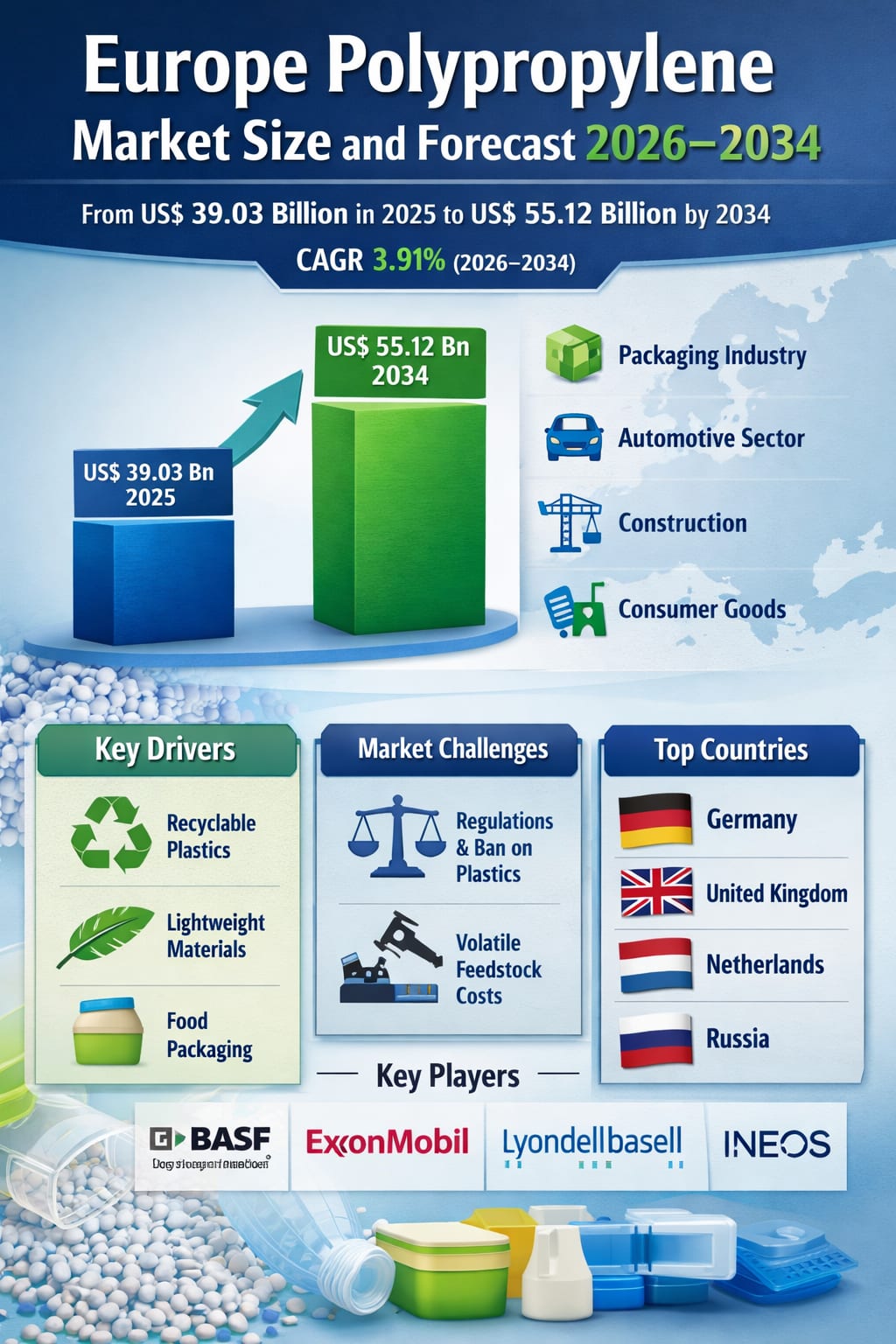
The Europe polypropylene market is positioned for steady expansion over the coming decade, supported by robust demand across packaging, automotive, construction, and consumer goods industries. According to Renub Research, the market is projected to grow from US$ 39.03 billion in 2025 to US$ 55.12 billion by 2034, registering a compound annual growth rate (CAGR) of 3.91% from 2026 to 2034.
Polypropylene (PP) is one of the most widely used thermoplastic polymers globally, valued for its lightweight nature, chemical resistance, durability, and flexibility. These properties allow it to serve a broad spectrum of applications ranging from food packaging and automotive components to medical devices and industrial products. In Europe, polypropylene has become a cornerstone material due to its compatibility with sustainability objectives, recyclability, and adaptability to both rigid and flexible uses.
The region’s strong policy focus on circular economy principles, combined with innovation in recycled and bio-based polypropylene grades, continues to reinforce the material’s long-term relevance in Europe’s industrial ecosystem.
Europe Polypropylene Market Outlook
Polypropylene is produced through the catalytic polymerization of propylene monomers and can be processed using injection molding, extrusion, blow molding, and fiber spinning. Its resistance to moisture, acids, and fatigue, along with excellent processability, makes it suitable for high-volume industrial manufacturing.
Across Europe, the packaging sector remains the largest consumer of polypropylene, particularly in food and beverage applications where hygiene, moisture resistance, and heat tolerance are critical. The automotive industry also relies heavily on PP for lightweight components that support fuel efficiency and emission reduction targets. In addition, growth in healthcare, hygiene products, and construction applications further strengthens overall market demand.
Continuous advancements in material science—particularly in recycled, high-performance, and specialty polypropylene grades—are enabling the substitution of heavier or more expensive polymers, reinforcing polypropylene’s competitive position.
Growth Drivers of the Europe Polypropylene Market
Strong Demand from Packaging and FMCG Sectors
Packaging remains the primary growth engine for polypropylene in Europe. PP’s low density, stiffness, and excellent moisture barrier properties make it ideal for rigid containers, caps and closures, films, and multilayer packaging solutions used in food, beverages, household goods, and personal care products.
European brand owners are increasingly adopting polypropylene for recyclable mono-material packaging designs that align with regulatory requirements and sustainability goals. Innovations in post-consumer recycled polypropylene further enhance its appeal, allowing manufacturers to reduce carbon footprints while maintaining product performance and aesthetics.
Automotive Lightweighting and Durable Components
The automotive and transportation sectors represent another major driver of polypropylene consumption in Europe. Vehicle manufacturers are under pressure to reduce emissions, improve energy efficiency, and extend electric vehicle range. Polypropylene’s lightweight nature, mechanical strength, and design flexibility make it well suited for interior trims, dashboards, door panels, bumpers, battery housings, and under-the-hood components.
Additionally, PP’s chemical resistance and noise-damping characteristics—especially when compounded with fillers and fibers—support its growing use in advanced automotive applications. As electric vehicle production expands across Europe, polypropylene’s role in lightweight structural components is expected to strengthen further.
Technological Advancements and Circular Economy Initiatives
Technological innovation plays a crucial role in the evolution of the European polypropylene market. Improvements in catalysts, polymerization processes, and compounding technologies are delivering PP grades with enhanced clarity, impact strength, heat resistance, and processing efficiency.
At the same time, Europe’s strong emphasis on circular economy principles is accelerating investments in mechanical and chemical recycling infrastructure. Polypropylene is increasingly designed for recyclability, with simplified structures and mono-material packaging formats that support higher recovery rates. These developments help polypropylene remain compliant with stringent EU regulations while expanding its application potential.
Challenges in the Europe Polypropylene Market
Regulatory Pressure and Anti-Plastic Sentiment
Despite its recyclability, polypropylene faces increasing regulatory and public scrutiny across Europe. EU directives targeting packaging waste reduction, single-use plastics, and higher recycling targets are prompting brand owners to reassess material choices. Negative consumer perception of plastics—driven by concerns around marine pollution and microplastics—may encourage substitution with paper, glass, or biodegradable alternatives in certain applications.
Volatile Feedstock Prices and Energy Costs
Polypropylene production is closely tied to the availability and pricing of propylene, which is derived from crude oil and natural gas refining processes. Volatile feedstock prices, combined with high energy costs and carbon pricing mechanisms in Europe, pose structural challenges for producers. These factors can impact profitability and influence production capacity decisions across the region.
Europe Polypropylene Market by Segment
Europe Homopolymer Polypropylene Market
Homopolymer polypropylene dominates the European PP market due to its high stiffness, tensile strength, and excellent processability. It is widely used in rigid packaging, housewares, caps and closures, and automotive interior components. European producers continue to refine homopolymer grades for improved clarity, higher melt flow, and faster cycle times.
Europe Blow Molding Polypropylene Market
Blow-molded polypropylene serves applications such as bottles, containers, automotive reservoirs, and technical hollow parts. Its chemical resistance and durability make it suitable for detergents, food products, and personal care packaging. Automotive applications increasingly favor blow-molded PP for lightweight fluid tanks and air ducts.
Europe Extrusion Polypropylene Market
Extrusion-grade polypropylene is extensively used for films, sheets, pipes, and profiles. BOPP and CPP films are widely applied in snack packaging, labels, and flexible wraps due to their transparency and sealability. The shift toward recyclable mono-material flexible packaging continues to benefit polypropylene films.
Europe Fiber Polypropylene Market
Polypropylene fibers play a key role in nonwoven hygiene products, geotextiles, carpets, automotive interiors, and industrial fabrics. The material’s low density and hydrophobic properties make it suitable for disposable hygiene articles, filtration media, and construction reinforcement applications.
Europe Raffia Polypropylene Market
Raffia-grade polypropylene supports woven bags, sacks, tarpaulins, and agricultural fabrics. In Europe, regulatory pressure on single-use plastics has shifted demand toward reusable woven PP solutions, which offer durability, recyclability, and longer service life.
Europe Polypropylene Market by End Use
Packaging
Packaging is the largest end-use sector, encompassing rigid containers, closures, trays, and flexible films. Polypropylene’s heat resistance, toughness, and chemical stability make it suitable for food and non-food applications, including microwaveable and hot-fill packaging.
Medical and Healthcare
Medical applications represent a specialized but growing segment. Polypropylene is widely used in syringes, IV components, laboratory ware, and medical packaging due to its sterilizability and chemical resistance. Growth in single-use medical devices and home healthcare supports steady demand.
Country-Level Insights
Germany Polypropylene Market
Germany is Europe’s largest polypropylene market, supported by a strong automotive, packaging, and chemical industry base. Sustainability, precision engineering, and advanced recycling initiatives drive demand for high-performance PP grades.
United Kingdom Polypropylene Market
The UK polypropylene market is shaped by packaging, consumer goods, construction, and automotive applications. Sustainability regulations and recycled content mandates encourage innovation in mono-material and recycled polypropylene solutions.
Netherlands Polypropylene Market
The Netherlands serves as a major logistics and chemical hub in Europe. Strong agricultural, packaging, and horticulture sectors drive polypropylene consumption, while circular economy policies support recycling and material innovation.
Russia Polypropylene Market
Russia’s polypropylene market benefits from abundant hydrocarbon resources and domestic petrochemical capacity. Demand is driven by packaging, construction, fibers, and automotive components, with increasing focus on higher-value PP grades.
Market Segmentation
By Type:
Homopolymer
Copolymer
By Process:
Injection Molding
Blow Molding
Extrusion
Others
By Application:
Film & Sheet
Fiber
Raffia
Others
By End User:
Packaging
Automotive
Building & Construction
Medical
Electrical & Electronics
Others
By Country:
France, Germany, Italy, Spain, United Kingdom, Belgium, Netherlands, Russia, Poland, Greece, Norway, Romania, Portugal, Rest of Europe
Key Companies Covered
BASF SE
China Petrochemical Corporation
Daelim Co. Ltd
Exxon Mobil Corporation
Formosa Plastics Corporation
HPCL-Mittal Energy Limited
INEOS
LG Chem Ltd.
LyondellBasell Industries N.V.
Sumitomo Chemical Co. Ltd.
Each company is analyzed across five viewpoints: overview, key personnel, recent developments, SWOT analysis, and revenue performance.
Final Thoughts
The Europe polypropylene market is set for consistent, long-term growth through 2034, supported by strong demand from packaging, automotive, medical, and industrial applications. While regulatory pressure and energy costs present challenges, innovation in recyclable, bio-based, and high-performance polypropylene grades ensures continued relevance.
As Europe advances toward a circular economy, polypropylene’s recyclability, versatility, and cost efficiency position it as a vital material for sustainable industrial development. Companies that invest in advanced recycling technologies, lightweight solutions, and compliance-driven product innovation are likely to capture the greatest opportunities in the evolving European polypropylene landscape.
About the Creator
Silver Sprints Ahead… Then Hits a Wall: Why Metals Really Lost Momentum
The first weeks of 2026 delivered a dramatic spectacle for commodity markets. Silver surged at a pace few expected, outshining gold and drawing intense investor attention. Then, almost as suddenly, momentum stalled. Prices tumbled, speculative positions were liquidated, and traders scrambled to understand what went wrong.
By Sajida Sikandarabout 6 hours ago in Trader



Comments
There are no comments for this story
Be the first to respond and start the conversation.