
Europe Luxury Residential Real Estate Market Size and Forecast 2025–2033
Where Heritage Meets High-End Living

Market Snapshot
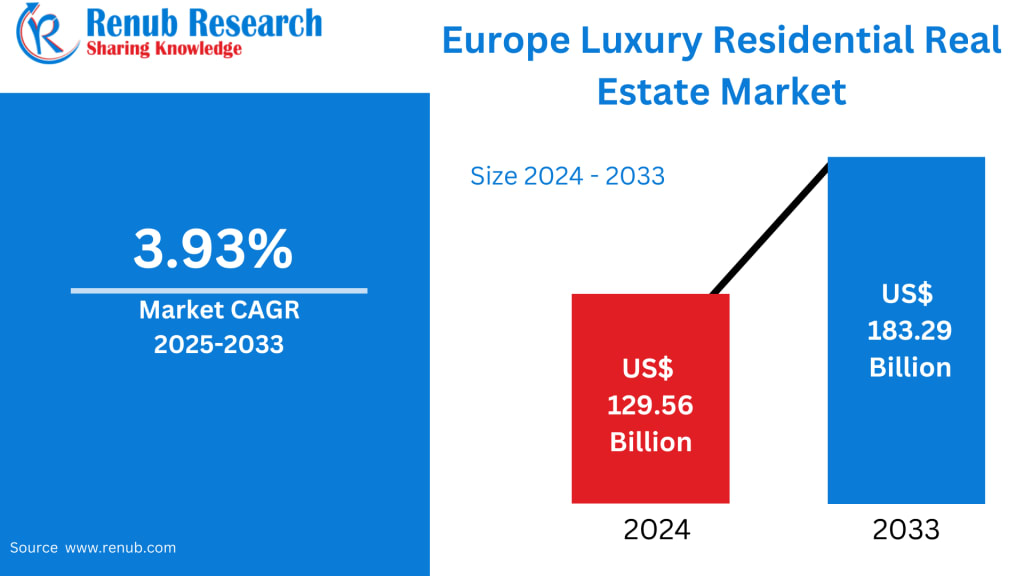
The Europe Luxury Residential Real Estate Market is projected to grow from US$ 129.56 billion in 2024 to US$ 183.29 billion by 2033, registering a CAGR of 3.93% during 2025–2033. Demand is being fueled by rising global wealth, sustained foreign investment, and strong appetite for premium urban and coastal properties across Europe’s most iconic destinations.
Industry Overview: Defining Luxury Living in Europe
Luxury residential real estate in Europe represents the pinnacle of architecture, location, and lifestyle. These properties—ranging from historic mansions to ultra-modern penthouses—are defined by premium construction, expansive layouts, bespoke interiors, and access to elite amenities. They are commonly located in prestigious city centers, celebrated coastal belts, and culturally rich countryside regions.
Beyond being primary homes, luxury residences often function as investment assets, second homes, or vacation retreats for high-net-worth individuals (HNWIs) and ultra-high-net-worth individuals (UHNWIs). Europe’s long-standing appeal stems from its political stability, cultural depth, strong legal frameworks, and global connectivity.
Cities such as Paris, London, Milan, and Berlin continue to dominate demand, while lifestyle destinations like the French Riviera, Tuscany, and the Alps retain timeless allure. Despite macroeconomic fluctuations, Europe’s luxury housing market remains comparatively resilient due to limited supply and enduring international demand.
Key Factors Driving Market Growth
1. Strong Foreign Buyer Demand and Cross-Border Investment
Europe remains one of the safest and most prestigious destinations for global real estate investment. Buyers from Asia, the Middle East, and North America increasingly view European luxury properties as long-term wealth preservation tools. Favorable exchange rates, residency-by-investment programs in select countries, and transparent legal systems further enhance appeal.
High-profile cities and exclusive resort regions benefit the most, as international buyers seek capital appreciation combined with lifestyle benefits. This sustained cross-border interest continues to underpin market expansion.
2. Post-Pandemic Lifestyle Shifts
Luxury real estate preferences have evolved significantly since the pandemic. Buyers now prioritize:
Larger living spaces
Private outdoor areas
Wellness and fitness facilities
Home offices and smart-home integration
Remote and hybrid work models have encouraged affluent buyers to explore secondary cities and resort regions without sacrificing connectivity. As a result, luxury developments increasingly emphasize health, sustainability, and flexible living.
3. Limited Supply in Prime Locations
One of the strongest value drivers in Europe’s luxury market is scarcity. Strict zoning laws, heritage preservation regulations, and land constraints limit new construction in premium districts. This imbalance between demand and supply supports long-term price stability.
Iconic addresses in historic neighborhoods command premium valuations, reinforcing luxury real estate’s defensive investment profile even during economic uncertainty.
Challenges Facing the Market
Regulatory and Taxation Pressures
European luxury real estate markets operate within complex and evolving regulatory frameworks. Changes in property taxes, capital gains rules, and foreign ownership regulations can affect investor sentiment. Enhanced anti-money laundering (AML) checks also increase compliance requirements, sometimes lengthening transaction timelines.
Economic Uncertainty and Interest Rate Volatility
Although many luxury transactions are cash-based, broader economic conditions still influence buyer confidence. Inflation concerns, geopolitical tensions, and fluctuating interest rates can delay purchasing decisions. Rising construction and labor costs may also compress developer margins.
Regional Outlook: Key European Markets
Germany
Germany’s luxury residential market is concentrated in cities such as Munich, Hamburg, Frankfurt, and Berlin. Strong economic fundamentals, political stability, and sustainability-driven demand define the market. Limited new supply in prime urban zones continues to push prices upward.
France
France remains a global luxury real estate powerhouse. Paris dominates urban demand, while Provence, the Alps, and the French Riviera attract international buyers seeking second homes. Architectural heritage combined with modern upgrades makes French luxury properties particularly attractive for long-term investors.
Italy
Italy’s luxury market thrives on lifestyle and heritage. Milan and Rome anchor urban demand, while Tuscany, Lake Como, and the Amalfi Coast are synonymous with elite holiday living. Restoration projects and historic villas are especially popular among foreign buyers.
United Kingdom
The UK—particularly London—remains one of the world’s most liquid luxury residential markets. Neighborhoods such as Mayfair, Kensington, and Belgravia are globally recognized. Beyond London, countryside locations like the Cotswolds and Surrey are gaining traction among buyers seeking privacy and space.
Latest Developments Shaping the Market (2025)
In April 2025, Claudiu Diaconu launched App Town Exclusive by Ima, a boutique luxury residential project in Pipera, Romania.
Ghelamco announced a €140 million mixed-use luxury residential skyscraper on London’s Battersea waterfront, featuring 113 high-end apartments and wellness-centric amenities.
Birmingham-based Fisher German was appointed agent for a new luxury apartment project in the city’s Southside district.
Market Segmentation
By Type
Villas / Landed Houses
Condominiums / Apartments
By Country
France, Germany, Italy, Spain, United Kingdom, Belgium, Netherlands, Russia, Poland, Greece, Norway, Romania, Portugal, Rest of Europe
Competitive Landscape
The European luxury residential real estate market is highly fragmented and relationship-driven, with global brokerages and premium digital platforms playing a critical role.
Key Players Include:
Sotheby's International Realty Affiliates LLC
Barnes International Realty
John Taylor
Mansion Global
BellesDemeures
These firms compete through brand reputation, global networks, market intelligence, and personalized advisory services.
Final Thoughts
The Europe Luxury Residential Real Estate Market stands at the intersection of heritage, lifestyle, and long-term investment security. Despite regulatory complexities and economic headwinds, the market’s fundamentals remain strong—supported by limited supply, global wealth creation, and Europe’s unmatched cultural appeal.
As sustainability, wellness, and smart living redefine modern luxury, developers and investors who adapt to evolving buyer expectations will be best positioned to capitalize on growth opportunities through 2033. For discerning buyers and institutional investors alike, Europe continues to represent one of the world’s most compelling luxury real estate destinations.
About the Creator
Renub Research
Renub Research is a Market Research and Consulting Company. We have more than 15 years of experience especially in international Business-to-Business Researches, Surveys and Consulting. Call Us : +1-478-202-3244
Keep reading
More stories from Renub Research and writers in Trader and other communities.
Data Center Construction Market Size and Forecast 2025–2033
Introduction The rapid digitization of economies, enterprises, and public services has placed data centers at the very heart of the modern digital ecosystem. From cloud computing and artificial intelligence to e-commerce, fintech, and smart governance, nearly every digital interaction depends on robust, secure, and scalable data center infrastructure. As a result, the Data Center Construction Market has emerged as one of the most critical segments within the global construction and infrastructure landscape.
By Renub Research20 days ago in Trader
Philippines CT Scanners Market: Diagnostic Imaging Growth, Healthcare Modernisation & Technology Adoption
Philippines CT Scanners Market Overview The Philippines CT scanners market is experiencing strong growth as healthcare systems modernise, diagnostic imaging awareness increases, and technological advancements improve clinical outcomes. Computed Tomography (CT) scanners — essential radiology equipment that provides detailed cross-sectional images for disease diagnosis, trauma evaluation and treatment planning — are increasingly utilised across hospitals, diagnostic centres and specialty clinics nationwide. The Philippines CT scanners market size reached USD 196.65 Million in 2025. The market is projected to reach USD 355.98 Million by 2034, growing at a CAGR of 6.82% during 2026-2034. This expansion reflects rising healthcare demand, increased investment in medical infrastructure, and broader adoption of advanced imaging modalities that support early detection, personalised care and improved clinical workflows.
By Manisha Dixit3 days ago in Trader
How Ancient Empires Paid Their Armies
Rome was not unique in its rise or its fall. It was simply early. What made Rome important was not its morality, its culture, or even its military genius, but the pattern it revealed. That pattern would repeat across history in different regions, under different banners, using different tools, yet producing the same result. Power requires force. Force requires payment. And systems built to continuously fund force eventually consume the societies that support them.
By Fanince historian 2 days ago in Trader


Comments
There are no comments for this story
Be the first to respond and start the conversation.