
Europe Corn Starch Market Size and Forecast 2025–2033
From Food to Bioplastics: Why Corn Starch Is Becoming One of Europe’s Most Versatile Growth Markets

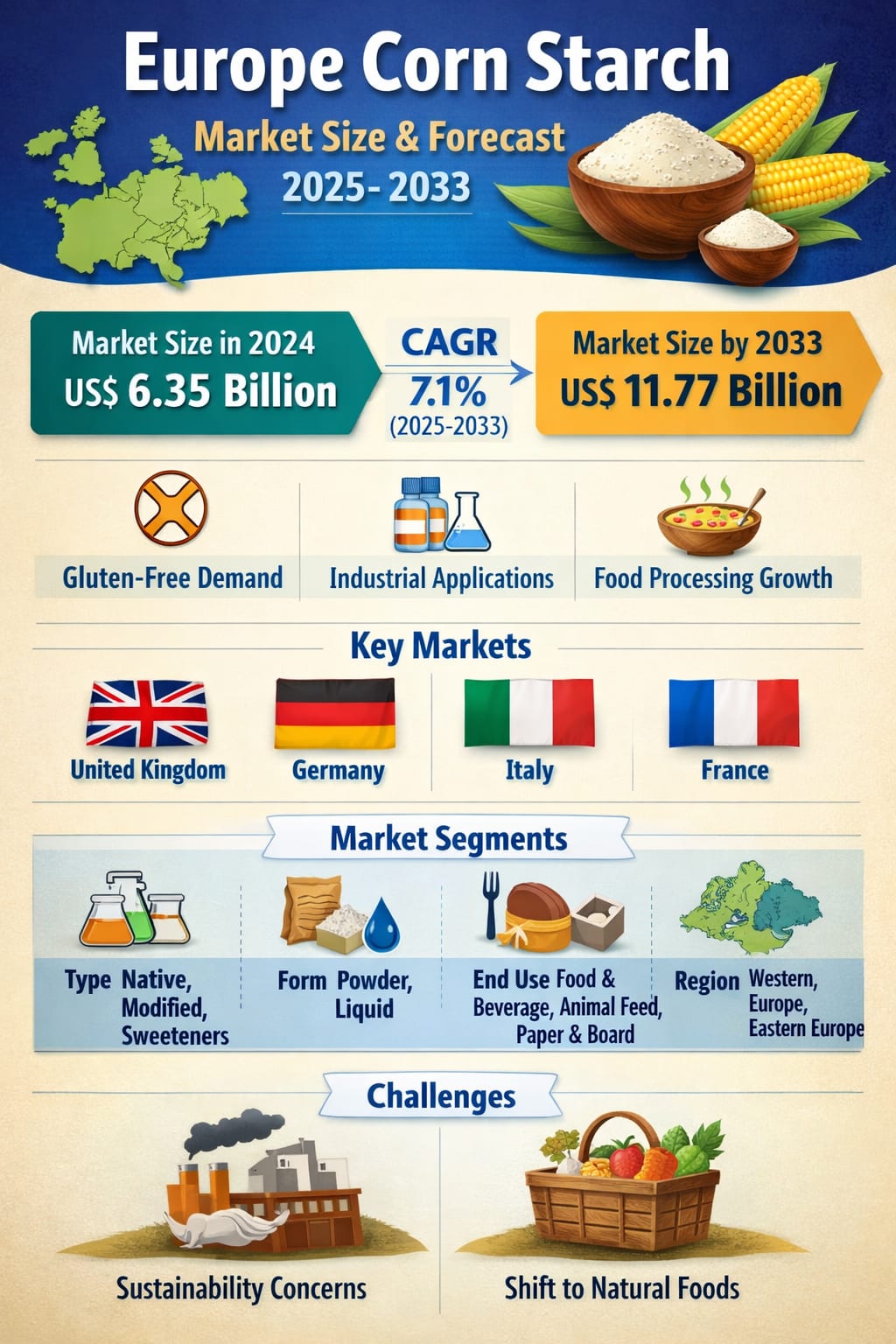
Europe Corn Starch Market at a Glance
The Europe Corn Starch Market is expected to reach US$ 11.77 billion by 2033, rising from US$ 6.35 billion in 2024, growing at a CAGR of 7.1% from 2025 to 2033. This impressive growth trajectory is being powered by rising demand for gluten-free products, expanding applications in pharmaceuticals and textiles, increasing usage in food processing, and continuous technological advancements in starch extraction and modification processes.
Corn starch, extracted from the endosperm of maize kernels, has long been a staple ingredient in the food industry. However, in today’s European market, it is no longer just a kitchen essential. It has become a strategic industrial input used across paper manufacturing, pharmaceuticals, textiles, adhesives, bioplastics, and biodegradable packaging. This expanding application base is transforming corn starch into one of the most versatile and resilient segments of the European agro-processing and bio-based materials economy.
Europe Corn Starch Market Overview
Corn starch accounts for a significant share of the European starch market due to its multifunctional properties and broad industrial usability. In food applications, it serves as a thickener, stabilizer, gelling agent, and texture enhancer. In industrial uses, it functions as a binder, filler, coating agent, and raw material for further chemical and biological processing.
One of the most important trends shaping the European corn starch market is the growing consumer preference for clean-label and gluten-free products. As awareness of celiac disease and gluten sensitivity increases, manufacturers are actively reformulating products to replace wheat-based ingredients with corn-derived alternatives. Corn starch, being naturally gluten-free and plant-based, fits perfectly into this shift.
Technological advancements have also played a key role in strengthening the market. Improvements in starch extraction efficiency, modification techniques, and derivative production (such as sweeteners and specialty starches) have expanded the performance range of corn starch in both food and non-food applications. Countries like Germany, France, and the Netherlands benefit from well-established agro-processing industries, strong logistics infrastructure, and supportive regulatory frameworks, making them major production and consumption hubs.
At the policy level, the European Union’s sustainability goals and support for bio-based products are further boosting demand for corn starch in green chemicals, biodegradable materials, and renewable packaging solutions. However, the market is not without challenges. Fluctuations in maize prices, climate-related supply risks, and dependence on imports in some countries can impact cost structures and production stability.
Despite these uncertainties, the overall outlook remains highly positive. With growing R&D investments, expanding industrial use cases, and strong alignment with Europe’s sustainability agenda, the corn starch market is positioned for steady and diversified growth through 2033.
Key Factors Driving the Europe Corn Starch Market Growth
1. Rising Demand in the Food & Beverage Industry
The food and beverage sector remains the largest and most consistent driver of corn starch demand in Europe. Corn starch is widely used in soups, sauces, gravies, bakery products, desserts, ready meals, and processed snacks, where it improves texture, stability, and shelf life.
As European lifestyles become increasingly urban and fast-paced, consumers are relying more on convenience and processed foods. This trend directly supports the demand for functional ingredients like corn starch that help manufacturers maintain product consistency, appearance, and mouthfeel. Additionally, corn starch aligns well with the growing preference for plant-based and clean-label ingredients, reinforcing its role in modern food formulations.
2. Increasing Popularity of Gluten-Free Products
The gluten-free movement is no longer a niche trend—it has become a mainstream dietary choice across Europe. Driven by rising diagnoses of celiac disease, gluten intolerance, and general health awareness, consumers are actively seeking alternatives to wheat-based products.
Corn starch, being naturally gluten-free, plays a critical role in gluten-free baking, snacks, and processed foods. It helps replicate the structure and texture typically provided by wheat flour, making it indispensable in product reformulation. This shift not only boosts volume demand but also supports premium pricing and product differentiation, creating attractive growth opportunities for corn starch producers.
3. Expanding Industrial Applications
Beyond food, corn starch is gaining importance across multiple industrial sectors:
Pharmaceuticals: Used as a binder and disintegrant in tablet formulations, ensuring proper drug delivery and stability.
Paper & Board: Improves paper strength, surface quality, and printability through coating and sizing applications.
Textiles: Used in fabric finishing and sizing to enhance stiffness and weaving efficiency.
Bioplastics and Adhesives: Serves as a renewable raw material for biodegradable polymers and eco-friendly adhesives.
This diversification of applications reduces the market’s dependence on any single sector and makes the European corn starch industry more resilient to economic and demand fluctuations.
Challenges in the Europe Corn Starch Market
1. Sustainability and Environmental Concerns
Although corn starch is a bio-based product, its upstream supply chain—particularly large-scale corn cultivation—raises environmental concerns. High water usage, heavy reliance on fertilizers and pesticides, and soil degradation are common issues associated with intensive maize farming.
These practices conflict with the EU’s long-term environmental goals, including carbon reduction, biodiversity protection, and sustainable agriculture. As regulations become stricter and consumers more eco-conscious, producers may face higher compliance costs and pressure to adopt more sustainable farming and processing methods. While this transition is necessary, it could impact short-term profitability and pricing.
2. Consumer Shift Toward Whole and Minimally Processed Foods
Another challenge comes from the growing preference for whole, minimally processed, and “natural” foods. Even though corn starch is plant-based, it is often perceived as a processed ingredient. Some health-conscious consumers and premium food brands are exploring alternatives such as agar, pectin, or seed-based thickeners.
If this trend accelerates, demand for corn starch in certain high-end or “cleanest label” segments could soften. To counter this, the industry will need to focus on transparency, cleaner processing methods, and better communication about corn starch’s natural origin and safety.
Europe Corn Starch Market Overview by Regions
Western Europe currently dominates the market due to its advanced food processing and industrial base, with Germany and France playing especially important roles. Meanwhile, Eastern Europe is emerging as a growth region, driven by industrialization, expanding food processing capacity, and rising consumption of packaged foods.
Below is a closer look at key national markets:
United Kingdom Corn Starch Market
The UK market is supported by a strong food and beverage industry, rising demand for gluten-free products, and growing interest in clean-label formulations. Corn starch is widely used in processed meals, sauces, soups, and bakery products.
Beyond food, the UK also uses corn starch in paper manufacturing, pharmaceuticals, and biodegradable packaging, aligning well with the country’s sustainability goals. However, reliance on imported maize and post-Brexit trade complexities can create supply chain and pricing challenges. Despite this, ongoing product innovation and expanding industrial applications continue to support long-term growth.
Germany Corn Starch Market
Germany represents one of the most important markets in Europe due to its powerful food processing, pharmaceutical, paper, and chemical industries. Corn starch is essential in food applications such as soups, sauces, and baked goods, and it also plays a key role in paper coating, textile finishing, and pharmaceutical formulations.
Germany’s strong commitment to sustainability has increased interest in using corn starch for bioplastics and biodegradable packaging. While raw material price volatility and competition from other starch sources remain challenges, steady industrial demand and eco-focused innovation keep the market on a positive growth path.
Italy Corn Starch Market
Italy’s diverse industrial structure makes corn starch an important input across food, textiles, pharmaceuticals, and biodegradable materials. In food processing, it enhances texture, stability, and shelf life. In textiles, it supports fabric finishing and weaving, while in pharmaceuticals it serves as a binder and disintegrant.
The growing focus on sustainable materials has also boosted interest in corn starch-based bioplastics and packaging. Although raw material price fluctuations and environmental concerns around corn farming persist, innovation and demand for greener alternatives continue to strengthen the Italian market outlook.
France Corn Starch Market
France holds a significant position in the European corn starch market, supported by strong food, pharmaceutical, and industrial sectors. The food industry remains the largest consumer, using corn starch extensively in soups, sauces, and bakery products.
At the same time, demand is rising in textiles, pharmaceuticals, and biodegradable materials, especially as sustainability becomes a strategic priority. Competition from other starch sources and raw material price volatility pose challenges, but consumer demand for natural and eco-friendly ingredients continues to drive steady market expansion.
Market Segmentation
By Type
Native
Modified
Sweeteners
By Form
Powder
Liquid
By End Use
Food and Beverage
Animal Feed
Paper and Board
Others
By Region
France
Germany
Italy
Spain
United Kingdom
Belgium
Netherlands
Russia
Poland
Greece
Norway
Romania
Portugal
Rest of Europe
Competitive Landscape
The European corn starch market is competitive and moderately consolidated, with several global and regional players focusing on capacity expansion, product innovation, and sustainability-oriented solutions.
Key Companies Covered:
Cargill Inc.
Ingredion Inc.
Archer Daniels Midland Company
Tate & Lyle
Associated British Foods plc
Tereos Group
Südzucker AG
Global Bio-Chem Technology Group Company Ltd.
These companies compete on factors such as product quality, functional performance, supply reliability, pricing, and innovation in modified starches, sweeteners, and bio-based materials. Strategic investments in R&D, partnerships with food and industrial manufacturers, and sustainability initiatives are becoming increasingly important differentiators.
Future Outlook: Where the Market Is Headed
Looking ahead to 2033, the Europe corn starch market is expected to benefit from three powerful, long-term trends:
Continued growth in processed and convenience foods, especially gluten-free and plant-based products.
Expansion of bio-based and biodegradable materials, driven by EU sustainability goals and corporate ESG commitments.
Technological advancements in starch modification, enabling higher-value applications in pharmaceuticals, packaging, and specialty chemicals.
While challenges related to sustainability, raw material supply, and shifting consumer preferences remain, the market’s broad application base and strong alignment with green industry trends provide a solid foundation for long-term growth.
Final Thoughts
With the market projected to grow from US$ 6.35 billion in 2024 to US$ 11.77 billion by 2033 at a CAGR of 7.1%, the Europe corn starch industry is clearly entering a phase of accelerated and diversified expansion. No longer confined to traditional food applications, corn starch is emerging as a strategic material for pharmaceuticals, paper, textiles, and, most importantly, sustainable and biodegradable products.
As Europe continues its transition toward a more sustainable, bio-based economy, corn starch is set to play a crucial supporting role—bridging the gap between agriculture, industry, and green innovation. For manufacturers, investors, and policymakers alike, this makes the European corn starch market not just a story of steady growth, but one of long-term strategic importance.
About the Creator
Understanding IPOs: A Beginner’s Guide to Initial Public Offerings
Introduction An Initial Public Offering (IPO) occurs when a private company offers its shares to the public for the first time. IPOs provide companies with capital to expand operations, while investors gain the opportunity to own a stake in a growing business.
By Hammad Nawaz5 days ago in Trader
If You Don't Want to Spend Time Researching Stocks, Just Buy Tech ETFs. Here's Why.
Not everyone wants to read annual reports. That's fine. There's a smarter path. Photo by Annie Spratt on UnsplashI've written about investing with conviction. About doing deep research. About concentrating your bets when you truly understand what you own.
By Destiny S. Harrisabout 14 hours ago in Trader




Comments
There are no comments for this story
Be the first to respond and start the conversation.