
United States Personalized Medicine Market Size and Forecast 2025–2033
How Genomics, AI, and Targeted Therapies Are Reshaping the Future of Healthcare in America

United States Personalized Medicine Market: A New Era of Precision Healthcare
The United States healthcare system is undergoing a profound transformation, driven by rapid advances in biotechnology, digital health, and genomics. At the heart of this transformation lies personalized medicine—an approach that tailors medical treatment to the individual characteristics of each patient, including genetic makeup, lifestyle, and environmental factors. This shift represents a decisive move away from the traditional “one-size-fits-all” model toward more precise, predictive, and preventive healthcare.
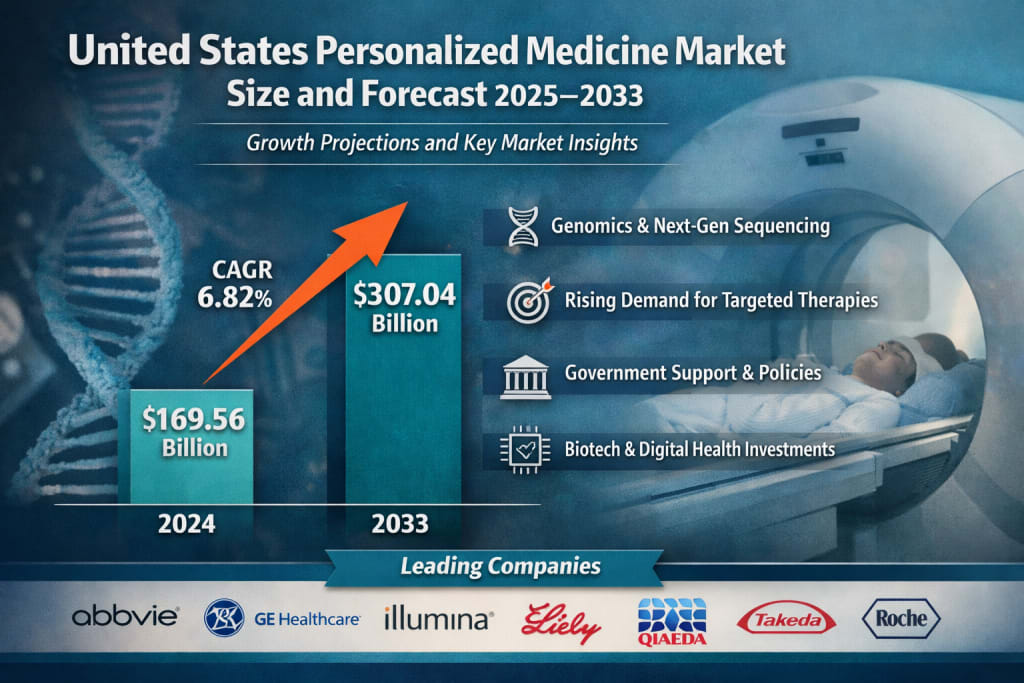
According to Renub Research, the United States Personalized Medicine Market is expected to reach US$ 307.04 billion by 2033, up from US$ 169.56 billion in 2024, growing at a compound annual growth rate (CAGR) of 6.82% from 2025 to 2033. This impressive expansion reflects not only technological progress but also changing patient expectations, evolving regulatory frameworks, and increasing investments in biotechnology and digital health solutions.
Personalized medicine is no longer a niche concept limited to advanced research labs. It is steadily becoming an integral part of mainstream clinical practice, especially in areas such as oncology, neurology, and rare disease management. From genetic testing and companion diagnostics to targeted therapies and personalized wellness plans, the ecosystem surrounding precision healthcare is expanding at an unprecedented pace.
What Is Personalized Medicine and Why It Matters
Personalized medicine, often referred to as precision medicine, focuses on customizing healthcare decisions and treatments based on individual patient data. This includes genetic information, biomarkers, lifestyle factors, and even real-time health data collected through digital devices. The ultimate goal is to deliver the right treatment to the right patient at the right time.
This approach offers several key advantages over conventional treatment models. First, it improves treatment effectiveness by identifying which therapies are most likely to work for a specific patient. Second, it reduces the risk of adverse drug reactions by avoiding medications that a patient’s genetic profile suggests may be ineffective or harmful. Third, it supports early detection and prevention by identifying disease risks before symptoms appear.
In the United States, where healthcare costs are high and chronic diseases are widespread, personalized medicine holds the promise of not only better outcomes but also more efficient use of healthcare resources. By minimizing trial-and-error prescribing and focusing on targeted interventions, the system can potentially reduce long-term costs while improving patient quality of life.
Market Growth Drivers: Why Personalized Medicine Is Taking Off
Advancements in Genomic and Molecular Technologies
One of the most powerful engines behind the growth of personalized medicine in the U.S. is the rapid evolution of genomic and molecular technologies. Next-generation sequencing (NGS), high-throughput screening, and advanced bioinformatics tools have dramatically reduced the cost and time required to analyze genetic data. What once took years and millions of dollars can now be accomplished in days at a fraction of the cost.
These technologies enable clinicians and researchers to identify specific genetic mutations, biomarkers, and molecular pathways associated with diseases. This information is crucial for developing targeted therapies and companion diagnostics, particularly in complex fields such as oncology and rare genetic disorders. As these tools become more accessible, they are increasingly being integrated into routine clinical workflows, accelerating the adoption of personalized medicine across hospitals, diagnostic centers, and research institutions.
Rising Demand for Targeted and Customized Therapies
Patients and healthcare providers alike are showing growing interest in treatments that are tailored to individual needs. Traditional therapies often produce variable results and can cause significant side effects, especially in the treatment of cancer, autoimmune disorders, and neurological conditions. Personalized medicine addresses these challenges by using genetic and molecular data to predict how a patient will respond to a specific treatment.
This shift toward targeted therapies is reshaping pharmaceutical research and development pipelines. Drug manufacturers are increasingly focusing on biologics, gene therapies, and precision drugs designed for specific patient subgroups. The parallel growth of companion diagnostics—tests that help determine whether a patient is likely to benefit from a particular drug—further reinforces this trend.
As awareness of these benefits grows, demand for personalized treatment options is expanding across the U.S. healthcare system, from large academic medical centers to community hospitals and specialized clinics.
Supportive Regulatory and Policy Environment
The regulatory landscape in the United States has become more supportive of personalized medicine over the past decade. Agencies such as the U.S. Food and Drug Administration (FDA) have introduced clearer guidelines for the development and approval of precision therapies and companion diagnostics. These frameworks help reduce uncertainty for companies investing in innovative treatments and encourage faster translation of research into clinical practice.
In addition, government-backed initiatives and public–private partnerships are playing a critical role in building the infrastructure needed for large-scale adoption of personalized healthcare. Programs focused on genomics research, data sharing, and digital health integration are helping to create a more connected and data-driven healthcare ecosystem. Gradual improvements in reimbursement models are also making personalized treatments more financially viable, further supporting market growth.
Challenges Facing the U.S. Personalized Medicine Market
High Costs of Development and Treatment
Despite its enormous potential, personalized medicine faces significant cost-related challenges. Developing targeted therapies often requires extensive research, complex clinical trials, and sophisticated manufacturing processes, all of which drive up expenses. Genetic testing, advanced sequencing technologies, and companion diagnostics also add to the overall cost burden.
For patients, this can translate into high out-of-pocket expenses, especially when insurance coverage is limited or inconsistent. While some precision therapies have demonstrated remarkable effectiveness, their high price tags can restrict access and slow widespread adoption. Until more scalable, cost-effective models are developed and reimbursement frameworks evolve further, affordability will remain a key barrier in the U.S. market.
Limited Standardization and Integration in Clinical Practice
Another major challenge is the lack of standardization in how genomic and molecular data are interpreted and used in everyday clinical settings. Many healthcare providers, particularly in primary care, may not have the training or tools needed to fully leverage complex genetic information. This skills gap can limit the practical impact of personalized medicine outside specialized centers.
In addition, electronic health record (EHR) systems are not always equipped to handle large volumes of genetic data or integrate them seamlessly into clinical decision-making processes. The shortage of trained professionals, such as genetic counselors and precision medicine specialists, further complicates implementation. Without consistent standards, training programs, and better digital integration, the real-world adoption of personalized medicine will continue to be uneven.
Market Segmentation: A Diverse and Expanding Ecosystem
The United States Personalized Medicine Market can be segmented by product, application, and end user, reflecting the broad and multifaceted nature of this industry.
By Product
Personalized Medicine Therapeutics:
This segment includes targeted drugs, biologics, gene therapies, and other treatments designed for specific patient profiles. It represents a major share of the market, driven by strong demand in oncology and rare disease treatment.
Personalized Medicine Diagnostics:
Diagnostic tools such as genetic tests, biomarker assays, and companion diagnostics are essential for identifying the right treatment for the right patient. Growth in this segment is closely linked to advances in genomics and molecular biology.
Personalized Medical Care:
This category covers customized treatment plans, data-driven care pathways, and integrated healthcare services that use patient-specific information to guide clinical decisions.
Personalized Nutrition and Wellness:
An emerging area, this segment focuses on tailoring diet, fitness, and preventive care strategies based on genetic and metabolic profiles, reflecting a broader shift toward proactive and preventive healthcare.
By Application
Oncology:
Cancer remains the largest and most mature application area for personalized medicine, with extensive use of targeted therapies and companion diagnostics.
Infectious Disease:
Precision approaches are increasingly being used to identify pathogen strains and tailor treatments, improving outcomes and reducing resistance.
Neurology or Psychiatry:
Genetic insights are helping to improve the diagnosis and treatment of complex neurological and mental health conditions, though this field is still evolving.
Cardiovascular:
Personalized risk assessment and targeted therapies are gaining traction in the management of heart disease and related conditions.
Others:
This includes applications in rare diseases, autoimmune disorders, and metabolic conditions, among others.
By End User
Hospitals:
Major adopters of personalized medicine technologies, especially in oncology and specialized care.
Diagnostic Centers:
Play a critical role in genetic testing, biomarker analysis, and companion diagnostics.
Research & Academic Institutes:
Drive innovation, clinical trials, and the development of new precision therapies.
Others:
Includes specialty clinics, biotechnology companies, and wellness providers.
Competitive Landscape: Innovation at the Core
The U.S. personalized medicine market is highly competitive and innovation-driven, with both established healthcare giants and specialized biotechnology firms playing key roles. Major players active in this space include:
Abbott Laboratories
GE Healthcare, Inc.
Aadi Bioscience, Inc.
Illumina, Inc.
QIAGEN
Eli Lilly and Company
Takeda Pharmaceutical Company Ltd
AbbVie Inc.
F. Hoffmann-La Roche Ltd.
These companies are investing heavily in research and development, strategic partnerships, and technology platforms that support genomics, diagnostics, and targeted therapies. Their activities span product innovation, clinical trials, mergers and acquisitions, and global expansion, all aimed at strengthening their position in the rapidly evolving precision healthcare landscape.
Future Outlook: Where the Market Is Headed
Looking ahead to 2033, the U.S. personalized medicine market is expected to continue its strong growth trajectory, supported by ongoing technological progress and increasing clinical adoption. Artificial intelligence and machine learning are likely to play a larger role in analyzing complex datasets and supporting clinical decision-making. At the same time, improvements in data sharing, interoperability, and digital infrastructure will help integrate personalized medicine more deeply into everyday healthcare.
As costs gradually come down and reimbursement models evolve, access to precision therapies is expected to improve, bringing the benefits of personalized medicine to a broader patient population. The convergence of genomics, digital health, and advanced therapeutics positions the United States as a global leader in this transformative field.
Final Thoughts
The United States Personalized Medicine Market stands at the forefront of a healthcare revolution. With the market projected by Renub Research to grow from US$ 169.56 billion in 2024 to US$ 307.04 billion by 2033, at a CAGR of 6.82%, the momentum behind precision healthcare is undeniable. While challenges related to cost, standardization, and integration remain, the long-term outlook is overwhelmingly positive.
Personalized medicine is not just changing how diseases are treated—it is redefining how healthcare is delivered, shifting the focus from reactive care to proactive, patient-centered solutions. As technology, policy, and clinical practice continue to align, the promise of truly individualized healthcare in the United States is moving closer to reality.
About the Creator
Australia Isobutanol Market: Precision Chemicals Fueling Sustainable Growth
The Australia isobutanol market is steadily building momentum as industrial sectors increasingly adopt this versatile chemical intermediate. According to IMARC Group, the market size reached USD 30.00 million in 2024 and is forecast to grow to USD 47.95 million by 2033, representing a compound annual growth rate (CAGR) of 5.35 % between 2025 and 2033. This growth reflects robust demand from automotive and industrial applications, alongside a broader shift toward bio-based and sustainable solvent solutions.
By Rashi Sharma3 days ago in Trader
Introduction to Mutual Funds: A Beginner’s Guide to Smart Investing
Introduction Mutual funds are one of the most popular investment options for beginners and experienced investors alike. They pool money from multiple investors to invest in a diversified portfolio of stocks, bonds, or other securities. Mutual funds offer a simple way to achieve diversification, professional management, and potential long-term growth without the complexity of managing individual investments.
By Hammad Nawaz5 days ago in Trader
Goodbye, Mr. Duvall
It is turning out to be an interesting year. I was in the middle of teaching a class when a pop-up appeared on the screen announcing the death of Mr. Robert Seldon Duvall (yes, that was his full name). I was in the middle of a discussion on the obsession we have with winning when it comes to sports (the Winter Olympics was a theme), and I felt as though things were coming full circle. We had already lost Gene Hackman last year, and along with that titan, it feels though one particular golden age has closed off to be replaced by...?
By Kendall Defoe 4 days ago in Geeks



Comments
There are no comments for this story
Be the first to respond and start the conversation.