
Europe Air Conditioner (AC) Market Trends & Outlook 2025–2033
How Climate Change, Urbanization, and Energy Efficiency Are Reshaping Europe’s Cooling Industry

Introduction: Cooling Becomes a Necessity, Not a Luxury
The Europe Air Conditioner (AC) Market is undergoing a significant transformation, driven by shifting climate patterns, rapid urbanization, and the growing emphasis on energy efficiency and sustainability. Once considered a non-essential appliance in many European countries, air conditioning is now increasingly viewed as a necessity—particularly as heatwaves become more frequent and intense across the continent.
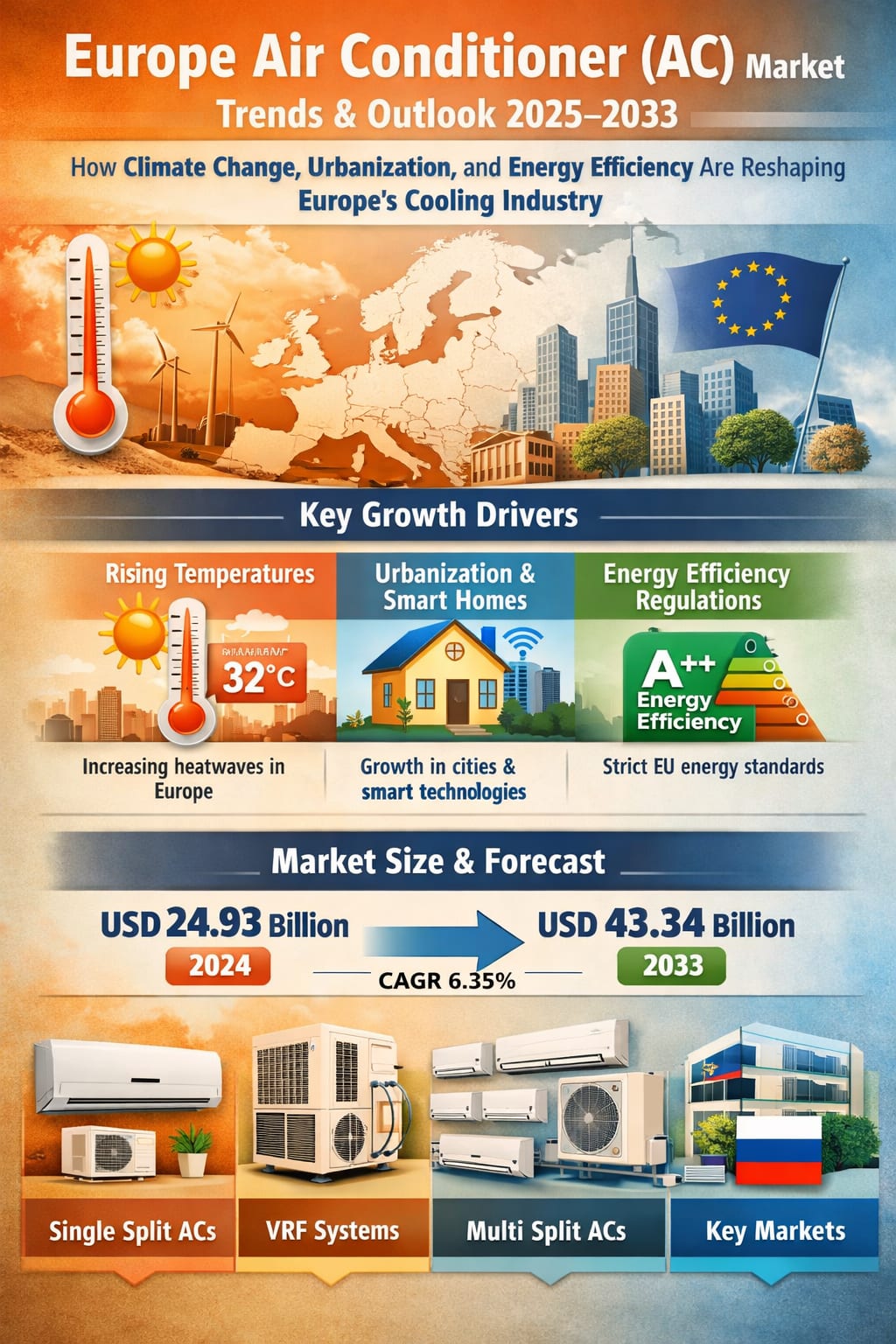
According to Renub Research, the Europe Air Conditioner (AC) Market was valued at USD 24.93 billion in 2024 and is expected to reach USD 43.34 billion by 2033, growing at a CAGR of 6.35% from 2025 to 2033. This robust growth reflects a fundamental change in how European households, businesses, and institutions approach indoor climate control.
Air conditioners are designed to regulate indoor temperature and humidity by removing heat from the air through a system of compressors, refrigerants, and fans. They are now widely used across residential, commercial, and industrial environments, not only to enhance comfort but also to improve air quality and productivity. With smart technologies and energy-efficient systems becoming mainstream, the European AC market is evolving from basic cooling solutions into a sophisticated, sustainability-driven industry.
Europe Air Conditioner Market Outlook: A Changing Climate, A Changing Market
Europe has historically had lower air conditioner penetration compared to regions such as North America or parts of Asia. However, this dynamic is changing rapidly. Rising average temperatures, longer summers, and more frequent heatwaves have made cooling solutions increasingly essential, particularly in Southern and Western Europe.
Countries such as Spain, Italy, France, and Greece have seen sharp increases in residential AC installations, while commercial adoption is expanding across Germany, the UK, and the Benelux region. At the same time, consumers are becoming more conscious of energy consumption and environmental impact, pushing demand toward inverter-based, smart, and eco-friendly air conditioning systems.
The integration of smart home technologies is also reshaping the market. Modern air conditioners can now be controlled via mobile apps, voice assistants, and AI-powered climate management systems, offering greater convenience and optimized energy use. As a result, air conditioning in Europe is no longer just about cooling—it is about intelligent, efficient, and sustainable climate control.
Key Growth Drivers in the Europe Air Conditioner Market
1. Rising Temperatures and Climate Change
Climate change is one of the most powerful forces driving the European air conditioner market. Europe has experienced a steady increase in average summer temperatures, along with more frequent and severe heatwaves. In fact, the summer of 2024 was recorded as one of the hottest in Europe, with average temperatures significantly exceeding long-term norms and several regions experiencing prolonged periods of extreme heat stress.
In Southern and Southeastern Europe, “feels-like” temperatures above 32°C were recorded for a large portion of the summer, making cooling systems essential for both comfort and health. These conditions have accelerated AC adoption not only in homes, but also in offices, hospitals, retail spaces, and public buildings. As heat becomes a recurring challenge rather than an occasional inconvenience, air conditioning is increasingly seen as critical infrastructure rather than a luxury appliance.
2. Urbanization and Smart Home Adoption
Europe’s continued urbanization is another major growth engine for the AC market. Expanding cities, rising numbers of apartments, and increasing construction of commercial buildings all contribute to higher demand for efficient cooling solutions. Urban living often means smaller, more insulated spaces that retain heat, further increasing the need for reliable climate control.
At the same time, the rise of smart homes is transforming consumer expectations. Today’s buyers are looking for air conditioners that integrate seamlessly with their digital ecosystems. Features such as remote control via smartphone apps, voice assistant compatibility, and AI-driven temperature optimization are becoming key differentiators. This shift toward connected and intelligent appliances is pushing manufacturers to innovate and is accelerating the replacement of older, less efficient systems.
3. Stringent Energy Efficiency Regulations
The European Union has implemented some of the world’s strictest energy efficiency and environmental regulations, significantly influencing the air conditioner market. Policies such as the Ecodesign Directive and the Energy Labelling Regulation require manufacturers to meet high standards for energy performance, noise levels, and product transparency.
These regulations have encouraged the widespread adoption of inverter-based and high-efficiency systems that consume less electricity while delivering better performance. Consumers, in turn, are increasingly motivated by lower operating costs and environmental concerns. Incentives for sustainable technologies and green buildings further support the transition toward energy-efficient cooling solutions, making sustainability a central pillar of market growth in Europe.
Challenges Facing the Europe Air Conditioner Market
High Initial Costs and Installation Expenses
Despite strong demand, the relatively high upfront cost of modern, energy-efficient, and smart air conditioners remains a barrier for many consumers. Advanced systems such as VRF and multi-split installations often require significant investment, not only for the equipment itself but also for professional installation.
For price-sensitive consumers and small businesses, especially in developing parts of Europe, affordability remains a key concern. To address this, manufacturers and governments are exploring financing options, subsidies, and incentive programs aimed at making efficient cooling technologies more accessible.
Environmental Concerns and Refrigerant Regulations
Traditional air conditioners often rely on hydrofluorocarbon (HFC) refrigerants, which have a high global warming potential. In response, the EU’s F-Gas Regulation is progressively restricting the use of these substances, forcing manufacturers to invest in alternative, more environmentally friendly refrigerants.
While this transition is crucial for sustainability, it also increases research, development, and production costs. Smaller manufacturers, in particular, may struggle to adapt quickly, which could create short-term challenges for market growth and competition.
Segment Insights: Technology Driving Differentiation
Europe Single Split Air Conditioner Market
Single split air conditioners remain one of the most popular choices across Europe, especially in residential settings and small businesses. Their relatively low cost, ease of installation, and good energy efficiency make them highly attractive for apartments and small offices.
The segment is evolving rapidly with the introduction of smart features such as remote monitoring, voice control, and AI-based climate management. As urban living continues to expand and home renovation activity increases, single split ACs are expected to maintain steady growth across the region.
Europe Multi-Split Air Conditioner Market
Multi-split systems, which connect multiple indoor units to a single outdoor compressor, are gaining traction among homeowners and commercial users seeking flexible and space-saving solutions. These systems are particularly popular in hotels, offices, and larger residential properties where multiple rooms require independent temperature control.
The growing emphasis on energy efficiency and sustainability is driving demand for inverter-based multi-split systems, which offer better performance with lower power consumption. This segment is expected to benefit strongly from Europe’s green building initiatives.
Europe VRF Air Conditioner Market
Variable Refrigerant Flow (VRF) systems are increasingly favored in large commercial buildings, office complexes, and modern infrastructure projects. Their ability to provide precise temperature control, zoning flexibility, and superior energy efficiency makes them ideal for complex, large-scale applications.
Countries such as Germany, France, and the UK are seeing rising VRF adoption, supported by the expansion of commercial real estate and stricter energy performance standards for buildings. Government incentives for sustainable construction further strengthen the outlook for this segment.
Country-Level Market Highlights
Portugal
Portugal’s air conditioner market is growing steadily, driven by rising summer temperatures and the expansion of the tourism and hospitality sectors. Hotels, resorts, and short-term rental properties are major contributors to demand, with energy-efficient models gaining popularity due to operating cost concerns and sustainability goals.
Belgium
Belgium’s market is shaped by urbanization and a strong policy push toward energy-efficient appliances. Government incentives and growing interest in smart home integration are encouraging consumers to upgrade to modern, eco-friendly cooling systems.
France
France has witnessed a notable increase in air conditioner adoption, particularly in commercial and office environments. Regulatory pressure to reduce energy consumption is accelerating the shift toward inverter-based and environmentally friendly systems, making efficiency a key purchasing criterion.
Germany
Germany’s AC market is expanding in line with the country’s strong focus on sustainability and energy transition. Smart and IoT-enabled systems are gaining momentum, reflecting consumer interest in intelligent energy management and long-term cost savings.
Spain
With its high summer temperatures, Spain represents one of Europe’s most important markets for air conditioning. Residential and hospitality sectors are major demand drivers, and interest in energy-saving and solar-assisted cooling solutions is rising steadily.
United Kingdom
Traditionally a low-penetration market due to its milder climate, the UK is now experiencing growing demand for air conditioners as heatwaves become more frequent. Portable and energy-efficient systems are particularly popular in homes and offices seeking flexible cooling solutions.
Russia
Russia’s AC market is expanding, especially in urban areas experiencing warmer summers. The office and retail sectors are key growth drivers, with increasing interest in energy-efficient and innovative cooling products.
Netherlands
The Netherlands is seeing a noticeable rise in air conditioner adoption, driven by climate change, urbanization, and a strong sustainability agenda. Consumers and businesses are increasingly investing in smart, energy-efficient systems that balance comfort with environmental responsibility.
Competitive Landscape: Innovation as a Core Strategy
The European air conditioner market is highly competitive, with leading global players focusing on product innovation, energy efficiency, and smart technology integration. Companies such as Daikin Industries, Toshiba Corporation, Mitsubishi Corporation, Electrolux AB, Carrier Global Corporation, Panasonic Corporation, and Fujitsu Limited are actively expanding their product portfolios and strengthening their regional presence.
From advanced inverter technologies to AI-powered climate control and environmentally friendly refrigerants, innovation is at the heart of competition. Strategic partnerships, acquisitions, and continuous product launches are shaping a market where technological leadership and sustainability credentials are becoming decisive competitive advantages.
Europe Air Conditioner Market Segmentation Overview
By Country:
Russia, Italy, Spain, France, Turkey, Greece, Germany, England, Netherlands, Poland, Portugal, Bulgaria, Belgium, Romania, Hungary, Norway, Finland, Sweden, Cyprus, Croatia Republic, Austria, Switzerland, Rest of Europe
By Type:
Split Type (Single), Split Type (Multi), PAC, VRF, Others
Final Thoughts: A Market Cooling Down Heat, Warming Up Opportunities
The Europe Air Conditioner (AC) Market is entering a decisive growth phase, shaped by climate realities, technological innovation, and a strong push toward sustainability. With the market expected to grow from USD 24.93 billion in 2024 to USD 43.34 billion by 2033, opportunities are expanding across residential, commercial, and industrial segments.
As consumers increasingly prioritize energy efficiency, smart features, and environmental responsibility, manufacturers that can deliver innovative, compliant, and user-friendly solutions will be best positioned to lead. In a Europe facing hotter summers and stricter environmental standards, air conditioning is no longer just about comfort—it is about resilience, efficiency, and the future of sustainable living.
About the Creator
Sakshi Sharma
Content Writer with 7+ years of experience crafting SEO-driven blogs, web copy & research reports. Skilled in creating engaging, audience-focused content across diverse industries.
Keep reading
More stories from Sakshi Sharma and writers in Trader and other communities.
Schizophrenia Drugs Market Size and Forecast 2025–2033: Innovation, Access, and the Future of Mental Health Treatment
Introduction The global conversation around mental health has shifted dramatically over the past decade. Conditions that were once misunderstood or stigmatized are now increasingly recognized as critical public health priorities. Among these, schizophrenia stands out as one of the most complex and challenging psychiatric disorders to diagnose, treat, and manage over the long term. As healthcare systems, governments, and pharmaceutical companies invest more resources into mental health, the market for schizophrenia drugs is entering a new phase of growth and transformation.
By Sakshi Sharmaabout 7 hours ago in Trader
Australia Advertising Market — Growth, Forecast & Strategic Insights
The Australia advertising market continues to adapt to rapidly evolving media landscapes and consumer behaviours. According to IMARC Group, the market reached USD 21.7 billion in 2025 and is projected to grow to USD 27.8 billion by 2034, exhibiting a compound annual growth rate (CAGR) of 2.83% during 2026–2034.
By Amélie Belleabout 16 hours ago in Trader
IFCI Share Price Insights: What Investors Need to Know Right Now
The IFCI Share Price has been gaining attention from investors who are looking for new opportunities in the financial market. Understanding the factors that influence the IFCI Share Price can help you make informed decisions about buying, selling, or holding shares. In this article, we explore the latest trends, market influences, and tips for smart investing in IFCI.
By John.doe798a day ago in Trader


Comments
There are no comments for this story
Be the first to respond and start the conversation.