
Diamond Hands (CAN) Beat Volatility Decay
A study of one person (me) who held TQQQ through a 75% crash like a psychopath


Abstract
Conventional financial wisdom states that leveraged ETFs like TQQQ are not suitable for long-term holding due to volatility decay.
This paper presents a groundbreaking counter-argument: what if you simply don't give a shit?
For years, financial advisors have warned investors about the dangers of holding 3x leveraged ETFs. "Volatility decay will eat your returns," they said. "These are trading instruments, not investments," they cautioned.
I actually found out about leveraged ETFs through my own research and never took the time to acquire advice on them.
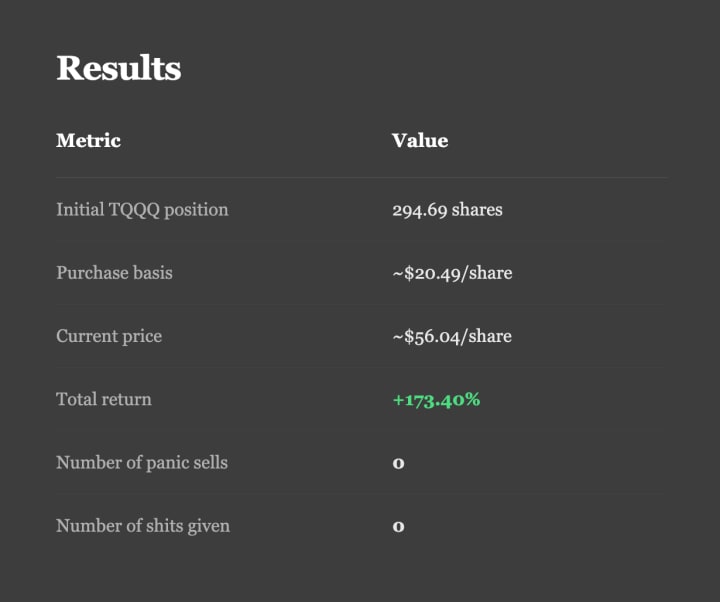
The ETFs are now up 173% over less than 3 years.
Background: What Is Volatility Decay?
Volatility decay is the phenomenon where leveraged ETFs lose value in choppy, sideways markets, even when the underlying index ends flat.
Example:
Day 1: Nasdaq drops 10%
Day 2: Nasdaq rises 10%
Net result for Nasdaq: roughly flat
Net result for TQQQ: down ~9%
Over time, this decay compounds. In theory, TQQQ should be a terrible long-term hold.
In theory.
Methodology
My sophisticated investment strategy consisted of two steps:
Buy TQQQ
Never sell TQQQ
When asked about my risk management approach, I always replied aggressive.
The 2022 Stress Test
In 2022, the Nasdaq fell approximately 33%. TQQQ, being 3x leveraged, dropped over 75%.
Normal investor response:
- Panic
- Sell at the bottom
- Swear off leveraged ETFs forever
- Write angry Reddit posts
My response:
- Literally nothing
- Didn't even check the app
- Kept holding
Results
Discussion: Why Did This Work?
Three factors contributed to my returns:
1. The Nasdaq Went Up Long-Term
Despite the 2022 crash, the Nasdaq has been in a long-term uptrend driven by AI, cloud computing, and people buying things online instead of touching grass.
2. I Never Sold
Volatility decay is real. But it's also partially offset by the fact that if the underlying index trends upward over time, the leverage works in your favor.
The catch? You have to actually hold through the drops. Most people cannot do this.
3. Emotional Detachment
When asked how they felt watching their portfolio drop 75%, "I didn't really look at it."
This level of emotional detachment from one's financial future might typically be considered unhealthy. In this case, it was extremely profitable.
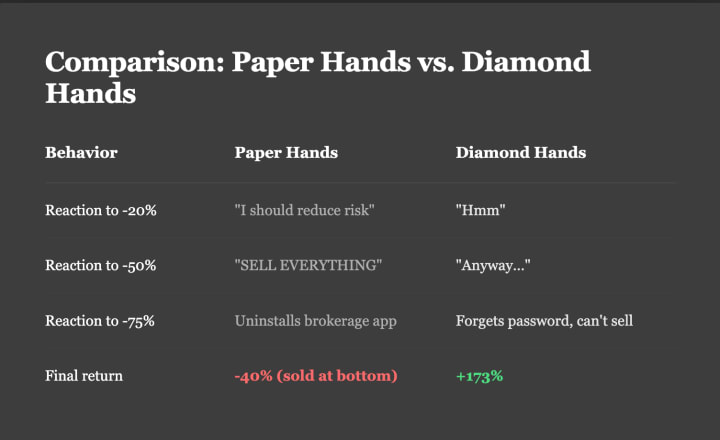
Comparison: Paper Hands vs. Diamond Hands
Limitations of This Study
Sample size of one (1) - This could be survivorship bias. For every diamond hands success story, there may be countless others who held leveraged ETFs to zero.
Time period - The 2020s featured unprecedented monetary stimulus and an AI boom. Past psychopathic holding behavior may not guarantee future results.
Not financial advice . Seriously.
Implications For Financial Advisors
Financial advisors may need to update their client questionnaires:
Current question: "What is your risk tolerance?"
- Conservative
- Moderate
- Aggressive
Proposed new question: "If your portfolio dropped 75%, what would you do?"
- Sell immediately
- Rebalance to reduce risk
- Literally not notice for several months
If the client selects option 3, TQQQ may actually be appropriate.
Conclusion
Volatility decay is real. Leveraged ETFs are risky. The math checks out.
But the math doesn't account for someone who simply refuses to sell.
My returns did not come from sophisticated analysis, tactical rebalancing, or market timing. They came from a complete inability (or unwillingness) to react to market conditions.
In a world of algorithmic trading, real-time alerts, and financial news panic, sometimes the winning strategy is to simply not participate in the drama.
Diamond hands beat volatility decay. Not because the math changed. But because the math assumed you were paying attention.
Start investing in 20 minutes or less.
-
This content is for informational and educational purposes only. It is not financial, investment, or professional advice. Always do your own research or consult a licensed financial advisor before making investment decisions.
About the Creator
Destiny S. Harris
Writing since 11. Investing and Lifting since 14.
destinyh.com
Keep reading
More stories from Destiny S. Harris and writers in Trader and other communities.
My $156,000 Mistake
I did everything right. At least, that's what I thought. At 26 years old, I decided to randomly open two accounts, one with a robo-advisor and another with private equity just to try it out. It seemed like the smart, modern thing to do. The robo-advisor app was slick. The promises were reassuring.
By Destiny S. Harrisabout 14 hours ago in Trader
Russell Hawthorne: Implementing Modern Investment Principles in Business
Abstract Modern Investment Theory (MIT), particularly Modern Portfolio Theory (MPT), has profoundly influenced how investors evaluate risk, return, and diversification in financial decision-making. While the theory originated in academic finance, its real value is demonstrated through practical application by business leaders and investors. This report examines the practice and application of Modern Investment Theory through the entrepreneurial and investment activities of Russell Hawthorne, an Australian businessman best known as the founder of RSEA Safety. Although Hawthorne is not a traditional financial theorist, his strategic decisions, capital allocation philosophy, and long-term value orientation reflect key principles of modern investment theory. By analyzing his business expansion strategies, risk management practices, diversification decisions, and capital discipline, this report illustrates how theoretical investment concepts can be applied pragmatically in real-world enterprise development.
By Russell Hawthorne5 days ago in Trader




Comments
There are no comments for this story
Be the first to respond and start the conversation.