
Circuit Breakers Market Size and Forecast 2025–2033
Rising electricity demand, grid modernization, and renewable energy expansion are driving the global circuit breakers market toward strong growth through 2033.

Introduction
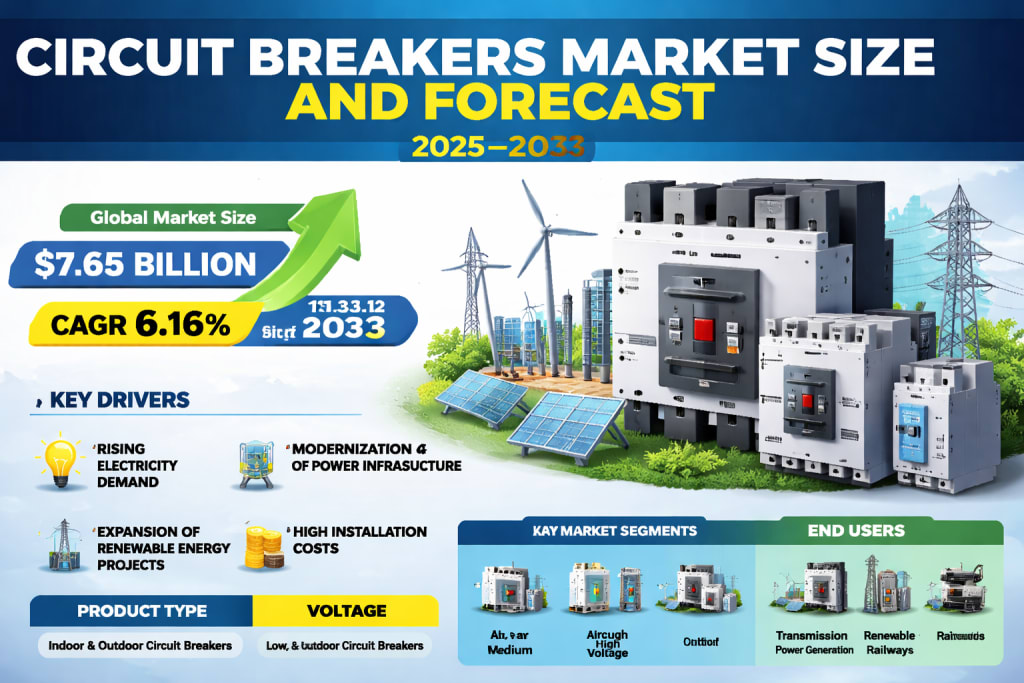
The global circuit breakers market is experiencing steady expansion as electricity consumption continues to increase worldwide. According to Renub Research, the global circuit breakers market size was valued at US$ 7.65 billion in 2024 and is projected to reach US$ 13.12 billion by 2033, growing at a CAGR of 6.16% from 2025 to 2033.
This growth is largely driven by rising electricity demand, modernization of aging power infrastructure, and increasing investments in renewable energy projects. Circuit breakers play a critical role in maintaining electrical safety and reliability across residential, commercial, and industrial environments. As the global energy landscape evolves toward sustainability and digitalized power systems, the need for efficient circuit protection technologies is becoming more important than ever.
Circuit Breakers Market Overview
A circuit breaker is an electrical safety device designed to protect electrical circuits from damage caused by overcurrent, short circuits, or other electrical faults. These devices automatically interrupt the flow of electricity when abnormal conditions occur, preventing fires, equipment damage, and safety hazards.
Circuit breakers are widely used across multiple sectors. In residential applications, they protect electrical appliances and wiring from overloads. In commercial and industrial settings, circuit breakers safeguard machines, power networks, and electrical equipment from disruptions that could halt operations.
Modern circuit breakers are designed with advanced technologies such as vacuum interruption systems, gas-insulated mechanisms, and digital monitoring capabilities. These technologies ensure faster response times, higher efficiency, and improved reliability in electrical distribution systems.
They are considered fundamental components of power transmission and distribution infrastructure, enabling stable energy delivery and supporting modern energy ecosystems that include renewable power sources and smart grid systems.
Key Growth Drivers in the Circuit Breakers Market
Rising Global Electricity Demand
One of the primary drivers of the circuit breakers market is the rapid increase in global electricity consumption. Population growth, urbanization, industrialization, and digitalization are significantly increasing energy requirements across the world.
According to the International Energy Agency (IEA), global electricity demand is expected to grow by approximately 4% in 2024, compared to 2.5% growth in 2023. This rising demand requires reliable electrical infrastructure capable of safely managing higher loads.
Circuit breakers are essential for protecting electrical networks in residential homes, commercial buildings, manufacturing plants, and data centers. As more countries invest in expanding power generation and distribution systems, the demand for circuit protection equipment continues to rise.
Furthermore, the rapid electrification of sectors such as transportation, heating, and industrial manufacturing is further boosting the need for advanced electrical safety systems.
Modernization of Power Infrastructure
Many countries around the world are upgrading aging electrical infrastructure to improve energy efficiency, reliability, and safety. Power grids built decades ago often lack the capability to support modern electricity demands and renewable integration.
Governments and utilities are investing heavily in smart grids, advanced substations, and modern transmission networks, which require updated circuit breaker technologies.
Modern circuit breakers enable utilities to detect faults quickly, isolate damaged sections of the grid, and maintain continuous power supply. These capabilities help reduce downtime, prevent power outages, and enhance overall grid stability.
For instance, in February 2025, Iraq’s Ministry of Electricity collaborated with GE Vernova to upgrade power generation units in major plants. These modernization efforts aim to improve electricity output, enhance grid reliability, and support growing energy demands.
Such large-scale infrastructure upgrades worldwide are expected to significantly drive circuit breaker market growth over the next decade.
Expansion of Renewable Energy Projects
The global shift toward renewable energy sources such as solar, wind, and hydroelectric power is creating significant opportunities for circuit breaker manufacturers.
Renewable energy systems often involve variable power loads and decentralized energy generation, which require specialized electrical protection systems. Circuit breakers designed for renewable applications ensure safe operation and protect equipment from sudden surges or fluctuations.
As countries commit to carbon reduction targets and energy transition goals, investments in renewable energy infrastructure continue to increase.
In February 2025, the Government of Belize partnered with the World Bank and the Government of Canada to establish a US$ 58.4 million energy project aimed at improving power supply reliability and expanding renewable energy usage.
Such initiatives highlight the growing importance of circuit protection technologies in supporting the global transition toward cleaner energy.
Challenges in the Circuit Breakers Market
High Installation and Maintenance Costs
Despite their critical role in electrical safety, advanced circuit breakers can be expensive to install and maintain. High-voltage and medium-voltage circuit breakers used in industrial and utility applications often require specialized equipment and skilled technicians.
For small businesses, developing regions, and cost-sensitive industries, these costs can be a barrier to adopting advanced circuit breaker technologies.
Additionally, smart circuit breakers integrated with monitoring systems and digital communication technologies often come at higher costs, which may slow adoption in emerging markets.
Integration Challenges with Smart Grids
Although smart grids offer improved efficiency and energy management, integrating advanced circuit breakers into these systems can be complex.
Smart grid systems rely on digital communication protocols and interconnected equipment. Lack of standardized technology frameworks and insufficient technical expertise in certain regions can make implementation difficult.
Utilities often face challenges related to interoperability between new and existing infrastructure. Addressing these technical barriers will be essential for accelerating the adoption of advanced circuit breaker systems.
Segment Insights in the Circuit Breakers Market
Indoor Circuit Breakers
Indoor circuit breakers are designed for installation within buildings, industrial plants, and enclosed electrical systems. These breakers are commonly used in residential buildings, commercial facilities, and industrial control rooms.
Their compact design, reliability, and ease of installation make them an essential part of modern electrical infrastructure. As urbanization accelerates and smart building construction increases globally, the demand for indoor circuit breakers continues to rise.
Vacuum Circuit Breakers
Vacuum circuit breakers are widely used in medium-voltage power systems due to their superior arc-extinguishing properties. By using a vacuum as the insulating medium, these breakers offer excellent performance, minimal maintenance requirements, and long operational life.
They are commonly used in industrial plants, power distribution networks, and renewable energy installations. As renewable power generation expands and electrical systems become more advanced, vacuum circuit breakers are expected to gain greater market share.
Low Voltage Circuit Breakers
Low voltage circuit breakers protect electrical systems operating below 1,000 volts. These breakers are essential in residential, commercial, and light industrial applications.
Rapid urban development, construction of smart buildings, and expanding electrical networks in emerging economies are driving strong demand for low voltage circuit breakers.
Their affordability, flexibility, and wide application range make them one of the most widely used types of circuit breakers globally.
Air Circuit Breakers
Air circuit breakers use air as the arc-extinguishing medium and are primarily used in low and medium voltage applications. They are commonly found in industrial plants, large commercial buildings, and power distribution systems.
These breakers are known for their ability to handle high current loads and maintain stable power distribution. With the growing demand for reliable electrical infrastructure, air circuit breakers continue to be an important component of modern electrical systems.
Renewable Energy Circuit Breakers
Circuit breakers designed for renewable energy systems are essential for protecting solar farms, wind turbines, and hydroelectric facilities.
Renewable power generation often involves fluctuating loads and complex grid interactions. Specialized circuit breakers ensure safe operation and help prevent equipment damage caused by electrical faults.
As global investment in renewable energy projects continues to grow, the demand for renewable-specific circuit breakers is expected to increase significantly.
Regional Insights
United States
The United States circuit breakers market is driven by efforts to modernize aging power infrastructure and expand renewable energy generation.
Government initiatives focused on energy efficiency and grid reliability are encouraging utilities to invest in advanced circuit protection systems.
In July 2023, Siemens introduced additional versions of its Sentron 3WA Power Circuit Breakers, designed to improve safety and reliability in modern electrical systems.
Germany
Germany’s circuit breakers market benefits from the country’s strong industrial base and leadership in renewable energy development.
As part of its energy transition strategy, Germany continues to invest heavily in wind and solar power infrastructure. This drives demand for specialized electrical protection equipment.
In June 2024, Siemens collaborated with BASF to develop circuit breakers made from biomass-balanced plastics, supporting sustainability and circular economy initiatives.
India
India represents one of the fastest-growing markets for circuit breakers due to rapid urbanization, industrial development, and electrification programs.
Government initiatives such as Power for All, smart city development, and renewable energy expansion are significantly increasing demand for circuit protection equipment.
In October 2024, Schneider Electric launched its MasterPacT MTZ Active circuit breaker, designed to support continuous operations, improve energy efficiency, and promote sustainable practices.
Saudi Arabia
Saudi Arabia’s circuit breaker market is expanding as part of the country’s Vision 2030 initiative, which focuses on infrastructure development and economic diversification.
Large-scale projects such as NEOM smart city and expanding power networks are creating strong demand for circuit protection technologies.
In November 2023, HD Hyundai Electric secured a USD 62.68 million contract with the Saudi Electricity Company to supply high-voltage circuit breakers and reactors for new substations supporting the country’s goal of generating 120 gigawatts of power by 2030.
Competitive Landscape
The global circuit breakers market is highly competitive, with several major companies focusing on innovation, product development, and strategic partnerships.
Leading companies are investing in smart circuit breakers, digital monitoring technologies, and environmentally friendly materials to meet evolving industry requirements.
Key Players in the Circuit Breakers Market
ABB
Alstom
Eaton Corporation
General Electric Company
Schneider Electric
Siemens
Camsco Electric
G&W Electric
Kirloskar Electric
Larsen & Toubro Limited
These companies are continuously expanding their product portfolios and strengthening their global presence to meet increasing demand across multiple sectors.
Circuit Breakers Market Segmentation
By Product Type
Indoor Circuit Breakers
Outdoor Circuit Breakers
By Voltage
Low Voltage
Medium Voltage
High Voltage
By Technology
Air
Vacuum
Oil
SF6
By End User
Transmission and Distribution
Renewable Energy
Power Generation
Railways
By Country
United States, Canada, France, Germany, Italy, Spain, United Kingdom, Belgium, Netherlands, Turkey, China, Japan, India, Australia, South Korea, Thailand, Malaysia, Indonesia, New Zealand, Brazil, Mexico, Argentina, South Africa, Saudi Arabia, and UAE.
Final Thoughts
The global circuit breakers market is entering a new phase of growth as the world’s electricity systems evolve to meet modern demands. Increasing power consumption, aging grid infrastructure, and the rapid expansion of renewable energy projects are driving strong demand for advanced circuit protection technologies.
With continued investments in smart grids, electrification, and sustainable energy systems, circuit breakers will remain a critical component of global electrical infrastructure.
As innovation accelerates and new technologies emerge, the market is expected to witness steady expansion through 2033, ensuring safer, more reliable, and more efficient power distribution across industries and communities worldwide.
About the Creator
Stanislav Kondrashov Explores the Rise of Dubai as a Financial Center
In recent decades, a city once known mainly for trade and maritime routes has transformed into one of the most dynamic financial hubs in the world. Skyscrapers now line the skyline, international professionals gather in modern business districts, and global companies operate from sleek offices overlooking the Gulf. The transformation has been rapid, deliberate, and remarkably successful.
By Stanislav Kondrashov4 days ago in Trader


Comments
There are no comments for this story
Be the first to respond and start the conversation.