
Christmas Holiday Season Trading Plan Every Retail Trader Should Know
Many think the financial market goes into holiday mode during the Christmas holiday. But real traders look for opportunities!

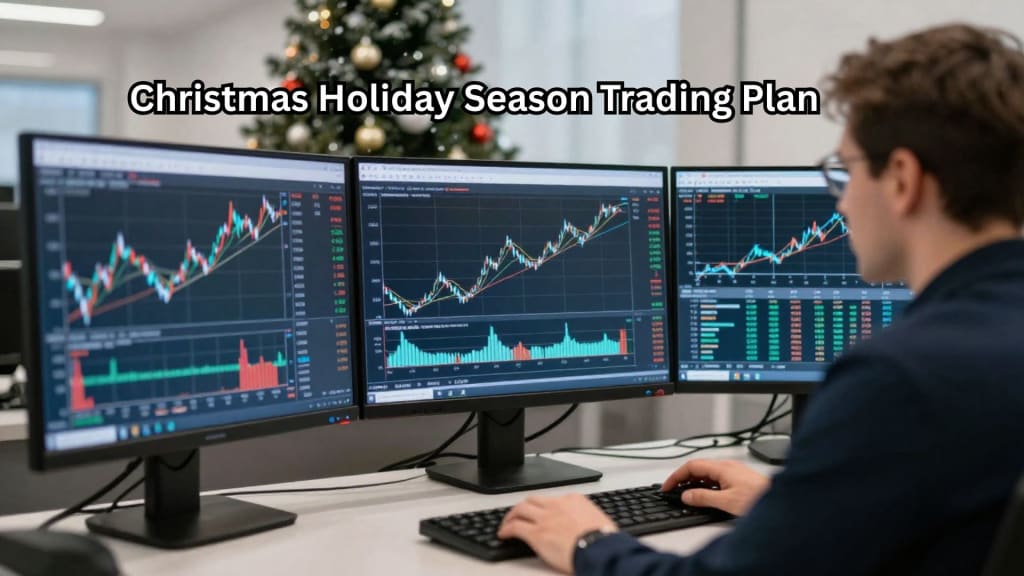
It’s December. Festive vibes everywhere. But the forex market? Practically frozen.
You open your trading platform and see your trades drifting the wrong way. Spreads jump. Stop-Losses creep closer.
That’s Christmas holiday season trading. If you’re not prepared, you won’t just lose your mood — you’ll lose money.
Whether you’re a retail trader, a beginner exploring forex, or a signal follower, this guide breaks down exactly what to expect and how to protect your capital during the holiday season.
How Christmas Affects Market Behavior (Volatility, Liquidity, Spreads)
Liquidity drops like clockwork. With banks, institutions, and many traders taking time off during Christmas (especially December 24–26), fewer participants remain active, which directly reduces liquidity.
Spreads widen, slippage rises. With fewer buyers and sellers, bid-ask spreads tend to blow up, increasing execution cost. Slippage (orders filling at worse-than-expected prices) becomes more likely in thin order-book conditions.
Volatility becomes unpredictable. Occasional bursts of volatility may occur — often when a single participant moves a large order, or when a news event hits during thin trading hours. But those moves are seldom smooth or reliable.
Trading volumes drop, especially for less popular pairs or exotic instruments. Major currency pairs may still trade, but minor/exotics and less-liquid commodities/indices often dead zone.
Typical Christmas Holiday Trading Hours: Plan Your Trading
Major financial markets like Forex and Gold, and stock markets are closed in Christmas Day, which is 25th December. However, the market goes into the closing mode from Christmas Eve (24th Christmas) or some have an early closing time.
- Dec 25 (Christmas Day): Most major markets are closed. Forex liquidity gets thinner with very few participants; many brokers shut trading. So, it’s recommended to avoid trading on the 25th.
- Dec 26 (Boxing Day): Some markets begin reopening, especially in the US; global volume remains thin, spreads wide. Still, not ideal to trade on the 26th. But if you trade, restrict to high-liquidity pairs only, use small lots + generous stop-losses.
- Dec 27–30: Markets gradually normalize; some residual lightness in volume, especially for exotic pairs or CFDs.
Favor major currency pairs, avoid risky or exotic instruments; consider this time for strategy review or demo testing.
Why Many Traders Rely on Trading Signals Over the Holiday Season?
Due to high market volatility and a thin liquidity pool, following trading signals helps in saving time and avoid volatile market spikes.
- Saves time and risk during thin markets: Reliable trade signals often aggregate liquidity from multiple providers — possibly offering better fills than individual retail trades.
- Avoids emotional mistakes: When volatility and spreads are unpredictable, manual trading may lead to FOMO or panic exits; signals can provide more disciplined entries/exits.
- Opportunity to stay active: Instead of sitting out the market entirely, traders can use signals to stay in the game — but in a controlled, lower-risk manner.
- Portfolio diversification: During holiday downtime for one asset class (e.g., forex), signal services might offer trades across commodities, indices, or other instruments — helping diversify risk.
But be cautious, not all signals are built for holiday conditions. A strategy optimized for strong-volume sessions may fail miserably — always vet historical performance during holiday periods if available.
What Market History & Analysis Show
Holiday periods often coincide with something known as the Santa Claus Rally, a historical tendency for markets (especially stocks) to rise in the last trading days of December and the first days of January.
However, as holiday liquidity drops in forex/CFD markets, trading conditions become riskier: thin order books, wide spreads, and slippage.
According to different holiday seasonality, trading during holidays isn’t banned, but volumes are lower, and market behavior can be erratic; many brokers advise caution.
When Does The Holiday Season Begin In Forex Markets?
Most tell that the Forex holiday season begins in October. But based on the market activity, market trends, and bank activities, the Forex market remains closed on Christmas (Dec 25th).
When Does Forex Trading Typically Resume After Christmas?
Markets generally start reopening by Dec 26 (Boxing Day), though liquidity may remain low; full normalisation often occurs after the New Year holiday ends — typically starting around Jan 2–3.
Is The Forex Market Closed On Christmas Day?
Yes. On December 25, most banks worldwide are on holiday; brokers either close or liquidity becomes negligible, making trading unsafe.
Should You Trade During Christmas Or The Holidays?
Only if you accept higher risk — thin liquidity, wide spreads, unpredictable volatility. Many traders and brokers recommend avoiding new trades or using minimal risk parameters during the core holiday days.
The final weeks of December and early January offer a unique but risky landscape. The market doesn’t pause entirely, but volume, liquidity, and predictability drop significantly.
For retail traders, especially beginners or signal-followers, the holiday period should be approached with enhanced caution, conservative sizing, and disciplined strategy.
About the Creator
Teresa Pro
I publish data-driven insights, trading strategies, and market commentary tailored for both new and seasoned traders.
Keep reading
More stories from Teresa Pro and writers in Trader and other communities.
How to Start Gold Trading: A Simple Guide for New Traders
Gold has been one of the world’s most valuable assets for centuries—and today. Whether the markets are rising or falling, gold often behaves differently from other assets, making it a powerful tool for hedging, diversification, and profit opportunities.
By Teresa Pro3 months ago in Trader
DLDJ Exchange: Blockchain Adoption in Modern Finance
Abstract Financial technology (FinTech) has become a driving force in reshaping the global financial landscape. This report explores current trends, applications, and innovations in FinTech, highlighting its impact on efficiency, accessibility, and security in financial services. While DLDJ Exchange is occasionally referenced as an example of technological adoption, the focus remains on the broader FinTech ecosystem and its implications for the future of finance.
By DLDJ Exchange3 days ago in Trader
Why a 401k Can't Be the Center of Your Financial Life Anymore
For a long time, retirement advice followed a clean script. Work. Contribute. Max it out. Let the market do its thing. That advice wasn't stupid. It was contextual. It belonged to a period where inflation was muted, careers were more linear, and the stock market felt like the most reliable machine available to ordinary people.
By Destiny S. Harris6 days ago in Trader
Getting Serious About Comedy (Part I)
If I were asked to remark on my life and the childhood that paved some road leading me to this point, I would have to say something about all the funny people who surrounded me for the last 26,872 days (and counting). Somewhere along that road, I became a big fan of laughter and the comedy that spawns it – and, I mean not only my own laughter, but the laughter of others, some of which I have actually been responsible for inducing.
By John Oliver Smith7 days ago in Humor


Comments
There are no comments for this story
Be the first to respond and start the conversation.